

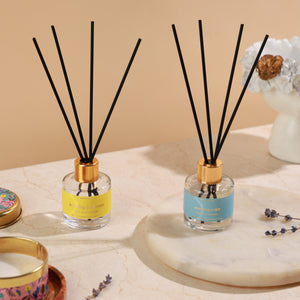



The coverage numbers: a reed diffuser on six reeds holds up to about 150 sq ft closed and still; a Sukoon about 270–320 sq ft; a Megh only about 215 — less than a Sukoon.
The builds: ₹1,998 for a two-point home, ₹3,347 for three spaces, ₹6,394 for a whole 3BHK with a machine in the main room. All three totals are itemised below.
2. Delete every space nobody occupies. A room used for under about two hours a day does not repay a bottle, because a diffuser empties at the same rate whether or not anybody is in the room. Cross off the kitchen, the passage, the utility balcony, the guest bedroom and the formal sitting room nobody sits in. In most Indian flats this removes two or three spaces immediately, which is why rooms nobody uses and the hours a room needs before it deserves a diffuser are the two most useful pages in this cluster.
3. Size what remains by volume, not floor area. A reed diffuser on six reeds holds up to about 150 sq ft closed and still, at a standard ceiling. Coverage is really cubic: 150 sq ft at nine feet is 1,350 cubic feet; at twelve feet it is 1,800, a third more air for the same bottle. Past about 200 sq ft in one open volume, or past a high ceiling, you are into two positions or a machine — see where to stop adding reeds and buy a Sukoon.
4. Set the reed count, which is free. Six reeds is full strength and holds about 150 sq ft. Four holds about 100 and runs a 130ml towards twenty-one weeks. Three holds about 75. Two or three suits a small bathroom. More reeds is stronger and faster, in the same movement, so it is a trade rather than an upgrade — one extra reed costs about ₹150 over a bottle’s life, and three reeds for longer is 36 per cent cheaper a week.
5. Check the total — and expect it to be lower than you feared. Multiply the spaces that survived steps one and two by the right size, and add it up. A 1RK comes to ₹1,998. A 2BHK comes to ₹3,347. A full 3BHK, honestly counted, comes to ₹6,394 rather than the ₹8,000 people budget. If your total is higher than that, you have almost certainly kept a room that step two should have deleted — see how to stop overspending.
Made in India, composed by an ISIPCA Versailles-trained perfumer — and a portion of every order supports girl-child education through Nanhi Kali.
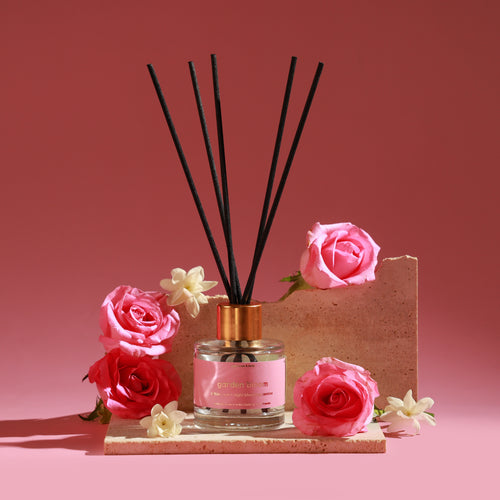
Why the unit is the air space, and what the coverage number really means
Every mistake in this category starts with the wrong unit. People count rooms, because rooms are what a floor plan shows; or square feet, because that is what they paid for; or occupants, because more people feels like more of everything. None of those is what a diffuser responds to. A passive reed diffuser reaches equilibrium with a volume of air bounded by whatever stops that air moving, and the thing that stops air moving in a home is a closed door. So a 900 sq ft flat with five doors shut is five separate problems, each needing its own source; the same 900 sq ft with everything open is one long problem needing two positions at most. The floor area did not change. Neither did the family. What changed was the number of boundaries, which is why doors are a better unit than square feet and why a household of four rather than one barely moves the answer at all.
The second thing to hold steady is what a coverage figure actually promises. Up to about 150 sq ft on six reeds is a steady-state number for a closed room with still air and a standard ceiling. It is not a radius the bottle projects; it is the size of air pocket a passive source can keep charged when nothing is carrying that air away. Three things break it, and all three are common in Indian flats. Height: coverage is cubic, so 150 sq ft at twelve feet is 1,800 cubic feet against 1,350 at nine. Shape: fragrance does not turn corners well, so an L-shaped living room or a run over about twenty-two feet needs two starting points rather than a bigger bottle. And ventilation, which is the brutal one — a closed room exchanges 0.2 to 0.5 of its air an hour and a cross-ventilated one exchanges three to eight, so a permanently open balcony door cannot be solved by any bottle size at all. Where those conditions hold, the numbers are reliable: a 130ml holds the same 150 sq ft, and so does a 50ml for six to eight weeks rather than fourteen to eighteen.
Three builds, itemised and checked
 Two positions₹1,998Entrance or living room — one 130ml Morning Freshness, ₹1,249, six reeds, 14–18 weeks.
Main bathroom — one 50ml Morning Freshness, ₹749, two reeds, about thirteen weeks.
Everything else — nothing. ₹0.
₹1,249 + ₹749 = ₹1,998. Two encounters on one walk is what makes a home read as a decision rather than an ornament, which is the argument in the minimum number of products. If ₹1,998 is too much, the Day & Night duo at ₹1,498 gives you the same two positions in two 50ml bottles — cheaper to buy and more expensive to run.
Main bedroom, about 140 sq ft — one 130ml Evening Calm, ₹1,299, four reeds, about twenty-one weeks.
Main bathroom, about 40 sq ft — one 50ml Morning Freshness, ₹749, two reeds.
Kitchen, passage, spare room — nothing. ₹0.
₹1,299 + ₹1,299 + ₹749 = ₹3,347. This is the whole answer for most 1BHK and 2BHK flats in India, and it deliberately stops ₹653 short of a ₹4,000 budget. Keep that ₹653 towards the first 300ml refill at ₹2,399 rather than spending it on a fourth bottle for a room you walk through. See which three rooms to scent first for the order in which the three rooms should be bought.
Main bedroom — 130ml Evening Calm, ₹1,299, four reeds.
Second bedroom — 130ml Mountain Breeze, ₹1,349, four reeds.
Main bathroom — 50ml Garden Bloom, ₹799, two reeds.
Second bathroom — 50ml Morning Freshness, ₹749, two reeds.
Third bedroom used as a study twice a week, kitchen, passage, balcony — nothing. ₹0.
₹2,198 + ₹1,299 + ₹1,349 + ₹799 + ₹749 = ₹6,394. A ₹8,000 budget should stop here and keep ₹1,606 towards liquid. Note the correction most people need: the Megh at ₹3,499 covers only about 215 sq ft — less than the Sukoon — so if you want more area, buy a second Sukoon, not a Megh.
Sizing by space — every home type, with an honest unit count
Air spaces are what a visitor would encounter with the doors as you actually keep them. The "how many" column is what to buy, not how many rooms exist, and the difference between those two numbers is the whole point of this guide.
| Space | What it needs | How many | Cost |
|---|---|---|---|
| 1RK or studio, 300–400 sq ft | Two air spaces: the main volume and the bathroom. One 130ml on six reeds and one 50ml on two | Two | ₹1,998 |
| 1BHK, 550–650 sq ft | Three spaces: living-kitchen, bedroom, bathroom. Two if the bedroom door stays open all day | Two or three | ₹1,998–₹3,347 |
| 2BHK, 850–950 sq ft ★ | Four or five spaces on paper, three worth buying for: living, the bedroom in daily use, the main bathroom | Three | ₹3,347 |
| 3BHK, 1,150–1,400 sq ft | Six to eight spaces, four or five worth buying for. Reeds throughout is ₹5,495; a Sukoon in the open living-dining makes it ₹6,394 | Four or five | ₹5,495–₹6,394 |
| Duplex or two-floor flat | Count each floor separately and ignore the stairwell — it behaves like a chimney, not a room | Per floor, as above | from ₹3,347 |
| Corridors, kitchens, utility balconies, unused guest rooms | Nothing, in every home type. Transit space is measured in seconds of occupancy, and cooking is a source that ventilation answers rather than fragrance | None | ₹0 |
| A note on all of the above: every figure above is for closed rooms with still air and standard ceilings. Raise the ceiling, open a balcony door, run a fan or bend the room into an L and the same bottle covers less — and in all four of those cases the answer is placement, reed count or a machine, almost never a bigger bottle. | |||
One room · the unitFrom ₹749Shop → 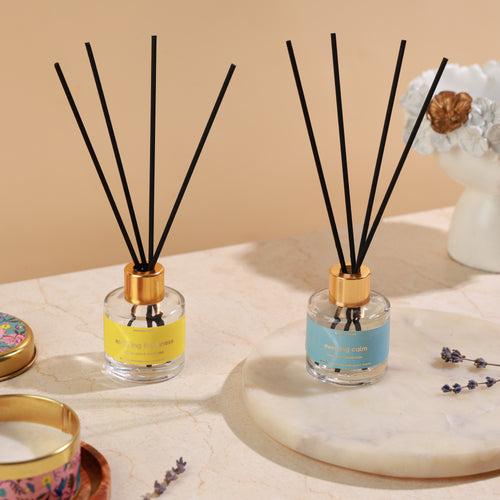 Two rooms · better value₹1,498Shop →
  Large room · a switch₹1,899Shop →
Setting reeds, placement and running cost
Start low on reeds and climb, because adding is easy and subtracting is slow. Six reeds for a hall or a living room, four for a bedroom, two or three for a small bathroom. Put the lower number in, wait a full forty-eight hours for the fibre to wick along its whole length, then judge — and judge from the doorway after half an hour out of the flat, because olfactory adaptation is essentially complete in about twenty minutes and you are the least reliable judge of your own home. If a visitor cannot locate it, add one reed before you consider adding a bottle: more reeds settles the question more often than a second diffuser, and it is free. This single habit is what stops most homes buying a unit they do not need.
Then place each bottle where the air moves a little and the sun does not reach. A shelf or chest near a doorway outperforms a side table in a still corner, because a passive diffuser needs gentle air movement to distribute at all. Avoid three specific spots: direct sunlight, which fades the fragrance and heats the oil; the direct path of a fan or an AC vent, which strips the reeds and empties the bottle fast; and bare polished wood, because reed oil marks a finish permanently if the bottle is knocked. Stand every bottle on a tray or coaster and keep it out of reach of children and pets. Placement is free and it routinely makes more difference than the ₹500 between a 50ml and a 130ml.
And plan the running cost before you buy the second bottle, not after. A 50ml at ₹749 lasts 6–8 weeks and a 130ml at ₹1,249 lasts 14–18, which is roughly ₹105 a week against ₹78 — the larger bottle is the cheaper one per week. Once a room is settled, stop buying glass: a 300ml refill at ₹2,399 is ₹8.00 a millilitre against ₹9.61 in a new bottle, fills a 130ml about 2.3 times, and keeps one room going about eight months or two rooms about four. Fit fresh reeds at every refill, because clogged fibre is the commonest reason a topped-up bottle reads weaker than a new one. And keep the collection to a size you will actually maintain — four to five bottles is the practical ceiling for one person, past which bottles stand empty.
What to buy
The whole range in the order this guide uses it. The starred row is the unit almost every build is counted in, and the last row is where a settled home stops buying glass.
| Buy | What it covers | Lasts | Price |
|---|---|---|---|
| One 50ml | A single reed diffuser — bathrooms, a first try of a blend, and the second position in a ₹1,998 two-point home | 6–8 weeks | from ₹749 |
| One 130ml ★ | The value size — every main position — up to about 150 sq ft on six reeds, 14–18 weeks, about ₹78 a week | 14–18 weeks | from ₹1,249 |
| The duo | Day & Night duo — two air spaces in one purchase at ₹1,498 — the cheapest honest way to reach the two-product threshold | 6–8 weeks each | ₹1,498 |
| Sukoon | 500ml ultrasonic — an open living-dining past about 200 sq ft — 270–320 sq ft, and more coverage than any Megh | Runs when you switch it on | ₹1,899 |
| 300ml refill | The running cost — the running cost once the rooms are settled — ₹8.00 a millilitre against ₹9.61 for new glass | Roughly 2 × 130ml fills | ₹2,399 |
Versailles
I have written a hundred pages on this question and they all reduce to four steps. Count the doors you actually close. Delete the rooms nobody sits in. Size what is left by volume rather than floor area. Then set the reed count, which costs nothing. Do them in that order and you will buy two or three products where you expected to buy five, and the home will read better for it — because a flat with three positions working properly reads as considered, and a flat with six half-done reads as a shop.
The step people skip is the second one, and it is the expensive one. Kitchens, corridors, utility balconies, guest bedrooms, formal sitting rooms — these are rooms in a floor plan and not in a nose. A diffuser empties at exactly the same rate in an empty room as in a full one; it just does it for nobody. In the ₹6,394 build above, three spaces get ₹0, and that is not restraint on my part. It is the only reason the figure is ₹6,394 rather than ₹9,000.
And please try the free thing first. If a room feels quiet, add a reed, move the bottle out of the draught, or fit fresh reeds if the ones in there are months old. Those three fixes solve most of what people write to me about, and none of them costs anything. I would rather you bought two bottles and ran them well for ten years than five bottles and gave up in April. A portion of every order supports girl-child education through Nanhi Kali.
Frequently asked questions
- Why counting doors beats counting square feet — step one, in full.
- When to stop adding reeds and buy a Sukoon — the honest crossover.
- A whole year in one order — ₹10,994, itemised and dated.
- How to stop overspending — the deletions, listed.
- Brand: the SOSA founder story.
SOSA products & prices (verified August 2026): Hotel Collection water-based ultrasonic diffuser fragrance 15ml ₹299 · 100ml ₹999 · 300ml ₹1,799 · Pack of 7 (15ml, all fragrances) ₹1,799; refills 100ml from ₹999. Seven scents: The Ritz-Carlton-inspired (white tea · bergamot · cedar), Westin-inspired (white tea · aloe · cedar), 1 Hotels-inspired (cedarwood · vetiver · green leaves), The St. Regis-inspired (amber · violet · woods), Shangri-La-inspired (jasmine · green tea · white tea), Four Seasons-inspired (citrus · floral · sandalwood), W Hotels-inspired (citrus · pepper · amber). Diffusers: Boond 300ml ₹899 · Sukoon 500ml ₹1,899 · Megh 6L ₹3,499. Water-based, phthalate-free, composed to IFRA standards for home diffusion; 3–6 drops per tank. Made in India, Pune. The Hotel Collection scents are SOSA's own interpretations inspired by the world's finest hotels; all hotel names are trademarks of their respective owners and are used only to describe the scent style — SOSA is an independent Indian fragrance house, not affiliated with or endorsed by any hotel brand. Prices and availability subject to change — see the live product pages.