



The refill dates: three 300ml refills at ₹2,399, due around weeks 16, 25 and 48. That is ₹7,197.
The year: 3,797 + 7,197 = ₹10,994, of which ₹3,797 is glass bought once. Year two, for the same three rooms, is about ₹4,798.
2. Open them four weeks apart, not on the same afternoon. Sealed reed oil keeps perfectly well, so there is no reason to start all three the day they arrive. Open the living room in week 0, the bedroom in week 4 and the bathroom in week 8. Combined with different reed counts — six, four and two — that puts the three finish dates at roughly weeks 16, 25 and 38. Three separate small decisions, none of them urgent.
3. Put three refill dates in a calendar: weeks 16, 25 and 48. Each is one 300ml refill at ₹2,399, which is ₹8.00 a millilitre against ₹9.61 for new glass. Week 16 is Morning Freshness for the living room; week 25 is Evening Calm for the bedroom; week 48 is Morning Freshness again. ₹2,399 × 3 = ₹7,197.
4. The year: ₹3,797 + ₹7,197 = ₹10,994. That is three rooms scented for fifty-two weeks with no gaps, four orders in total, and about ₹211 a week for the whole flat. It is also, deliberately, three rooms and not five — the passage, the kitchen and the spare bedroom get nothing, and leaving them out is what keeps the figure sane.
5. Year two is about ₹4,798, because you never buy glass again. Three rooms need roughly 970ml of liquid across a year. You begin year two already holding about 379ml — part-full bottles plus 170ml in a jug — so two 300ml refills covers it. If you run the living room hard on six reeds all year, budget a third and call it ₹7,197. Either way the bottles are a one-off.
Made in India, composed by an ISIPCA Versailles-trained perfumer — and a portion of every order supports girl-child education through Nanhi Kali.

Why the staggering matters more than the total
The mistake in an annual plan is not spending too much; it is buying everything on the same day. Three bottles opened on the same afternoon, all on six reeds, all in rooms of similar size, will empty within a fortnight of each other some time in month four — and what happens next is entirely predictable. The house goes quiet in every room at once, somebody notices, and a single large panic order goes in, usually for more than is needed because a home that has just gone quiet feels emptier than it is. Staggering is not a tidiness preference. It is the mechanism that stops one bad fortnight turning into a habit of over-buying. And it is free: sealed reed oil keeps, so you can order all three bottles at once and simply open them a month apart.
There is a second, quieter staggering that does most of the work, and it is reed count. A 130ml gives 14–18 weeks on six reeds, towards twenty-one on four, and towards thirty on two. So a living room on six, a bedroom on four and a bathroom on two will drift apart on their own even if you did start them together — sixteen, twenty-one and thirty weeks. Combine the two mechanisms, opening in weeks 0, 4 and 8, and the finish dates land at roughly weeks 16, 25 and 38 — three widely separated moments, each of which is one small decision about one room. That is what an annual plan is actually for. Not the total, which you would have spent anyway, but the removal of every occasion on which you might panic.
The order, the calendar and the second year
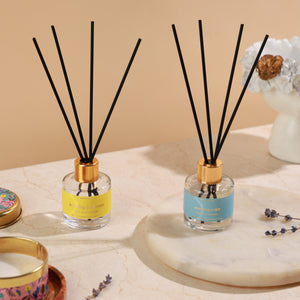
 Three bottles₹3,797Living room and entrance, about 190 sq ft — one 130ml Morning Freshness, ₹1,249, six reeds, opened week 0.
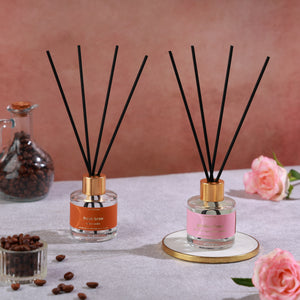
Main bedroom, about 140 sq ft — one 130ml Evening Calm, ₹1,299, four reeds, opened week 4.
Main bathroom, about 40 sq ft — one 130ml Morning Freshness, ₹1,249, two reeds, opened week 8.
₹1,249 + ₹1,299 + ₹1,249 = ₹3,797. Two of the three are the same blend deliberately, so that one refill later serves both — and the bathroom is behind a door, so the bedroom can differ without anything colliding in the passage.
Week 25 — the bedroom finishes. One 300ml Evening Calm refill, ₹2,399. Fill it; 170ml in reserve.
Week 32 — the living room again, from the Morning Freshness jug. No order. 40ml left.
Week 38 — the bathroom finishes. Pour in the last 40ml of Morning Freshness: about nine weeks on two reeds. No order.
Week 46 — the bedroom, from the Evening Calm jug. No order. 40ml left, which goes to the bathroom in week 47.
Week 48 — the living room again. One 300ml Morning Freshness refill, ₹2,399.
Three orders, ₹2,399 each: ₹7,197. Every remainder is used.
Sizing by space — the three rooms in the plan, and the three that are not
This is the flat the plan is built for: a 900 sq ft 2BHK with an open living-dining, one used bedroom, one spare, one bathroom, a kitchen and a passage. Three of the six rows cost nothing.
| Space | What it needs | How many | Cost |
|---|---|---|---|
| Living room and entrance, about 190 sq ft, opened week 0 ★ | One 130ml on six reeds — the arrival position, and the only room worth the full setting | One, refilled three times | ₹1,249 + ₹3,120 of liquid |
| Main bedroom, about 140 sq ft, opened week 4 | One 130ml on four reeds — about twenty-one weeks a fill, and you adapt to it in twenty minutes anyway | One, refilled twice | ₹1,299 + ₹2,080 of liquid |
| Main bathroom, about 40 sq ft, opened week 8 | One 130ml on two reeds — about thirty weeks, and it runs entirely on the remainders of the other two refills | One, topped up twice from remainders | ₹1,249 + ₹640 of liquid |
| Spare bedroom used a few nights a year | Nothing. Move the bedroom bottle in the day before guests arrive and take it out afterwards | None | ₹0 |
| Kitchen | Nothing. Cooking is a source, and extraction and ventilation are what answer a source | None | ₹0 |
| Passage between the bedrooms | Nothing. A transit space measured in seconds of occupancy, and it borrows from the rooms either side | None | ₹0 |
| A note on all of the above: the liquid figures are that room's fills priced at ₹8.00 a millilitre — ₹1,040 for a full 130ml, ₹320 for a 40ml top-up. They add to ₹9,637 against the ₹10,994 spent, and the ₹1,357 difference is the 170ml still sitting in the jug on the last day of the year, which starts year two. Every coverage and longevity figure assumes a closed room, still air and a standard ceiling; a hot flat or an open balcony door will shorten all of them. | |||
One room · the unitFrom ₹749Shop → 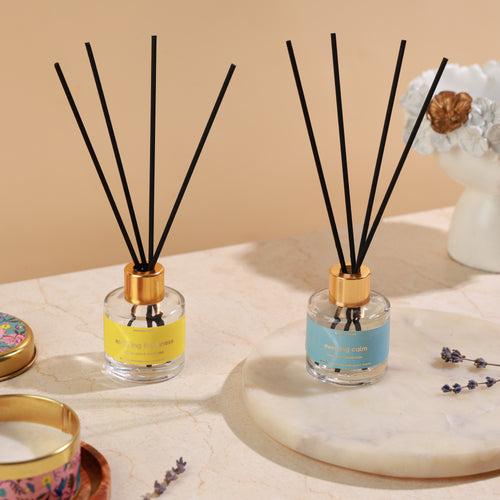 Two rooms · better value₹1,498Shop →
  Large room · a switch₹1,899Shop →
Running the plan without having to think about it
Write the three refill dates down on the day the bottles arrive, not when they run out. Weeks 16, 25 and 48 from the day you open the first bottle. A reminder costs nothing and it removes the only failure mode this plan has, which is a fortnight of silence in the living room followed by a large emotional order. If you prefer physical cues, put a small strip of tape under each bottle with the week it was opened and the reed count it is running — after two months nobody remembers which room is on four reeds and which is on six, and that single piece of information is what makes the next decision obvious.
Top up at two-thirds down rather than waiting for empty. A 300ml jug divides into a 130ml bottle 2.3 times, and the third of those fills is the 40ml remainder that people leave in a cupboard for a year. Topping up early means the jug empties cleanly across three visits instead of two fills and an orphan, and it keeps the reeds continuously wetted — a reed that has stood dry in an empty bottle for a week wicks noticeably worse afterwards. Fit fresh reeds each time you refill, at the same count you were running: clogged fibre is the commonest reason a refilled bottle seems weaker than a new one, and adding two extra reeds while you are at it quietly costs about ₹150 a reed over the bottle's life.
And review the plan once, at about week twenty. By then you will have lived with all three rooms for long enough to know two things: whether the reed counts are right, and whether the bathroom is earning its place. If the living room is not registering when you walk in from outside, go to six reeds and accept the shorter fill; if the bedroom is too present at bedtime, go to three. Both adjustments are free and both change the annual figure by more than any discount ever will. The cheaper version of this whole year, for the record, is the same three rooms with the living room on five reeds instead of six — two refills rather than three, and ₹8,595 instead of ₹10,994.
What to buy
Four orders across a year: one for glass and three for liquid. The table below is the whole range in the order most annual plans actually use it.
| Buy | What it covers | Lasts | Price |
|---|---|---|---|
| One 50ml | A single reed diffuser — trying a fourth blend mid-year without committing a refill to it | 6–8 weeks | from ₹749 |
| One 130ml ★ | The value size — each of the three rooms in the plan — ₹3,797 for all three, and the only glass you buy | 14–18 weeks | from ₹1,249 |
| The duo | Day & Night duo — a two-room version of this plan at ₹1,498, for a smaller flat or a smaller budget | 6–8 weeks each | ₹1,498 |
| Sukoon | 500ml ultrasonic — a living-dining past about 200 sq ft, where the arrival position needs a switch rather than a bottle | Runs when you switch it on | ₹1,899 |
| 300ml refill | The running cost — the three dated orders that make up ₹7,197 of the year — ₹8.00 a millilitre against ₹9.61 | Roughly 2 × 130ml fills | ₹2,399 |
Versailles
People ask for an annual plan because they want the whole thing solved in one transaction, and I understand that. You can do it: order ₹10,994 of bottles and refills today and the year is genuinely covered, because sealed reed oil keeps. But I would not, and not because I want more orders from you. You would be committing a whole year to three blends you have not lived with yet, and paying in August for liquid you use in April.
So buy the glass in one order and the liquid on three dates. ₹3,797 now, then ₹2,399 around week sixteen, ₹2,399 around week twenty-five, ₹2,399 around week forty-eight. Open the bottles a month apart so they never finish together — that one habit is worth more than any discount, because a house that goes quiet in every room on the same weekend always over-orders.
And notice how much of this plan is rooms getting nothing. The kitchen, the passage and the spare bedroom are all ₹0, and that is not modesty — it is what keeps the annual figure at ₹10,994 instead of ₹18,000. Three rooms, properly done, reads as a considered home. Six rooms half-done reads as a shop. A portion of every order supports girl-child education through Nanhi Kali.
Frequently asked questions
- Budgeting across a full year — the same arithmetic, month by month.
- Staggering so they do not finish together — the mechanism, in detail.
- The first-year cost of three rooms — the total, checked another way.
- The complete sizing and quantity guide — every home type, three builds.
- Brand: the SOSA founder story.
SOSA products & prices (verified August 2026): Hotel Collection water-based ultrasonic diffuser fragrance 15ml ₹299 · 100ml ₹999 · 300ml ₹1,799 · Pack of 7 (15ml, all fragrances) ₹1,799; refills 100ml from ₹999. Seven scents: The Ritz-Carlton-inspired (white tea · bergamot · cedar), Westin-inspired (white tea · aloe · cedar), 1 Hotels-inspired (cedarwood · vetiver · green leaves), The St. Regis-inspired (amber · violet · woods), Shangri-La-inspired (jasmine · green tea · white tea), Four Seasons-inspired (citrus · floral · sandalwood), W Hotels-inspired (citrus · pepper · amber). Diffusers: Boond 300ml ₹899 · Sukoon 500ml ₹1,899 · Megh 6L ₹3,499. Water-based, phthalate-free, composed to IFRA standards for home diffusion; 3–6 drops per tank. Made in India, Pune. The Hotel Collection scents are SOSA's own interpretations inspired by the world's finest hotels; all hotel names are trademarks of their respective owners and are used only to describe the scent style — SOSA is an independent Indian fragrance house, not affiliated with or endorsed by any hotel brand. Prices and availability subject to change — see the live product pages.