

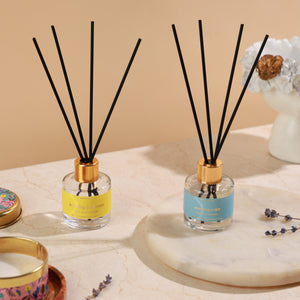

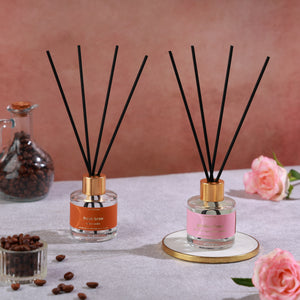

Why two and not one: intention is read from a second encounter, not from a stronger first one. Two bottles in the same room does not count — a visitor cannot tell it from one.
What it costs: ₹1,998 for a 130ml in the living room and a 50ml in the bathroom, or ₹1,498 for the Day & Night duo if you want the cheapest honest entry.
2. Position one is where arrival happens. In a flat with a foyer, that is the foyer. In the far more common Indian flat where the front door opens into the living room, it is the living room — placed near the door rather than by the sofa. This is the position where a nose that has spent twenty minutes on a road actually registers what you paid for, which is why it takes the 130ml and the full six reeds.
3. Position two is the main bathroom, for a reason that is not squeamishness. The bathroom is the only room in an Indian home that a guest occupies alone, deliberately, with their full attention and nothing to look at. It is also small — 30 to 50 sq ft — so it holds fragrance on two or three reeds and is by some distance the cheapest square footage in the house to dose properly. Skipping it is the commonest mistake in a first purchase.
4. Two bottles in one room does not count. A second bottle in the same air space gives you a second starting point in a space one bottle already reaches. It is a legitimate purchase for shape — an L-shaped room, a blind leg, a run over about twenty-two feet — but it contributes nothing to whether the home reads as intentional, because no visitor perceives two sources as two decisions.
5. The bedroom is third, and it is for you. Nobody else goes into your bedroom. It therefore does nothing at all for how the house reads to a visitor, which is what this question is about. Buy it third, at ₹1,299 for a 130ml on four reeds, and buy it because you want to sleep in it — not because you think the home needs it.
Made in India, composed by an ISIPCA Versailles-trained perfumer — and a portion of every order supports girl-child education through Nanhi Kali.
Why the threshold is two, and what actually makes a home read as deliberate
The instinct is to think of "intentional" as a matter of strength — that a home smells deliberate when the fragrance is strong enough to be unmissable. It is the opposite. A single very present bottle in one room reads as that room has a diffuser in it, and past a certain level it reads as a shop rather than a home. What signals deliberateness is a second encounter on the same walk. A visitor arrives, registers something at the door, then loses it entirely for twenty minutes because their nose adapts — this happens to everybody, within about twenty minutes, and it is why you cannot smell your own home. Then they go into the bathroom, a different small volume of air holding a different concentration, and register something again. Two separate registrations is the whole effect. It is a pattern, and a pattern is what a person reads as a choice.
This is also why buying two bottles for the living room does not produce the same result for the same money. Two sources in one air space raise the concentration and give you a second starting point for distribution, which is useful in an L-shaped room or a long run, but a person walking through experiences one air space and therefore one encounter. You have doubled the spend and left the impression where it was. The unit of this problem is the air space, not the bottle — which is also why a home with fewer closed doors needs fewer products to reach the threshold. A 1RK or a studio with one bathroom is genuinely finished at two: the main volume and the bathroom is the entire home. A 3BHK with five closed doors has more spaces available, but still only two that carry the impression, which is why the honest minimum does not scale with square footage the way people expect it to.
The two positions, and the one that comes third
 The first buy₹1,249If you only ever buy one thing, buy this one and put it near the front door — not on the far side of the living room by the television. Arrival is the only moment in the whole visit when somebody's nose is working properly, and it is also the moment they form their impression of the flat. Use a 130ml at ₹1,249 rather than a 50ml, and run all six reeds: this is the one room in the house where the full setting is unambiguously worth its ₹78 a week, because it is entered fresh a dozen times a day by people who have been somewhere else. Keep the bottle off bare polished wood and out of direct sun.
Sizing by space — where the two products go, and where nothing goes
Read this in order. The first two rows are the minimum; everything below them is optional, and two of the rows recommend spending nothing at all.
| Space | What it needs | How many | Cost |
|---|---|---|---|
| Entrance, or the living room in a flat that opens into it ★ | The only space entered repeatedly by a nose that has been outside. One 130ml on six reeds | One — buy first | from ₹1,249 |
| Main bathroom, 30–50 sq ft | The only room a guest occupies alone and attentively. Two or three reeds is plenty | One — buy second | from ₹749 |
| Main bedroom, 100–150 sq ft | Contributes nothing to the impression because nobody else goes in. Worth having, third | One — buy third | from ₹1,299 |
| A second bottle in the living room you already scent | Buys a second starting point, not a second encounter. Justified by shape — an L, a blind leg — not by ambition | None, unless the room bends | ₹0 |
| Kitchen | Cooking is a source, and extraction and ventilation are what answer a source. A bottle here is spent against the strongest smell in the house | None | ₹0 |
| Guest bedroom used a few nights a year | Move an existing bottle in the day before they arrive, and take it out afterwards | None extra | ₹0 |
| A note on all of the above: a 1RK or a studio reaches the threshold at two products or sometimes one, because the main volume and the bathroom is the entire home — the minimum is set by the number of air spaces a visitor passes through, not by floor area. A 3BHK has more rooms available but still only the same two that carry the impression. | |||
One room · the unitFrom ₹749Shop → 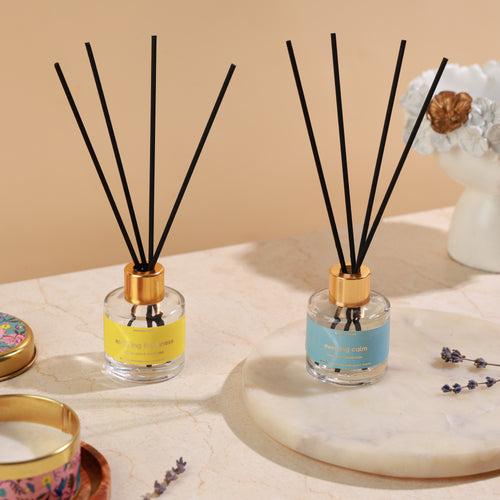 Two rooms · better value₹1,498Shop →
  Large room · a switch₹1,899Shop →
Making two products read as one decision
Get the relationship between the two scents right, because two products can easily read as two accidents. The rule is simple: within one continuous air space, use one scent; across a closed door, you may use a different one. So if your entrance and living room are one volume, they take one bottle and one blend. The bathroom is behind a door, which makes it a separate air space, so it can carry a different scent without anything colliding in the hallway — but the two should still sit beside each other rather than argue. Morning Freshness at the door with Garden Bloom in the bathroom works. So does the same blend in both, which is the safest and often the most convincing option, because repetition is exactly what you are trying to signal. The Day & Night duo at ₹1,498 is two 50ml bottles chosen to sit together, which is why it is the cheapest honest way to reach two.
Then set the reed counts differently, because the rooms are not the same size. Six reeds in the arrival position, two or three in the bathroom. That single adjustment is what stops the small room from reading as overpowering and the large one from reading as thin, and it costs nothing — reeds come six to a box and the ones you do not use go in a drawer for later. Give both bottles forty-eight hours before you judge anything, because fibre has to saturate along its full length before it throws properly, and then judge from the doorway rather than from the sofa. You cannot assess your own home from inside it.
And place them where the air moves a little. A shelf near the entrance beats a console in a still corner; a windowsill or a cistern top in the bathroom beats the back of a cupboard. Avoid direct sunlight, which fades fragrance and heats the oil, and avoid the direct path of a fan or an AC vent, which empties the bottle quickly and pushes everything against one wall. Stand both on a tray or coaster — reed oil marks a polished finish permanently if the bottle is knocked — and keep them out of reach of children and pets. When the arrival bottle finishes, a 300ml refill at ₹2,399 fills a 130ml roughly twice at ₹8.00 a millilitre against ₹9.61 in a new bottle, and refilling is the right moment to fit fresh reeds.
What to buy
Three ways to reach two products, at ₹1,498, ₹1,998 and ₹2,498. All three totals are checked, and the cheapest to buy is the most expensive to run.
| Buy | What it covers | Lasts | Price |
|---|---|---|---|
| One 50ml | A single reed diffuser — the bathroom half of a two-product home — two or three reeds, about thirteen weeks | 6–8 weeks | from ₹749 |
| One 130ml ★ | The value size — the arrival position — six reeds, 14–18 weeks, about ₹78 a week | 14–18 weeks | from ₹1,249 |
| The duo | Day & Night duo — both positions in one purchase at ₹1,498 — the cheapest genuine two-product home | 6–8 weeks each | ₹1,498 |
| Sukoon | 500ml ultrasonic — a living-dining run past about 200 sq ft, where the arrival position needs a switch rather than a bottle | Runs when you switch it on | ₹1,899 |
| 300ml refill | The running cost — the running cost once both positions are established — ₹8.00 a millilitre against ₹9.61 | Roughly 2 × 130ml fills | ₹2,399 |
Versailles
People ask me what the minimum is because they are worried about looking like they have tried too hard, and the honest answer surprises them: the risk is almost never too much, it is one lonely bottle in a living room doing all the work. One product reads as an object. Two products read as a home somebody has thought about. The gap between those two impressions is ₹749, and it is the best ₹749 in this entire cluster.
The room people leave out is always the bathroom, and I understand why — it feels like the least glamorous place to spend money. But it is the only room your guest is alone in, with nothing to do, paying attention. It is also thirty or forty square feet, which means two reeds hold it comfortably and it costs less to run than anywhere else in the flat. If somebody tells me they have ₹2,000 and a whole flat, I send them to the front door and the bathroom, in that order, every single time.
And then I tell them to stop. Three products is a lovely home. Four is fine. Past that you are buying rooms you personally sit in, which is a different and perfectly good reason to buy, but it is not making the house read as more deliberate to anybody else — and you will adapt to all of it within twenty minutes of walking in, so you will be the last person to know. Buy two. Live with them for a season. Then decide. A portion of every order supports girl-child education through Nanhi Kali.
Frequently asked questions
- Which three rooms to scent first — the order, room by room.
- The cheapest setup that still feels scented — the same threshold, from the budget end.
- Two different scents or two of the same? — what to put in position two.
- The complete sizing and quantity guide — every home type, three builds.
- Brand: the SOSA founder story.
SOSA products & prices (verified August 2026): Hotel Collection water-based ultrasonic diffuser fragrance 15ml ₹299 · 100ml ₹999 · 300ml ₹1,799 · Pack of 7 (15ml, all fragrances) ₹1,799; refills 100ml from ₹999. Seven scents: The Ritz-Carlton-inspired (white tea · bergamot · cedar), Westin-inspired (white tea · aloe · cedar), 1 Hotels-inspired (cedarwood · vetiver · green leaves), The St. Regis-inspired (amber · violet · woods), Shangri-La-inspired (jasmine · green tea · white tea), Four Seasons-inspired (citrus · floral · sandalwood), W Hotels-inspired (citrus · pepper · amber). Diffusers: Boond 300ml ₹899 · Sukoon 500ml ₹1,899 · Megh 6L ₹3,499. Water-based, phthalate-free, composed to IFRA standards for home diffusion; 3–6 drops per tank. Made in India, Pune. The Hotel Collection scents are SOSA's own interpretations inspired by the world's finest hotels; all hotel names are trademarks of their respective owners and are used only to describe the scent style — SOSA is an independent Indian fragrance house, not affiliated with or endorsed by any hotel brand. Prices and availability subject to change — see the live product pages.