




Per week: ₹59 a week on four reeds against ₹78 on six. The difference is ₹19 a week for the pair.
Per year: about ₹4,059 of liquid a year at six reeds against ₹3,093 at four — ₹966 for the pair, ₹483 each.
2. Per week it is about ₹19 for the pair. ₹1,249 over twenty-one weeks is about ₹59 a week; over sixteen weeks it is about ₹78. That ₹19 is the honest running-cost difference between a room set to four and the same room set to six, and it is the figure to weigh against whether anybody can actually tell the two settings apart from the doorway.
3. Per year it is about ₹966 for the pair, per room. A room run continuously gets through 52 ÷ 16 = 3.25 bottles a year at six reeds, which is about ₹4,059 of liquid. At four reeds it is 52 ÷ 21 = 2.48 bottles, or about ₹3,093. The gap is ₹966 a year in one room. In a house running five bottles on six reeds where four would do, that is close to ₹4,830 a year.
4. The small bottle behaves differently, and worse. A 50ml at ₹749 gives 6–8 weeks on six reeds — call it seven — and about nine on four. So two reeds cost only two weeks, or about ₹166 in absolute terms, which sounds cheaper. But the cost per week moves from about ₹83 to about ₹107, which is a bigger proportional jump. The small bottle punishes extra reeds hardest.
5. Refilling changes the price of a reed. A 300ml refill at ₹2,399 works out at ₹8.00 a millilitre, so a 130ml fill costs ₹1,040 rather than ₹1,249. Recalculate: 3.25 fills a year at six reeds is ₹3,380, and 2.48 fills at four reeds is ₹2,575. The same two reeds now cost about ₹805 a year instead of ₹966. Reeds get cheaper the moment you stop buying glass.
Made in India, composed by an ISIPCA Versailles-trained perfumer — and a portion of every order supports girl-child education through Nanhi Kali.
Why a reed is a tap rather than an accessory
A reed diffuser has no fan, no pump, no timer and no dial. Fragrance climbs the porous core of each reed by capillary action, arrives at the exposed length above the neck, and evaporates from there into the room. That means the total exposed fibre surface is the entire volume control. Six reeds is not six times the fragrance of one, because the reeds sit close together and share the air immediately above the bottle, but it is meaningfully more than four — and every additional square millimetre of exposed fibre is pulling liquid out of the bottle whether or not anybody is in the room to appreciate the result. There is no way to have more presence and more weeks at the same time from the same bottle. The two move against each other, and the reed count is where you set the exchange rate.
So the sensible way to price a reed is in weeks first and rupees second. Take the 130ml: 14–18 weeks on six reeds, and towards twenty-one on four. That is roughly a quarter off the bottle's life for the two extra reeds, which is a bigger number than most people expect from something that arrives free in the box. Priced at the four-reed rate of ₹59 a week, those five weeks are worth about ₹297, so each additional reed is costing you something in the order of ₹150 per bottle. Nobody would casually add a ₹150 item to a basket without looking at it, and yet almost everybody adds two reeds without a thought, because the cost is deferred and expressed in a currency — weeks — that does not appear on the invoice.
Three ways to read the same number
 Six reeds includedFrom ₹749This is the reading that makes the decision feel real, because it converts weeks back into rupees. A 130ml at ₹1,249 gives about twenty-one weeks on four reeds and about sixteen on six. The two extra reeds have consumed five weeks of a bottle you paid for, and at the four-reed rate of ₹59 a week that is ₹297 for the pair, or roughly ₹150 each. Nothing about this is hidden — it is simply the physics of a passive evaporative system. But it is worth stating in rupees, because "the bottle finished early" and "I spent an extra ₹297" are the same sentence, and only one of them prompts anybody to act.
Sizing by space — how many reeds each room is worth
The cost column here is the annual liquid cost of running that room at the stated reed count, using a 130ml at ₹1,249 and 52 weeks. The last row is the cheapest one on the page.
| Space | What it needs | How many | Cost |
|---|---|---|---|
| Entrance hall or foyer, entered repeatedly with a fresh nose ★ | The one space where the sixth reed reliably earns its ₹150 — arrival is the whole job | Six reeds | about ₹4,059 a year |
| Living room used for guests as well as evenings | Five or six. Judge it from the front door rather than from the sofa | Five or six reeds | ₹3,500–₹4,059 a year |
| Bedroom, 100–150 sq ft, door usually shut | Four. You adapt within twenty minutes, so the extra output is spent on nobody | Four reeds | about ₹3,093 a year |
| Small bathroom, 30–50 sq ft | Two or three. A 130ml on two reeds runs towards thirty weeks and still reads clearly in a small room | Two or three reeds | ₹2,166–₹2,598 a year |
| A study or guest room used a few hours a week | Two, and only while it is in use — or move the bottle in on the day and out again | Two reeds | about ₹2,166 a year |
| A corridor, a store room, or any space nobody stands still in | Nothing. No reeds, no bottle. Transit space does not repay a single one of them | None | ₹0 |
| A note on all of the above: these annual figures assume a room running continuously for all fifty-two weeks, which very few rooms genuinely do. They also assume you rebuy bottles. Switch to a 300ml refill at ₹2,399 — ₹8.00 a millilitre, so ₹1,040 a fill — and every figure in the right-hand column drops by about seventeen per cent. | |||
One room · the unitFrom ₹749Shop → 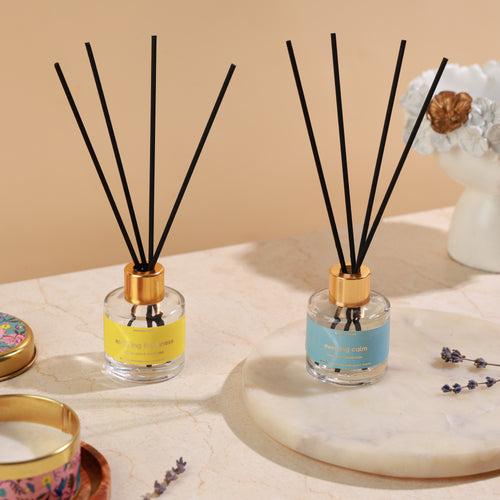 Two rooms · better value₹1,498Shop →
  Large room · a switch₹1,899Shop →
How to find your own reed count in forty-eight hours
Start low and climb, because you cannot go back down. Adding a reed takes ten seconds; removing one does nothing for a day or two, because the reeds already in the bottle are saturated and continue to evaporate. So begin at three in a bedroom or two in a bathroom, wait a full forty-eight hours for the fibre to wick along its whole length, and only then judge. A great many people conclude on day one that a diffuser is weak, add three more reeds, and end up running a bedroom at hall strength for four months at ₹78 a week. Patience here is worth about ₹966 a year.
Judge it from the doorway, with a nose that has been somewhere else. Olfactory adaptation is essentially complete within about twenty minutes, which means you are the least qualified person in the world to assess your own living room. Leave the flat for half an hour and judge the first breath on returning, or ask whoever visits next — not "can you smell it", which invites politeness, but "where do you think it is coming from", which invites an honest answer. If the first breath registers, you are at the right reed count. If it registers and then keeps insisting for the next ten minutes, you are one reed too high and you are paying for the privilege.
Then treat reeds as a maintenance item, not a permanent setting. Fibre clogs. The heavier fragrance molecules gradually saturate the core, wicking slows, and throw drops off after a few months — at which point the instinct is to add reeds or blame the liquid, when the correct move is to fit fresh reeds at the same count. Flip the reeds every couple of weeks if you want a small lift for free, and replace them whenever you refill. And keep the bottle off bare polished wood and out of direct sunlight, which fades the fragrance and speeds evaporation in exactly the way this whole page is trying to help you avoid.
What to buy
Nothing on this page requires you to buy anything — the saving comes from taking reeds out. This table is for when the bottle itself is genuinely finished.
| Buy | What it covers | Lasts | Price |
|---|---|---|---|
| One 50ml | A single reed diffuser — a small bathroom on two or three reeds, where a 130ml would outlast your interest in the scent | 6–8 weeks | from ₹749 |
| One 130ml ★ | The value size — any room you run continuously — 14–18 weeks on six reeds, towards twenty-one on four | 14–18 weeks | from ₹1,249 |
| The duo | Day & Night duo — two rooms at different reed counts — a hall on six and a bedroom on four, from one purchase | 6–8 weeks each | ₹1,498 |
| Sukoon | 500ml ultrasonic — a large room where you would otherwise be tempted to run two bottles at six reeds each | Runs when you switch it on | ₹1,899 |
| 300ml refill | The running cost — the cheapest reed there is: refilling drops a 130ml fill from ₹1,249 to ₹1,040 | Roughly 2 × 130ml fills | ₹2,399 |
Versailles
Six reeds come in every box because six is what a large room needs, and because a box that shipped four would look mean on a shelf. I have never liked that the number reads as an instruction. Six is a maximum, and in most rooms in most Indian flats the right answer is three or four.
What I wanted to do on this page was put a rupee figure on it, because "it will last longer" is not a number and nobody acts on it. ₹150 a reed over a bottle is a number. ₹966 a year in one room is a number. When a customer writes to say their 130ml only lasted ten weeks, the answer is almost always six reeds in a small bedroom, and once they see the figure they take two out and stop writing to me about longevity.
I am not telling you to run everything on three. The sixth reed in an entrance hall is one of the best ₹150 in the range, because a hall is entered fresh a dozen times a day and that is exactly where presence pays. I am telling you to spend the reed where somebody arrives, and to save it where somebody has already been sitting for two hours and cannot smell a thing regardless. A portion of every order supports girl-child education through Nanhi Kali.
Frequently asked questions
- Six reeds for less time or three for longer? — the value question behind this one.
- Do fewer reeds save money or delay the cost? — the objection, answered.
- Cost per week: 50ml against 130ml — ₹105 against ₹78, checked.
- The complete sizing and quantity guide — every home type, three builds.
- Brand: the SOSA founder story.
SOSA products & prices (verified August 2026): Hotel Collection water-based ultrasonic diffuser fragrance 15ml ₹299 · 100ml ₹999 · 300ml ₹1,799 · Pack of 7 (15ml, all fragrances) ₹1,799; refills 100ml from ₹999. Seven scents: The Ritz-Carlton-inspired (white tea · bergamot · cedar), Westin-inspired (white tea · aloe · cedar), 1 Hotels-inspired (cedarwood · vetiver · green leaves), The St. Regis-inspired (amber · violet · woods), Shangri-La-inspired (jasmine · green tea · white tea), Four Seasons-inspired (citrus · floral · sandalwood), W Hotels-inspired (citrus · pepper · amber). Diffusers: Boond 300ml ₹899 · Sukoon 500ml ₹1,899 · Megh 6L ₹3,499. Water-based, phthalate-free, composed to IFRA standards for home diffusion; 3–6 drops per tank. Made in India, Pune. The Hotel Collection scents are SOSA's own interpretations inspired by the world's finest hotels; all hotel names are trademarks of their respective owners and are used only to describe the scent style — SOSA is an independent Indian fragrance house, not affiliated with or endorsed by any hotel brand. Prices and availability subject to change — see the live product pages.