


What does move it: doors. Four people keep more bedroom doors shut, which brings more air spaces into use — but that is a door count, not a headcount.
What four people really need more of: extraction, laundry and open windows. A diffuser adds fragrance; it does not subtract anything, so a stronger bottle over a source gives you both at once.
2. What changes is how many doors are shut. This is the only honest way household size raises the number, and it is really a door count. A single occupant in a 2BHK typically leaves everything open and uses one bedroom, so two bottles at ₹1,998 covers the flat. Four people use both bedrooms and shut both doors at night, which is four air spaces and about ₹4,646. The extra money bought rooms coming into use, not people.
3. More people do add more source — and fragrance is not the answer to a source. More cooking, more shoes, more laundry, more soft furnishing holding what a home does all day. A reed diffuser adds a fragrance to a room; it does not remove anything, and it cannot. Running a bigger bottle over an unaddressed source gives you both smells at once, which is worse than either. Extraction over the hob, an open window at the right time and a laundry basket with a lid do more for a busy flat than a second diffuser ever will.
4. Four people do empty a bottle slightly faster. Doors opening, people moving, fans running: all of it is air movement, and evaporation rises with airflow. A 130ml that would give eighteen weeks in a quiet flat may give nearer fourteen in a busy one. That is about ₹89 a week against ₹69 — a running-cost difference of roughly a quarter, and the correct response is to run four reeds instead of six, not to buy a second bottle.
5. And a full house is the worst judge of its own smell. Olfactory adaptation is essentially complete within about twenty minutes. A household where somebody is always home never gets the fresh-nose arrival that makes a diffuser register, so the family concludes the bottles have gone weak and buys more. They have not. Send one person out for half an hour and have them judge the first breath on returning — that is the only reliable reading a busy home will get.
Made in India, composed by an ISIPCA Versailles-trained perfumer — and a portion of every order supports girl-child education through Nanhi Kali.
Why the room sets the number and the household does not
A reed diffuser reaches an equilibrium with the room it stands in. Fragrance climbs the reeds by capillary action, evaporates from the exposed length, and disperses until the concentration in the air is balanced by what the room loses through leakage and ventilation. The variables in that equation are volume, temperature and air-change rate. Occupancy is not one of them. A 150 sq ft room at nine feet is 1,350 cubic feet with one person in it and 1,350 cubic feet with four, so the bottle has exactly the same job to do. This is why the honest answer to "we are a bigger family, should we buy more" is almost always no, and why a brand that tells you otherwise is selling on an intuition rather than on physics. The intuition is understandable — more people feels like more of everything — but the room did not grow.
Where occupancy does touch the arithmetic, it touches it sideways, through three effects that are all worth knowing and none of which is "buy another bottle". The first is doors: more people use more rooms and close more doors, and since fragrance does not pass a closed door, a flat with four occupants often contains more separate air spaces in daily use than the same flat with one. That genuinely raises the count, but it is a door count. The second is airflow: a busy household opens doors, runs fans and moves around, and evaporation rises with air movement, so the same 130ml runs nearer fourteen weeks than eighteen. That is a running cost of about ₹89 a week instead of ₹69, and the sensible answer is four reeds rather than six. The third is adaptation: a home that is never empty never produces a fresh nose, so a busy household systematically under-reads its own flat and over-buys.
What four people actually change
 One per air spaceFrom ₹749Count the doors you actually close, not the people. A single occupant in an 850 sq ft 2BHK who leaves every internal door open has, in fragrance terms, roughly two spaces: one long volume plus the bathroom. That is about ₹1,998. A family of four in the identical flat uses both bedrooms, shuts both doors at night and closes the bathroom, which is four spaces and about ₹4,646. The extra ₹2,648 bought rooms that came into use — it did not buy fragrance for extra people. Put the same four people in a 1RK and the bill goes straight back down to one or two bottles, because a 1RK has no doors to shut.
Sizing by space — the same flat, one occupant or four
Each row gives the same space under two different households. The unit count moves in only one of them, and two rows recommend spending nothing.
| Space | What it needs | How many | Cost |
|---|---|---|---|
| 150 sq ft bedroom — one sleeper or three ★ | Identical. 1,350 cubic feet either way, and the coverage figure describes the air, not the occupancy | One 130ml, four reeds | from ₹1,249 |
| Living room, 180 sq ft — quiet flat or family flat | Same unit, shorter life. Expect nearer 14 weeks than 18 in a busy home — run four reeds, not six | One 130ml | from ₹1,249 |
| Second bedroom — empty in a household of one, in use in a household of four | This is the row where the number genuinely rises, because a door is now being closed on a used room | None, then one | ₹0, then from ₹1,349 |
| Bathroom shared by four rather than one | Same bottle, more door movement. Two reeds, and expect nearer 26 weeks from a 130ml than 30 | One | from ₹749 |
| Kitchen in a household that cooks three meals a day | Nothing. Cooking is a source and extraction answers a source. A bottle here is spent against the strongest smell in the flat | None | ₹0 |
| A second living or dining area nobody has sat in this month | Nothing, whoever lives there. Occupancy hours qualify a room, and four people do not make an unused room used | None | ₹0 |
| A note on all of the above: every coverage figure here assumes a closed room with still air and a standard ceiling. A household of four typically has more doors opening, more fans running and more windows in use, all of which reduce what any bottle holds — which is an argument for fewer reeds and better placement, not for more bottles. | |||
One room · the unitFrom ₹749Shop → 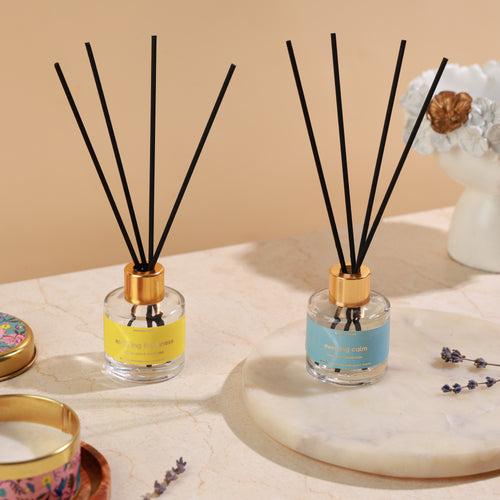 Two rooms · better value₹1,498Shop →
  Large room · a switch₹1,899Shop →
Running a shared home well
Choose the arrival blend for the household, not for yourself. In a flat with four opinions, the room everyone passes through should carry the least divisive of the five blends, and in practice that is usually Morning Freshness — lemon, peppermint and eucalyptus read as clean rather than as perfume, which is what makes them hard to object to. Save the ones with a strong character for rooms behind doors, where whoever sleeps there gets the choice: Evening Calm in one bedroom and Mountain Breeze in another costs nothing in coherence because a closed door is a boundary. This is also the simplest way to stop a shared flat arguing about fragrance, which is a real problem and not a small one.
Run four reeds rather than six almost everywhere, and expect the bottom of every range. A busy household has more air movement than the conditions the coverage figures were measured in, so plan for fourteen weeks from a 130ml rather than eighteen and for the bottom of the 6–8 week band on a 50ml. Dropping to four reeds pushes a 130ml back towards twenty-one weeks and costs nothing, and in a flat where people are coming and going the lower setting is usually more pleasant anyway — a fresh nose arrives several times an hour in a busy home, and each of those arrivals registers the fragrance properly. Keep every bottle out of reach of children and pets, on a tray rather than on bare polished wood, and out of direct sun.
And appoint one person to judge the flat from outside. This sounds trivial and it is the single most useful habit a full household can adopt. Nobody who has been in the flat for twenty minutes can assess it — adaptation is essentially complete by then, which is why families reliably conclude their bottles have failed and buy more. Once a fortnight, whoever leaves first should be asked to judge the first breath on coming back in. If it registers within the first two steps, the flat is fine and nothing needs buying. If it does not, the fix is usually fresh reeds — fibre clogs over months — or a bottle moved out of a draught, not another purchase.
What to buy
The list below is identical for a household of one and a household of four in the same flat. What changes with occupancy is how many of the rooms are genuinely in use.
| Buy | What it covers | Lasts | Price |
|---|---|---|---|
| One 50ml | A single reed diffuser — a shared bathroom on two reeds, where door traffic is high and a large bottle is not needed | 6–8 weeks | from ₹749 |
| One 130ml ★ | The value size — any room in daily use by anybody — 14–18 weeks, nearer fourteen in a busy flat | 14–18 weeks | from ₹1,249 |
| The duo | Day & Night duo — two bedrooms behind two closed doors, each with its own character, from one purchase | 6–8 weeks each | ₹1,498 |
| Sukoon | 500ml ultrasonic — a large shared living-dining where a switch suits several schedules better than something always on | Runs when you switch it on | ₹1,899 |
| 300ml refill | The running cost — the running cost in a home where bottles empty at the fast end of the range | Roughly 2 × 130ml fills | ₹2,399 |
Versailles
This is the question where the easy upsell is most tempting and least defensible. A family writes to say there are five of them in a 900 sq ft flat and asks how many diffusers they need, and the commercial answer is "more". The true answer is: the same as if you lived there alone, because the rooms are the same size. I would rather sell three bottles that work than five that make somebody feel they have been sold a set.
What a full house genuinely needs more of is not something I make. It is extraction while you cook, a window opened on purpose, laundry that does not sit around, and curtains washed more than once a year. A reed diffuser adds a fragrance to a room. It does not take anything away, and if you put a strong one over a problem you have not dealt with, you get both at once and blame the bottle.
The other thing I would say to a busy household is that you are the worst judge of your own flat. Somebody is always home, so nobody ever walks in with a fresh nose, and within twenty minutes none of you can smell a thing — which feels exactly like the diffusers having failed. Send one person out for half an hour and ask them what they notice on the way back in. Nine times out of ten the answer is that everything is working, and you have just saved yourself two bottles. A portion of every order supports girl-child education through Nanhi Kali.
Frequently asked questions
- Family home all day — does it change anything? — occupancy hours, not headcount.
- A joint family in a 3BHK — the same logic at a larger scale.
- Why counting doors beats counting square feet — the rule this page rests on.
- The complete sizing and quantity guide — every home type, three builds.
- Brand: the SOSA founder story.
SOSA products & prices (verified August 2026): Hotel Collection water-based ultrasonic diffuser fragrance 15ml ₹299 · 100ml ₹999 · 300ml ₹1,799 · Pack of 7 (15ml, all fragrances) ₹1,799; refills 100ml from ₹999. Seven scents: The Ritz-Carlton-inspired (white tea · bergamot · cedar), Westin-inspired (white tea · aloe · cedar), 1 Hotels-inspired (cedarwood · vetiver · green leaves), The St. Regis-inspired (amber · violet · woods), Shangri-La-inspired (jasmine · green tea · white tea), Four Seasons-inspired (citrus · floral · sandalwood), W Hotels-inspired (citrus · pepper · amber). Diffusers: Boond 300ml ₹899 · Sukoon 500ml ₹1,899 · Megh 6L ₹3,499. Water-based, phthalate-free, composed to IFRA standards for home diffusion; 3–6 drops per tank. Made in India, Pune. The Hotel Collection scents are SOSA's own interpretations inspired by the world's finest hotels; all hotel names are trademarks of their respective owners and are used only to describe the scent style — SOSA is an independent Indian fragrance house, not affiliated with or endorsed by any hotel brand. Prices and availability subject to change — see the live product pages.