



Strong near the bottle, nothing at the far end: a distance problem. A second position earns its ₹1,249.
Quiet to you, obvious to a visitor: nothing is wrong. That is your nose, not the bottle.
2. Then ask where the room is quiet. This is the whole diagnostic. Walk to the furthest point from the bottle, then walk back to the bottle. If it is clearly present at the bottle and gone at the far end, you have a distance problem and a second bottle placed at the far end is the correct purchase. If it is much the same in both places — quietly there, or barely there — then adding a second bottle gives you two quiet bottles, which is ₹1,249 for nothing.
3. Check the fibre before you check your wallet. If the room was right for the first two months and has faded since, while the bottle is still a third or half full, the reeds have clogged. Heavier fragrance molecules saturate the fibre core over months and the capillary climb slows to almost nothing. The fix is fresh reeds, not more liquid and certainly not another bottle. Fresh reeds come with every new bottle and every refill, so keep the spares from your last purchase rather than throwing them away.
4. Check yourself, too. Olfactory adaptation is essentially complete within about twenty minutes, which means you are the least reliable instrument in your own home. Leave the flat for half an hour and judge the first breath on returning, or simply ask whoever visits next. A surprising number of second bottles are bought to solve a problem that only the owner has.
5. Buy the second bottle when the answer is a position, not a level. A second bottle does not widen a circle; it starts a new one. So it is worth ₹1,249 in an L-shaped room, a room with a blind leg behind a partition, a run longer than about twenty-two feet, a double-height volume, or any space past about 150 sq ft. It is worth nothing at all standing beside the first bottle on the same console.
Made in India, composed by an ISIPCA Versailles-trained perfumer — and a portion of every order supports girl-child education through Nanhi Kali.
What reeds do, and what a second bottle does
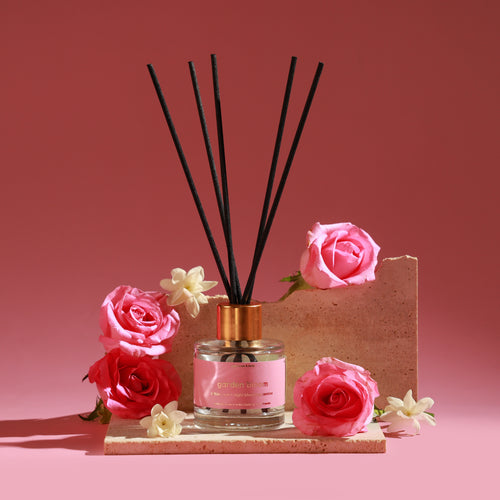
These two purchases solve different problems, which is why swapping one for the other wastes money. A reed diffuser works by capillary action: oil climbs the porous core of each reed, reaches the exposed length above the collar and evaporates from there. The total exposed fibre is the strength dial. Six reeds evaporate roughly twice as much as three, so reed count changes how much fragrance enters the room per hour. It also changes how long the bottle lasts, in the same direction and by roughly the same proportion — this is a trade rather than a free upgrade, and anyone who tells you otherwise is selling you the next bottle sooner.
A second bottle does something quite different. It does not raise the level in the room the first bottle is already holding; it creates a second point of origin. That is only valuable when there is somewhere the first point cannot reach — because a passive source has no fan, and fragrance travels only as far as the room's own gentle air movement carries it before it dilutes below the threshold of notice. In practice that means a second bottle buys shape and distance, never volume. Past about 150 sq ft, past about twenty-two to twenty-four feet of run, around a corner in an L, behind a partition, or up into a double-height space: those are the cases. In a plain 120 sq ft bedroom, the second bottle is two bottles emptying simultaneously in a room that one was already holding.
The diagnostic, in three steps
 Six reeds included₹0 to tryDo all three before spending anything. Add the spare reeds — if you are on three or four, go to five or six and wait two days for them to saturate along their full length. Move the bottle to a shelf or console near the doorway at chest height, where air already moves, rather than a still corner or a low bedside table; and out of direct sunlight and out of the throw of a fan or AC vent, both of which cost you weeks. Replace clogged fibre if the bottle is still part-full but throw has dropped over months. Between them these three account for most rooms that feel underscented.
Sizing by space — which fix each situation actually needs
Find the line that matches what your room is doing. Four of these six rows cost nothing at all, which is roughly the true ratio.
| Space | What it needs | How many | Cost |
|---|---|---|---|
| A 120 sq ft room on four reeds that reads too quiet ★ | Add the two spare reeds and wait forty-eight hours — this is most rooms | No new bottle | ₹0 |
| A 150 sq ft room already on six reeds, quiet at the far end | Move it first — near the doorway, chest height, out of the fan's path. Then check the ceiling and door | No new bottle yet | ₹0 |
| A part-full bottle whose throw faded over four months | Clogged fibre. Fresh reeds come with every bottle and every refill — fit them and keep the old ones out | No new bottle | ₹0 |
| A room you cannot smell but a visitor immediately can | Nothing. Adaptation is near-complete in about twenty minutes and it is not a fault | None | ₹0 |
| An L-shaped 140 sq ft room with one leg that never gets there | A genuine position problem — a small second bottle in the blind leg beats any change of reed count | One more 50ml | from ₹749 |
| A 200 sq ft room, six reeds, strong at one end only | Past what one passive point holds — two positions well apart, or a Sukoon | Two bottles or one machine | ₹2,498 or ₹1,899 |
| A note on all of the above: all of this assumes the room is closed and still. If the door stands open, a fan runs all evening, or the ceiling is above about eleven feet, neither reeds nor a second bottle is the answer — the air is being replaced or the volume is larger than the floor plan suggests, and that has to be dealt with first. | |||
One room · the unitFrom ₹749Shop → 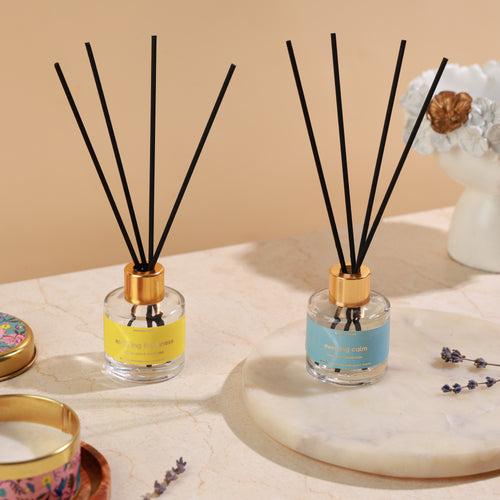 Two rooms · better value₹1,498Shop →
  Large room · a switch₹1,899Shop →
How to add reeds properly
Add one at a time, not all at once, and wait two days between changes. A fresh reed has to saturate along its full length before it throws at all, so a reed added at eight in the evening has done almost nothing by bedtime. People add two, judge it the same night, decide it made no difference, and go and buy a bottle. Add one, wait forty-eight hours, judge it from the doorway after half an hour out of the flat, and only then add another. Most bedrooms settle at four; a 150 sq ft main room usually wants all six; a small bathroom wants two or three and no more.
Flip the reeds once, and then leave them alone. Turning the reeds end for end brings the saturated length up out of the bottle and gives a genuine, immediate lift — useful before guests arrive. It is not a routine, though. Flipping every few days simply consumes the bottle faster and drags dust and residue down into the oil, which is one of the things that clogs fibre in the first place. Once when you first set it up, and once more if you need a lift for an evening, is plenty. When the throw has genuinely gone, replace the reeds rather than flipping tired ones again.
Then know when to stop adjusting and accept the room. If you are on six reeds, the bottle is well placed, the fibre is fresh and a visitor still cannot detect anything, the problem is no longer the diffuser. It is almost always one of three things: the door stands open onto a passage so the air space is larger than the room; the ceiling is above about eleven feet, so 150 sq ft of floor is 1,800 cubic feet rather than 1,350; or a fan or open window is exchanging the air several times an hour, against the 0.2 to 0.5 a closed room manages. In all three cases a second bottle will disappoint too. A Sukoon at ₹1,899, rated to about 270–320 sq ft and switched on when the room is occupied, is the better answer to a room that keeps losing its air.
What to buy
The honest first line of this table is "nothing yet". The rest is here for when the walk test says you genuinely have a distance problem.
| Buy | What it covers | Lasts | Price |
|---|---|---|---|
| One 50ml ★ | A single reed diffuser — a genuine second position — a blind leg, an L, or the far end of a long room. The cheap way to solve distance | 6–8 weeks | from ₹749 |
| One 130ml | The value size — the main position, if you are replacing rather than adding — 14 to 18 weeks depending on reed count | 14–18 weeks | from ₹1,249 |
| The duo | Day & Night duo — two positions at once for ₹1,498 against ₹1,548 separately, with two blends composed to sit together | 6–8 weeks each | ₹1,498 |
| Sukoon | 500ml ultrasonic — a room past about 200 sq ft where two bottles would still be chasing the problem | Runs when you switch it on | ₹1,899 |
| 300ml refill | The running cost — refills a 130ml roughly twice, and brings fresh reeds with it — the fix for faded throw | Roughly 2 × 130ml fills | ₹2,399 |
Versailles
I would rather sell you no bottle than the wrong one, and this is the question where that matters most. Six reeds come in the box. If your room feels quiet and you are running four, the answer is sitting in your drawer, it costs nothing, and it takes two days to find out. I do not know how to say that more plainly.
The reason people skip it is that adding a reed feels like a small gesture and buying a bottle feels like taking the problem seriously. It is the reverse. Reed count changes the strength in a room more than bottle size does — a 50ml and a 130ml on six reeds each throw the same distance, because both are evaporating from six reeds of the same length. What the bigger bottle buys is weeks. What reeds buy is presence.
The one case where I will tell you to buy the second bottle is distance. If it smells right by the diffuser and genuinely of nothing fifteen feet away, no reed count will bridge that, and a second bottle placed at the far end is worth every rupee. Just put it far away. A second bottle next to the first is the most common wasted purchase in home fragrance, and I see it constantly. A portion of every order funds a girl's classroom through Nanhi Kali.
Frequently asked questions
- How many spare reeds should I keep? — and when they are the right fix.
- Do fewer reeds save money or delay the cost? — the other half of the trade.
- Is one enough for a 150 sq ft room? — where six reeds is the correct setting.
- The complete sizing and quantity guide — every home type, three builds.
- Brand: the SOSA founder story.
SOSA products & prices (verified August 2026): Hotel Collection water-based ultrasonic diffuser fragrance 15ml ₹299 · 100ml ₹999 · 300ml ₹1,799 · Pack of 7 (15ml, all fragrances) ₹1,799; refills 100ml from ₹999. Seven scents: The Ritz-Carlton-inspired (white tea · bergamot · cedar), Westin-inspired (white tea · aloe · cedar), 1 Hotels-inspired (cedarwood · vetiver · green leaves), The St. Regis-inspired (amber · violet · woods), Shangri-La-inspired (jasmine · green tea · white tea), Four Seasons-inspired (citrus · floral · sandalwood), W Hotels-inspired (citrus · pepper · amber). Diffusers: Boond 300ml ₹899 · Sukoon 500ml ₹1,899 · Megh 6L ₹3,499. Water-based, phthalate-free, composed to IFRA standards for home diffusion; 3–6 drops per tank. Made in India, Pune. The Hotel Collection scents are SOSA's own interpretations inspired by the world's finest hotels; all hotel names are trademarks of their respective owners and are used only to describe the scent style — SOSA is an independent Indian fragrance house, not affiliated with or endorsed by any hotel brand. Prices and availability subject to change — see the live product pages.