





The diagnostic: what you smell at seven, after a morning clean, is your home's true baseline with the covering removed — the most useful reading available to you.
The seven baselines: nothing at all means clean but not fresh; faintly stale means no air exchange; cooking means a fabric reservoir; damp means humidity or a source; sharp or sulphurous means a dry drain trap; musty means growth; medicinal means phenyl residue.
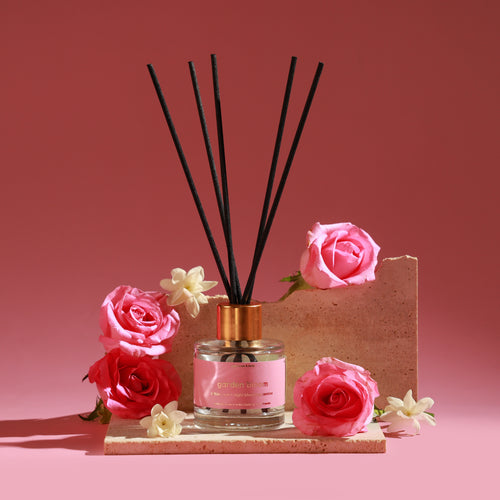
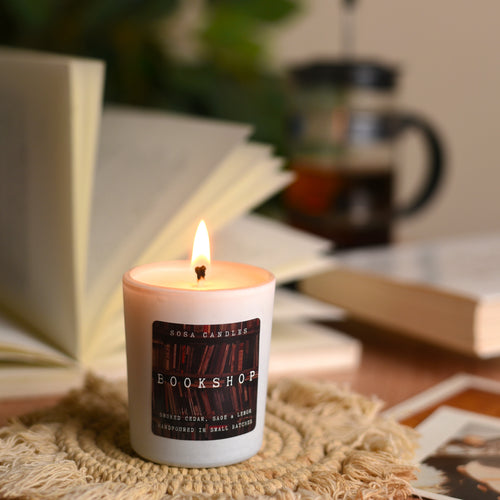
Then the commercial part, plainly: once nothing is wrong, the only thing that makes a clean home smell of something at seven is a background composed to persist — a reed diffuser from ₹749 for a level that holds for months, the Sukoon at ₹1,899 for a deliberate change on a timer, a Bookshop candle at ₹379 for one evening.
2. And because a clean room has no smell of its own. Once you have removed what was wrong, what remains is an absence rather than a presence. Nothing is producing anything, which is exactly the result you wanted and is nothing whatsoever to smell.
3. So the evening state is the default and the morning state was the exception. That reversal is the whole page. You have not lost something; you have stopped adding something, and the room has returned to being itself.
4. Which makes the evening the most useful diagnostic hour of your day. Whatever you smell at seven, with the covering gone, is your home's true baseline. It is a free reading of the building, and it is more honest than anything you can get by walking around at eleven in the morning.
5. Read it, then fix it, and almost all of the fixes are free. Nothing at all means clean but empty. Faintly stale means no air exchange. Cooking means fabric. Damp means humidity or water. Sharp means a drain trap that has run dry. Musty means growth. Medicinal means residue on the floor.
6. And once there is genuinely nothing left to find, add a background composed to persist. That is the honest commercial answer and I will not dress it up: a reed for a level that holds for months, a timed diffuser for a room you want to change deliberately, a candle for one evening.
A portion of every order supports girl-child education through Nanhi Kali.
Part one — the principle, and the diagnostic gift inside it
Nine articles come before this one and they all reduce to a single sentence that is worth putting plainly. Cleaning is subtraction and it is composed to be temporary; a clean room's own smell is nothing at all; and therefore the evening, when the addition has gone and the absence is all that is left, is your home in its resting state. Everything else on this page follows from that, including the unexpected part, which is that the resting state is enormously useful information and almost nobody reads it.
Part two — the seven evening baselines, and what each one means
One lap of the flat at seven, one word per room, and this table converts the word into a cause, a free fix and the page that covers it at length. Six of the seven are things to deal with rather than to scent. The first row is the one where a fragrance is the right and complete answer, and it is deliberately at the top so that nobody mistakes it for the others.
| What you smell at seven | What it means | The free fix | Read next |
|---|---|---|---|
| Nothing at all ★ | The room is clean and empty. Nothing is wrong and nothing is there — clean is an absence, and freshness is a presence you have not added yet | Twenty minutes of cross-ventilation, which supplies movement. Then this is the one reading where a fragrance is the correct answer rather than a cover | Clean but not fresh |
| Faintly stale, closed, like a shut room | No air exchange. A closed room does not stop producing smell, it stops removing it, so everything that off-gasses slowly accumulates | Two openings on opposite or adjacent walls for twenty minutes. One window is ventilation; two is exchange | Why a deep clean lasts a week |
| Old cooking, when nothing has been cooked | A fabric reservoir. Cooking aerosol and body oils deposit into textiles and re-release for weeks — the standing-up-fine, sitting-down-stale test | Cushion covers, throws, curtains and bedlinen into the machine; two hours of sun on what cannot be washed | The kitchen version of this |
| Damp, earthy, like wet cardboard | Humidity above roughly 60 percent, or actual water. In monsoon indoor humidity commonly runs 80 to 95 percent, and growth accelerates above 60 | Fans rather than windows on a wet day, wardrobes and bathroom doors left open, and find the water before anything else | What humidity level starts it |
| Sharp, faintly sulphurous, unplaceable | A drain trap that has run dry. The U-bend water seal evaporates in two to four weeks of disuse and the drain then vents into the room | A mug of water down every floor drain, basin and unused shower. It works within minutes and it is free | What a dried-out drain trap is |
| Musty, like a cupboard or old books | Microbial growth in a small closed volume — a wardrobe, a store room, a guest bathroom, the inside of an AC | Empty it, wipe it dry, leave it open with a fan on; and wash the AC filter every two to four weeks in season | The eight things a clean misses |
| Medicinal, hospital-like, still there at four | Phenyl or disinfectant residue on the floor, quietly topping the room up. It is persistent by design rather than by accident | A second bucket of plain water and a well-wrung mop, then twenty minutes of ventilation | Why phenyl stays all day |
Reeds · a level, for months₹749Shop →  Sukoon · a change, on a timer₹1,899Shop →
  Candle · one evening₹379Shop →
Part three — the order of work, and the free fixes in full
The order matters more than any individual step, and it is the same order this whole cluster is built on. Find the source. Change the air. Deal with moisture. Deal with fabric. Clean. Then, and only then, add fragrance. Working out of order is the single commonest mistake, and it always takes the same shape: somebody scents a room whose cause has not been found, gets two smells instead of one, decides the product is at fault and starts again with a different product. So: sources first, and the four that account for most cases are a bin that has been relined but never washed, a fridge drawer nobody has emptied, a drain trap that has run dry in a bathroom nobody uses, and a wet towel or a load of washing left in the machine. All four are free and all four take under ten minutes. Then air, which is the only removal rate you control: two openings on opposite or adjacent walls for twenty minutes, daily, with the exception that on a heavy monsoon day at 80 to 95 percent outdoor humidity you use ceiling and exhaust fans instead, because opening up imports the problem. Then moisture, which outranks everything else because above roughly 60 percent relative humidity microbial growth accelerates and every other smell in the flat gets louder. Then fabric, which is where a room keeps its memory: covers, curtains, throws and bedlinen into the machine, two hours of direct sun on a mattress or a rug, and a vacuum with the upholstery head over the sofa cores rather than only the covers. Then cleaning, top to bottom, wet work last, windows open throughout and for twenty minutes after.
Then the free fixes in full, because a reader who buys nothing should leave this page with the problem solved and I would rather list them than gesture at them. A mug of water down every floor drain, basin and unused shower, fortnightly and after every trip — the U-bend seal evaporates in two to four weeks and a dry trap is the sharp, unplaceable smell nobody can name. The washing machine door and detergent drawer left open between washes, with the rubber gasket wiped dry. The AC filter out and washed every two to four weeks in season, because the evaporator coil and filter run cold and wet, grow biofilm, and blow it into the room in the first minute after start-up. Exhaust fans on while cooking and for ten minutes after, not only during. The bin washed rather than relined, and the fridge's vegetable drawer, door seal and anything at the back older than a week dealt with. Chimney filters soaked monthly. Curtains washed, which almost nobody does and which is the largest single fabric reservoir in most flats. And one honest guest asked what your home smells like, because you genuinely cannot answer that question about your own house — receptors adapt to a constant within minutes and a home becomes invisible to its residents within about a fortnight, while every visitor still receives it exactly as it is. That last one is free, it is slightly uncomfortable, and it is worth more than any product on this site.
Then the part where something gets bought, and on this page I am going to state it plainly rather than wrap it. Once the diagnosis comes back clear — nothing wrong, nothing left to find, air moving, fabric washed — a room has no smell of its own, and the only thing that will make your home smell of something at seven in the evening is a background that was composed to persist. That is not a cover-up and it is not a substitute for anything. It is the one job in this entire cluster that a fragrance is actually for. Three shapes, and they are different jobs rather than three price points. A reed diffuser from ₹749 is a level: a small quantity carried into the room continuously by capillary action, no electricity, no switch, nothing to remember, holding for months, and 24 to 72 hours to establish — which makes it the wrong buy for tonight and the right one for a house you want to have a resting smell. Morning Freshness at ₹749 is Malabar lemon, peppermint and eucalyptus; Garden Bloom and Evening Calm from ₹799; Fresh Brew and Mountain Breeze from ₹849; 130ml from ₹1,249, duos from ₹1,498, 300ml refills ₹2,399. The Sukoon at ₹1,899 is a change: a 500ml BPA-free tank, 270–320 sq ft, 16–18 hours per fill on low at 30–50 ml/h against 9–12 on high, a 2.4MHz cool-mist plate, a remote, auto shut-off and steady, 2H and 4H timers, with three 15ml Hotel Collection scents of your choice included, at three to six drops per tank — per tank rather than per litre, so a Boond at ₹899 takes the same drops for one room and a Megh at ₹3,499 suits an open-plan flat. Two hours from six leaves a room scented all evening. And a Bookshop candle at ₹379 is an evening: 80g, 15 to 18 hours of burn, fifteen to twenty minutes to reach a normal room, attended and put out; Amber Rose candle is ₹599 and ₹799, Smoked Oudh candle is ₹449, a ceramic jar candle is ₹949 and the Pure Calm wax melt set is ₹854. The constraints, for completeness: SOSA makes no room or linen spray for the home and no cleaning product of any kind; the water-based Hotel Collection runs in the Sukoon, Boond and Megh only, never in a reed and never in the waterless Vaayu at ₹11,999; reed oil clogs a 2.4MHz plate; a cool-mist ultrasonic adds 30 to 50 millilitres of water an hour and is the wrong machine for a damp room; and you will stop noticing whatever you choose within a fortnight, at which point the answer is one honest guest rather than two more drops.
Part four — the complete edit, and the honest commercial case
The whole group in one table, in the order I would work through it. The first four rows are free and they are where the result comes from. The last two are the legitimate purchase, and they arrive here rather than at the top because on six of the seven evening readings a fragrance would have made things worse rather than better.
| Do this | What it is | When it is the right answer | Price |
|---|---|---|---|
| 1. Take the seven o'clock reading ★ | One lap of the flat on the evening you cleaned, lights on, nothing cooking, one word per room | First, before anything else. Your nose has just been reset by the clean, which makes this the most accurate hour of your week | ₹0 |
| 2. Sources — the bin, the fridge, the drains, the machine | A washed bin rather than a relined one, an emptied vegetable drawer, a mug of water down every unused drain, the washer door left open | Whenever the reading is sharp, sour or unplaceable. Four checks, ten minutes, and they resolve most cases | ₹0 |
| 3. Air, then moisture | Two openings on opposite walls for twenty minutes daily; fans instead of windows above 80 percent outdoor humidity | Whenever the reading is stale, closed, damp or musty. Growth accelerates above roughly 60 percent relative humidity | ₹0 |
| 4. Fabric, then filters | Covers, curtains, throws and bedlinen washed; sun on the mattress; AC filter every two to four weeks; chimney filters monthly | Whenever the reading is old cooking, or the room smells fine standing and stale sitting down | ₹0 |
| 5. A reed diffuser | A level held for months by capillary action, with no electricity and nothing to switch on. 24–72 hours to establish | Once the reading comes back clear. This is the correct product for a home you want to have a resting smell | from ₹749 |
| 6. Sukoon or a candle | 500ml, 270–320 sq ft, steady/2H/4H timers, three 15ml scents included — or 80g and one attended evening | The Sukoon for a room you want to change deliberately at a chosen hour; the candle for a specific evening | ₹1,899 / ₹379 |
Versailles
If I could change one belief about home fragrance in this country it would be this one, and it is the reason I wanted the last page of this group to be about a diagnosis rather than a product. People treat the hour after cleaning as the truth about their home and the evening as a decline. It is exactly backwards. The morning was a borrowed smell, made of materials chosen by a perfumer who was instructed to make them leave, sitting temporarily on top of a room that was always going to be what it is. The evening is your house. And rather than being the bad news, that is the single most useful half hour available to you, because your nose has just been reset and you are briefly able to smell your own home the way a guest does — which is something you otherwise only manage by going away for a weekend.
So take the reading, and then act on it in the order the reading requires rather than in the order the shopping would prefer. Six of the seven things you might smell at seven are causes, and I would rather you spent nothing and fixed them than spent two thousand rupees and covered them, because a scent on top of a source gives you two smells and ruins a fragrance you liked in the process. But the seventh reading is real and it is the most common one I get from people who have already done the work: nothing at all. A flat where everything is clean and nothing is wrong and the air still says nothing, which is unsatisfying in a way that is hard to articulate and has nothing to do with hygiene. That is the moment a background scent is not a cover-up but the actual answer — a reed at ₹749 holding one quiet level for months without being asked, or a machine on a timer if you would rather the room changed at six. Nothing else in this cluster is a straightforward sale, and I would rather have one honest one than nine dressed up.
Everything is made and supported from Pune, and a part of every order funds girl-child education through Nanhi Kali. You get a home that smells like somewhere you chose; a girl gets a classroom. That equation has always felt right to me.
Frequently asked questions
- Why the flat smells wonderful after mopping and bad again by evening and why the floor smells different once it has dried — the two mopping pages, and the physics under both.
- Why the house smells of phenyl all day and whether to add fragrance to mopping water — the too-much complaint, and the four reasons the answer is no.
- Clean but not fresh and how long a cleaned smell actually lasts — the distinction that names the problem, and the honest durations behind it.
- Why cleaning makes it worse before it gets better, the kitchen version of the same thing and why a deep clean stops working within a week — the mid-clean hour, the grease, and the reservoirs nothing reached.
- Brand: the SOSA founder story.
Facts verified August 2026: Diagnostic facts used in this guide: a closed room accumulates what it cannot exchange, so cross-ventilation needs two openings rather than one; a drain's U-bend water seal evaporates in roughly two to four weeks of disuse and then admits sewer gas, which is corrected by pouring water down the drain; microbial growth in fabric and on surfaces accelerates above about 60% relative humidity, and Indian monsoon indoor humidity commonly runs 80–95%, which is the one situation where ventilating on a wet day can import moisture rather than remove it; an air-conditioner's cold, wet evaporator coil and filter grow biofilm that is blown into the room on start-up; textiles adsorb cooking aerosol and body oils and re-release them for weeks; and olfactory adaptation makes a constant household smell undetectable to its residents within about a fortnight while visitors still perceive it. Timings: a scented candle scents a normal room in roughly 15–20 minutes, a Sukoon ultrasonic diffuser reaches a steady level in about 20 minutes from cold, and a reed diffuser needs roughly 24–72 hours. SOSA products and prices: Sukoon 500ml ₹1,899 (270–320 sq ft, 16–18h on low, 9–12h high, 30–50 ml/h, 2.4MHz cool mist, remote, steady/2H/4H timers, BPA-free, auto shut-off, includes three 15ml Hotel Collection scents of your choice); Boond 300ml ₹899; Megh 6-litre ₹3,499; waterless Vaayu ₹11,999 (up to 1000m³); Aangan ₹25,999. Hotel Collection water-based fragrance 15ml ₹299, 100ml ₹999, 300ml ₹1,799, Pack of 7 at 15ml ₹1,799; dose 3–6 drops per tank. Reed diffusers (separate alcohol-free line): Morning Freshness from ₹749, Garden Bloom and Evening Calm from ₹799, Fresh Brew and Mountain Breeze from ₹849; 130ml from ₹1,249; duos from ₹1,498; 300ml refills ₹2,399. Scented candles: Bookshop 80g ₹379, Amber Rose 130g ₹599 and 220g ₹799, Smoked Oudh 130g ₹449, ceramic jar candles ₹949, Pure Calm wax melt set ₹854. Free shipping above ₹499. SOSA does not make a room or linen spray for the home. The Hotel Collection scents are SOSA's own interpretations; SOSA is not affiliated with or endorsed by any hotel brand. Prices subject to change — see the live product pages.