

The fifth thing, which is not about the room at all: adaptation. Receptors adjust to a constant stimulus within minutes, so you can sit in a properly fragranced room and honestly report smelling nothing. Leave for fifteen minutes and walk back in, and ask someone who does not live there.
What to change first, all free: close the door, fit all six reeds rather than three, halve the distance to where you actually sit, put the bottle at nose height on a surface, keep it out of a draught and out of the AC's blast, and run the ceiling fan on low. A fan supplies the transport a reed structurally lacks — and it shortens the bottle's life, which you should know first.
What is not the answer: a bigger bottle. A 130ml lasts 14–18 weeks against 6–8 and reaches no further. Bottle volume is a duration specification, not a coverage one.
The honest gap: between Safar ₹3,999 — named and sold as a car and travel diffuser — and Vaayu ₹11,999 at 1000 m³, roughly 2,000–3,000 sq ft, SOSA makes no mid-sized waterless machine for a single room. Sukoon ₹1,899 is very often the correct answer and should not be skipped on the way to something dearer.
2. Volume is the first term, and it is bigger than the floor plan suggests. Concentration is output divided by volume, and volume includes the ceiling. A 50 sq ft bathroom under a low ceiling holds roughly a third of the air of a 150 sq ft bedroom, and often less. Warm air rises and carries fragrance with it, so a tall room quietly parks a share of your output above head height where nobody is breathing. The number to compare rooms by is never the number on the floor plan.
3. Air exchange is the second term, and it is the one nobody accounts for. Fragrance accumulates only to the extent that the room keeps the air it has. A shut door, no open window, no balcony and no fan means what leaves the reeds stays. An open balcony door means the room's whole air content turns over, and everything dissolved in it goes. An open window does not weaken the bottle; it flushes the room. This is why the same bedroom smells strongest at night with the door shut and the AC recirculating, and faintest on a breezy afternoon.
4. Your distance is the third term, and it is entirely free to change. A reed is a point source: concentration peaks at the reeds and falls away with distance. In a bathroom you cannot get more than a metre or two from it, so you stand inside the strong part of the gradient by force of geometry. In a living room the sofa may be four metres from the console, which puts you at the thin end of the same curve. Halving the distance between the bottle and the place you actually sit does more than any change of scent.
5. So diagnose before you spend. Take the two rooms and compare them on those three terms rather than on the product, which is identical in both. Then take the free levers in order: close the door, fit all six reeds, move the bottle nearer at roughly nose height on a surface, keep it out of the draught and out of the AC's blast, and run the ceiling fan on low — the best free change there is, because a fan is the transport a reed does not have, at the honest cost of a shorter bottle life. Only after that does a purchase make sense, and it should be a mechanism rather than a bigger bottle.
Alcohol-free, phthalate-free, made in Pune. A portion of every order supports girl-child education through Nanhi Kali.
The four variables, defined
These definitions are worth learning because they turn an unanswerable question — why is it weaker here? — into a checklist with four entries, three of which you can inspect in your own home in about a minute. I have put them in the order in which they usually explain the difference.
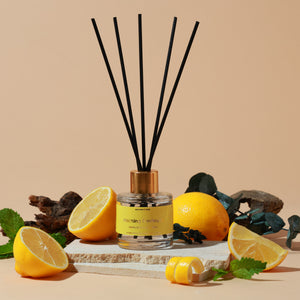
 Morning Freshness₹749The same emission spread through more air is a lower concentration everywhere in that air. This is the term that people do account for, and they still usually get it wrong, because they compare floor areas while the physics uses cubic metres. Bathrooms have the lowest ceilings in most flats; living rooms frequently have the highest, and open-plan rooms have no boundary at all on one side. A bottle is specified against a room, which is why our own sizing is written that way: a 50ml suits rooms up to about 150 sq ft, a 130ml above that. The 130ml is not a stronger bottle. It is the same oil, running 14–18 weeks instead of 6–8, in a room that will empty it faster.
 Evening Calm₹799This is the term that most often explains a difference people find inexplicable, and it is invisible, which is why it goes unexamined. Fragrance builds up in a room only while the room retains its air. Every opening is a loss: a door onto a hall, a window on the latch, a balcony, a bathroom extract, cross-ventilation between two openings on opposite walls, which behaves like a straight line through the room and takes everything on that line with it. A room on a high floor turns its air over more readily than the same room at street level, because wind speed rises with height. None of this makes the bottle weaker. All of it makes the room emptier. Nothing here is a percentage or a rate I can quote you honestly — reason about it qualitatively and change one opening at a time.
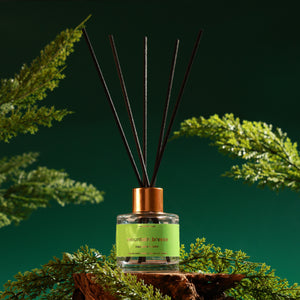
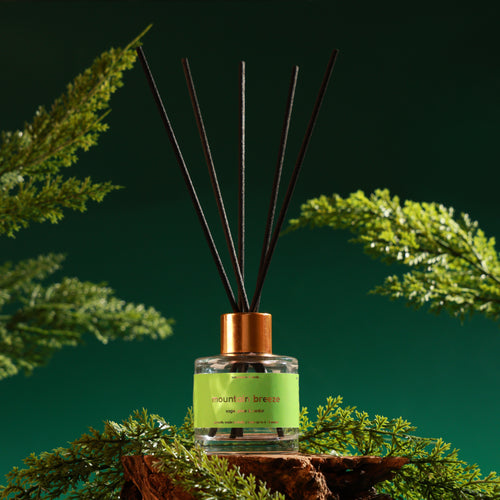
 Mountain Breeze₹849Distance is the free one. A point source produces a gradient, so the answer to "how strong is this room" depends on where in the room you asked. Two people in the same room at the same moment get different answers, and neither is wrong. Then there is the weather, which quietly changes the numerator: heat speeds evaporation, so a bottle in a hot room emits more and empties sooner, while saturated monsoon air carries fragrance less readily, so projection shortens and the scent hangs close to the source. A bottle can therefore smell different in June and January without anything having changed in the bottle — a different evaporation curve, not a different oil. What heat must never do is change the smell itself, which is why every SOSA reed sits on a heat-stable CCT carrier rather than DPG, which can crack and go bitter above 40°C.
Why two rooms differ by more than their size difference
If the only difference between your two rooms were floor area, the effect would be modest and predictable. It rarely is. The rooms that differ in size almost always differ in the other terms too, and in the same direction, which is why the change feels dramatic. Small rooms tend to be contained rooms, and contained rooms tend to be rooms you stand close to everything in. A bathroom is small, has one door that stays shut, usually has no balcony and no ceiling fan, and is too tight to let you leave the fragrant zone. A living room is large, often opens onto a dining area or a balcony, has a fan running, and seats you across the room from wherever the bottle is. Every term moves the wrong way at once.
This is the answer to a question I am asked constantly, which is why the bathroom feels so much more than three times as fragrant as a bedroom three times its size. It is not that the arithmetic is wrong. It is that only one of three or four multiplied terms was being counted. And it explains why the fixes that work are the ones that address the neglected terms rather than the counted one: closing a door improves exchange, moving the bottle improves distance, and a fan on low substitutes for the transport a passive source does not have. Adding reeds, buying a larger bottle or choosing a stronger scent all push on the one term that was never the problem.
Since we are on the subject of the wrong lever, our own range contains the clearest illustration I know of, and I would rather point at it than pretend it is not there. Megh at ₹3,499 has a six-litre tank and about a hundred hours of runtime, and covers only around 215 sq ft — less than the ₹1,899 Sukoon's 270–320. Six litres against half a litre, and the smaller machine covers more room. Tank size is runtime. It has never been reach, in a machine or in a bottle, and the same sentence applies to a 130ml reed: more weeks, not more metres.
Diagnosing your own two rooms
Take the room where the bottle performs and the room where it does not, and score them on each line. The row where they differ most is your answer, and the right-hand column tells you what that particular difference costs to fix.
| Term | What to look at | The room that wins | What it costs to change |
|---|---|---|---|
| Emission — the product | Same oil, same reed count, same flip cadence? | Neither. It is identical, which is the point | Nothing to change. The bottle is not the variable |
| Volume | Floor area and ceiling height, plus any space with no door between | The smaller, lower, more separated room | Cannot be changed. Choose the room, or the mechanism |
| Air exchange | Door, window, balcony, extract fan, cross-ventilation, floor level | The room that is kept shut | Free, tonight. The largest free lever there is |
| Your distance | Metres from the reeds to where you sit, and the height it sits at | The room where you are always within a metre or two | Free, in one minute. Halve it and reassess |
| Temperature and humidity | Hot room, running AC, monsoon air, direct sun on the bottle | Neither reliably — heat gives more output and a shorter bottle | Free to manage: keep it out of direct sun and out of the AC blast |
| Transport | Is any air actually moving through the fragrant zone? | The room with a ceiling fan on low and the door shut | Free if you have a fan. Otherwise this is what a machine sells |
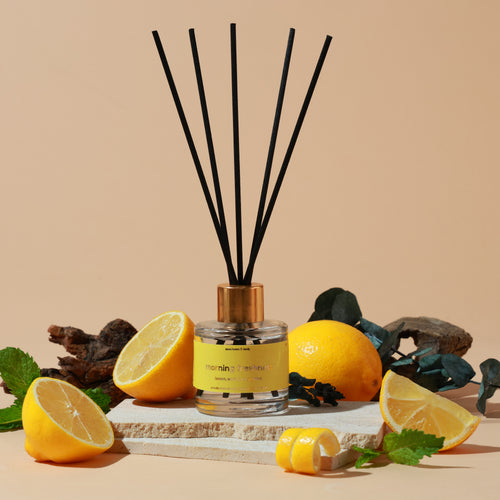 Up to ~150 sq ft · 50ml₹749Shop →
 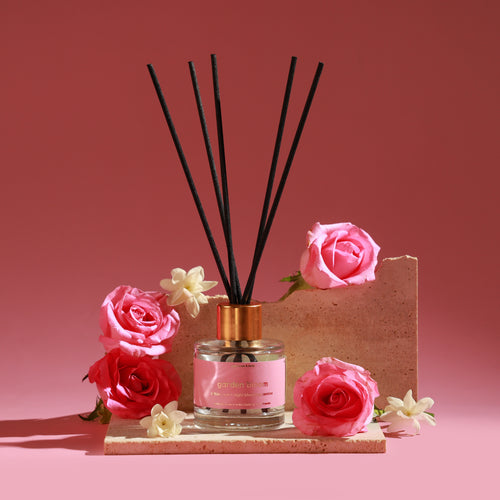 Above 150 sq ft · 130ml₹1,299Shop →
  Moves air · Sukoon₹1,899Shop →
The fifth variable, which is not in the room at all
There is one more reason two rooms report differently and it has nothing to do with air. It is you. Olfactory receptors adapt to a constant stimulus within minutes: the molecules keep arriving and the brain stops passing the message on. The room you spend four hours a day in is the room you are most adapted to, and it will therefore always under-report. The room you enter briefly — a bathroom, a guest room, a hall — is a room you keep crossing the gradient into, and the nose reports change far better than it reports steady state, so those rooms over-report by comparison. Part of the gap you are trying to explain is measurement rather than physics, and it is worth separating the two before you spend money on the physics.
The diagnostic costs nothing. Leave the disappointing room for fifteen minutes and walk back in; if it greets you at the door, the room was working and you had simply stopped noticing. Better still, ask someone who does not live there. A visitor is a far better instrument than a resident, and if guests remark on a scent you cannot detect, the product is working for everybody including you. This also disposes of the most common private worry in this whole subject, which people are shy about raising: did I get a weak bottle? Very occasionally something is genuinely wrong and we replace it without argument. Far more often the same bottle is performing correctly in one room in the same house — and if it is, you have already run the control experiment, and the oil has passed it.
While we are being even-handed, the reed deserves the other half of the ledger, since this page has been a long account of what the room does to it. It is silent, with nothing that hums or clicks. It uses no power, so it keeps working through a power cut. There is nothing to fill, charge, clean or remember, and it was working while you were out. It costs roughly ₹13–₹15 a day, it is an object rather than an appliance, and it has no service life: a machine can fail, and a glass bottle with fibre reeds in it cannot. What it cannot do is move air, and evenness across a large room is a property of moved air. That is the whole trade, stated in one sentence.
What to change, in order of what it costs
The order matters more than the list. Everything free comes before everything paid, and the free items are not a warm-up act — they resolve this question for a large share of the people who ask it, which is precisely why they belong at the top rather than buried under a recommendation.
| Change | What it does | When it is the right answer | Price |
|---|---|---|---|
| 1. Containment, dose, distance, fan ★ | Close the door, six reeds not three, bottle nearer at nose height, out of the draught, ceiling fan on low | Always first. These address air exchange, dose, distance and transport — three of the four terms — and cost nothing | ₹0 |
| 2. A 50ml sized to the room | Six fibre reeds, 6–8 weeks, built for rooms up to about 150 sq ft, roughly ₹13–₹15 a day | For a bedroom, bathroom or home office. Two or three reeds in a 50 sq ft bathroom stretches it to close to three months | ₹749–₹849 |
| 3. A 130ml for the larger room | 14–18 weeks instead of 6–8, for about ₹500 more | Above 150 sq ft, and only for the weeks. Per week it is better value; in a 120 sq ft bedroom it is over-specified | ₹1,249–₹1,349 |
| 4. Sukoon, or Boond for a smaller room | Ultrasonic: 500ml, 270–320 sq ft, 16–18h on low, three 15ml scents included. Boond ₹899 is 300ml, up to about 150 sq ft, ~6h | When evenness across a room is the actual requirement. Water-diluted, adds humidity, needs filling, and will not run reed oil | ₹899 / ₹1,899 |
| Not this: a bigger tank or bottle for reach | Megh ₹3,499 has six litres and ~100 hours of runtime, and covers only ~215 sq ft — less than the ₹1,899 Sukoon's 270–320 | Right for long unattended runtime and for humidity. Wrong, always, as a coverage upgrade | ₹3,499 |
| The honest gap: no mid-sized waterless machine | Safar ₹3,999 diffuses undiluted oil without water, cordless, three speeds, a 1 / 2 / 3-hour timer — and it is named and sold as a car and travel diffuser. Vaayu ₹11,999 is 1000 m³, roughly 2,000–3,000 sq ft | Nothing sits between them for one room. Vaayu wastes most of its capacity in a bedroom, and Safar is not set-and-forget — the timer runs hours and it needs recharging | — |
Versailles
Perfumery school teaches you to think about a fragrance as a composition — what is in it, how the materials behave over time, what survives the eighth week. It does not teach you that the customer's experience of your work will be decided almost entirely by a building you will never see. That was the most useful and least glamorous thing I learned after starting SOSA. The same bottle, honestly made, arrives in a sealed 90 sq ft Mumbai bedroom and in a 400 sq ft Gurugram living room with a balcony, and produces two experiences that would not obviously be the same product.
Which is why I would rather a page like this teach the four terms than recommend anything. If you know that strength is emission over volume, reduced by exchange, read at a distance, you will never again be sold a larger bottle to solve a larger room — and you will also stop suspecting your own bottle when it behaves differently between rooms. It is behaving exactly as a passive source must.
One material note, because it is the part of the work that never shows. India is the hard case for this category, not the easy one: 40°C afternoons, monsoon air at 85% humidity, and rooms that are sealed and air-conditioned at night and wide open by day. That is why every SOSA reed sits on a heat-stable CCT carrier rather than DPG, which can crack and turn bitter in an ordinary May here, and why the reeds are fibre rather than rattan, since rattan wicks unevenly in high humidity and fades at the dry end. Neither shows up in a note list. Both are the reason the bottle you like still smells like itself in whichever of your rooms it ends up in. Everything is composed in Pune, and a part of every order funds a girl's classroom through Nanhi Kali.
Frequently asked questions
- It fills the bathroom but barely works in the bedroom — the head question, answered in three parts.
- Powerful in the bathroom, weak in the living room — the largest gap in the flat.
- Why reeds seem stronger in small closed spaces — the underlying principle.
- Amazing at 60 sq ft, gone at 150 — nothing about the product changed.
- Does the bathroom prove the fragrance is not weak? — yes, said as strongly as it deserves.
- Moving it to the bathroom made it strong again — the experiment run backwards.
- Does a reed need a small enclosed room? — powerful and pleasant are different specifications.
- Bathroom vs bedroom vs living room — the three-way comparison with real sizing.
- My diffuser isn't bad — is my bedroom asking more of it? — the pillar of this family.
- Brand: the SOSA founder story.
SOSA facts verified August 2026: Reed diffusers are supplied in 50ml and 130ml only — 50ml suits rooms up to about 150 sq ft and lasts 6–8 weeks, 130ml suits rooms above 150 sq ft and lasts 14–18 weeks, at roughly ₹13–₹15 a day. Six reeds is full projection; three is a soft bedside level and roughly doubles the life; two or three reeds in a 50 sq ft bathroom can make a 50ml last nearly three months; flip the reeds every 3–5 days. Morning Freshness ₹749 / ₹1,249 · Evening Calm ₹799 / ₹1,299 · Garden Bloom ₹799 / ₹1,299 · Mountain Breeze ₹849 / ₹1,349 · Fresh Brew ₹849 / ₹1,349. Strength scale, perceived intensity rather than quality: Evening Calm 8.9 softest, Garden Bloom 8.9, Morning Freshness 9.0, Mountain Breeze 9.4, Fresh Brew 9.5 deepest. Morning Freshness uses a eucalyptus globulus base that slows lemon evaporation three to four times; Garden Bloom holds indole below the fecal threshold so jasmine stays floral above 30°C. Six fibre reeds rather than rattan, heat-stable CCT carrier rather than DPG, alcohol-free, phthalate-free, paraben-free, IFRA-compliant, 0 ppm formaldehyde, refillable glass bottle, tested at 45°C and 85% RH, composed in Pune. Refills 300ml ₹2,399 and 500ml ₹3,499, oil only. Machines: Boond ₹899 (300ml, up to about 150 sq ft, ~6h, USB, night light) · Sukoon ₹1,899 (500ml, 270–320 sq ft, 16–18h on low) · Megh ₹3,499 (6L, ~100h runtime but only ~215 sq ft) · Safar ₹3,999, a waterless cold-diffusion device named and sold as a car and travel perfume diffuser, with a 1 / 2 / 3-hour timer and a rechargeable battery · Vaayu ₹11,999, rated to 1000 m³, roughly 2,000–3,000 sq ft and the wrong purchase for one bedroom. No coverage figure is published for Safar and none is quoted here. Hotel Collection oils are water-based and for ultrasonic machines only; reed oil cannot be used in them. No health, air-quality, allergy, sleep or mood claims are made anywhere on this page. Free shipping above ₹499. SOSA is an independent Indian fragrance house; the Hotel Collection is SOSA's own interpretation inspired by the world's finest hotels and SOSA is not affiliated with or endorsed by any hotel brand. Prices subject to change — see the live product pages.