

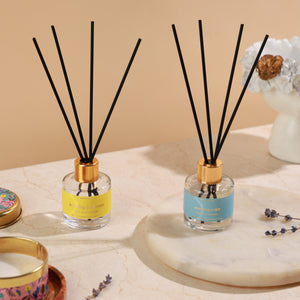



The list: 130ml Mountain Breeze ₹1,349 at the entrance end on six reeds · 50ml Mountain Breeze ₹849 at the sleeping alcove on three reeds · 50ml Morning Freshness ₹749 in the bathroom on two.
The total: ₹1,349 + ₹849 + ₹749 = ₹2,947.
Not buying: anything for the kitchenette, anything for the balcony, and no third point in the open volume.
2. The reason for the second bottle is shape, not floor area. A second bottle in one volume never widens the circle; it adds a second point of origin. That is only worth ₹849 when the volume has a shape one point cannot anchor — an L, a blind leg, a double-height ceiling, or a straight run over about 22 to 24 feet. This flat runs about 26 ft from the front door to the far wall of the sleeping alcove. That is past the threshold, and it is why the answer is two rather than one.
3. Both open-volume bottles must be the same scent. This is the instruction that gets missed. Fragrance treats an absent door as an absent wall, so the entrance blend and the bedside blend are not in separate rooms — they are two sources charging the same 3,465 cubic feet of air. Two different blends do not produce two moods; they produce one indistinct third thing that smells like neither. Buy a 130ml and a 50ml of the same scent — here, Mountain Breeze at ₹1,349 and ₹849 — and make the two ends behave differently using reeds instead.
4. Use six reeds at the entrance and three at the bed. Reed count is the only volume control a reed diffuser has, and in a doorless flat it is also the only way to vary anything from one end to the other. Six reeds at the entrance, because that end is met by people arriving from outside and because the bottle there is anchoring the largest part of the volume. Three at the sleeping alcove, because you are lying two feet from it for eight hours and because you do not want a second full-strength source in a space one already reaches.
5. The bathroom is the only place a second scent is allowed — and the reason is the door. At 35 sq ft behind the one internal door in the flat, the bathroom is genuinely separate air. It can run Morning Freshness at ₹749 on two reeds without touching the Mountain Breeze outside, and the change as you open that door is a pleasant thing rather than a muddle. Running total: ₹1,349 + ₹849 + ₹749 = ₹2,947. Nothing for the kitchenette, nothing for the balcony, no third point.
Made in India, composed by an ISIPCA Versailles-trained perfumer — and a portion of every order supports girl-child education through Nanhi Kali.
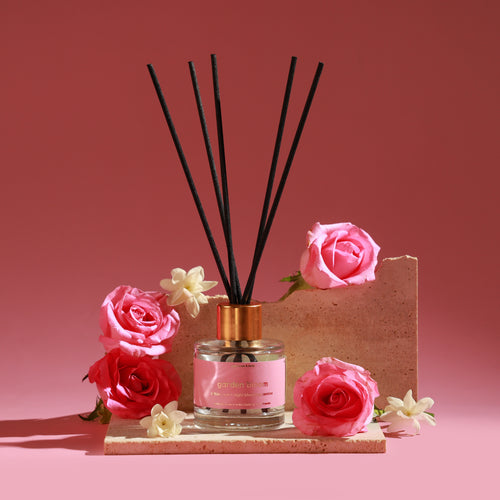
Counting a flat with no internal doors — positions, not rooms
This flat is 500 sq ft on paper and one room in practice. About 385 sq ft of it is continuous: a 25 sq ft entrance, a 55 sq ft kitchenette along one wall, a 175 sq ft living-dining and a 130 sq ft sleeping alcove, with nothing but furniture and a change of flooring between them. Behind the only internal door there is a 35 sq ft bathroom, and outside there is a 30 sq ft balcony. Two air spaces. Every counting rule that works elsewhere in this cluster — one bottle per room, count the doors, add up the bedrooms — collapses here into a single question: where in this one volume do you want a source, and how many sources does the shape justify?
The honest arithmetic first. At a nine-foot ceiling, 385 sq ft is roughly 3,465 cubic feet, against the roughly 1,350 that a reed diffuser on six reeds is rated to hold in closed, still air — about two and a half times as much air as one bottle is measured against. But that comparison is not why you buy a second bottle, and it is important to be clear about it, because a second bottle does not multiply coverage. It gives you a second place for fragrance to start from. The question is therefore geometric: is there any part of this volume that one source cannot reasonably anchor? Here, yes — the long axis runs about 26 ft, past the 22 to 24 feet at which the answer changes, and the two ends of that axis are used at opposite times of day by a person standing in completely different places. A second, smaller bottle at the sleeping end is buying a position, and it is worth ₹849. A third would not be buying anything at all. There is also a fact about doorless flats worth knowing before you spend: with no internal doors there is nothing to contain fragrance anywhere, and equally nothing to contain ventilation. Open the balcony door and the entire home ventilates at once — in a flat with rooms you could at least shut a bedroom.
The three decisions in an undivided flat
 Two positions₹2,198Position one is the entrance, at about chest height on whatever stands nearest the front door. It does two jobs: it is the first breath anyone takes on arriving, and it anchors the living-dining half of the volume. Position two is the sleeping alcove, on a shelf or chest rather than a bedside table. It exists because the far end of a 26 ft run is a long way from one source, and because the flat is used from that end for eight hours a night. A third point — usually proposed for the kitchenette — buys nothing. It sits in the middle of a volume already reached from both ends, it stands next to a hob where heat empties a bottle fast, and no passive source competes with a working kitchen anyway.
Every space in this flat, priced
The whole 500 sq ft, position by position rather than room by room. Three rows come to ₹0, and the three that do not add up to ₹2,947.
| Space | What it needs | How many | Cost |
|---|---|---|---|
| Entrance end of the open volume, anchoring the living-dining ★ | One 130ml on six reeds — the first breath on arriving and the anchor for the larger half of 385 sq ft | One | ₹1,349 |
| Sleeping alcove, far end of a 26 ft run | One 50ml on three reeds, same scent as the entrance bottle — a second position, not a second fragrance | One | ₹849 |
| Bathroom, about 35 sq ft, the only door in the flat | One 50ml on two reeds — genuinely separate air, and the only place a different scent belongs | One | ₹749 |
| The kitchenette, about 55 sq ft, inside the open volume | Nothing. Not a separate space, already reached from both ends, and heat beside a hob empties a bottle in weeks | None | ₹0 |
| A third point anywhere in the open volume | Nothing. Two positions already cover a 26 ft run from both ends. A third is a third origin in air that is already served | None | ₹0 |
| The balcony, about 30 sq ft | Nothing. Outdoors — and in this flat opening it ventilates the entire home at once, because there are no doors to shut | None | ₹0 |
| A note on all of the above: the coverage figures behind every row are steady-state — six reeds, closed, still air, standard ceiling. A doorless flat is the hardest place in this cluster to hold that condition, because you cannot isolate anything: one open window ventilates all 385 sq ft at once, and cross-ventilation takes a home from roughly 0.2–0.5 air changes an hour to three or eight. No passive bottle charges air that is being replaced eight times an hour, and no number of bottles fixes it. Close the balcony door an hour before you want the flat to read. | |||
One room · the unitFrom ₹749Shop → 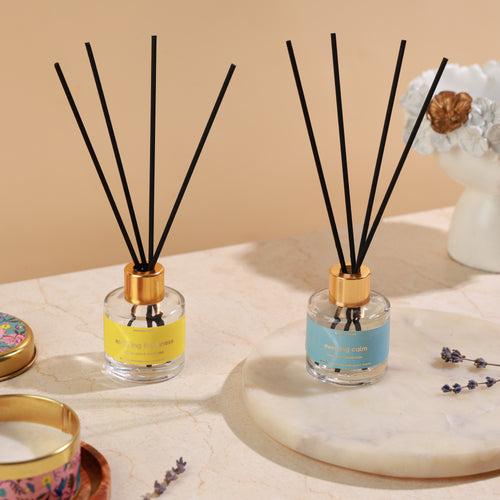 Two rooms · better value₹1,498Shop →
  Large room · a switch₹1,899Shop →
Reeds, positions and the one-scent rule
Six reeds at the entrance, three at the bed, two in the bathroom — and treat that as the only volume control you have. In a flat with rooms you can vary the mood by giving each room a different blend. Here you cannot, so reed count does all of that work. Six reeds by the front door because that bottle anchors the larger half of 385 sq ft and is met by people arriving from outside. Three at the sleeping alcove because you are lying a couple of feet from it for eight hours, and because it is a second source in a volume already reached from the other end — running it at full strength there is both unpleasant at night and expensive. Two in the bathroom, where 35 sq ft on three would be a shop counter. Fit them, then leave the flat alone for forty-eight hours: reeds must saturate along their whole length before they throw properly, and a first-evening verdict is meaningless.
Then the positions, which in a doorless flat carry the whole argument. The entrance bottle goes at about chest height on the first surface inside the door, on the side away from the swing, and out of the straight line to the balcony — that line is the flat's only real draught and a bottle standing in it empties quickly and pushes everything outside. The alcove bottle goes on a shelf or chest at least a metre from the pillow, never on a bedside table where a sleeve will find it. Keep both out of the kitchenette end: heat accelerates evaporation, so a bottle within a metre of a working hob will not see eight weeks. The bathroom bottle goes on the cistern, away from shower spray. All three stand on a tray or coaster, because reed oil marks a polished finish permanently and in a 500 sq ft flat every surface is a walkway. Keep all three out of reach of children and pets.
Then hold the one-scent rule when you reorder, because that is when it usually breaks. The 50ml at the alcove runs six to eight weeks on six reeds and past ten on three; the 130ml at the entrance runs 14–18. They will therefore finish at different times, and the temptation at each reorder is to try something new in the bottle that is empty. In a flat with doors that is a good instinct. Here it puts two blends into one volume of air. If you want to change scent, change both bottles at the same time — which is easiest if you let the small one run down and switch the pair together. When the 130ml finishes, a 300ml refill at ₹2,399 fills it roughly twice and is also the moment to fit fresh reeds from the spares in your boxes, since clogged fibre is the commonest reason throw drops after a few months. And remember the reed oil is for reed bottles only — it never goes in a machine, and Hotel Collection never goes in a reed bottle.
What to buy
The three starred purchases below are this flat. The machine row is priced with the fragrance it needs rather than at its sticker, because a Sukoon with nothing in it does nothing.
| Buy | What it covers | Lasts | Price |
|---|---|---|---|
| One 50ml | A single reed diffuser — the sleeping alcove on three reeds and the bathroom on two — ₹849 and ₹749, and the alcove one must match the entrance scent | 6–8 weeks | from ₹749 |
| One 130ml ★ | The value size — the entrance end on six reeds — ₹1,349, the bottle doing most of the work in 385 sq ft | 14–18 weeks | from ₹1,249 |
| The duo | Day & Night duo — two rooms in most homes — but not this one, because two scents in one undivided volume become one muddle | 6–8 weeks each | ₹1,498 |
| Sukoon | 500ml ultrasonic — the open volume as a switchable alternative — ₹1,899 plus ₹299 of fragrance is ₹2,198, the same as the two reed bottles it replaces | Runs when you switch it on | ₹1,899 |
| 300ml refill | The running cost — the entrance 130ml from week fifteen — and the moment to change scent in both open-volume bottles together | Roughly 2 × 130ml fills | ₹2,399 |
Versailles
The count in a flat like this is easy and nobody gets it wrong: one door, two air spaces. What people get wrong is the scent. I have lost count of the times somebody has told me they bought lavender for the bed end and lemon for the door end of a studio and that it smells strange. Of course it does. There is no wall between them. Those two bottles are charging the same air from opposite ends.
So buy one blend twice, in two sizes, and use reeds to make the ends behave differently. Six by the door, three by the bed. It costs nothing to change, you can adjust it any evening, and it does everything a second fragrance was supposed to do without the muddle. Pick something dry rather than sweet — you cook and sleep in the same air, and a sweet blend that is lovely in a living room becomes very tiring at two in the morning.
The bathroom is your one indulgence, and it is a real one: a door makes it genuinely separate, so it can be a different scent entirely, and at 35 square feet a ₹749 bottle owns it completely rather than being stretched across it. Three bottles, ₹2,947, and nothing for the kitchenette, the balcony or a third position. If you were about to buy five, I would rather you spent the difference on refills and kept the flat running all year. A portion of every order funds a girl's classroom through Nanhi Kali.
Frequently asked questions
- A home with no internal doors — the general counting case.
- How many for a 300 sq ft studio — positions inside one volume.
- Two scents or two of the same? — when doors decide it.
- The complete sizing and quantity guide — every home type, three builds.
- Brand: the SOSA founder story.
SOSA products & prices (verified August 2026): Hotel Collection water-based ultrasonic diffuser fragrance 15ml ₹299 · 100ml ₹999 · 300ml ₹1,799 · Pack of 7 (15ml, all fragrances) ₹1,799; refills 100ml from ₹999. Seven scents: The Ritz-Carlton-inspired (white tea · bergamot · cedar), Westin-inspired (white tea · aloe · cedar), 1 Hotels-inspired (cedarwood · vetiver · green leaves), The St. Regis-inspired (amber · violet · woods), Shangri-La-inspired (jasmine · green tea · white tea), Four Seasons-inspired (citrus · floral · sandalwood), W Hotels-inspired (citrus · pepper · amber). Diffusers: Boond 300ml ₹899 · Sukoon 500ml ₹1,899 · Megh 6L ₹3,499. Water-based, phthalate-free, composed to IFRA standards for home diffusion; 3–6 drops per tank. Made in India, Pune. The Hotel Collection scents are SOSA's own interpretations inspired by the world's finest hotels; all hotel names are trademarks of their respective owners and are used only to describe the scent style — SOSA is an independent Indian fragrance house, not affiliated with or endorsed by any hotel brand. Prices and availability subject to change — see the live product pages.