

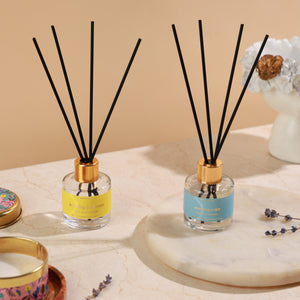

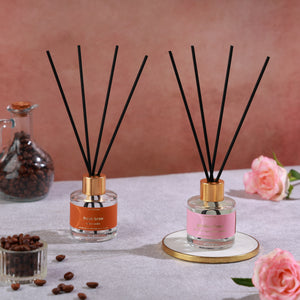

What it costs: ₹3,247 for two 130ml and a 50ml, or ₹2,747 if the second end takes a 50ml rather than a 130ml.
The non-negotiable: one blend everywhere. With no doors, two fragrances do not make two zones — they make a third smell, in the middle of the flat, that nobody chose.
2. Give the bathroom its own bottle, because it is the only door you have. In almost every doorless flat the bathroom is the single enclosed volume in the home, which makes it the one room that behaves the way coverage figures assume — closed, still, small. At 30–45 sq ft it is also the cheapest space in the house to hold at full presence. A 50ml at ₹749 on two or three reeds is the best-value bottle you will buy for this flat, and it is the room a guest will be alone in.
3. One blend everywhere, without exception. This matters more in a doorless home than anywhere else. Two fragrances in a continuous volume do not divide it into moods — they meet across the middle and produce something neither of them was composed to be. The bathroom can be a partial exception because it has a door, but even there most people are happier running the same blend, because the door is open more often than not and the flat reads as one impression to anyone arriving.
4. Six reeds in each, not four. Reed count is the only volume control a reed diffuser has, and this is a home where the volume genuinely needs it. A doorless flat has nothing to hold air locally: what one source produces disperses into the whole space rather than saturating a room. Run six. The trade is real — more reeds means a shorter bottle as well as a stronger space — but four reeds in an open 600 sq ft flat reads as nothing at all, and a bottle nobody can smell is the most expensive one you can own.
5. Buy nothing for the alcove, the passage strip or the kitchen counter. These are the three purchases people make in doorless homes and regret. A sleeping alcove sits inside air that is already charged from eight feet away. An entry strip is transit space of seconds. A kitchen counter is downstream of an exhaust hood, and while you are cooking, no passive bottle is going to be the dominant smell in the flat. Each of those is ₹749 better kept.
Made in India, composed by an ISIPCA Versailles-trained perfumer — and a portion of every order supports girl-child education through Nanhi Kali.
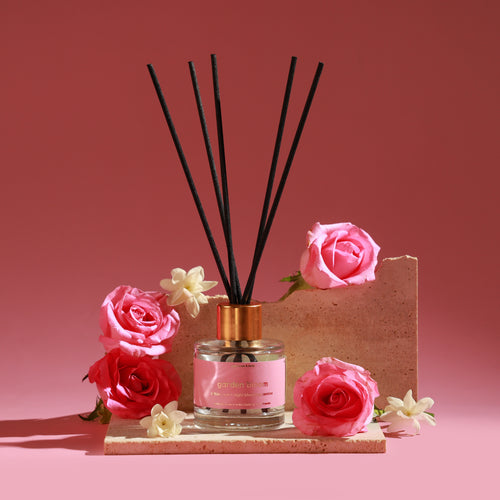
One air space — what disappears when the doors do
Count doors, not square feet. It is the most useful rule in this cluster, and a doorless home is the case that proves it in both directions. A 900 sq ft flat with five closed doors is five separate air pockets: each one has to be decided on its own, and each one holds what you put in it because nothing carries it away. Take the doors out and the same 900 sq ft becomes one continuous volume. That halves the number of decisions and, usually, the number of bottles — you stop buying per room. But it also removes the thing that made a single bottle effective in the first place, which is enclosure.
A reed diffuser is passive: fragrance climbs the fibre by capillary action, evaporates from the exposed tip, and the room's own gentle movement distributes it. The rated coverage of up to about 150 sq ft on six reeds describes an equilibrium reached in a closed, still room at standard height — roughly 1,350 cubic feet held because nothing is taking it out. In a doorless flat there is no equilibrium of that kind anywhere. What one bottle produces drifts across the whole volume and thins as it goes, and a flat like this typically has a main door at one end and a balcony at the other, so the air is changing faster too — perhaps three to eight times an hour with the balcony open, against 0.2 to 0.5 in a closed bedroom. This is why the answer is fewer bottles running harder, not more bottles running softly. Two sources on six reeds at the two ends beat four sources on three reeds scattered around, because the scattered version never reaches a level anybody notices anywhere.
The three decisions for a doorless home
 Two bottles₹2,498Walk the longest line you can walk inside the flat without turning — front door to balcony in most cases — and put one source near each end of it, on an inside wall rather than in the middle of the draught. Add the bathroom bottle and you are done. A third reed diffuser in the middle of a doorless flat is the purchase with the least to show for it, because the middle is already receiving from both ends. If the flat runs past about 900 sq ft, the honest upgrade is a Sukoon at the living end rather than a fourth bottle.
Sizing by space — doorless flats, end to end
Measure the longest straight walk in your flat first. Two rows here tell you to buy nothing, and both of them are purchases people commonly make.
| Space | What it needs | How many | Cost |
|---|---|---|---|
| 600 sq ft flat, no internal doors except the bathroom ★ | Two sources at the ends of the longest path, six reeds each, plus a 50ml in the bath | Three | ₹3,247 or ₹2,747 |
| Studio or 1RK under about 450 sq ft, no doors | One 130ml roughly central on six reeds, plus a 50ml in the bathroom | Two | ₹1,998 |
| The sleeping alcove or bed platform | Nothing. It sits inside air the nearest bottle is already charging | None | ₹0 |
| The kitchen counter in an open flat | Nothing. Cooking outranks it and the exhaust removes it — ventilate instead | None | ₹0 |
| The bathroom — the only closed volume in the home | A 50ml on two or three reeds, where fewer reeds stretch it past its stated 6–8 weeks | One | from ₹749 |
| Doorless home over about 900 sq ft | A Sukoon at the living end, one bottle at the far end, one in the bath | One machine, two bottles | ₹3,897 |
| A note on all of the above: these figures assume a standard ceiling and reasonably still air, which a doorless flat with the balcony open is not. Expect real coverage to sit under the rated numbers, and answer that with six reeds and better placement rather than with a fourth bottle. | |||
One room · the unitFrom ₹749Shop → 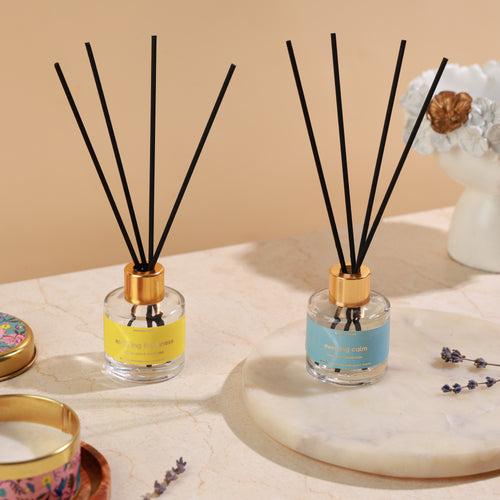 Two rooms · better value₹1,498Shop →
  Large room · a switch₹1,899Shop →
Placement, reeds and the single-blend rule
Six reeds in every bottle except the bathroom, and place them on inside walls. Reed count is the only volume dial you have, and it moves both ways at once: six reeds means a stronger space and a shorter bottle. In a 100 sq ft closed bedroom we tell people to take two out. In a doorless flat you leave all six in, because the air is continuous and anything gentler simply disperses. Keep both bottles off the straight line between the front door and the balcony — that line is where the air moves fastest, and a passive source standing in it is being emptied outdoors. Table or console height beside where people sit beats a high shelf, since fragrance in warm air drifts upward and the useful zone is the bottom two metres.
Give it forty-eight hours, then judge it from the front door. Reeds have to saturate along their whole length before they throw properly, so nothing you conclude on the first day is worth acting on. After two days, leave the flat for half an hour and take the first breath on returning — in a doorless home this matters more than anywhere, because you are adapted to the whole flat rather than to one room, and there is no second air space you can step into to reset your nose. If the far end reads flat after that, add a reed there before you add a bottle. Going from four reeds to six is free; a second 130ml is ₹1,249.
Then buy one blend twice and refill rather than rebuy. A doorless flat consumes more quickly than a doored one — more air, more movement, six reeds — so the running cost is the part worth planning. A 130ml at ₹1,249 gives 14–18 weeks at about ₹78 a week against the 50ml's ₹105, and a 300ml refill at ₹2,399 fills a 130ml roughly twice, which carries both main bottles through a cycle for less than replacing them. Refilling is also when you fit fresh reeds — clogged fibre is the usual reason a flat that smelled right in month one reads flat in month four. For a house blend, Mountain Breeze and Morning Freshness are the two that stay pleasant at the volume a doorless home needs.
What to buy
Three lines cover a doorless flat: two large bottles of one blend and a small one for the bathroom. Here is what each option in the range is actually for.
| Buy | What it covers | Lasts | Price |
|---|---|---|---|
| One 50ml | A single reed diffuser — the bathroom — the only closed room in the flat, on two or three reeds | 6–8 weeks | from ₹749 |
| One 130ml ★ | The value size — each end of the main space, on six reeds — 14–18 weeks at about ₹78 a week | 14–18 weeks | from ₹1,249 |
| The duo | Day & Night duo — two rooms behind two doors — which is precisely what this home does not have | 6–8 weeks each | ₹1,498 |
| Sukoon | 500ml ultrasonic — a doorless home past about 900 sq ft, where passive diffusion cannot hold the volume | Runs when you switch it on | ₹1,899 |
| 300ml refill | The running cost — keeping two six-reed bottles going without buying the glass again every cycle | Roughly 2 × 130ml fills | ₹2,399 |
Versailles
Doorless homes are the ones where people most often arrive with a list of five bottles, one per room on the plan, and leave with three. The plan is not the air. If there is no door between the bedroom and the living room, they are the same air space, and buying separately for each is buying the same space twice.
The mistake that actually spoils these flats, though, is two scents. Somebody puts lavender by the bed and lemon by the sofa, and in the middle of the flat — which is where the dining table usually is — you get neither. You will not notice it, because after twenty minutes your nose has stopped reporting. Everyone who walks in notices immediately. One blend, bought twice.
And do give the bathroom its own small bottle. In a home with no doors it is the only room that can hold its own air, it costs ₹749, it runs longer than the label says because you are using two reeds, and it is the room your guests are alone in. Nothing for the alcove, nothing for the kitchen counter, nothing for the entry strip. A portion of every order funds a girl's classroom through Nanhi Kali.
Frequently asked questions
- When every door stays open — the doors you have, unused.
- An open-plan living-dining-kitchen — counting length, not area.
- Homes with strong cross-ventilation — why the answer there is fewer.
- The complete sizing and quantity guide — every home type, three builds.
- Brand: the SOSA founder story.
SOSA products & prices (verified August 2026): Hotel Collection water-based ultrasonic diffuser fragrance 15ml ₹299 · 100ml ₹999 · 300ml ₹1,799 · Pack of 7 (15ml, all fragrances) ₹1,799; refills 100ml from ₹999. Seven scents: The Ritz-Carlton-inspired (white tea · bergamot · cedar), Westin-inspired (white tea · aloe · cedar), 1 Hotels-inspired (cedarwood · vetiver · green leaves), The St. Regis-inspired (amber · violet · woods), Shangri-La-inspired (jasmine · green tea · white tea), Four Seasons-inspired (citrus · floral · sandalwood), W Hotels-inspired (citrus · pepper · amber). Diffusers: Boond 300ml ₹899 · Sukoon 500ml ₹1,899 · Megh 6L ₹3,499. Water-based, phthalate-free, composed to IFRA standards for home diffusion; 3–6 drops per tank. Made in India, Pune. The Hotel Collection scents are SOSA's own interpretations inspired by the world's finest hotels; all hotel names are trademarks of their respective owners and are used only to describe the scent style — SOSA is an independent Indian fragrance house, not affiliated with or endorsed by any hotel brand. Prices and availability subject to change — see the live product pages.