

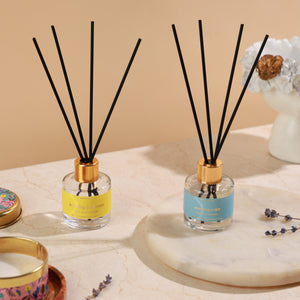

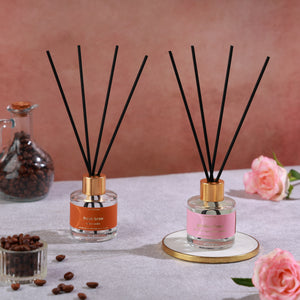

Reeds route: two 130ml at ₹2,498, plus a 50ml for the bathroom at ₹749 — ₹3,247.
Machine route: a Sukoon at ₹1,899 (rated to about 270–320 sq ft) plus a 15ml scent at ₹299 and the bathroom 50ml at ₹749 — ₹2,947.
2. The second bottle is buying distance, not strength. A 300 sq ft studio is commonly around fifteen by twenty feet, which gives a diagonal of about twenty-five feet. Past roughly twenty-two to twenty-four feet a single passive source cannot hold the far end at a useful level, whatever size bottle it is. So the two bottles go as far apart as the layout allows — one near the entrance, one at the far end near the bed — and never side by side on the same shelf.
3. Or buy one Sukoon at ₹1,899 and be done. The Sukoon is a 500ml ultrasonic diffuser rated to about 270–320 sq ft, which is a 300 sq ft studio almost exactly. It covers the whole volume from one position and it has a switch, which matters more in a studio than anywhere else: you cook, sleep and work in the same air, and there are evenings when you want none of this at all. It runs the water-based Hotel Collection at 3 to 6 drops a tank, so a 15ml at ₹299 lasts a long time.
4. Add a 50ml for the bathroom, on two or three reeds. The bathroom is the only air space in a studio that closes, and closed spaces get nothing from a bottle outside them. At 30 to 45 sq ft it wants the small bottle at ₹749, not a share of the main-room budget. That takes the reeds route to ₹3,247 and the machine route to ₹2,947.
5. Buy nothing for the kitchen zone. An open kitchen in a studio is not a separate space to be solved — it is the same air the sofa is in, and a third bottle standing next to the hob adds nothing the other two are not already doing. It also will not help with cooking smells; a reed diffuser adds a fragrance, it does not remove anything, and extraction and an open window are what actually clear a kitchen. Run the extractor, then let the room settle.
Made in India, composed by an ISIPCA Versailles-trained perfumer — and a portion of every order supports girl-child education through Nanhi Kali.

Why a studio counts as one space and not three
The counting rule for home fragrance is doors, not floor area, and a studio is the clearest demonstration of it in either direction. A 900 sq ft flat with five closed doors is five air spaces, each needing its own source. A 300 sq ft studio with one door is one air space and a bathroom. Fragrance moves on air movement; a closed door stops that movement almost entirely, and the absence of doors means nothing stops it at all. So the sleeping corner, the sofa and the kitchen counter are not three problems. They are three positions in one problem, and the fragrance you choose is the fragrance all three of them get.
What makes 300 sq ft hard is not the area alone but the distance across it. At nine feet of height a 300 sq ft studio holds about 2,700 cubic feet, precisely double the 1,350 cubic feet a reed diffuser on six reeds is rated for — and if there is a mezzanine or a loft bed the ceiling is often eleven or twelve feet, taking the volume nearer 3,600. Meanwhile the plan is long: fifteen by twenty feet is a twenty-five-foot diagonal, and past about twenty-two to twenty-four feet a single passive point simply does not hold the far end. That is a geometry limit, not a capacity limit, which is why a larger bottle does not fix it. A 130ml and a 50ml throw the same distance because both stand six reeds of the same length; the extra liquid buys weeks. Two positions fix it. One machine rated to 270–320 sq ft fixes it. A bigger bottle in the same corner does not.
The two routes, and the one door that shuts
 Two bottles₹2,498One 130ml by the entrance and one at the far end of the flat, six reeds in each, about fourteen weeks apiece at that setting. This is the route to take if you want fragrance that simply exists without a socket, a tank or a decision — which in a studio, where every surface is already doing two jobs, counts for something. The two bottles must be far apart to be worth two bottles. Standing them together on the same console gives you one point of origin at twice the running cost, and that is the single commonest waste of money in this whole subject. If ₹2,498 is too much this month, buy one and put it by the door.
Sizing by space — a studio, zone by zone
Read this as one air space with a bathroom attached rather than as a small flat with rooms. Two of the rows below tell you to spend nothing.
| Space | What it needs | How many | Cost |
|---|---|---|---|
| 300 sq ft studio, one open volume ★ | About 2,700 cubic feet — two points at opposite ends, or one machine rated to 270–320 sq ft | Two bottles or one Sukoon | ₹2,498 or ₹1,899 |
| The studio bathroom, door shuts | The only separate air space you have — a 50ml on two or three reeds, on the basin counter | One small bottle | from ₹749 |
| The open kitchen zone of the same studio | Nothing. It is the same air as the sofa, and extraction rather than fragrance is what clears cooking smells | None | ₹0 |
| 300 sq ft studio with a mezzanine or loft bed | Nearer 3,600 cubic feet once the ceiling is twelve feet, and scent stratifies upward | One Sukoon, placed low | ₹1,899 |
| 300 sq ft studio with the balcony door open most of the day | An air-change problem before a sizing one — run a machine in the closed evening hours instead | One Sukoon | ₹1,899 |
| 220–250 sq ft studio | One bottle by the entrance does most of it honestly — add the second when the budget allows | One, then two | from ₹1,249 |
| A note on all of the above: these figures assume still air and a standard ceiling. A studio is the room type least likely to be still — one open window changes the air-change rate from roughly 0.2–0.5 an hour to three or more, and at that point no bottle size is the answer. | |||
One room · the unitFrom ₹749Shop → 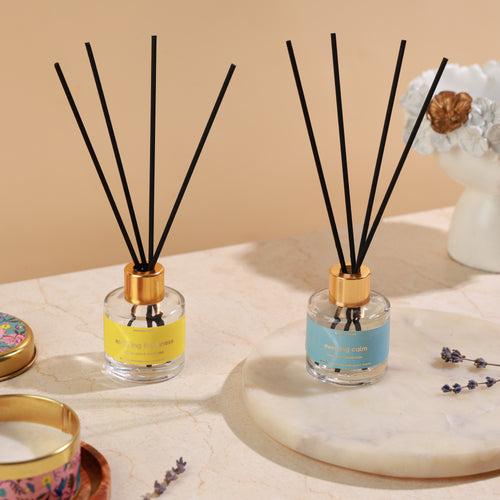 Two rooms · better value₹1,498Shop →
  Large room · a switch₹1,899Shop →
Positions, reeds and one blend for the whole flat
Choose the two positions before you choose anything else. The first is near the entrance, because that is where the flat is arrived at and where anyone with a fresh nose will actually register it; everyone already inside adapted about twenty minutes ago. The second is at the far end of the volume, usually near the bed, as distant from the first as the furniture permits. Both at roughly chest height on a shelf or console, both out of direct sunlight and out of the throw of a fan or AC vent. In a studio there is a third temptation — the kitchen counter — and it is the one to resist. It is close to heat, close to extraction and in the same air as everything else, so it costs a bottle and buys nothing.
Run six reeds in the main bottles and two or three in the bathroom. Reed count is the only volume control a reed diffuser has, and a 300 sq ft volume needs the full setting from both sources; the trade-off is real, so expect fourteen weeks rather than eighteen from each 130ml. Give fresh reeds forty-eight hours to saturate before judging anything. When throw drops after a few months, replace the reeds rather than the liquid — heavier fragrance molecules clog the fibre core over time and stop the capillary climb, and this is by far the commonest reason a bottle that is still half full stops smelling of much.
Then run one blend across the whole flat, and pick it for the cooking. This is the rule people resist and the one that matters most in a studio. There is no zoning: the bed, the sofa and the hob share one body of air, so two different blends at opposite ends do not create two moods, they create a muddle in the middle. Choose one and buy two bottles of it. Because you also cook in this air, the cleaner blends behave better than the sweet ones — Morning Freshness (Malabar lemon, peppermint, eucalyptus) or Mountain Breeze (Himalayan pine, sage, cedar) sit more comfortably beside a kitchen than Fresh Brew does, however good coffee and vanilla is in a living room with a door.
What to buy
Two complete lists: ₹3,247 on reeds or ₹2,947 with a machine, both including the bathroom. Nothing in either list is for the kitchen.
| Buy | What it covers | Lasts | Price |
|---|---|---|---|
| One 50ml | A single reed diffuser — the bathroom, on two or three reeds — the only closed air space in the flat | 6–8 weeks | from ₹749 |
| One 130ml ★ | The value size — each of the two main positions — buy two, ₹2,498, and stand them twenty feet apart | 14–18 weeks | from ₹1,249 |
| The duo | Day & Night duo — both main positions at ₹1,498 if the budget is tight, at the cost of reordering sooner | 6–8 weeks each | ₹1,498 |
| Sukoon | 500ml ultrasonic — the entire 300 sq ft volume from one position, rated to about 270–320 sq ft, with a switch | Runs when you switch it on | ₹1,899 |
| 300ml refill | The running cost — fills both main bottles once at ₹2,399 against ₹2,498 to rebuy — a ₹99 saving, and fresh reeds with it | Roughly 2 × 130ml fills | ₹2,399 |
Versailles
Studios get sold the wrong thing more often than any other home, because people count zones. Three areas, three diffusers, and a bill of nearly ₹3,750 for a flat of 300 square feet. There are no zones in a studio. There is one body of air and one bathroom door. Two positions in that air, well apart, is the whole answer, and the third bottle by the hob is simply a bottle evaporating.
I would give the machine route a serious look here, and I say that as someone whose reed diffusers are the heart of the business. A studio is where you sleep and where you fry onions, sometimes within the hour. Reeds have no off switch — that is their great virtue in a bedroom and their one real limitation in a room that has to be four things. The Sukoon at ₹1,899 is rated to about 270 to 320 square feet, which is your flat, and you can leave it off on a Tuesday.
Whichever route you take, do the bathroom separately and do it small. And please do not buy the ₹3,499 machine thinking it is the big one — it covers about 215 square feet, which is less than the ₹1,899 one. It is built for runtime and humidity. If you ever genuinely need more coverage than one Sukoon, the answer is a second Sukoon, and in a 300 sq ft flat you will never need that. A portion of every order funds a girl's classroom through Nanhi Kali.
Frequently asked questions
- A home with no internal doors — the same counting problem, at flat scale.
- How many for a 400 sq ft 1RK? — counting air spaces when almost nothing closes.
- Can one cover a 200 sq ft living room? — where one bottle first runs out.
- When to stop adding reeds and buy a Sukoon — the honest crossover point.
- Brand: the SOSA founder story.
SOSA products & prices (verified August 2026): Hotel Collection water-based ultrasonic diffuser fragrance 15ml ₹299 · 100ml ₹999 · 300ml ₹1,799 · Pack of 7 (15ml, all fragrances) ₹1,799; refills 100ml from ₹999. Seven scents: The Ritz-Carlton-inspired (white tea · bergamot · cedar), Westin-inspired (white tea · aloe · cedar), 1 Hotels-inspired (cedarwood · vetiver · green leaves), The St. Regis-inspired (amber · violet · woods), Shangri-La-inspired (jasmine · green tea · white tea), Four Seasons-inspired (citrus · floral · sandalwood), W Hotels-inspired (citrus · pepper · amber). Diffusers: Boond 300ml ₹899 · Sukoon 500ml ₹1,899 · Megh 6L ₹3,499. Water-based, phthalate-free, composed to IFRA standards for home diffusion; 3–6 drops per tank. Made in India, Pune. The Hotel Collection scents are SOSA's own interpretations inspired by the world's finest hotels; all hotel names are trademarks of their respective owners and are used only to describe the scent style — SOSA is an independent Indian fragrance house, not affiliated with or endorsed by any hotel brand. Prices and availability subject to change — see the live product pages.