

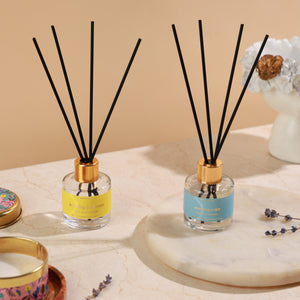



The 900 sq ft 2BHK: one 130ml in the living room, one 130ml at the far end of the shared volume, one 50ml in the bathroom. ₹3,247, against ₹6,245 room by room.
The free tool: shut a bedroom door for the two hours before bed. A closed room exchanges 0.2 to 0.5 of its air an hour instead of several, so the bottle you already own suddenly reads properly in there.
2. So buy three, not five. One 130ml at ₹1,249 in the living room where people sit; one 130ml at the far end of the open volume, which is usually the far bedroom or the dining end, because a single passive source cannot hold a run of more than about twenty-two feet; and one 50ml at ₹749 in the main bathroom, the one room whose door is genuinely closed. That is ₹3,247. The room-by-room version — a 130ml in each of five rooms — is ₹6,245, so the open doors have saved you ₹2,998 whether you noticed or not.
3. Then use the doors, because you already own them. This is the part that separates a flat with open doors from a flat with no doors at all. You have the option; you are simply not exercising it. Shut a bedroom door for the two hours before bed and that room goes from several air changes an hour to roughly 0.2 to 0.5 — the still condition coverage figures assume. The bottle you already own starts reading properly in there, and you have spent nothing. Two hours is enough; it does not need to be shut all day.
4. One blend for everything that is open to everything else. With the doors back, two fragrances do not give you two moods — they overlap through the passage and the middle of the living room and produce a third thing nobody chose. Run one blend across the shared volume. The bathroom is the one legitimate exception, because its door genuinely closes, and a bright, clean blend in there against a softer one outside is a contrast people notice in a good way.
5. Buy nothing for the passage, and nothing for the second bedroom. These are the two rooms in an all-doors-open flat that people buy for and should not. The passage is transit space — a couple of minutes of occupancy a day, in the flat's fastest-moving air. The second bedroom, standing open onto a scented living room and used for a few hours in the evening, is already borrowing. If either genuinely reads flat, close its door for two hours rather than buying a bottle.
Made in India, composed by an ISIPCA Versailles-trained perfumer — and a portion of every order supports girl-child education through Nanhi Kali.

Why an open doorway is not a boundary — and why that is good news
The most useful counting rule in this cluster is count doors, not square feet: a 900 sq ft flat with five closed doors is five separate air spaces, and the same 900 sq ft with everything open is one. What follows from that is almost always cheaper than what people expect. A closed door is a boundary that fragrance cannot cross, so each sealed room needs its own source. An open doorway is not a boundary at all — the rooms on either side exchange air continuously, and a bottle in each of them is charging the same volume twice over. That is the arithmetic behind three bottles instead of five, and it is the single largest saving available in sizing a flat like yours.
The less obvious half is what open doors cost you, because there is a cost. Enclosure is what makes a passive source work: a reed diffuser produces vapour at a steady rate and the room holds it, reaching an equilibrium you can smell. A closed room exchanges roughly 0.2 to 0.5 of its air an hour, which is slow enough for that equilibrium to build. Leave the doors open and the whole flat behaves as one leaky volume, with the front door and the balcony at either end of it — often three to eight air changes an hour. You are not just sharing the fragrance between rooms, you are also losing it faster. This is why the answer for your home is a small number of bottles running on six reeds rather than a large number running on three, and it is why the free move — shutting one door for two hours when you want a room to hold something — is worth more than the next ₹1,249 you were going to spend.
The three decisions for an all-doors-open flat
 Three bottles₹3,247One 130ml at ₹1,249 where people sit. One 130ml at the far end of the open volume, because a single passive source cannot hold a straight run of much more than twenty-two feet. One 50ml at ₹749 in the bathroom, the only door that genuinely closes. ₹1,249 + ₹1,249 + ₹749 = ₹3,247. Bought room by room at a 130ml each, the same flat is five bottles and ₹6,245 — so the doors you leave open have already saved you ₹2,998, before you have adjusted anything.
Sizing by space — a flat with the doors hooked back
Go room by room and mark which doors are genuinely shut for hours at a time. Two rows in this table are worth nothing at all, and both of them are common purchases.
| Space | What it needs | How many | Cost |
|---|---|---|---|
| 900 sq ft 2BHK, every internal door standing open ★ | Two 130ml across the shared volume and one 50ml in the bathroom — the case in this article | Three | ₹3,247 |
| The second bedroom, door open onto a scented living room | Nothing. It borrows already — and if it reads thin, shut the door for two hours | None | ₹0 |
| The passage joining the bedrooms to the living room | Nothing. Two or three minutes of daily occupancy, in the flat's fastest air | None | ₹0 |
| The main bathroom — the one door that does get closed | A 50ml on two or three reeds, and the one place a second blend is worth running | One | from ₹749 |
| A bedroom you are willing to close for two hours before bed | A 50ml on four reeds — the closed door is what makes the small bottle enough | One | from ₹749 |
| 1,400 sq ft flat, every door open | A Sukoon in the main volume, a 130ml at the far end, a 50ml in the bath | One machine, two bottles | ₹3,897 |
| A note on all of the above: coverage of up to about 150 sq ft on six reeds assumes a closed, still room. Your flat is neither while the doors are back, so treat these as the arrangement that works rather than a guarantee — and remember that the cheapest way to meet the assumption is to close a door for a couple of hours. | |||
One room · the unitFrom ₹749Shop → 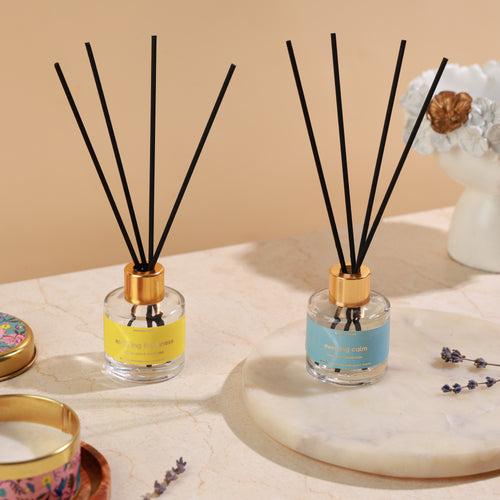 Two rooms · better value₹1,498Shop →
  Large room · a switch₹1,899Shop →
Placement, reeds and using the doors you have
Six reeds in the two main bottles, two or three in the bathroom. Reed count is the only volume control a reed diffuser has, and it moves strength and lifespan together — more reeds means a stronger space and a shorter bottle. In a flat where the doors stand open, the shared volume is large and leaky and six is the honest setting; anything gentler disperses to nothing. The bathroom is the opposite case at 30–45 sq ft, where two reeds is right and six is roughly four times what the volume can absorb. Give everything forty-eight hours to saturate before you judge it, then judge by walking in from outside — inside your own home you have adapted within about twenty minutes and will always under-read it.
Place the two large bottles apart, and both off the main flow line. The point of the second bottle in an open flat is distance, not strength, so put it genuinely at the far end rather than a few feet from the first. Keep both off the straight line between the front door and the balcony, which is the fastest air in the flat, and away from direct sunlight, AC vents and fans — all three empty a bottle early and push everything against one wall. Table or console height beside where people sit works better than a high shelf, since warm air carries fragrance upward and the useful zone is the bottom two metres. Stand each on a tray: reed oil marks a polished finish permanently if a bottle is knocked.
Then treat the doors as part of the product. If the far bedroom reads flat, close it at nine in the evening and check it at eleven. If the whole flat reads flat when guests are coming, shut the front door properly and close the balcony for an hour beforehand — an hour of stillness does more than a bottle you buy tomorrow. And when the large bottles run low, a 300ml refill at ₹2,399 fills a 130ml roughly twice, so one refill carries both through their next cycle for less than replacing them; refilling is also when to fit fresh reeds, since clogged fibre is the usual reason a flat that smelled right in month one reads tired in month four. For a whole-flat blend, Garden Bloom or Mountain Breeze.
What to buy
Three lines cover an all-doors-open flat. Here is what each option in the range is genuinely for, including the ones you should skip.
| Buy | What it covers | Lasts | Price |
|---|---|---|---|
| One 50ml | A single reed diffuser — the bathroom, or a bedroom you are willing to close for two hours — on two to four reeds | 6–8 weeks | from ₹749 |
| One 130ml ★ | The value size — each end of the shared volume, on six reeds — 14–18 weeks at about ₹78 a week | 14–18 weeks | from ₹1,249 |
| The duo | Day & Night duo — the shared volume and the bathroom, if you want the one closed door to read differently | 6–8 weeks each | ₹1,498 |
| Sukoon | 500ml ultrasonic — a flat past about 1,200 sq ft with the doors back, where passive diffusion cannot hold the volume | Runs when you switch it on | ₹1,899 |
| 300ml refill | The running cost — keeping two six-reed bottles going without buying the glass again every cycle | Roughly 2 × 130ml fills | ₹2,399 |
Versailles
Most people in flats like this arrive expecting to buy one diffuser per room and are surprised when I talk them down to three. Five open doorways are not five rooms. They are one large room with furniture arranged in groups, and putting a bottle in each part of it means paying for the same air several times.
What I would rather you knew is the other side of it. You have doors. You are simply not using them. When someone tells me the back bedroom never smells of anything, I ask them to close it at nine in the evening and walk in at eleven — and most of the time that is the end of the conversation. A closed room holds air for hours; an open one exchanges it several times an hour. Two hours of a shut door is worth more than the next bottle.
And keep it to one blend for everything that is open. I have been in beautiful flats where the passage is a collision of three fragrances and the owner cannot smell it at all, because they adapted twenty minutes after walking in. One blend across the shared space, something different behind the bathroom door if you like, and nothing whatsoever in the corridor. A portion of every order funds a girl's classroom through Nanhi Kali.
Frequently asked questions
- A home with no internal doors — when you do not have the choice.
- The passage between two bedrooms — the strongest case for buying nothing.
- Homes with strong cross-ventilation — why the answer there is fewer.
- The complete sizing and quantity guide — every home type, three builds.
- Brand: the SOSA founder story.
SOSA products & prices (verified August 2026): Hotel Collection water-based ultrasonic diffuser fragrance 15ml ₹299 · 100ml ₹999 · 300ml ₹1,799 · Pack of 7 (15ml, all fragrances) ₹1,799; refills 100ml from ₹999. Seven scents: The Ritz-Carlton-inspired (white tea · bergamot · cedar), Westin-inspired (white tea · aloe · cedar), 1 Hotels-inspired (cedarwood · vetiver · green leaves), The St. Regis-inspired (amber · violet · woods), Shangri-La-inspired (jasmine · green tea · white tea), Four Seasons-inspired (citrus · floral · sandalwood), W Hotels-inspired (citrus · pepper · amber). Diffusers: Boond 300ml ₹899 · Sukoon 500ml ₹1,899 · Megh 6L ₹3,499. Water-based, phthalate-free, composed to IFRA standards for home diffusion; 3–6 drops per tank. Made in India, Pune. The Hotel Collection scents are SOSA's own interpretations inspired by the world's finest hotels; all hotel names are trademarks of their respective owners and are used only to describe the scent style — SOSA is an independent Indian fragrance house, not affiliated with or endorsed by any hotel brand. Prices and availability subject to change — see the live product pages.