



What to do instead: leave one of the bedroom doors open for the couple of hours before bed. The passage borrows from a room that is already holding scent, and it costs nothing.
The exception: if that passage is also how people arrive — a foyer, a landing off the front door — then it is not a passage, it is an entrance, and an entrance is the best rupee in the house at ₹749 for a 50ml.
2. Do the cost-per-occupied-hour sum once and you will never buy for a corridor again. A 130ml at ₹1,249 runs 14–18 weeks; take sixteen, which is 112 days, and the bottle costs about ₹11 a day. Spread that over the five hours a day a living room is used and you are paying roughly ₹2.20 an hour for something people are actually breathing. Spread it over three minutes in a passage and the same bottle costs more than ₹200 an occupied hour. That is the whole argument, and it does not change if you buy the cheaper 50ml.
3. A passage is also the worst physical location in the flat. It is defined by having openings at both ends. That makes it the flow path between rooms, the route the cross-breeze takes, and often the corridor that connects the front door to a balcony. A closed room exchanges roughly 0.2 to 0.5 of its air an hour; a passage with two doors open behaves far more like the three-to-eight range. A passive source cannot charge air that is being replaced several times an hour, so even if you wanted to scent it, this is the space where a bottle would empty first and read least.
4. Leave a door open instead. It is free and it works. Bedrooms hold scent well because they are closed, still and modestly sized — the exact conditions coverage figures assume. Open one bedroom door for the two hours before bed and the passage becomes an extension of a space that is already charged. You get the impression you were trying to buy, at no cost, and you close the door again when you want the bedroom to hold its own air overnight.
5. The one exception: when the passage is also the entrance. If the front door opens into that passage, or it is the landing everyone walks through on arrival, the calculation inverts. Arriving noses have not adapted to your home yet, so they take one clear reading in the first ten seconds and then stop registering it. That single reading is the most valuable ten seconds of fragrance in the house, and it is worth a 50ml at ₹749 — placed near the door, not halfway down the corridor.
Made in India, composed by an ISIPCA Versailles-trained perfumer — and a portion of every order supports girl-child education through Nanhi Kali.

Occupancy is the qualifier — not floor area
Almost every sizing guide, including the rest of this cluster, starts with square feet, and for good reason: coverage figures are stated in them. But square feet only tell you whether a bottle can hold a space. They say nothing about whether that space deserves one. A passage of 48 sq ft is well inside what a single 50ml can charge. It would work. That is not the question. The question is whether anyone will be standing in it long enough to notice, and the honest answer for an internal corridor between two bedrooms is that they will not. Two adults crossing it twenty times a day accumulate under three minutes between them, most of it in motion.
Set that against how you actually experience your own home. Olfactory adaptation is essentially complete in about twenty minutes: your nose is built to detect change, so a constant unchanging smell stops registering almost immediately. That single fact does two things to this decision. First, it means the time you spend in a space has diminishing returns — the bedroom you sleep in for eight hours gives you roughly twenty minutes of perceived fragrance, not eight hours of it. Second, and more usefully, it means the moments worth buying are the moments of arrival — walking in from outside, opening a bathroom door, coming back into the living room after cooking. A passage between two bedrooms contains no arrivals. It is the least eventful air in the house, and it moves faster than any of it, because a corridor is by definition the gap between two openings. Buying for it is paying full price for the one thing a nose is guaranteed not to register.
The three decisions for a passage
 Buy nothing₹0Use a threshold of roughly two hours of daily occupancy before a space earns its own bottle. A living room clears it easily. A bedroom clears it. A main bathroom clears it in short visits that happen to be the ones people notice most. A passage between two bedrooms does not come close, and neither does a landing, a lobby outside a lift, or a formal dining room used on festivals. Below the threshold, borrow: leave the adjoining door open and let a charged room supply the space next to it.
Sizing by space — which transit spaces earn anything
This is the table with the most zeroes in it, and that is not modesty — it is arithmetic. Read down to the version of the space you actually have.
| Space | What it needs | How many | Cost |
|---|---|---|---|
| Internal passage between two bedrooms, 40–60 sq ft ★ | Nothing. Under three minutes of daily occupancy, in the draughtiest air in the flat | None | ₹0 |
| The same passage, where the front door opens into it | Not a passage — an entrance. One 50ml on six reeds within a metre or two of the door | One | from ₹749 |
| A passage carrying the bathroom door | Nothing in the passage. Put a 50ml on two reeds inside the bathroom, where 35 sq ft holds it | None here | ₹0 |
| A landing used as a reading corner or a study nook, two hours a day | Occupancy clears the threshold — it has stopped being transit space and become a room | One 50ml | from ₹749 |
| A passage with a shoe rack or laundry basket in it | Nothing. Air the cupboard and move the basket — fragrance is a layer, not a fix | None | ₹0 |
| A long passage over 20 ft with four doors off it, in a large flat | Nothing of its own. The four rooms behind those doors do the work when they are open | None | ₹0 |
| A note on all of the above: coverage figures assume a closed, still room. A passage is the opposite of that by design, so even in the entrance case, keep the bottle to one side rather than in the direct line between the front door and a balcony, or it will be gone in half its stated life. | |||
One room · the unitFrom ₹749Shop → 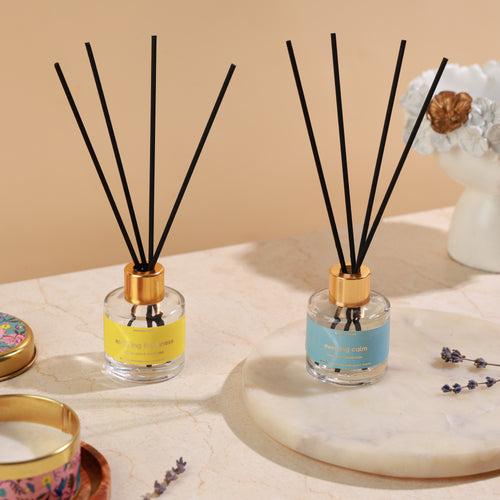 Two rooms · better value₹1,498Shop →
  Large room · a switch₹1,899Shop →
What to do instead, and what it costs
Start by opening a door for two hours, and see whether the problem existed. If either bedroom already has a diffuser, leave that door open through the evening. The bedroom is closed, still and the right size, so it holds scent properly, and the passage next to it borrows a diluted version — which is exactly what a passage needs, because nobody is stopping there. Judge it the way you would judge any room: not from inside, where you adapt within twenty minutes, but by walking in from outside the flat and taking the first breath in the corridor. Most people find the passage reads of something already and had simply never noticed, because they had never arrived with a fresh nose and paid attention.
Then move the bottle you own, rather than buying one you do not. In a bedroom, a diffuser on a chest of drawers near the doorway will always outperform the same bottle on a bedside table in a still corner, and it has the side effect of feeding the passage every time the door is open. Keep it out of direct sunlight, which heats the oil and fades the fragrance, and out of the throw of an AC vent or fan, which empties the bottle fast. Stand it on a tray, since reed oil marks a polished finish permanently if the bottle is knocked. None of this costs anything, and between the door and the placement you have spent ₹0 to solve a space you were about to spend ₹749 on.
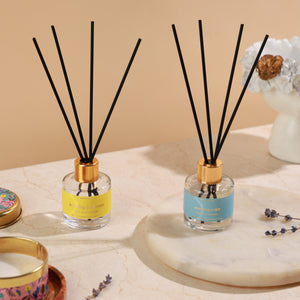
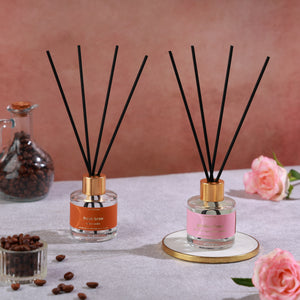
Spend the money where noses arrive. If you have ₹749 earmarked for the corridor, the two places it does real work are the entrance and the main bathroom. The entrance because every visitor and every returning member of the household reads it clearly in the first ten seconds before adapting; the bathroom because it is 30–45 sq ft, the smallest and cheapest volume in the home to hold at full presence, and it is the one room a guest is alone in. A 50ml at ₹749 on six reeds by the door, or on two reeds in the bathroom, will be noticed by more people in a week than a corridor bottle would be in its entire life. Morning Freshness suits both.
What to buy
For the passage itself the answer is nothing. This table is what to do with the money instead, and where each option genuinely belongs.
| Buy | What it covers | Lasts | Price |
|---|---|---|---|
| One 50ml ★ | A single reed diffuser — an entrance or a small bathroom — the two places a nose arrives unadapted and reads clearly | 6–8 weeks | from ₹749 |
| One 130ml | The value size — a living room or bedroom that clears two hours of daily occupancy — about ₹78 a week | 14–18 weeks | from ₹1,249 |
| The duo | Day & Night duo — an entrance and a bathroom solved together, which is a better pair of rooms than any corridor | 6–8 weeks each | ₹1,498 |
| Sukoon | 500ml ultrasonic — a large living room past about 200 sq ft, where you want a switch rather than something always on | Runs when you switch it on | ₹1,899 |
| 300ml refill | The running cost — keeping the rooms that do earn a bottle going, without buying the glass twice | Roughly 2 × 130ml fills | ₹2,399 |
Versailles
This is the page where I most enjoy saying buy nothing. A corridor between two bedrooms is the single worst purchase in home fragrance, and it is a common one, because people size their homes by looking at a floor plan rather than at where they actually stand. A room earns a diffuser by being occupied, not by existing.
Work it out once. Sixteen weeks from a ₹1,249 bottle is about eleven rupees a day. In a living room that is a couple of rupees an hour for hours people are genuinely in. In a passage that nobody stops in, it is more than two hundred rupees for every hour anyone is present to smell it — and the bottle is standing in a draught between two doorways, so it will not even last its sixteen weeks.
If the passage genuinely bothers you, open a bedroom door in the evening and see how it reads when you come in from outside. If it is an entrance rather than a corridor, that is different, and I would happily sell you a 50ml for it — the ten seconds at the door are the most valuable ten seconds of fragrance in the whole flat. But for the corridor itself, keep the ₹749. A portion of every order funds a girl's classroom through Nanhi Kali.
Frequently asked questions
- A bedroom with an attached bath — why the small room is the one to do.
- When every door stays open — counting air spaces, not rooms.
- A home with no internal doors — when the whole flat is one air space.
- The complete sizing and quantity guide — every home type, three builds.
- Brand: the SOSA founder story.
SOSA products & prices (verified August 2026): Hotel Collection water-based ultrasonic diffuser fragrance 15ml ₹299 · 100ml ₹999 · 300ml ₹1,799 · Pack of 7 (15ml, all fragrances) ₹1,799; refills 100ml from ₹999. Seven scents: The Ritz-Carlton-inspired (white tea · bergamot · cedar), Westin-inspired (white tea · aloe · cedar), 1 Hotels-inspired (cedarwood · vetiver · green leaves), The St. Regis-inspired (amber · violet · woods), Shangri-La-inspired (jasmine · green tea · white tea), Four Seasons-inspired (citrus · floral · sandalwood), W Hotels-inspired (citrus · pepper · amber). Diffusers: Boond 300ml ₹899 · Sukoon 500ml ₹1,899 · Megh 6L ₹3,499. Water-based, phthalate-free, composed to IFRA standards for home diffusion; 3–6 drops per tank. Made in India, Pune. The Hotel Collection scents are SOSA's own interpretations inspired by the world's finest hotels; all hotel names are trademarks of their respective owners and are used only to describe the scent style — SOSA is an independent Indian fragrance house, not affiliated with or endorsed by any hotel brand. Prices and availability subject to change — see the live product pages.