

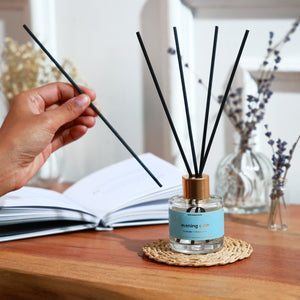



Why it feels like an edge: your sense of smell has a floor. Below a certain concentration it does not report a faint smell, it reports nothing. A smooth decline crossing that floor is experienced as a hard boundary.
Free fixes, in order: six reeds rather than three; halve the distance between the bottle and where you sit; nose height on a surface; out of the draught but not in a dead corner; shut the door; and put the ceiling fan on low, which is the single best free fix here because a fan supplies the transport a reed structurally does not have.
The honest gap: no reed count, bottle size or fragrance strength adds transport. If you want evenness rather than a stronger corner, that is a different machine — most often Sukoon at ₹1,899, not something dearer.
2. The gradient is smooth. The edge is not. If you could see concentration as a colour, your bedroom would look like a lamp in a dark room: brightest at the source, dimming continuously outwards, with no line anywhere. What you perceive instead is a bright patch with a border, because your nose does not report small quantities as small — below a threshold it reports them as absent.
3. That threshold is the border you are feeling. Walk from the far wall towards the bottle and the concentration rises steadily the whole way, but you will notice nothing at all for most of the walk and then quite suddenly notice a great deal. The change in the air was gradual. The change in your report of it was a switch.
4. This is the design, not a defect. A reed produces a fragrant zone, not a fragranced room. Almost everything else about it follows from that same restraint: it is silent, it needs no socket, there is nothing to fill, charge or remember, it carries on through a power cut, and it costs roughly ₹13–₹15 a day. It is an object rather than an appliance, and it never breaks.
5. Fix the free things first, and only then decide whether you want a different machine. Six reeds instead of three, the bottle at half the distance, at nose height, out of the draught, door shut, ceiling fan on low. Those six changes cost nothing and settle a large share of these questions. If after all of them you still want the far side of the room to smell like the near side, you want moved air, and the honest answer is Sukoon at ₹1,899 before anything more expensive.
Alcohol-free, phthalate-free, made in Pune. A portion of every order supports girl-child education through Nanhi Kali.
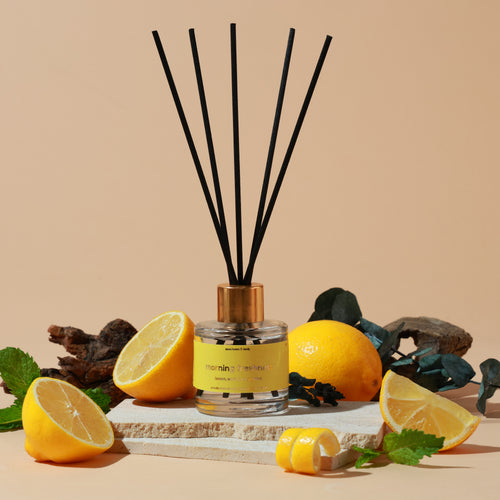
Why the edge you can feel is not in the air
This is the part of the cluster I care most about explaining properly, because once you have it, every other question about reed diffusers answers itself. You are describing a boundary. There is no boundary. There is a quantity that falls away from a point, the way heat falls away from a candle or light falls away from a lamp, and there is a nose reading that quantity through two filters that both squash the middle of the range flat. Three things are stacking, and they are worth taking one at a time.
 Evening Calm₹799Vapour leaving a single point spreads into an ever-larger volume of air as it moves outwards, so the same quantity of fragrance is thinned over more and more space. The consequence is that concentration drops fastest in the first stretch away from the source and then keeps dropping, more and more gently, for the rest of the room. Most of the decline has already happened before you have taken two steps. That is why the near field feels so decisive and the far field feels so empty: you are not comparing two ends of a gentle slope, you are comparing the top of a cliff with the long flat plain below it. The curve is still smooth. It is simply very unevenly distributed across the floor plan.
 Mountain Breeze₹849Every odorant has a detection threshold, and beneath it the honest output of the system is silence. This is the single most important idea on the page, because it converts a smooth physical decline into a hard perceptual line. The fragrance in the middle of your bedroom has not gone to zero; it has gone below the level at which you are able to say anything about it, and the only word available for that state is nothing. Think of a radio station as you drive out of a city: signal strength falls away steadily the whole time, but you do not hear it getting gradually quieter for forty kilometres — you hear music, and then you hear static, and the transition feels abrupt.
 Garden Bloom₹799The nose is a ratio instrument rather than a measuring jug. Large changes in the amount of material in the air produce comparatively modest changes in perceived intensity, which is why a fragrance twice as concentrated does not smell twice as strong. Inside the fragrant corner, then, big differences in concentration get compressed into a fairly even impression of strong. The corner reads as uniformly scented right up to its outer limit, which makes the drop beyond it feel like a step off a kerb. Two compressions, one at each end of the walk — a flat-feeling near field and a silent far field — and between them they manufacture an edge out of a slope.
Why it is that corner, and not a different one
There is a second question hiding inside the first, and it is the one people usually mean when they say corner rather than area. If the decline were purely a matter of distance, the fragrant region would be a neat sphere around the bottle and you would never call it a corner. You call it a corner because it is lopsided, and it is lopsided because the small amount of transport your room does supply is not symmetrical. Warm air rises off a sunlit wall and a working laptop; cool air falls off a window pane and slides along the floor; a door left ajar sets up a slow one-way drift; an air conditioner sends a directed stream across the ceiling and down the far wall. None of that is under the bottle's control, and all of it is doing more to shape the fragrant region than the oil is.
This is why two people with identical bottles in identically sized bedrooms get differently shaped results, and why moving the bottle a metre can change the whole map. It also explains the placement rule that sounds contradictory the first time you read it: keep the diffuser out of the draught, but not in a dead corner. Sitting in an open window or in the direct blast from a split unit strips the reeds and throws the fragrance at one wall, so you lose it fast and unevenly. Sitting in a genuinely still nook behind a wardrobe leaves the vapour pooling with nothing to pick it up. The productive spot is the quiet part of the room's own circulation — somewhere air passes gently rather than either racing through or standing still.
And there is one more asymmetry that is entirely about you rather than the room. You are adapted to your own home. You walk into that corner several times a day, so your receptors have been meeting it constantly, and constant stimuli fade from report within minutes even while they continue to arrive. A visitor who has not been sitting in your bedroom all evening is a far better instrument than you are. If guests remark on the fragrance and you cannot find it, the room is working for everybody except its owner — which is a common and slightly annoying property of home fragrance rather than a fault in a bottle.
What is actually happening, against what you report
Here is the same walk across your bedroom described twice: once as a physical quantity in the air, once as the sentence you would say out loud. The right-hand column is the free change worth making at each stage. I have deliberately kept every row qualitative, because there is no published figure for how far a reed diffuser projects and any brand quoting you a distance in feet is quoting a number for a room it has never seen.
| Where you are | What the air is doing | What you say | The free change |
|---|---|---|---|
| At the bottle neck | Concentration at its maximum, replenished continuously by six reeds | "This is beautiful" | Nothing. This is the product working |
| Within reach of it | Already falling steeply as the vapour spreads into more air | "Still lovely, slightly softer" | This is the zone — put the bottle where you actually sit |
| The middle of the room | Thin but genuinely present, below your reporting threshold | "Nothing at all" | Six reeds rather than three pushes the line outwards |
| The far side | Thinner still, and being diluted further by air leaving the room | "It doesn't reach" | Shut the door; put the ceiling fan on low |
| Anywhere, with the fan on | The room's air is now circulating and carrying vapour with it | "It's everywhere, but gentler" | Free, and it shortens the bottle's life. Both are true |
Bright · Morning Freshness₹749Shop → 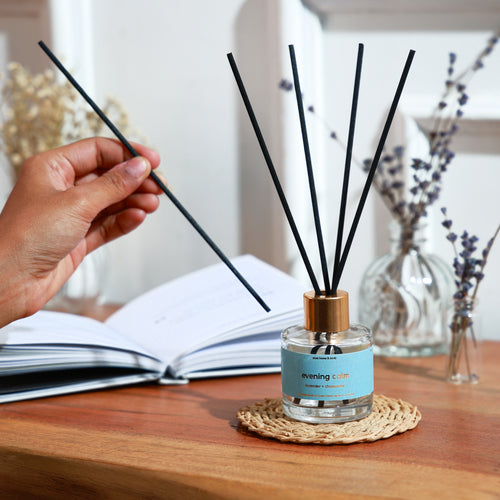 Softest · Evening Calm₹799Shop →
 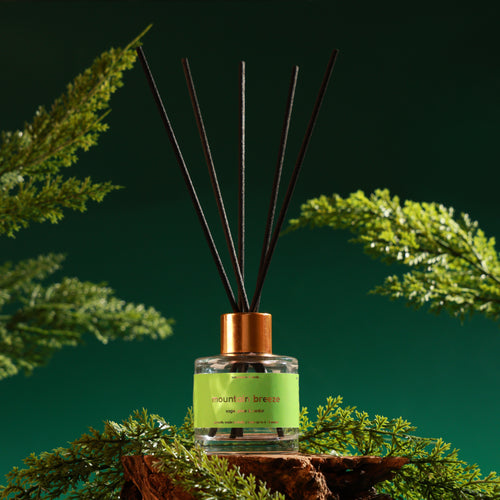 Deepest woody · Mountain Breeze₹849Shop →
The free fixes, in the order I would try them
Before anybody spends anything, these are the six changes that cost nothing, and a large share of readers who arrive at this page are finished after the first three. I would rather give all of them away than sell a device to somebody whose bottle is simply standing in the wrong place. Reed count first. Every SOSA bottle ships with six fibre reeds and a great many people use three, because three looks tidier. Six is full projection; three is a soft bedside level and roughly doubles the life of the bottle. If your corner is strong and your room is quiet, put all six in and give it two days to saturate before you judge it.
Then distance, which is the biggest single lever there is. Halve the gap between the bottle and the place you actually sit or lie. Moving a diffuser from a chest of drawers across the room to the bedside table is not a compromise or an admission of defeat — it is the correct use of a point source, and it will do more for you than changing the fragrance ever could. Then height. At or slightly below nose height, on a surface, not on the floor where it scents your ankles and not on a high shelf where it scents the ceiling. Then the draught. Off the windowsill, out of the direct AC stream, away from an open balcony door — but not tucked into a still nook either. Then the door. Containment is half of this equation and shutting a door costs nothing; a closed room holds what the bottle produces, an open one exchanges it with the rest of the flat.
And then the one I would put first if it did not need explaining: turn the ceiling fan on low. This is the best free advice in the whole cluster, because a fan is precisely the transport a reed structurally lacks. The bottle makes fragrance; the fan distributes it; and the two together give you something much closer to the even room you are picturing than any reed count can. The honest caveat is that it will shorten the bottle's life, because faster air across the reeds means faster evaporation. Both things are true and you get to choose which you want on a given evening. The same trade sits behind the observation that a bedroom often smells strongest at night with the air conditioning running in a closed room: recirculation distributes beautifully, and dry moving air empties the bottle sooner.
If you have done all of that and still want the whole room
Then you have a legitimate requirement that a passive device cannot meet, and I would rather say so than sell you a second bottle. Everything on the free list raises emission or improves containment. None of it, except the fan, adds transport — and the reason the fan works so well is exactly that it is the only item on the list that does. If you want the far corner of a bedroom to smell like the near corner, you are asking for moved air, and moved air is what an active diffuser sells. The table below is the whole ladder in buying order, including the two purchases in our own range that I would talk most readers out of.
| Step | What it is | When it is the right answer | Price |
|---|---|---|---|
| 1. Six reeds, half the distance, fan on low ★ | Emission raised, containment improved, and one genuine source of transport | First, always. A large share of readers stop here | Free |
| 2. A 50ml reed placed properly | Six fibre reeds, refillable glass, 6–8 weeks, silent, no power | If a beautiful fragrant zone where you sit is genuinely what you want | ₹749–₹849 |
| 3. The same scent in 130ml | 14–18 weeks instead of 6–8. A duration upgrade, not a coverage one | When you are happy with the zone and tired of repurchasing | ₹1,249–₹1,349 |
| 4. Sukoon ultrasonic ★ | 500ml, 270–320 sq ft, 16–18 hours on low, three 15ml Hotel Collection scents included | When evenness across the room is the actual requirement | ₹1,899 |
| 5. Safar waterless | Named and sold as a car and travel diffuser. Undiluted oil, 20ml, cordless, three speeds, a 1 / 2 / 3-hour timer — so not set-and-forget, and it needs recharging | For strong personal-scale projection without water or dilution | ₹3,999 |
| The gap, and the trap: Megh and Vaayu | Megh ₹3,499 has a six-litre tank and ~100 hours of runtime but covers only ~215 sq ft — less than the ₹1,899 Sukoon. Vaayu ₹11,999 is rated to 1000 m³, roughly 2,000–3,000 sq ft. Between Safar and Vaayu there is no mid-sized waterless bedroom nebuliser in this range | Megh is a runtime and humidity machine, never a coverage upgrade. Vaayu is the wrong purchase for one bedroom and I will say so before you spend ₹11,999 | ₹3,499 / ₹11,999 |

Versailles
The first time somebody described this to me — one glorious corner and a bedroom that smelled of nothing — I heard it as a complaint and answered it as one. I was wrong. What they were actually telling me was that the fragrance had worked so well in one place that its absence elsewhere had become conspicuous. Nobody notices the far side of a room until the near side has given them something to compare it with. That is a compliment wearing a complaint's clothes, and I have learned to answer the compliment first.
The honest thing to say next is that no amount of composition solves it. I can slow a lemon's evaporation with a eucalyptus base, I can hold the indole in a jasmine below the threshold where heat makes it turn, I can choose a heat-stable CCT carrier instead of the DPG that cracks and goes bitter above 40°C on an ordinary Pune afternoon. Every one of those decisions changes what leaves the bottle and how long it keeps leaving. Not one of them changes how far it gets. Reach is a property of the air in your room, and I do not sell your air.
So the advice I give friends is unromantic. Put all six reeds in. Move the bottle to where you actually are. Shut the door and put the fan on low for half an hour before bed. If that gives you what you wanted, keep the ₹1,899 — I would genuinely rather you did. And if it does not, buy the Sukoon and not the thing three times its price, because in one bedroom the expensive machine wastes nine-tenths of what it makes. Everything is composed in Pune, and a part of every order funds a girl's classroom through Nanhi Kali.
Frequently asked questions
- Why can I smell it only when I stand next to it? — the point-source explanation from the beginning.
- Amazing within two feet and nowhere else — is that normal? — yes, and here is why.
- Why doesn't the fragrance travel across the room? — molecular diffusion, and how slow it really is.
- Strong beside the bottle, weak from the bed — the distance problem, with the free answers.
- How far should it actually travel? — why no honest brand publishes a figure.
- Is it weak if I have to walk close to it? — no, and what weak would really look like.
- It's definitely evaporating, so why can't I smell it? — where the millilitres actually go.
- Walking past versus sitting still — two mechanisms, stacked.
- I love the fragrance — how do I get it everywhere? — the full ladder, free fixes first.
- Brand: the SOSA founder story.
SOSA products — facts verified August 2026: Reed diffusers in 50ml and 130ml only. Morning Freshness ₹749 / ₹1,249 · Evening Calm ₹799 / ₹1,299 · Garden Bloom ₹799 / ₹1,299 · Mountain Breeze ₹849 / ₹1,349 · Fresh Brew ₹849 / ₹1,349. 50ml suits rooms up to ~150 sq ft and lasts 6–8 weeks; 130ml suits above 150 sq ft and lasts 14–18 weeks; roughly ₹13–₹15 a day. Six fibre reeds in a refillable glass bottle, on a heat-stable CCT (caprylic/capric triglyceride) carrier rather than DPG, alcohol-free, phthalate-free, paraben-free, IFRA-compliant, 0 ppm formaldehyde, climate-tested at 45°C and 85% RH, composed in Pune. Duos ₹1,498–₹1,598 (50ml × 2). Refills 300ml ₹2,399 · 500ml ₹3,499, oil only. Machines: Boond ₹899 (300ml, ≤~150 sq ft, ~6h) · Sukoon ₹1,899 (500ml, 270–320 sq ft, 16–18h on low, three 15ml Hotel Collection scents included) · Megh ₹3,499 (6L, ~100h runtime, ~215 sq ft) · Safar ₹3,999, named and sold as a waterless car perfume diffuser, 20ml, 2000 mAh, up to 10 hours continuous or around 30 hours intermittent per charge, three speeds and a 1 / 2 / 3-hour auto-off timer, 6.9 cm — SOSA publishes no room coverage figure for it and none is given here · Vaayu ₹11,999 (up to 1000 m³, roughly 2,000–3,000 sq ft, 400ml, under 38 dB). Hotel Collection oils are water-based and ultrasonic-only: 15ml ₹299 · 100ml ₹999 · 300ml ₹1,799. Reed oil and Hotel Collection oil are not interchangeable in either direction and there is no hotel-inspired reed diffuser. No health, air-quality or sleep claims are made for any SOSA product; fragrance does not remove an unwanted smell, which is a matter of source, then ventilation, then fragrance. Free shipping above ₹499. A portion of every order supports girl-child education through Nanhi Kali. SOSA is an independent Indian fragrance house; the Hotel Collection scents are SOSA's own interpretations inspired by the world's finest hotels, and SOSA is not affiliated with or endorsed by any hotel brand. Prices subject to change — see the live product pages.