
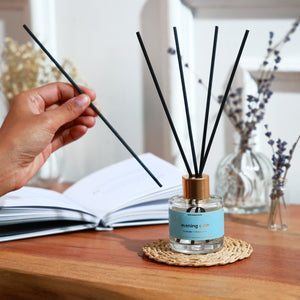

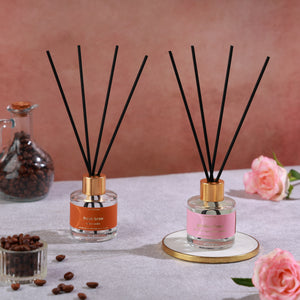

Why "two feet" feels like a wall: the concentration falls off smoothly, with no boundary anywhere in the air. Your nose compresses a very wide range of concentrations into a narrow range of impressions, so a gentle slope is reported as an edge. The two-foot figure is something perception invented, not something the bottle did.
Free fixes to try tonight: put all six reeds in rather than three; halve the distance between the bottle and where you sit; move it to nose height on a surface; keep it out of a draught but not in a dead corner; close the door; and run the ceiling fan on low, which supplies the transport a reed has no way of supplying.
The honest gap: if what you want is even fragrance everywhere in a bedroom, no reed count and no bottle size will deliver it, and I will not pretend otherwise. That is an active-diffusion requirement. Sukoon at ₹1,899 is usually the right size for a bedroom; Vaayu at ₹11,999 is emphatically not.
2. What is missing is not made by the bottle. Getting fragrance from the bottle to the far side of the room requires moving air, and a reed diffuser contains nothing that moves air. It is a source. Beyond the source, distribution is the room's job — convection, a fan, an air conditioner, a draught under a door — and the room may not be doing much of it.
3. The two-foot boundary does not exist in the air. Concentration falls away continuously and smoothly. Perception is what makes it feel like a line: the nose compresses a very large range of concentrations into a small range of impressions, so a gradual slope is experienced as a fragrant zone with a rim. You are describing a perceptual edge, not a physical one.
4. Run the free fixes before you spend a rupee. All six reeds instead of three. Halve the distance to where you actually sit or sleep. Nose height, on a surface, not on the floor and not on a high shelf. Out of the draught but not in a dead corner. Door closed. And the ceiling fan on low, which is the best free advice in this whole subject because a fan is the transport a reed structurally lacks — with the honest caveat that it will shorten the life of the bottle.
5. If you want the whole room even, that is a different machine, not a better bottle. Sukoon at ₹1,899 covers 270–320 sq ft and moves its own air. Safar at ₹3,999 is waterless cold diffusion of undiluted oil and is named and sold as a car and travel diffuser, with a 1, 2 or 3-hour timer and a battery to recharge. Neither of them is silent, needs no power, works in a power cut or costs about ₹13–₹15 a day — which the reed does.
Alcohol-free, phthalate-free, paraben-free, IFRA-compliant, 0 ppm formaldehyde. Six fibre reeds in a refillable glass bottle, composed in Pune. Free shipping above ₹499, and a portion of every order supports girl-child education through Nanhi Kali.
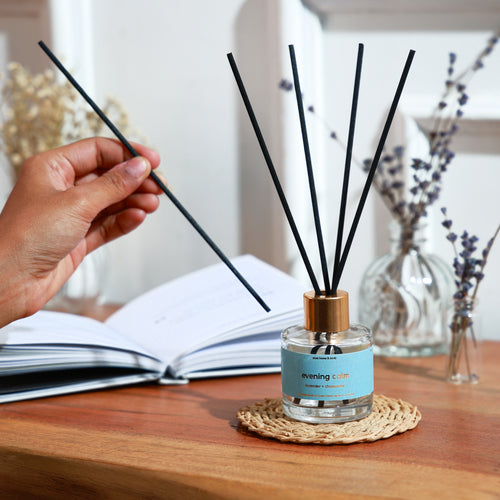
What normal looks like, and what a genuinely faulty bottle looks like
I would like to give you something more useful than reassurance, which is a way of checking for yourself. There are only a small number of things that can actually go wrong with a reed diffuser, and none of them produces the pattern you have described. Knowing what the real failure modes look like is the fastest way to stop worrying about the imaginary one.
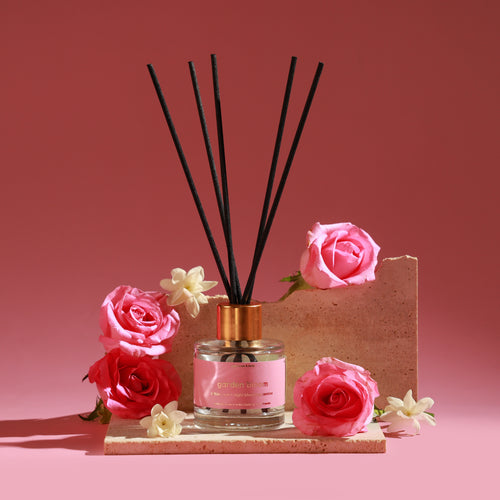
 Garden Bloom₹799This is the only real mechanical failure available to a reed diffuser: oil that does not climb. Within a day or two of setting up, the reeds should be visibly darker along their length, and within a fortnight the liquid level should have moved. If both of those are true, capillary action is working and the product is emitting. Fibre reeds are used rather than rattan for this reason — rattan has irregular internal channels and wicks unevenly in high humidity, which produces the fade-then-nothing pattern people blame on the oil. A strong two-foot zone is itself proof that the wicking is fine, so if you have that, you can skip this check entirely.
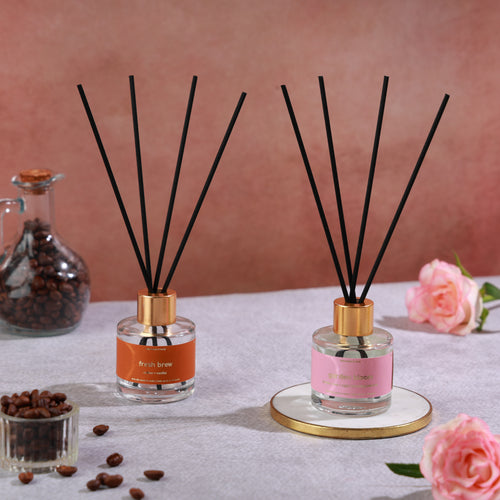
 Mountain Breeze₹849The second real failure is chemical rather than mechanical, and it is the one worth knowing about in Indian heat. A fragrance that has gone sour, bitter or faintly acrid has usually been let down by its carrier: DPG, the cheap industry default, can crack above about 40°C, which is an ordinary afternoon in most of this country. Every SOSA reed sits on a heat-stable CCT base instead and is tested through a 45°C heat soak and 85% humidity. Note also that a diffuser being loud in week one and quieter by week three is not a fault either — the first days run hot because the reeds are saturating and the lightest materials leave first. Week three is the heart and base, which is the composition as designed. Settling, not fading.
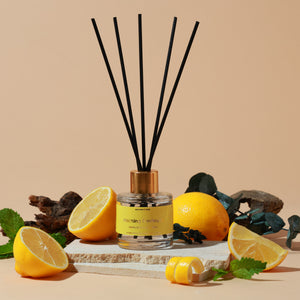
 Morning Freshness₹749The third check is not about the bottle at all. Sensitivity varies enormously between people, and you are permanently adapted to the smell of your own home in a way no guest is. Receptors respond to change, not to constancy, so a steady concentration stops being reported within minutes even though it keeps arriving. This produces the very common and very confusing situation where everybody who visits comments on the fragrance and the person who bought it cannot detect it. If that is happening, it is working for everyone except you, and the honest instrument is somebody else's nose. Leave the house for fifteen minutes and walk back in.
Why two feet feels like a wall when what is actually there is a slope
The detail I find people are most relieved to hear is that the edge they are describing is not in the room. There is no membrane at two feet. Concentration falls away from the reeds continuously and smoothly, in the way the light from a lamp falls away — there is no point at which the lamp stops illuminating, only a point at which you stop being able to read by it. Fragrance behaves the same way, and the reason it feels more abrupt is that the nose is a compressive instrument. It maps an enormous range of concentrations onto a small range of impressions, so a smooth physical decline gets reported as strong here, nothing there.
This matters practically, not just conceptually, because it changes what a small improvement is worth. If you imagine a boundary, then moving the bottle a foot closer sounds trivial — you are either inside the bubble or outside it. Once you understand that you are standing on a slope, moving a foot closer is obviously worth doing, and halving the distance between the bottle and where you sit is the most reliable free change available to you. It is also why nose height matters: the fragrance is not filling the room from the floor up, it is spreading outward from a point, and a bottle on the floor is putting that point below the air you breathe.
And it explains why so many perfectly sensible purchases fail to help. More reeds, a deeper fragrance, a larger bottle and a second diffuser all raise emission — the height of the peak — and leave the width of the slope alone. That is the whole of it. You cannot fix a transport problem by increasing emission, and the reason people keep trying is that our industry has never bothered to give them two different words.
A symptom table, for anyone about to email us about a bad bottle
Every complaint we receive about reach maps onto one of these rows, and only one of them is a product fault. I would rather publish this than have anyone spend a fortnight worrying they have been sold something defective when the fix is a fan switch.
| What you are seeing | What it feels like | What it is | What to do |
|---|---|---|---|
| Strong at two feet, nothing at six ★ | A faulty or weak bottle | Completely normal. A point source with no transport | Six reeds, move it closer, close the door, fan on low |
| Guests notice it, you cannot | Embarrassing and confusing | Adaptation. You are used to your own home | Leave for fifteen minutes and return. Believe the visitor |
| Loud in week one, quiet by week three | Fading fast | Settling. The lightest materials leave first; week three is the heart and base | Flip the reeds every three to five days |
| Strong in the bathroom, faint in the bedroom | Inconsistent product | Volume, containment and distance — all three favour the bathroom | Nothing. You have just proved the oil is fine |
| Empties faster than expected | Poor value | Heat, a fan or an AC raising the evaporation rate | Drop to three reeds, which roughly doubles the life |
| The smell has turned sour or bitter | An off bottle | The one genuine fault on this list — usually a carrier failing in heat | Write to us. SOSA uses a heat-stable CCT carrier for this reason |

The free fixes, given away in full, because most people here need nothing else
Start with the reeds, because it is the adjustment nobody makes. Six fibre reeds come in every bottle and most people use three, either because it looks tidier or because that is what the last brand suggested. Six is full projection. Three is a soft bedside level, and it roughly doubles how long the bottle lasts, which is a genuinely useful trade if what you want is quiet and long rather than present and shorter. Flipping the reeds every three to five days restores output for a few hours — worth doing, but be clear that it is a dose adjustment and not a distribution one. It will not push anything further.
Then attend to geometry, which is where the real gains are. Halve the distance between the bottle and where you actually are — the bedside table rather than the dressing table, the side table by the sofa rather than the console across the room. Put it at or just below nose height, on a surface, because a bottle on the floor is emitting below the air you breathe and a bottle on top of a cupboard is emitting above it. Then think about the room's air: keep it out of a direct draught, so not on a windowsill, not in the blast of a split AC and not beside an open balcony door, because air that leaves the room takes the fragrance with it — a home with the windows open all day is not a fragrance environment during those hours, and it becomes one again the moment they close. But do not overcorrect into a dead corner behind a curtain, where nothing circulates at all. Out of the exhaust, into the circulation.
Then close the door, which costs nothing and does as much as any purchase on this page. Containment is half the equation; it is the entire reason a bathroom performs so convincingly on the same bottle. And then the best free fix there is: turn the ceiling fan on low. This is the one that changes the category of the problem, because a fan is exactly the transport a reed lacks. It lifts the concentrated air sitting around the reeds and mixes it through the room, which is the single thing the bottle cannot do for itself. It also shortens the bottle's life, since more air across the reeds means faster evaporation, and you should decide that trade knowingly rather than discover it in week five. Almost everyone I have said this to takes the trade.
Only then: what is worth buying, and what is not
If you have run the free fixes and your requirement genuinely is the same fragrance wherever I stand, that is a real requirement and no reed will satisfy it, because evenness is a property of moved air and a reed moves none. At that point the honest thing is to change mechanism rather than to keep buying emission. One warning before the ladder, and it is the one that causes the most disappointment in this whole subject: your favourite reed scent does not travel with you. Reed oil cannot go into an ultrasonic machine, the water-based Hotel Collection cannot go into reeds, and Safar takes pure fragrance oil. Changing mechanism usually means finding a new scent you love, so think of it as adding a second device rather than replacing the first.
| Step | What it is | When it is right | Price |
|---|---|---|---|
| 1. Nothing ★ | Six reeds, halve the distance, nose height, door closed, ceiling fan on low | First, always. A large share of readers are fixed here for free | Free |
| 2. The right size of reed | 50ml up to ~150 sq ft, 6–8 weeks · 130ml above ~150 sq ft, 14–18 weeks | If a 50ml is being asked to hold a large room. Note this buys duration and room fit, not distance | ₹749 / ₹1,249 |
| 3. Sukoon | Ultrasonic, 500ml, 270–320 sq ft, 16–18 hours on low, three 15ml Hotel Collection scents included | The usual correct answer for a bedroom that must be evenly fragranced. Water-diluted, adds humidity, needs filling | ₹1,899 |
| 4. Safar | Waterless cold diffusion of undiluted oil, 20ml, cordless, three speeds, 1/2/3-hour timer. Named and sold as a car and travel diffuser | Personal-scale spaces where you want no water and no dilution. Not set-and-forget — the timer stops and the battery needs charging | ₹3,999 |
| Megh, if you are buying it for reach | Six-litre tank and about 100 hours of runtime — and only around 215 sq ft, less than the ₹1,899 Sukoon | The clearest trap in our own range. It is a runtime and humidity machine, never a coverage upgrade | ₹3,499 |
| The gap: no mid-sized waterless bedroom nebuliser | Between Safar ₹3,999 and Vaayu ₹11,999 there is nothing shaped like one bedroom. Vaayu is rated to 1000 m³, roughly 2,000–3,000 sq ft, and is the wrong purchase for a single room | Stated plainly rather than stretched to fit | — |
Versailles
The reason I answer this one so directly is that the question is rarely about physics. Somebody has spent a few hundred rupees on something lovely, it is behaving in a way nobody warned them about, and the quiet worry underneath is have I been taken in. No. The two-foot zone you are describing is the product working. I would be far more concerned by a message that said the opposite.
What I do accept is that the disappointment is ours to have prevented. Our industry sells an object that emits and a machine that emits and distributes under the same word, at different prices, as though the second were simply a better version of the first. They are different categories. If somebody had told you at the point of purchase that a reed diffuser makes a fragrant zone rather than a fragranced room, you would have placed it differently and never written to us at all.
And I would defend the zone, because it is not a consolation prize. A reed diffuser is silent. It needs no socket, nothing to fill, nothing to charge and nothing to remember. It keeps working in a power cut. It costs about ₹13 to ₹15 a day, it lives on a table as an object rather than as an appliance, and it never breaks — which is more than I can say for anything with a circuit board in it. So use all six reeds, move it to where you sit, shut the door and run the fan on low. If you still want the whole room, buy the ₹1,899 machine that fits your bedroom, not the ₹11,999 one that fits a showroom. Everything is composed in Pune, and part of every order funds a girl's classroom through Nanhi Kali.
Frequently asked questions
- Why can I smell it only when I stand next to it? — the mechanism, from the beginning.
- Why it doesn't travel across the room — how slow molecular diffusion really is.
- Strong at the bottle, weak from the bed and how far should it travel?
- One corner strong, the rest nothing — the perceptual edge explained.
- Is it weak if I have to walk close? and it's evaporating, so why can't I smell it?
- Walking past versus sitting still — why your nose reports one and not the other.
- I love it — how do I get it everywhere? — the family pillar.
- Brand: the SOSA founder story.
SOSA facts verified August 2026: Reed diffusers are supplied in 50ml and 130ml only — 50ml suits rooms up to about 150 sq ft and lasts 6–8 weeks, 130ml suits larger rooms and lasts 14–18 weeks. Morning Freshness 50ml ₹749 / 130ml ₹1,249 · Evening Calm ₹799 / ₹1,299 · Garden Bloom ₹799 / ₹1,299 · Mountain Breeze ₹849 / ₹1,349 · Fresh Brew ₹849 / ₹1,349. Perceived-intensity scale: Evening Calm 8.9, Garden Bloom 8.9, Morning Freshness 9.0, Mountain Breeze 9.4, Fresh Brew 9.5 — intensity in the room, not quality. Six fibre reeds in a refillable glass bottle, heat-stable CCT carrier rather than DPG, alcohol-free, phthalate-free, paraben-free, IFRA-compliant, 0 ppm formaldehyde, tested through 45°C heat and 85% RH, composed in Pune. Reed flip cadence every 3–5 days. Refills 300ml ₹2,399 (roughly six 50ml fills) and 500ml ₹3,499 are oil only and never a first purchase. Machines: Boond ₹899 (300ml, up to ~150 sq ft, ~6h) · Sukoon ₹1,899 (500ml, 270–320 sq ft, 16–18h on low, three 15ml Hotel Collection scents included) · Megh ₹3,499 (6L, ~100h runtime, ~215 sq ft) · Safar ₹3,999 (waterless, 20ml, 2000 mAh, up to 10 hours continuous or ~30 intermittent, three speeds, 1/2/3-hour timer — named and sold as a car and travel diffuser, with no published room-coverage figure) · Vaayu ₹11,999 (up to 1000 m³, roughly 2,000–3,000 sq ft, 400ml, under 38 dB). Reed oil and the water-based Hotel Collection are separate products and are not interchangeable; there is no hotel-inspired reed diffuser. Free shipping above ₹499. A portion of every order supports girl-child education through Nanhi Kali. SOSA is an independent Indian fragrance house; the Hotel Collection is SOSA's own interpretation inspired by the world's finest hotels, and SOSA is not affiliated with or endorsed by any hotel brand. Prices subject to change — see the live product pages.