

Why Does My Wardrobe Smell of Naphthalene, and How Do I Get Rid of It?

Why Does My Wardrobe Smell of Naphthalene, and How Do I Get Rid of It?

★ Cupboards, stored clothes and the smell that transfers onto everything you wearCandle ₹379 · reed ₹749 · Boond ₹899 · Sukoon ₹1,899 · free shipping above ₹499A portion funds girl-child education
★ SOSA · find the cause, then scent the room
A wardrobe is a small sealed room with no ventilation and a lot of fabric in it. Treat it as one and the problem solves itself
★ ★ ★ ★ ★
★★★★★
"Washing machine gasket. Four years of not knowing. Wiped it, left the door open between washes, and my towels stopped smelling sour."
Aarti B. Free fix · washer seal
Towels
★★★★★
"Cupboard doors open for an hour on a dry day, once a week. That is the entire fix and nobody had ever told me."
Shashank R. Free fix · air the cupboard
Monsoon, Pune
★★★★★
"Asked about putting a reed inside the wardrobe. Was told it would perfume every shirt I own and to put it beside the wardrobe instead. Exactly right."
Nandini P. Told where not to put it
Wardrobe
★★★★★
"Naphthalene smell in everything. Turns out the answer is time and air rather than a stronger smell on top."
Kabir M. Naphthalene
Air, not cover
★★★★★
"Clothes packed away for eight months came out smelling of the box, not of dirt. Sun and a day on a hanger sorted it."
Ruchi S. Stored clothes
Free fix · sunlight
★★★★★
"Morning Freshness on the shelf outside the wardrobe. Lemon and eucalyptus, nothing floral on my clothes, and the whole corner reads clean."
Aman T. Morning Freshness ₹749
Beside, not inside
★★★★★
"Washing machine gasket. Four years of not knowing. Wiped it, left the door open between washes, and my towels stopped smelling sour."
Aarti B. Free fix · washer seal
Towels
★★★★★
"Cupboard doors open for an hour on a dry day, once a week. That is the entire fix and nobody had ever told me."
Shashank R. Free fix · air the cupboard
Monsoon, Pune
★★★★★
"Asked about putting a reed inside the wardrobe. Was told it would perfume every shirt I own and to put it beside the wardrobe instead. Exactly right."
Nandini P. Told where not to put it
Wardrobe
★★★★★
"Naphthalene smell in everything. Turns out the answer is time and air rather than a stronger smell on top."
Kabir M. Naphthalene
Air, not cover
★★★★★
"Clothes packed away for eight months came out smelling of the box, not of dirt. Sun and a day on a hanger sorted it."
Ruchi S. Stored clothes
Free fix · sunlight
★★★★★
"Morning Freshness on the shelf outside the wardrobe. Lemon and eucalyptus, nothing floral on my clothes, and the whole corner reads clean."
Aman T. Morning Freshness ₹749
Beside, not inside
Reed diffusers: no electricity, no routine, one level for months · from ₹749 A reed needs 24–72 hours to establish — the right buy for a habit, the wrong one for tonight Air the room first · scent layers on clean air, it never replaces it


Founder Diaries · Home Fragrance · Wardrobes, Cupboards & Stored Clothes
By Sonal Sahani · ISIPCA Versailles 11 min read Updated August 2026
This is the one smell in the group that most people did not choose. Mothballs are usually somebody else's decision — a grandmother's, a mother-in-law's, the last tenant's — and the habit ends long before the smell does. People inherit a cupboard, throw away a bag of white balls, and are surprised to find the flat still smelling of them a year later. That is not imagination and it is not a stubborn memory. It is a physical fact about the material, and once you know what naphthalene actually does you will understand both why it is so hard to shift and why the only two things that shift it are moving air and a great deal of time.
Quick answers — read this first
The mechanism: naphthalene sublimes. It passes from solid straight to vapour without ever being a liquid, which is why a few balls fill an entire cupboard, and why the vapour deposits into every porous surface in there — the timber, the shelf paper, the plastic, the clothes.

Why removing the balls does not work: by then the cupboard itself is the source. The wood and the fabric have absorbed the vapour and release it back slowly for months.

The fix, all of it free: remove every ball and any residue, empty the cupboard completely, wash or air every garment, wipe the interior, replace the lining paper, and leave the doors open for days rather than hours. Expect weeks.
The short answer
Short answer: because naphthalene sublimes — it turns from a solid directly into a vapour at room temperature — so it saturates the enclosed air of a cupboard and is then absorbed by every porous thing inside it. Removing the mothballs removes the supply, not the smell, because the wardrobe and the clothes have become the source.
The fix: take out every ball and sweep or vacuum any white residue; empty the wardrobe completely; wash everything washable and hang the rest outdoors in moving air; wipe the interior including the underside of the shelves; throw away the old lining paper and replace it; and leave the doors wide open for several days with the window open. It costs nothing and it takes weeks.
Afterwards: cedar blocks, a lavender sachet, a sealed garment bag or a desiccant are the modern replacements, and SOSA makes none of them. What SOSA makes is scent for rooms — alcohol-free reed diffusers from ₹749, candles from ₹379, and the Boond at ₹899 or Sukoon at ₹1,899 running the water-based Hotel Collection at ₹299 for 15ml. Free shipping above ₹499.
Straight answer
Why does my wardrobe still smell of naphthalene after I have thrown the mothballs away, and how do I clear it?
1. Because naphthalene sublimes, which is an unusual property and the whole explanation. A naphthalene ball does not melt and evaporate. It passes straight from solid to vapour at ordinary room temperature, steadily, for months, which is why a handful of balls saturates a closed cupboard so completely.

2. That vapour is then absorbed by everything porous in there. The timber and particle board of the carcass, the shelf lining paper, plastic hangers and garment covers, and above all the clothes themselves. Each of those becomes a small reservoir that releases the compound back into the air afterwards.

3. So removing the balls removes the supply and not the smell. This is the step almost everybody takes first and then concludes has failed. It has not failed; it is necessary and it is nowhere near sufficient, because the cupboard is now the source.

4. The fix is entirely free and it is air. Every ball and every trace of white residue out; the wardrobe emptied completely; everything washable washed; the rest hung outdoors in moving air, in shade on a dry day; the interior wiped including the undersides of the shelves; the old lining paper thrown away and replaced; and the doors left wide open for days rather than hours with the room's window open at the same time.

5. And it takes weeks, which I would rather tell you now. Clothes clear in days. Old unsealed timber can take a couple of months. Nothing you buy shortens that, and a fragrance added on top of it gives you two smells rather than one.

A portion of every order supports girl-child education through Nanhi Kali.

TL;DR: naphthalene sublimes — solid straight to vapour — so it saturates a closed cupboard and is absorbed by the wood, the lining paper and the clothes, which then become the source. Removing the balls is necessary and not sufficient. Empty it, wash everything, wipe and reline the interior, and leave the doors open for days. It is free, and it takes weeks.
SOSA home scenting
The product that would be wrong here, named early
SOSA home scenting from ₹379
There is no SOSA product for this page and I would rather write that than imply otherwise. A cupboard carrying naphthalene has a solid dissolved into its timber and its textiles, and the only two things that remove it are moving air and elapsed time. Adding a fragrance to that gives you a fragrance and a naphthalene note in sequence, which is worse than the naphthalene alone because it is now confusing as well as unpleasant. SOSA makes no room spray, no linen spray, no wardrobe sachet and no cupboard product of any kind. What it makes is scent for rooms — candles from ₹379, reeds from ₹749, diffusers from ₹899 — and that becomes relevant on the day the cupboard is finally clear, not before.

A solid that becomes a vapour without ever melting

Most household smells are made by something wet, something living or something burning, and the advice that follows is about removing a source or drying a surface. This one is different, because the material involved does something almost nothing else in a house does: it converts directly from solid to gas without passing through a liquid stage at all. That single property explains the two things people find most baffling about mothballs — how thoroughly they fill a space, and how long they linger after the last ball has gone into the bin. It is worth two minutes of physics, because once you have it the whole plan for clearing the cupboard writes itself.

1
THE MECHANISM
Sublimation, and why it saturates an enclosure so completely
Start with what the ball is actually doing while it sits on a shelf getting smaller. Naphthalene sublimes at ordinary Indian room temperatures. Molecules leave the surface of the solid and enter the air directly, continuously, without the ball ever becoming wet or leaving a puddle. That is why a mothball simply shrinks and eventually disappears, and it is why the vapour is produced at a steady rate for as long as any solid remains. Para-dichlorobenzene, the other white ball sold for the same job, behaves the same way, and so does the camphor tablet a great many Indian households use instead of either. All three are solids with enough vapour pressure at thirty degrees to keep an enclosed volume saturated more or less permanently. Then consider the volume they are saturating. A wardrobe holds well under a cubic metre of free air and exchanges it for perhaps half a minute a day when the door opens. A supply that would be trivial in a room is overwhelming in a box. The concentration climbs until the air is holding as much as it can, and it stays there, and every time you open the door a slug of that saturated air rolls out into the bedroom — which is the moment you actually notice it, and the reason people describe the smell as arriving in pulses rather than sitting steadily. It also explains something people find counter-intuitive: a tightly closed cupboard is worse rather than better. Sealing the doors keeps the vapour in and pushes the concentration up. The instinct to shut it away is exactly the wrong instinct, and it is the instinct almost everyone has.
2
WHY THE BALLS GOING CHANGES NOTHING
The cupboard, the paper and the clothes have become the source
Here is the part that matters, and it is the reason this page exists. A vapour held at saturation against porous materials for months does not simply sit in the air. It partitions into those materials — it is absorbed into the timber, the particle board and the plywood of the carcass, into the shelf lining paper, into plastic hangers and garment covers, into leather, and into the fibre of every garment hanging there. Naphthalene has a strong affinity for oils and waxes, which is why it takes so readily to wool, to the finish on wood and to plastics, and rather less readily to bare cotton. What you end up with is not a cupboard containing a smell. It is a cupboard made of it. Throw the balls away and the supply stops, but forty or fifty small reservoirs carry on releasing at their own pace, and the air inside the closed box climbs back towards saturation between openings. That is why the honest answer to 'how do I get rid of it' is a procedure rather than a purchase, and why the procedure is measured in weeks rather than in afternoons. One more thing belongs here, stated plainly and then left alone. Naphthalene is not a benign household material. It is a pesticide, it is treated as hazardous by regulators in a number of countries, and consumer sale of naphthalene mothballs has been withdrawn across the European Union for years; the usual advice is to keep it well away from where infants sleep or where their clothes are stored. I am not raising that to alarm anybody who has been using them for thirty years. I am raising it because it means the ventilation this page recommends is worth doing for more than one reason, and because if you were undecided about whether to go back to mothballs after clearing the cupboard, that is a reasonable input to the decision.
3
THE CLEARING
Empty it, wash it, wipe it, reline it, and leave it open
So the plan, in the order that works. First, every ball out, including the ones that have shrunk to the size of a pea and rolled to the back of a shelf or into the toe of a shoe. If there is white powder or crystalline residue, vacuum it rather than sweeping it, because sweeping drives it into the fabric of whatever is standing nearby. Check pockets, check the corners of drawers, and check the loose paper sachets people fold them into. Second, empty the wardrobe completely — everything out, hangers included, so that the box is bare. This step is the one people skip and it is not optional: you cannot air a cupboard that is still packed, because the fabric inside it is a substantial part of the problem. Third, deal with the clothes as a separate job from the cupboard. Wash everything washable at the warmest temperature the label allows, and hang it in moving air outdoors, in shade rather than harsh sun for anything coloured, for a full day. Woollens, silk and anything tailored go on hangers outdoors or on a balcony for two or three days; it is astonishing what a breeze does to a coat in a weekend. Dry-clean what must be dry-cleaned, and tell them what it is, because they will run it differently. Fourth, the cupboard itself: wipe every internal surface including the undersides of the shelves, the top of the carcass and the back panel, with warm water and a little dish soap or a dilute vinegar solution, and let it dry. Throw away the lining paper and the newspaper, which is often the single most saturated object in the whole unit, and put down fresh plain paper only once everything is dry. Fifth, and this is the part that actually does the work: leave the doors wide open for days rather than hours, with the room's window open at the same time and a fan pointed into the opening for an hour or two each day. Air exchange is the only mechanism that removes what has already been absorbed, and it works at the rate it works at.
The single most useful sentence I can give somebody in the middle of this: you are not cleaning a cupboard, you are ventilating a material. Wiping helps at the surface, but everything below the surface comes out slowly, into moving air, over weeks.

What holds it, and for how long

The same cupboard, broken into the materials it is made of, because they clear at wildly different rates and knowing which is which stops you giving up in week two. The times below assume the doors are genuinely open and the room is ventilated, not a cupboard opened for an hour on Sunday. The last row is what to do instead of mothballs, and none of it is a SOSA product.

Clearing times by material
Where the naphthalene actually went, and how long each thing takes
What holds it Why it holds it How long after the balls go What clears it Cost
The wardrobe carcass ★ Unsealed timber, plywood and particle board are porous and slightly waxy; vapour is absorbed well below the surface Four to eight weeks, and longer for old unfinished wood in a shut room Doors wide open for days, a fan into the opening, the window open, and a wipe of every internal face including the shelf undersides ₹0
Shelf lining paper and newspaper Paper is highly porous and usually the oldest thing in the cupboard; it is often the strongest single source left Indefinite while it stays in there Throw it away, do not try to air it, and reline with fresh plain paper only after everything is dry ₹0–₹100
Wool, silk, cashmere and tailoring Protein fibres with lanolin and finishing oils; naphthalene has a strong affinity for anything waxy or oily Two days to two weeks Two or three days on a hanger outdoors or on a balcony in moving air, in shade. Dry-clean the pieces that need it and say what it is ₹0
Cotton and linen on hangers Bare cellulose fibre takes it up least of everything in there, which is the one piece of good news One or two washes A normal wash at the warmest temperature the label allows, then dried in moving air rather than folded warm ₹0
Plastic hangers, boxes and garment covers Polymers absorb it readily and give it back slowly; a plastic cover also seals it against the garment inside Weeks, and often not worth waiting for Wash them in hot soapy water, or simply replace them. Never store a treated garment inside a sealed plastic cover ₹0–₹300
Leather, shoes and belts Porous and oily, and usually at the bottom of the cupboard where the vapour is densest Several weeks Out of the cupboard entirely, aired in shade for a fortnight, then conditioned. Do not wash and do not put them in the sun ₹0
Instead of mothballs: cedar, lavender, a desiccant, a sealed bag SOSA makes none of these. Cedar and dried lavender are mild and low in transfer; a sealed garment bag excludes insects physically; a desiccant removes the humidity that damages stored wool Cedar blocks re-sanded rather than replaced once a year; lavender squeezed to refresh; a desiccant recharged in the sun. All ordinary and cheap ₹100–₹600
Shop this guide
What SOSA makes, and when it becomes relevant
The SOSA principle
Removing the mothballs removes the supply. It does not remove the smell, because by then the cupboard is the source. Wood, paper and wool have been holding it for years.
A vapour held at saturation against porous material partitions into it. That is why the cupboard keeps releasing after the balls are gone, and why the only two tools that work are moving air and elapsed time.

The clearing, week by week

Week one is the heavy work and it is best done on a dry morning rather than in monsoon. Everything comes out — clothes, hangers, boxes, shoes, the lot — and the wardrobe stands empty with both doors held fully open. Vacuum the interior including the corners and the runners of any drawers, then wipe every internal surface with warm water and a little dish soap or a solution of one part white vinegar to four parts water, working across the back panel, the underside of each shelf and the top face of the carcass, which nobody ever wipes and which has had vapour sitting against it for years. Let it dry completely before anything goes near it. Bin the old lining paper without hesitating over it; that sheet has been absorbing since the day it went down and it will re-scent a cupboard you have just cleaned. Then sort the clothes into three piles: washable, airable and professional. The washable pile goes through the machine at the warmest temperature each label allows, dried in moving air and not folded away afterwards. The airable pile — wool, tailoring, anything structured — goes onto hangers on a balcony, a clothesline or a rail by an open window, in shade, spaced so air passes between the garments, for two or three days. The professional pile goes to the dry-cleaner with a word about what it is. For the first week the clothes live outside the wardrobe, on a rail, in a spare room, anywhere with air. Putting them back into a cupboard that is still off-gassing simply re-loads them, and that is the single most common way this job gets done twice.

Weeks two and three are about air exchange, and the arithmetic here is the same one that governs every cupboard in this group. The cupboard doors stay open. Not aired for an hour on a Sunday — open, all week, with the bedroom window open for at least part of every day and a fan pointed into the opening for an hour or two at a time. A pedestal fan on low aimed into an empty wardrobe does more in one afternoon than a fortnight of passive standing, because absorbed vapour comes out into moving air far faster than into still air; the concentration gradient at the surface is what drives it, and a fan keeps that gradient steep. If the flat has cross-ventilation, use it properly: two openings on opposite or adjacent walls for twenty minutes twice a day beats one window ajar all afternoon, because one opening is ventilation and two is exchange. In monsoon, do this on the driest hours of a dry day rather than into rain, because at 85% relative humidity you are importing water into a wooden box and trading a naphthalene problem for a musty one. Sunlight helps too, and it is worth moving what you can: two hours of sun on a rug, a bag or a cushion that lived in that cupboard does more than any product, and warmth speeds the release from the material. Around the end of week two the smell usually drops sharply and then plateaus, and this is where people conclude it has stopped working. It has not. The easy fraction has gone and the deep fraction is still coming, and the deep fraction is measured in months for old timber.

Then the finish, the constraints and the principle. Do not close the cupboard up with something fragrant in it, and do not replace one set of white balls with another. Both instincts are natural and both make the situation worse: an enclosure with no exchange concentrates whatever you put in it, so a strongly scented sachet among clothes that still carry a trace of naphthalene gives you a two-part smell that is harder to identify and harder to like than the original. What goes back in, once the box is genuinely clear, is dry air and space — fresh plain lining paper, a hand's width of gap along the rail so air can move between garments, and nothing damp put away at any point. If moths are the reason the balls were there in the first place, the modern answers are cedar blocks, a dried lavender sachet, a properly sealed garment bag for the pieces that matter, and clean storage, because clothes moths are drawn to worn wool rather than to clean wool. SOSA makes none of those things and I am not going to pretend a fragrance is an alternative to any of them. Then the nose-blindness, which on this page cuts in an unusual direction: you have been living with this smell, so you are the last person in the building able to judge whether it has gone. Ask somebody who does not live there to open the doors and tell you honestly, at the end of week three and again at the end of week six. And only after that, if you want the corner to have a character rather than merely an absence, a reed diffuser from ₹749 on the dresser beside the wardrobe, or a Boond at ₹899 or Sukoon at ₹1,899 running the water-based Hotel Collection at three to six drops per tank in the bedroom. Nothing scented goes inside the cupboard, then or ever. Fragrance is a finish on air that is already clean, and on this page it is the last sentence rather than the first.

You are not cleaning a cupboard. You are ventilating a material — and material gives things back at its own pace, not at yours.
— Sonal Sahani, SOSA

The SOSA edit

This is the least commercial page in the group and the order below reflects that. Six steps, five of them free, and a fragrance only in the last row and only for the room — because nothing with a scent in it removes a compound that has been absorbed into timber.

The SOSA edit
Clearing naphthalene, in the order to do it
Do What it is Why it works Cost
1. Every ball and every trace out ★ Including the shrunken ones at the back of shelves and in shoes; vacuum any white residue rather than sweeping it It stops the supply. Necessary, and on its own it changes almost nothing, which is why this list has five more rows ₹0
2. Empty it completely Everything out — clothes, hangers, boxes, shoes — so the carcass stands bare with both doors held open You cannot air a packed cupboard. The fabric inside it is a large part of what is holding the smell ₹0
3. Wash, air or dry-clean every garment Washables at the warmest temperature the label allows; wool and tailoring on hangers outdoors in shade for two or three days Clothes clear far faster than furniture, and they clear completely. This is the fastest visible progress in the whole job ₹0
4. Wipe the interior and reline it Warm soapy water or one part vinegar to four of water on every internal face; old lining paper binned and replaced once dry The lining paper is usually the most saturated object in the unit, and the shelf undersides are the surfaces nobody ever wipes ₹0–₹100
5. Doors open for days, with a fan Open all week, the room's window open, a pedestal fan pointed into the opening for an hour or two a day Absorbed vapour leaves into moving air far faster than into still air. This is the step that actually removes it ₹0
6. A reed beside the wardrobe — afterwards Malabar lemon, peppermint and eucalyptus on the dresser, once the cupboard has been clear for a fortnight. 24 to 72 hours to establish It gives the corner a character rather than merely an absence. It is a finish on clean air, and it goes nowhere near the shelves ₹749
Never: a fragrance while it is still off-gassing No scented sachet, no reed inside, no perfumed liner, and no fresh set of mothballs of any kind A sealed box concentrates whatever you put in it. Scent over naphthalene gives you both, in sequence, every time the door opens
Honest notes for buyers: fragrance is the last step, never the first. It layers on air that is already clean and moving, and it will not remove a source — not damp, not a dry drain trap, not a loaded sofa, not a filter that needs washing. Deal with the cause, change the air, then scent the room. On timing: a candle puts scent into a room in fifteen to twenty minutes and a Sukoon reaches a steady level in about twenty, while a reed diffuser needs a day to three days before it is doing its job — the wrong buy for a deadline and the right buy for a room you want to hold one level for months. SOSA does not make a room or linen spray for the home; the sprays in the range are car perfumes. A cool-mist ultrasonic adds 30–50 ml of water an hour to the air, so it is the wrong machine for a room you are trying to dry out. The Hotel Collection is water-based and runs in the Sukoon, Boond and Megh only — not in reeds and not in the waterless Vaayu. Reed diffusers are a separate alcohol-free line with their own scents. Candles must be attended and put out. The Hotel Collection scents are SOSA's own interpretations inspired by the world's finest hotels; SOSA is an independent Indian fragrance house, not affiliated with or endorsed by any hotel brand. A portion of every order supports girl-child education through Nanhi Kali.
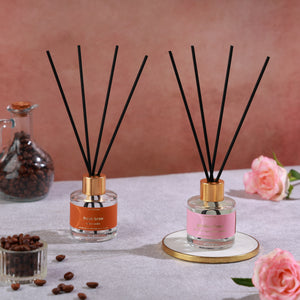
Morning Freshness reed diffuser
For the month after, when the corner is finally empty of it
Morning Freshness reed diffuser ₹749
Malabar lemon, peppermint and eucalyptus in the alcohol-free reed line. I am naming this at the end of a long clearing job rather than in the middle of one, because a reed placed on the dresser while a wardrobe is still off-gassing will simply be the second thing in the room. Once the cupboard has been empty, wiped, relined and left open for a fortnight, a lemon and eucalyptus register is a good way to give that corner a character of its own — it reads as air and laundry rather than as perfume, which is precisely the impression a room that used to smell of mothballs is short of. It takes 24 to 72 hours to establish. From ₹749, 130ml from ₹1,249, 300ml refills ₹2,399.
SS
ISIPCA
Versailles
A note from Sonal

I get this question in a particular tone of voice, usually from somebody who has just moved into a flat or inherited a piece of furniture, and it is almost always half apologetic. Nobody in the house chose the mothballs. They were a completely rational decision taken by somebody thirty years ago in a country with a serious moth and silverfish problem and no sealed storage worth speaking of, and the person who made it was looking after their good saris and their winter wool. I say that because the internet is full of scolding on this subject and it is not useful. What is useful is knowing that the material sublimes, which is why it got everywhere, and that the wood and the paper are now doing the releasing rather than the balls.

So the honest advice costs nothing and takes longer than anybody wants. Empty it, wash what washes, hang the wool outside for three days, wipe the inside, bin the lining paper and then leave the doors open for a fortnight with a fan pointed in. Six weeks in, ask a friend to put their head in and tell you the truth, because you will have stopped being able to judge it. What I will not do is sell you a reed to put on that shelf. It would not work, it would make the smell more complicated rather than less, and you would rightly blame the product. When the cupboard is genuinely clear and you want the corner of the bedroom to smell of something chosen, Morning Freshness at ₹749 on the dresser is a good answer. Not before, and not inside.

Everything is made and supported from Pune, and a part of every order funds girl-child education through Nanhi Kali. You get a home that smells like somewhere you chose; a girl gets a classroom. That equation has always felt right to me.

Frequently asked questions

Why does my wardrobe still smell of naphthalene after I removed the mothballs?
Because the cupboard has become the source. Naphthalene sublimes from solid straight to vapour, saturates the enclosed air, and is then absorbed into the timber, the lining paper, plastics and the clothes. Those reservoirs keep releasing for weeks after the last ball has gone.
How long does it take to get the mothball smell out of a wardrobe?
Clothes clear in a day or two of airing or one wash. Plastics and leather take several weeks. Old unsealed timber can take one to two months of genuinely open doors and a ventilated room. There is no product that shortens it, and anything you shut in there slows it down.
Can I use a fragrance or a diffuser to cover the naphthalene smell?
No, and it makes things worse. A nose detects difference rather than averaging two smells together, so you get the naphthalene and the fragrance in sequence every time the door opens. Deal with it by air, and scent the room afterwards if you want to.
Are mothballs actually harmful?
Naphthalene is a pesticide and is treated as a hazardous substance by regulators in a number of countries; consumer sale of naphthalene mothballs has been withdrawn across the European Union. The usual guidance is to keep it away from where infants sleep or where their clothes are kept, which is one more reason to ventilate rather than to reseal.
What should I use instead of mothballs?
Aromatic cedar blocks, a dried lavender or herb sachet, a properly sealed garment bag for the pieces that matter, and a desiccant to control humidity. Clothes moths go for worn wool rather than clean wool, so storing things clean does most of the work. SOSA makes none of those four things.
A smell you inherited, and the only two things that shift it
It sublimes, so it went everywhereand only air and weeks bring it back out
Nothing on this page costs anything until the cupboard is clear. Afterwards, the alcohol-free reed line starts at ₹749 for Morning Freshness, ₹799 for Garden Bloom and Evening Calm and ₹849 for Fresh Brew and Mountain Breeze, with 130ml from ₹1,249 and 300ml refills at ₹2,399; a reed needs 24 to 72 hours to establish. The Boond is ₹899 and the Sukoon ₹1,899 for 270–320 sq ft with steady, 2H and 4H timers and three 15ml Hotel Collection scents of your choice included. Free shipping above ₹499, and a portion of every order supports girl-child education through Nanhi Kali.
See what SOSA actually makes → Morning Freshness · ₹749
Continue the read
More from SOSA
Editorial standards & sources
About this guide: Written by Sonal Sahani, ISIPCA Versailles-trained founder and perfumer at SOSA Home & Body, on why a wardrobe goes on smelling of mothballs long after the mothballs have gone — because naphthalene sublimes from solid directly to vapour, saturates an enclosed volume and partitions into the timber, the lining paper, plastics and every garment inside — with the clearing procedure set out week by week, the clearing times for each material, one brief factual note on why ventilation matters for more than one reason, and the modern replacements, none of which SOSA makes.

Facts verified August 2026: Diagnostic facts used in this guide: a closed room accumulates what it cannot exchange, so cross-ventilation needs two openings rather than one; a drain's U-bend water seal evaporates in roughly two to four weeks of disuse and then admits sewer gas, which is corrected by pouring water down the drain; microbial growth in fabric and on surfaces accelerates above about 60% relative humidity, and Indian monsoon indoor humidity commonly runs 80–95%, which is the one situation where ventilating on a wet day can import moisture rather than remove it; an air-conditioner's cold, wet evaporator coil and filter grow biofilm that is blown into the room on start-up; textiles adsorb cooking aerosol and body oils and re-release them for weeks; and olfactory adaptation makes a constant household smell undetectable to its residents within about a fortnight while visitors still perceive it. Timings: a scented candle scents a normal room in roughly 15–20 minutes, a Sukoon ultrasonic diffuser reaches a steady level in about 20 minutes from cold, and a reed diffuser needs roughly 24–72 hours. SOSA products and prices: Sukoon 500ml ₹1,899 (270–320 sq ft, 16–18h on low, 9–12h high, 30–50 ml/h, 2.4MHz cool mist, remote, steady/2H/4H timers, BPA-free, auto shut-off, includes three 15ml Hotel Collection scents of your choice); Boond 300ml ₹899; Megh 6-litre ₹3,499; waterless Vaayu ₹11,999 (up to 1000m³); Aangan ₹25,999. Hotel Collection water-based fragrance 15ml ₹299, 100ml ₹999, 300ml ₹1,799, Pack of 7 at 15ml ₹1,799; dose 3–6 drops per tank. Reed diffusers (separate alcohol-free line): Morning Freshness from ₹749, Garden Bloom and Evening Calm from ₹799, Fresh Brew and Mountain Breeze from ₹849; 130ml from ₹1,249; duos from ₹1,498; 300ml refills ₹2,399. Scented candles: Bookshop 80g ₹379, Amber Rose 130g ₹599 and 220g ₹799, Smoked Oudh 130g ₹449, ceramic jar candles ₹949, Pure Calm wax melt set ₹854. Free shipping above ₹499. SOSA does not make a room or linen spray for the home. The Hotel Collection scents are SOSA's own interpretations; SOSA is not affiliated with or endorsed by any hotel brand. Prices subject to change — see the live product pages.
Back to blog