




Cause B, the sealing: to use the air conditioner you close the room. It does not stop producing smell when it is closed. It stops removing it, and eight hours of accumulation is what you wake up into.
The test: if the smell is strongest in the first minute after switch-on and then fades, it is the machine. If it is absent at midnight and worst at six in the morning, it is the sealing.
Both fixes are free: filter out and washed, ten minutes of cross-ventilation before the AC goes on and ten more on waking, and fan mode for the last ten minutes to dry the coil.
2. The machine. A split unit's evaporator coil runs far colder than the room. Water condenses on it for as long as the compressor runs, the filter in front of it is damp and full of the dust it has caught, and biofilm establishes itself on both. When the fan starts, the first surge of air lifts some of that and delivers it to you.
3. The sealing. Using an air conditioner means closing the room, and a split unit recirculates rather than ventilates. It cools the air that is already in there and takes nothing from outside. So for eight hours nothing leaves: not what two sleeping people give off, not what the mattress and the cupboard and the paint are slowly releasing, not last night's dinner still sitting in the curtains.
4. The test takes one night. Note when the smell peaks. If it is loudest in the first minute after switch-on and then fades away, it is the machine, because a finite deposit is being blown off and used up. If it is barely there at eleven and worst at the moment you open your eyes, it is the sealing, because concentration has been rising steadily all night.
5. Both repairs are free, and neither of them is a bottle. Filter out and washed. Ten minutes of genuine cross-ventilation before the AC goes on and ten more on waking, with two openings rather than one. The last ten minutes of the night in fan mode so the coil dries instead of being switched off wet.
A portion of every order supports girl-child education through Nanhi Kali.

Two causes wearing the same costume
The reason this question is asked so often, and answered so badly, is that both causes are invisible and both peak in the same room on the same night. You are not smelling one thing that has two explanations. You are smelling two things, at different moments, with a sleeping person in between who cannot report on the difference. Once they are separated the whole problem becomes tractable, because one of them is a maintenance job that takes ten minutes and the other is a habit that takes twenty, and neither of them has anything to do with how clean your bedroom is. That last part is worth saying plainly, because most people arriving here have already scrubbed a room that was never dirty.
The test that separates them, in one night
Six observations you can make without buying anything, and what each one rules in and out. The first row is the decisive one and the only one most people need. Note that three of the six are timing observations rather than smell descriptions — when a smell arrives is far more diagnostic than what it smells like, and it is the part almost nobody thinks to record.
| What you notice | Points at the machine | Points at the sealed room | What to do, and the cost |
|---|---|---|---|
| When it peaks ★ | Strongest in the first sixty seconds of switch-on, then fades and does not come back | Absent at bedtime, climbing through the night, worst in the first seconds after waking | Filter washed · ventilate at both ends of the night · ₹0 |
| What it smells of | Sour, vinegary, wet cloth, old sock — a damp note with an edge on it | Flat, warm, closed, faintly bodily and slightly sweetish; no sharpness at all | Different causes entirely. Do not treat them together |
| Fan mode from cold, compressor off | The smell still arrives, because the deposit is on the filter and coil regardless of cooling | Nothing arrives; running the fan in a stale room simply moves stale air about | A thirty-second test with the remote · ₹0 |
| After twenty minutes with two windows open | Air clears, then the smell returns the moment the unit restarts | Air clears and stays clear until the room is sealed again | Tells you which repair to spend your evening on · ₹0 |
| Who notices it | Everyone, immediately, including you — it is loud and brief | Visitors and whoever walks in at seven; rarely the person who slept there | Ask one honest person rather than trusting your own nose · ₹0 |
| Season | Worst in the humid months, when the coil condenses most and dries least | Present all year, but far worse once the room is sealed nightly rather than left open | Filter fortnightly in season; ventilation always · ₹0 |
The night routine, and the dose that comes after it
Take it as a shape for the evening rather than as a list of chores, because that is what makes it stick. Twenty minutes before the air conditioner goes on, open two windows on opposite or adjacent walls — one open window is ventilation and two is exchange, and ten minutes of genuine cross-draught achieves more than an hour of a single window ajar. You are not airing the room for its own sake; you are deliberately choosing what gets sealed in, because whatever is in the room at the moment you close it is what you will be breathing at six. Then shut up the room and cool it. Then, at the other end, set the unit to fan mode for the last ten minutes rather than switching it off at the wall while the coil is soaked — many remotes have a dry or self-clean setting that does precisely this, and on the ones that do not, ten minutes of fan is the manual equivalent. On waking, before anything else, open the same two windows for ten minutes. That single habit is the difference between a bedroom that resets every morning and one that carries yesterday into today, and it is free. Add the filter to the calendar — out, rinsed, dried completely, replaced, every two to four weeks while the machine is running daily — and if there is an attached bathroom nobody uses, a mug of water down its floor drain once a fortnight. Everything in this paragraph costs nothing, and between them these four habits solve the great majority of the emails I receive on this subject.
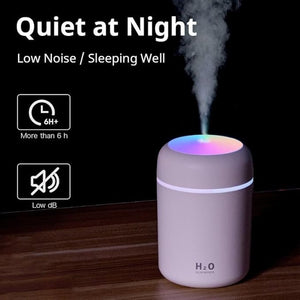
Only then is there anything for a fragrance to sit on, and in this particular room the instruction is restraint. The Hotel Collection is composed at three to six drops per tank, and an air-conditioned bedroom takes three. A sealed room does not disperse a scent outwards the way an open one does, so the level you set is the level that stays, and a fourth drop in a room with the door shut behaves like a fifth in a room with it open. Run it on the 2H timer while you are reading and let it stop before you sleep, rather than running a machine all night beside your head; the Sukoon at ₹1,899 gives 16 to 18 hours per fill on low at 30 to 50 ml/h against 9 to 12 on high, with a 2.4MHz cool-mist plate, a remote, auto shut-off and steady, 2H and 4H timers, and three 15ml scents of your choice arrive with it. The Boond at ₹899 is the honest smaller answer for one bedroom, and the dose is per tank rather than per litre, since you are scenting the mist and not the water, so the smaller machine costs nothing in fragrance and puts less into the air each hour. Placement has one rule specific to this page: keep the machine out of the air conditioner's blast. A cold draught across a diffuser strips the light top off a composition and leaves the heavy end standing on its own, which is how a clean scent starts reading as thick without the dose having changed. Waist height or above, on the far side of the room from the indoor unit, never on the floor, since cool mist falls rather than rises.
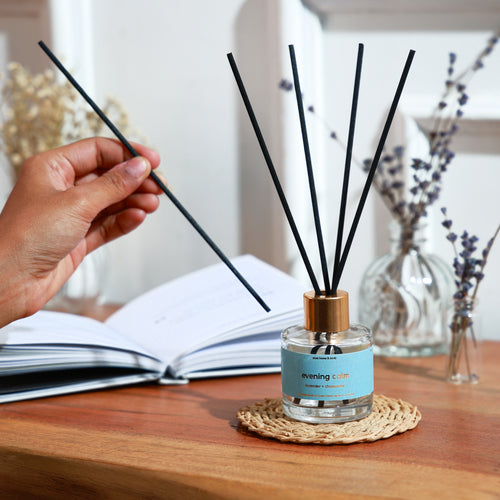
Then the constraints and the principle. Within about a fortnight you will stop being able to smell your own bedroom at all, because olfactory receptors report change and discard constants, and the instinct that produces is to add drops while every visitor is still receiving the level you originally set. In a sealed room that instinct is more dangerous than usual, for the reason given above. One honest guest asked to be truthful rather than polite is worth more than any adjustment you can make by nose. On the constraints: the Hotel Collection is water-based and runs in the Sukoon, the Boond and the Megh only — not in a reed diffuser, which is a separate alcohol-free line with its own scents, and not in the waterless Vaayu at ₹11,999, which takes its own undiluted oil. Never put raw essential or carrier oils into an ultrasonic machine, because they clog the 2.4MHz plate, and rinse the tank when you change scent. SOSA does not make a room or linen spray for the home; the sprays in the range are car perfumes. And if you would rather have nothing to switch on at all in a room you sleep in, Evening Calm at ₹799 — Himalayan lavender and chamomile — holds one level for months, though it needs 24 to 72 hours to establish and is therefore the wrong purchase for tomorrow. The principle underneath all of it: fragrance is a finishing layer on air that is already clean and already moving. It has no opinion about a coil and no effect on a sealed room, and anybody who tells you otherwise is selling you the second smell rather than fixing the first.
The SOSA edit
In the order I would actually do things, which begins with two rows that cost nothing and one that SOSA does not sell. The fragrance rows are genuinely fourth and fifth, and the last row states plainly what this page cannot help you with, because an honest edit is more useful to you than a longer one.
| Buy | What it is | When it earns its place | Price |
|---|---|---|---|
| 1. The filter, and fan mode ★ | Filter out, rinsed, dried and replaced every two to four weeks in season; the last ten minutes of the night on fan so the coil dries | First, always. If the smell is a first-minute burst that fades, this is the entire answer | ₹0 |
| 2. Two windows, twice a day | Ten minutes of cross-ventilation before the AC goes on, ten more on waking, with two openings rather than one | For the smell that builds through the night. Nothing you can buy replaces it | ₹0 |
| 3. An AC service | A technician cleaning the evaporator coil, the blower and the drain, once a season | If the first-minute smell survives a clean filter. SOSA does not sell this and cannot help with it | Not ours |
| 4. Hotel Collection 15ml | Seven water-based scents, three to six drops per tank, ultrasonic only. Three drops in a sealed bedroom | After the two free rows, never instead of them. A cool bottle suits a cold room better than a warm one | ₹299 |
| 5. Sukoon or Boond | 500ml for 270–320 sq ft with steady, 2H and 4H timers and three scents included, or 300ml for a single room | For the timer rather than the coverage. Two hours before sleep, then off | ₹1,899 / ₹899 |
| Evening Calm reed — the no-switch option | Himalayan lavender and chamomile, alcohol-free, from the separate reed line | If a nightly routine is not going to happen. 24 to 72 hours to establish, then months at one level | ₹799 |

Versailles
I have had this conversation more times than any other in the last two summers, and it nearly always goes the same way. Somebody writes to say their bedroom smells stale in the morning, they have cleaned everything, and would a diffuser help. I ask two questions back: when exactly is it worst, and when did you last take the filter out. The second question is usually met with silence, and the first one solves the case. Four years is the commonest answer I get about the filter, and it is not carelessness — nobody tells you. The machine is sold as an appliance that makes cold air, and the fact that it is also a wet surface with a fan behind it does not appear in the brochure.
The part I feel more strongly about is the second cause, because it is the one nobody thinks of as a cause at all. We have collectively decided that an air-conditioned room is a fresh room, and it is the opposite: it is the most thoroughly sealed volume most of us ever sleep in. Eight hours, two people, no exchange with anywhere. When I say ten minutes of two windows before bed and ten on waking, people are sometimes disappointed, because it sounds too small to be the answer to something that has bothered them for years. It is usually the answer. And I would rather send you away with a habit that costs nothing than sell you a bottle that would sit on top of the problem and make it harder to identify.
Everything is made and supported from Pune, and a part of every order funds girl-child education through Nanhi Kali. You get a home that smells like somewhere you chose; a girl gets a classroom. That equation has always felt right to me.
Frequently asked questions
- Why the AC smells musty for the first minute after switch-on — the mechanism behind cause A, in full.
- Why the smell comes back every time you close the room — the principle behind cause B, and what it means for how much fragrance to use.
- How often to clean an AC filter — the numbers, the method and a maintenance calendar.
- Why your bedroom smells weird every morning — the same hour, without an air conditioner in the room.
- Brand: the SOSA founder story.
Facts verified August 2026: Diagnostic facts used in this guide: a closed room accumulates what it cannot exchange, so cross-ventilation needs two openings rather than one; a drain's U-bend water seal evaporates in roughly two to four weeks of disuse and then admits sewer gas, which is corrected by pouring water down the drain; microbial growth in fabric and on surfaces accelerates above about 60% relative humidity, and Indian monsoon indoor humidity commonly runs 80–95%, which is the one situation where ventilating on a wet day can import moisture rather than remove it; an air-conditioner's cold, wet evaporator coil and filter grow biofilm that is blown into the room on start-up; textiles adsorb cooking aerosol and body oils and re-release them for weeks; and olfactory adaptation makes a constant household smell undetectable to its residents within about a fortnight while visitors still perceive it. Timings: a scented candle scents a normal room in roughly 15–20 minutes, a Sukoon ultrasonic diffuser reaches a steady level in about 20 minutes from cold, and a reed diffuser needs roughly 24–72 hours. SOSA products and prices: Sukoon 500ml ₹1,899 (270–320 sq ft, 16–18h on low, 9–12h high, 30–50 ml/h, 2.4MHz cool mist, remote, steady/2H/4H timers, BPA-free, auto shut-off, includes three 15ml Hotel Collection scents of your choice); Boond 300ml ₹899; Megh 6-litre ₹3,499; waterless Vaayu ₹11,999 (up to 1000m³); Aangan ₹25,999. Hotel Collection water-based fragrance 15ml ₹299, 100ml ₹999, 300ml ₹1,799, Pack of 7 at 15ml ₹1,799; dose 3–6 drops per tank. Reed diffusers (separate alcohol-free line): Morning Freshness from ₹749, Garden Bloom and Evening Calm from ₹799, Fresh Brew and Mountain Breeze from ₹849; 130ml from ₹1,249; duos from ₹1,498; 300ml refills ₹2,399. Scented candles: Bookshop 80g ₹379, Amber Rose 130g ₹599 and 220g ₹799, Smoked Oudh 130g ₹449, ceramic jar candles ₹949, Pure Calm wax melt set ₹854. Free shipping above ₹499. SOSA does not make a room or linen spray for the home. The Hotel Collection scents are SOSA's own interpretations; SOSA is not affiliated with or endorsed by any hotel brand. Prices subject to change — see the live product pages.