
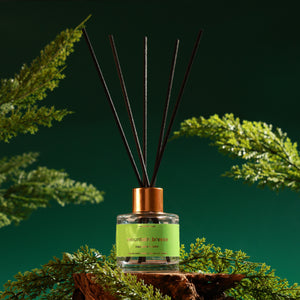

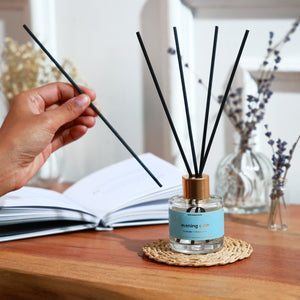
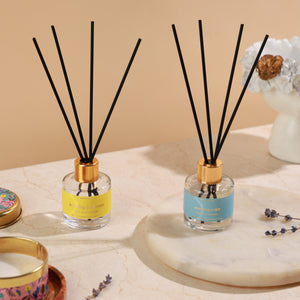
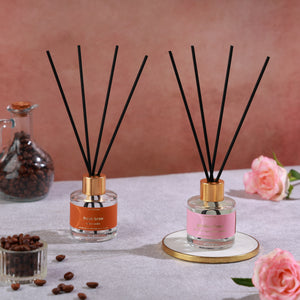
The fibre caveat: our reeds hold up through 85% humidity where rattan clogs. They are stripped by moving air exactly as fast as any other reed. Do not treat fibre as permission to stand a bottle in an AC stream.
The best surface in most homes is the entrance console or a sideboard beside a doorway — no direct sun, chest height, and the passing traffic that a passive format needs to distribute at all.
Always on a tray. Reed oil marks wood and stone, and the ring is permanent by the time you notice it. Keep bottles and spare reeds away from children and pets.
2. At waist to chest height. Fragrance released at ankle height sits low and gets walked through; released above head height it drifts along the ceiling. Chest height is where a nose is and where the room's ordinary currents will carry it.
3. With genuine clearance around the bottle. Not at the back of a crowded shelf, not inside a cabinet, not tucked behind a curtain or a plant. Fragrance released into an enclosed pocket pools within a foot of the glass, which produces the commonest complaint in this category and has nothing to do with strength.
4. Several feet clear of an AC vent, a table fan or the sweep directly under a ceiling fan. Continuous mechanical air keeps the reed surface stripped for hours, so the bottle runs at a raised rate and the fragrance is carried away rather than into the room. Hold a tissue where the bottle stands; if it lifts and keeps lifting, move.
5. Out of direct sunlight, on a tray. Sun heats the oil, thins it and shortens the bottle regardless of whether the window is open. And reed oil marks wood and stone — always a tray or coaster, spare reeds standing in a small glass, everything away from children and pets.
6. Fibre reeds do not change any of the above. They change what happens in a monsoon, where rattan clogs and fibre keeps wicking. That is a real SOSA advantage and it is a humidity advantage only.
Composed and handmade in small batches in Pune, and a portion of every order supports girl-child education through Nanhi Kali.
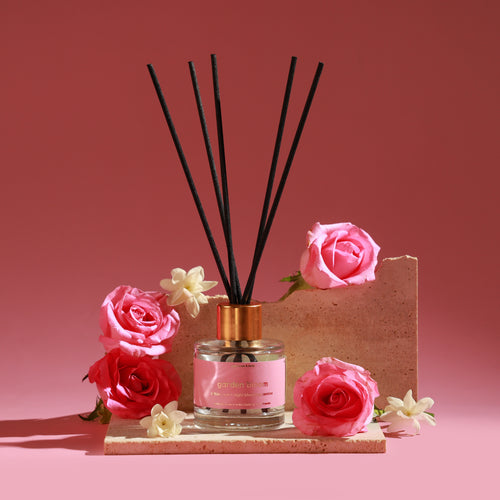
Part one — the three coordinates, and the fibre caveat
Placement advice usually arrives as a list of don'ts, which is hard to act on when you are standing in a room holding a bottle. It is easier to think in three coordinates: how high, how clear, and what kind of air. Get those three right and the don'ts take care of themselves, because every bad placement fails at least one of them. A cabinet interior fails clearance. A windowsill fails air and usually light. A low coffee table fails height. The cards below take each coordinate in turn, and the third one is where SOSA's fibre reeds need a caveat rather than a boast.
 Evening Calm₹799 · 8.9/10The second coordinate is the one people break for aesthetic reasons. A diffuser looks charming tucked between books, behind a lamp, inside a display cabinet or half-hidden by a trailing plant, and in every one of those positions the fragrance released simply fills the small pocket of still air around it and stops. You have not made a quiet fragrance; you have made a small one. Leave real space on at least two sides, keep the reeds standing free rather than leaning against anything, and avoid deep shelves where the bottle sits at the back. This coordinate matters most for the softer compositions — Evening Calm at 8.9 on our internal scale is deliberately the quietest thing we make, built for sleep rather than for announcing itself, and it has no headroom to spare for a bad shelf. Give the loud ones a poor position and they underperform. Give a sleep fragrance a poor position and it disappears entirely.
Part two — the room-by-room map for an Indian flat
Every room has its own characteristic air, and the placement that works in a bedroom is wrong in a kitchen. This is the map I would give someone unpacking their first SOSA bottle. Reed counts are starting points, not rules: six is the count each composition is dosed for, four is the quiet setting, and nine is a hosting setting that costs you weeks. Scents are suggestions matched to what each room is for.
| Room | The air it actually has | Best surface | Reeds to start | The scent I would choose |
|---|---|---|---|---|
| Entrance hall ★ | The front door stirs it several times a day — ideal intermittent air | Console or shoe cabinet top, chest height, on a tray | Six | Garden Bloom 8.9 — first impression, no insistence |
| Living-dining, open plan | Long and divided; one point source rarely reaches both ends | Sideboard near the connecting doorway, not the centre | Six each, two bottles | Fresh Brew 9.5 with Garden Bloom — they meet on warmth |
| Bedroom with a split AC | Sealed and still when off, a directed stream when on | Dressing table or bedside on the wall away from the unit | Four to six | Evening Calm 8.9 — the softest, built for sleep |
| Home office or study | Low traffic; often a closed door all day | Open shelf at eye level beside the desk, not on it | Six | Mountain Breeze 9.4 — dry, grounding, no sweetness |
| Bathroom | Small, humid, an exhaust fan running in bursts | Shelf or counter away from the extractor and the shower | Four | Morning Freshness 9.0 — cold and clear in damp air |
| Kitchen | Cooking air, extractor, open window — hostile and intermittent | Passage side of the kitchen, well away from the hob | Six | Fresh Brew 9.5 — coffee belongs in that room |
| Nursery or reading corner | Small, often closed, and shared with someone sensitive | High shelf out of reach, still with clearance | Three to four | Evening Calm 8.9 at a reduced count |
| The honest caveat: reed counts here are SOSA working guidance rather than specifications, and they cost bottle life roughly in proportion — a 50ml is rated 6–8 weeks at six reeds with weekly flipping, no draught and no direct sun, while nine reeds brings that closer to five weeks and ten to four or five. Strength figures are positions on our own internal scale at six reeds, not an industry standard and not a concentration. And never diffuse over live cooking: extractor on, window ten minutes, close up, then wait half an hour. Fragrance layered onto frying makes a third smell nobody designed. | ||||
Garden Bloom · entrancefrom ₹799Shop → 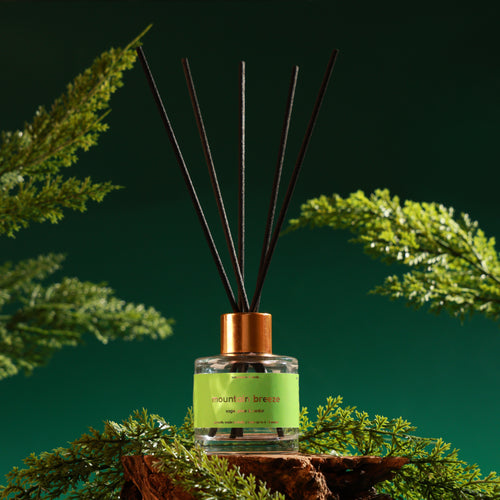 Mountain Breeze · studyfrom ₹849Shop →
 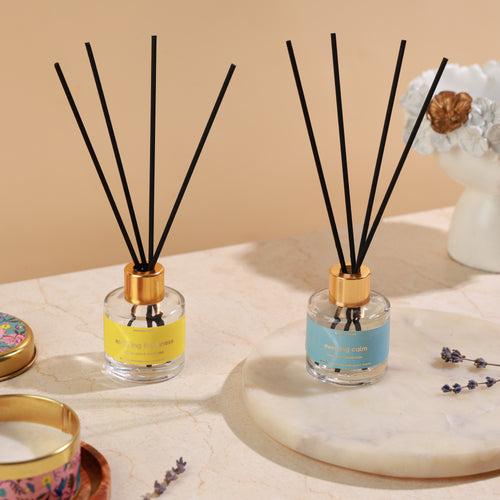 Day & Night duo₹1,498Shop →
Part three — when one well-placed bottle is still the wrong plan
Placement has a ceiling, and it is worth knowing where it is before you spend another evening moving furniture. A reed diffuser is a point source with no propulsion, so its reach is set by the room's own air. In a long or divided space, no shelf exists that solves the problem — you can place a single bottle perfectly and still have a dining end that never smells of anything, because the fragrance has to cross a distance that still air will not carry it. The correct answer there is more sources rather than more air or more oil: output per bottle is fixed at a given reed count, so two 50ml at opposite ends of an open living-dining will beat one 130ml standing in the middle. Two 50ml is ₹1,498 to ₹1,598 as a duo set, and the Day & Night duo at ₹1,498 is the version most homes use across a bedroom and a living room.
If two bottles will share connected air, choose compositions that meet on a note or you will smell the seam where one ends and the other begins. Mountain Breeze and Morning Freshness meet on green eucalyptus; Fresh Brew and Garden Bloom meet on warmth and a soft musk. Rooms separated by a door can hold anything you like. And while you are placing things, a related honesty: a bigger bottle is not a placement solution either. A 130ml lasts 14–18 weeks against 6–8 and at six reeds projects about the same, so it buys duration and never reach. If someone tells you otherwise about any brand's product, they are selling you the wrong variable.
Past roughly 250 to 300 sq ft of connected open volume, or when what you want is scent on demand — before guests, after cooking, on some evenings and not others — placement stops being the constraint and the format is. A reed diffuser is constant, passive and deliberately low; it cannot surge, and that is design rather than failure. The honest answer at that point is a Sukoon at ₹1,899, which covers 270–320 sq ft, runs 16–18 hours on low, has steady, two-hour and four-hour timers and includes three 15ml Hotel Collection scents. Two things not to do: do not buy a Megh at ₹3,499 for coverage — it is a 6L runtime machine at around 100 hours and only about 215 sq ft, so it buys hours, not area — and do not put reed oil in any machine or the water-based Hotel Collection in a reed bottle. Most homes end up running both formats, in different rooms, doing different jobs.
Part four — the five-minute placement audit
Run this once, in the room that is disappointing you, before buying anything at all. Five steps, five minutes, and a tissue is the only equipment.
| Step | What to do | A pass looks like | A fail means |
|---|---|---|---|
| 1. The tissue ★ | Hold a tissue beside the bottle for one minute | It stirs occasionally when someone walks past | Dead still: no distribution. Steadily lifting: you are in a stream |
| 2. The hand | Touch the glass at four in the afternoon | Cool, the same as the surface it stands on | Warm: direct sun is shortening the bottle. Move two feet inward |
| 3. The height | Stand normally and note where the reed tips sit | Between your waist and your chest | Too low or too high: the fragrance is not meeting anyone |
| 4. The clearance | Look at what is within a hand's width of the reeds | Open air on at least two sides | Books, walls, curtain, cabinet: the fragrance is pooling |
| 5. The wet line | Lift one reed and find the oil boundary on the fibre | Climbing steadily, a clear boundary partway up | High and dark: flip all six. Barely above the oil: refresh the reeds |
| Then, and only then | Add reeds, or change composition | Nine reeds for hosting, six as standard | Nine reeds costs weeks — roughly five instead of eight on a 50ml |
| Not an audit step: buying a 130ml | It is the same projection at six reeds | 14–18 weeks instead of 6–8 | Duration, never reach — said plainly rather than sold |
Versailles
The decision to ship fibre reeds instead of rattan was made in a Pune July, watching a set of perfectly good rattan sticks stop wicking while the room slowly stopped smelling of anything. Rattan is a beautiful natural material and it is the wrong material for this country. Fibre was a fix for a specific Indian failure, and I am proud of it.
What I did not anticipate was how often that choice would be heard as a general promise. People write to say they chose SOSA because the reeds are robust, and then describe a bottle standing directly beneath a ceiling fan or in front of a split AC. Fibre does nothing for you there. The mechanism that strips a reed in a draught is the same for any material, and no reed we or anyone else could make would survive it — that is why the honest guidance is about the shelf rather than the stick.
So use the audit. It costs five minutes and a tissue, and in my experience it settles most complaints before anybody spends anything. If it turns out the room is simply larger than the format, I would rather tell you to buy a machine than sell you a third bottle. Everything we make is composed and handmade in small batches in Pune, and a part of every order funds a girl's classroom through Nanhi Kali.
Frequently asked questions
- Does airflow make it stronger or finish faster? — the intermittent-versus-continuous rule in full.
- Placing a diffuser in an air-conditioned room and near a fan.
- Should you put a reed diffuser near a window? — why the sun costs more than the breeze.
- The complete airflow and placement guide — the whole sub-cluster in one page.
- Brand: the SOSA founder story.
SOSA reed diffuser range & prices (verified August 2026): alcohol-free, phthalate-free, paraben-free and IFRA-compliant compositions on a heat-stable coconut-derived (CCT) carrier, low-VOC, supplied in a refillable glass bottle with six fibre reeds; 50ml lasts 6–8 weeks and 130ml lasts 14–18 weeks. Morning Freshness (Malabar lemon · peppermint · Nilgiri eucalyptus) 50ml ₹749 · 130ml ₹1,249 · 9.0/10; Garden Bloom (British rose · night-blooming jasmine) 50ml ₹799 · 130ml ₹1,299 · 8.9/10; Evening Calm (Kashmir lavender · chamomile) 50ml ₹799 · 130ml ₹1,299 · 8.9/10; Fresh Brew (Coorg coffee · Kerala vanilla) 50ml ₹849 · 130ml ₹1,349 · 9.5/10; Mountain Breeze (Himalayan pine · sage · Indian cedar) 50ml ₹849 · 130ml ₹1,349 · 9.4/10. Reed diffuser refills are oil only — you reuse your own vessel and reeds: 300ml ₹2,399 (roughly 8–11 months) · 500ml ₹3,499 (roughly 14–18 months), about ₹7–8 per ml against ₹15–17 per ml for a 50ml bottle. Duo sets ₹1,498–₹1,598 for 2 × 50ml and ₹2,498–₹2,598 for 2 × 130ml. Strength figures are positions on SOSA’s own internal strength scale, not an industry standard. Replacement reeds are not sold as a separate SKU; SOSA guidance is to refresh reeds every few months. The reed line is separate from the water-based Hotel Collection for ultrasonic machines (15ml ₹299 · 100ml ₹999 · 300ml ₹1,799) and the two are not interchangeable. Diffusers: Boond 300ml ₹899 · Sukoon 500ml ₹1,899 · Megh 6L ₹3,499 · waterless Vaayu ₹11,999. Composed and handmade in small batches in Pune, India; tested through 45°C summer heat and 85% monsoon humidity. Free shipping above ₹499. A portion of every order supports girl-child education through Nanhi Kali. Prices subject to change — see the live product pages.