
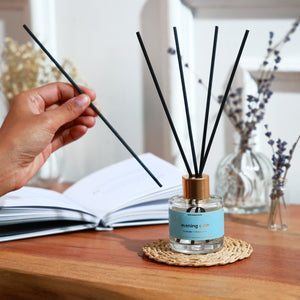
 Bedroom 50ml ₹799 Master bedroom 130ml ₹1,299
 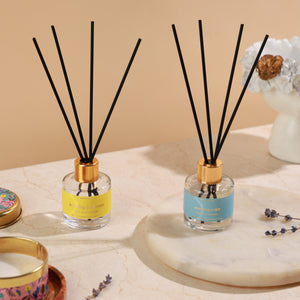 Two-bottle start ₹1,498
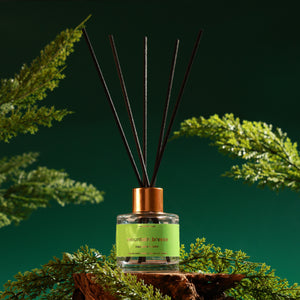
  Refill ₹3,499
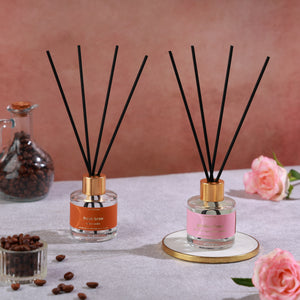
  Alt scent 50ml ₹849
The fix: stand the bottle at least a metre back from the window, clear of any direct sun path at any hour of the day, on the room side of the airflow between the window and the door. It costs nothing.
The exception: a north-facing window in a room that never sees direct sun, kept shut, is an acceptable surface. So is a small, high, frosted bathroom window.
2. Heat raises evaporation rate, and Indian summer sun through glass is not gentle heat. The composition is tested through 45°C so it will not spoil on a sill — it simply leaves faster, and a 50ml rated 6–8 weeks can empty in three on a south- or west-facing sill through summer.
3. Light strips the top notes before it strips anything else. This is why a windowsill bottle stops smelling like itself long before it runs dry — the bright, volatile part of a composition degrades under sustained UV, and what is left reads as flat and base-heavy. Two weeks of accurate scent is a realistic ceiling in direct sun.
4. An open window is not ventilation for a fragrance — it is an exit. A bottle on the sill of an open window sits closer to the outside air than to the room, and a cross-breeze running from that window to a door carries most of what evaporates straight past you rather than to you.
5. The fix costs nothing. At least a metre back from the glass, out of any direct sun path at any hour, on the room side of whatever airflow crosses the space. Hold a tissue where the bottle would sit — if it moves, so will your fragrance.
Alcohol-free, IFRA-compliant, composed by an ISIPCA Versailles-trained perfumer and handmade in small batches in Pune — and every purchase funds a girl's education through Nanhi Kali.
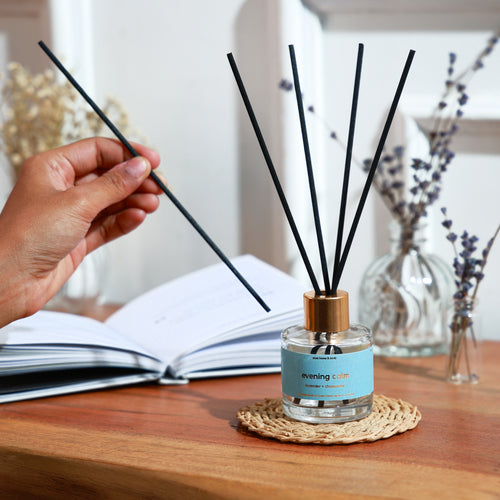
Why a windowsill looks like the right spot, and is not
The instinct is understandable. A windowsill sits at roughly the right height for a reed diffuser to be noticed, it is almost always free of the clutter that collects on a dresser, and a glass bottle with reeds fanning out genuinely looks good against a window. None of that is wrong as a piece of styling. It is wrong as a piece of engineering, because a reed diffuser has exactly one mechanism — oil climbing fibre reeds by capillary action and evaporating off the exposed ends at whatever rate the surrounding air permits — and that mechanism was tested and rated for a stable, shaded, still-air surface. A windowsill is the opposite of stable, shaded and still on three separate counts.
This matters more in a bedroom than almost anywhere else in the flat, because a bedroom bottle is already running on a smaller reservoir and a lower reed count by design — three reeds rather than six, so the room reads as calm rather than insistent while you sleep. That lower setting has less margin to absorb an aggressive environment. The same window exposure that merely shortens a six-reed living-room bottle by a few weeks can visibly wreck a three-reed bedroom bottle, because there is less oil movement to begin with and the heat, light and airflow acting on it are proportionally a bigger share of what is happening.
The three attacks below do not require all of them to be present before you have a problem — any one is enough to cost you real weeks, and a typical windowsill in an Indian flat usually has at least two running at once. A closed north window has none of the three. A closed west window has one. An open south window with a breeze running through the room has all three, and that is the combination that produces the "it was empty by week three" complaints I hear most often.
The three attacks, and the mechanism behind each
 Evening Calm 50ml₹799Glass magnifies sun before it even reaches the bottle, and a south- or west-facing sill through an Indian summer sits meaningfully hotter than the room around it for hours at a time. Evaporation rate rises with temperature, which is simple physics rather than anything specific to a reed diffuser, but the effect on a small reservoir is large: a 50ml rated 6–8 weeks can empty in three on a hot sill. The composition itself is tested through 45°C, so it does not spoil or turn — it simply leaves the bottle faster than the weeks you paid for.
Window situations, compared
Not every window is equally guilty, and the honest comparison is useful before you decide where the bottle goes. The figures below assume a standard bedroom bottle on three reeds, flipped every three to five days, and a 6–8 week rated life as the baseline against which "effect on life" is measured.
| Window situation | Effect on bottle life | Effect on scent accuracy | Verdict |
|---|---|---|---|
| South or west sill, open, direct sun for part of the day | Roughly halved — 3–4 weeks instead of 6–8 | Reads correctly for about 2 weeks, then flattens | Move it |
| East sill, morning sun only, window often open | Meaningfully shortened — 4–5 weeks | Reads correctly for 3–4 weeks | Move it |
| Sill with sheer curtain, window shut, some sun still gets through | Mildly shortened — 5–6 weeks | Slight fade after 4–5 weeks | Better, still move it |
| North-facing sill, window kept shut, no direct sun at any hour | Close to full rated life | Stable for the full bottle | Acceptable |
| At least 1m back from any window, out of the sun path | Full rated 6–8 weeks | Stable throughout | Correct |
| Small, high, frosted bathroom window | Full rated life, often longer on two reeds | Stable | Acceptable |
| Open window with a cross-breeze running to a door | Shortened regardless of sun, sometimes severely | Variable — depends on breeze strength | Move it |
| Note on north windows and frosted glass: both are acceptable because they remove two of the three attacks outright — no direct sun path means no meaningful heat or light exposure — and a north window kept shut removes the third. The moment either window opens regularly, re-run the tissue test described below. | |||
Evening Calm · standard bedroom50ml ₹799Shop → Evening Calm · master bedroom130ml ₹1,299Shop →  Refills · if it has already run downfrom ₹2,399Shop →
The one-metre rule, the tissue test, and the two real exceptions
The working rule is simple enough to apply without measuring anything precisely: stand the bottle at least a metre back from the glass, out of any direct sun path at any hour of the day — not just the hour you happen to check — and on the room side of whatever airflow moves through the space between the window and the door. A bedside table on the wall perpendicular to the window usually satisfies all three at once, which is why it remains the standard recommendation for a reed diffuser's placement in a bedroom generally, not just as a window workaround.
The tissue test settles any doubt in about ten seconds. Hold a strip of tissue paper where the bottle would sit, at the height it would sit. If it stirs at all with the window open, the spot sees enough airflow to carry the fragrance away faster than the room can hold it — move the bottle further from the window, or close the window when the room is unoccupied. Pair that with a hand check for heat: if the surface is warm to the touch in the early afternoon, it has been catching sun regardless of what the position looks like from across the room. Keep the bottle roughly a metre off the floor as with any placement, and above the reach of children and pets, since a reed diffuser is oil sitting in an open vessel.
Two situations are genuine exceptions, and it is worth naming them plainly rather than banning every window on principle. A north-facing window in a room that never receives direct sun, kept shut, removes the heat and light attacks entirely and, being shut, removes the airflow attack too — that sill is an acceptable surface for a bottle. And a bathroom with a small, high, frosted window is fine for the same reason: those windows are rarely opened wide, rarely admit a direct sun path, and the room is usually running on two reeds rather than three, which already errs towards a longer, gentler life. Everything else — any sill that gets a strip of sun at any hour, or any window that stays open for long stretches — is worth the metre of distance.
What it costs to get this right
The cheapest fix in this entire guide is also the most effective one: moving an existing bottle back from the glass costs ₹0 and can buy back weeks of life immediately. Buying anything new only makes sense once that move has already happened. For context across a whole flat, the standard multi-room kits run ₹2,847 for a 1BHK, ₹3,696 for a 2BHK, ₹4,445 for a 3BHK and ₹5,244 for a 4BHK — but a bedroom-window decision is a single-bottle decision, not a flat-wide one, and the numbers below reflect that.
| Setup | What you get | Reeds / longevity | Total |
|---|---|---|---|
| The free fix | The bottle you already own, moved at least a metre back from the glass | Unchanged reed count — recovers the full rated life | ₹0 |
| Small or shared room | Evening Calm 50ml, two reeds | Up to 10–12 weeks away from a window | ₹799 |
| Standard bedroom ★ | Evening Calm 50ml, three reeds | 6–8 weeks away from a window · roughly half that on a sunny sill | ₹799 |
| Master bedroom, 150 sq ft+ | Evening Calm 130ml, three reeds — never six | 14–18 weeks away from a window | ₹1,299 |
| Running cost | A 300ml refill ₹2,399, or 500ml ₹3,499 (₹7/ml) | 500ml is ten 50ml fills — roughly ₹350 a fill, against ₹749–₹849 for a new bottle | from ₹2,399 |
Versailles
Windowsills come up more than any other placement question, and almost always as a complaint about longevity rather than a question about placement — "my bottle keeps running out early, is it defective?" It very rarely is. What it usually is, is a bottle sitting on the one surface in the room that is simultaneously the hottest, the brightest and the most ventilated, which is a fair description of most windowsills in most Indian bedrooms for a good part of the year.
I understand the appeal completely — I have styled enough shelves myself to know a bottle looks right against morning light. But a reed diffuser was designed and tested for a stable, shaded surface, and a window is the opposite of that on three separate counts at once. The good news is that fixing it is the cheapest correction in this entire guide: pick the bottle up, put it down a metre away, and you have bought back most of what the window was taking.
If the bottle has already run down early, refill it rather than replace it — the glass was made for exactly that. Every purchase funds a girl's education through Nanhi Kali — not a percentage, not a quarterly cheque. Every one.
Frequently asked questions
- Where to place a reed diffuser in a bedroom — the full placement rule, window included.
- Reed diffuser on your bedside table — why it is usually the right surface instead.
- Reed diffuser near a bedroom door — the other draught to watch for.
- Reed diffuser in an air-conditioned bedroom — what the AC does that a window does not.
- Brand: the SOSA founder story.
SOSA reed diffusers & prices (verified August 2026): Morning Freshness (Malabar lemon · peppermint · eucalyptus) 50ml ₹749 · 130ml ₹1,249 · Evening Calm (lavender · chamomile) 50ml ₹799 · 130ml ₹1,299 · Garden Bloom (British rose · night-blooming jasmine) 50ml ₹799 · 130ml ₹1,299 · Fresh Brew (Coorg coffee · Kerala vanilla) 50ml ₹849 · 130ml ₹1,349 · Mountain Breeze (Himalayan pine · sage · cedar) 50ml ₹849 · 130ml ₹1,349. Duo sets: Day & Night 2 × 50ml ₹1,498 · 2 × 130ml ₹2,498; Fresh & Grounded 2 × 50ml ₹1,548 · 2 × 130ml ₹2,548; Warmth & Bloom 2 × 50ml ₹1,598 · 2 × 130ml ₹2,598. Refills 300ml ₹2,399 · 500ml ₹3,499. Six fibre reeds included with every bottle; refillable glass. 50ml suits rooms up to 150 sq ft and lasts 6–8 weeks; 130ml suits rooms above 150 sq ft and lasts 14–18 weeks. Fractionated coconut oil (CCT) carrier, alcohol-free, phthalate-free, paraben-free, IFRA-compliant, low VOC; tested through 45°C heat and 85% monsoon humidity. Composed and handmade in small batches in Pune. Ultrasonic machines quoted for comparison: Boond ₹899 · Sukoon ₹1,899 · Megh ₹3,499, which run the separate water-based Hotel Collection fragrances (15ml ₹299 · 100ml ₹999 · 300ml ₹1,799) — the two lines are not interchangeable. Every purchase funds a girl's education through Nanhi Kali. Prices and availability subject to change — see the live product pages.