
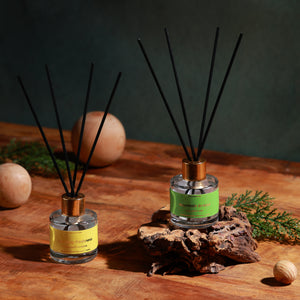

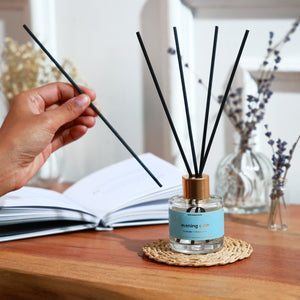
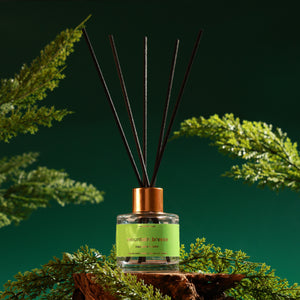

What several passive diffusers genuinely win, and it is not a short list: silence, no power at all, no single point of failure, nothing to fill or charge or remember, different scents in different zones, no added humidity or mineral dust, no appliance lifespan, and roughly ₹13–₹15 a day each with nothing to switch on. They also keep working in a power cut.
What one active diffuser genuinely wins: evenness across a volume, control — intensity as a setting rather than a weather report — and on-demand timing, so the room is scented for the hours you use it rather than continuously.
Free first, whichever you choose: six reeds rather than three, halve the distance, nose height on a surface, out of the draught but not in a dead corner, close the door, and the ceiling fan on low. The fan supplies the transport a reed lacks and it costs nothing, though it shortens the bottle.
Prices and the gap: reeds ₹749–₹1,349 · Sukoon ₹1,899 covers 270–320 sq ft · Megh ₹3,499 is never a coverage upgrade at about 215 sq ft · Safar ₹3,999 is named and sold as a car and travel diffuser · Vaayu ₹11,999 covers 1000 m³, roughly 2,000–3,000 sq ft, and is wrong for one bedroom. Between Safar and Vaayu there is no mid-sized waterless bedroom nebuliser.
2. For everything except evenness, several passive diffusers hold their own and often win outright. They make no sound at all. They need no socket, no water, no filling, no charging and no remembering. There is no single point of failure: if one bottle empties, the others carry on, and none of them can stop working in a power cut because none of them was ever working in the electrical sense. They add no humidity and leave no mineral dust. And they never break — there is no version of a reed diffuser that stops functioning in year three.
3. Several passive sources also do one thing a single machine structurally cannot: different scents in different places. One machine gives one room one smell. Three bottles let the study smell of Mountain Breeze, the bedroom of Evening Calm and the entrance of Garden Bloom. A home that smells identical throughout stops registering as a smell within a week, so this is a real advantage and not a consolation.
4. Against that, one active diffuser wins three rows and they are the rows your question is about. Evenness, as above. Control: intensity becomes a setting rather than a consequence of the weather, because reed emission climbs in a hot dry room, falls in saturated monsoon air and tapers as the bottle empties. And timing: a machine can run for an hour before you use the room and then stop, where a bottle runs continuously whether anyone is home or not.
5. So the honest decision rule is a question rather than a product. If you want one volume to read the same wherever you stand in it, buy the machine and start at Sukoon ₹1,899, which covers 270–320 sq ft. If you want several places to smell good with nothing to maintain, buy the bottles. If you want both — which is what I have at home — the machine handles the room and the bottles handle the bedside and the bathroom.
Alcohol-free, phthalate-free, composed in Pune. A portion of every order supports girl-child education through Nanhi Kali.
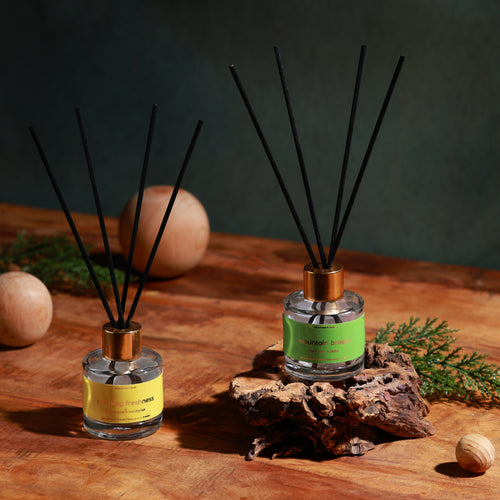
What each side genuinely wins
A comparison is only useful if it is willing to lose an argument, so here is each side’s real case, put as strongly as I can put it. Then the third card, which is the one that actually decides the purchase — not which side scores higher, but which single row you would be unwilling to give up.
 Evening Calm₹799Silence — total, not “quiet”; there is nothing in a reed diffuser that could make a sound. No power, so no socket, no cable, no charging, and it carries on through a power cut. No single point of failure: three bottles are three independent objects, and one running dry does not take the house with it. Nothing to maintain beyond flipping the reeds every three to five days — no tank to fill, no descaling, no mineral dust, no added humidity. Different scents in different zones, which one machine cannot do. And it never breaks; there is no year-three failure mode, because there is no mechanism. At roughly ₹13–₹15 a day per bottle it is also an object rather than an appliance, which for a lot of people is the entire point.
 Sukoon₹1,899Evenness, because the device disperses the oil internally and pushes it out with momentum, and a moving stream entrains the still air beside it and starts the circulation that mixing requires. Control, because intensity becomes a setting instead of a function of today’s temperature and humidity — a reed is brisk in a hot dry May, close and short-range in monsoon air, and quieter in week seven than week one, all of which is normal and none of which you can dial. Timing, because a machine can run for the hours you use the room and then stop; Vaayu offers 1h, 4h, 8h and 24h windows with a choice of days, and Safar has three speeds and a 1, 2 or 3-hour auto-off.
 Mountain Breeze₹849Scorecards invite people to count rows, which is the wrong operation. Nobody buys home fragrance on aggregate; they buy it on the one thing they keep noticing. So the useful question is: which single row would make you unhappy if you lost it? If the answer is “I want the room to read the same at the door and at the bed”, the machine wins and nothing else on the card matters. If the answer is “I do not want another appliance in my bedroom, and I like that it just sits there”, the bottles win and the evenness row is a price you are content to pay. If the answer is “I want my study and my bedroom to smell different”, you have already chosen passive, because one machine cannot do it.
The free changes that settle the question for a good many readers
Before either purchase, work this list for a week, because a fair number of people who arrive comparing two options discover they need neither. Reed count first: six fibre reeds is full projection, three is a soft bedside level and roughly doubles the life of the bottle. Distance: halving the gap between the bottle and where you actually sit or sleep does more than any change of scent. Height: at or slightly below nose height, on a surface, not the floor and not a high shelf. Draught: out of the AC blast, off the windowsill, away from an open balcony door — but not tucked into a dead corner either. The door: shut, for the hours that matter, since air that leaves takes the fragrance with it.
And then the one that bears directly on this comparison. Turn the ceiling fan on to its lowest setting, in a closed room. A fan is transport, and transport is the entire mechanical advantage the active side has on the scorecard — so switching it on buys you a meaningful share of that advantage for nothing, applied to the bottles you already own. It is the best free advice in this subject. The honest cost is bottle life: moving air over a wetted surface speeds evaporation, so a 50ml will not see out its full 6–8 weeks. I would far rather say that now than have anybody discover it in week five and conclude the oil was poor.
One more free change, which is about measurement rather than the room. Judge the result by leaving for fifteen minutes and walking back in, and by asking someone who does not live there. Receptors adapt to a constant stimulus within minutes, so a resident can sit in a well-scented room and honestly report nothing at all. A visitor is a better instrument than you are, and a page like this one should not talk anybody into ₹1,899 of hardware to solve a problem that turns out to be adaptation.
The full scorecard, row by row
Several passive sources against one active device, criterion by criterion, with the winner marked. Read down the left column and pick the two or three rows that matter to you; the rest is noise for your particular decision.
| Criterion | Several passive diffusers | One active diffuser | Winner |
|---|---|---|---|
| Evenness across one volume | Several peaks with the weakest readings between them | Broadly level across the rated area | Active |
| Control over intensity | Reed count only — a coarse dial, and the weather moves it | A setting, constant in May and in August | Active |
| On-demand timing | Runs continuously, occupied or not | Timers and schedules; scent the room for the hours you use it | Active |
| Silence | Absolute — there is nothing that could make a sound | Quiet, but not silent | Passive |
| Power and power cuts | No socket, no cable, unaffected by an outage | Mains or a battery that needs recharging | Passive |
| Single point of failure | None — three bottles are three independent objects | One device; if it fails, the whole room goes quiet | Passive |
| Maintenance | Flip the reeds every 3–5 days. Nothing to fill, charge or descale | Filling, cleaning, and in hard water a possible white mineral dust | Passive |
| Different scents in different zones | Yes — a study, a bedroom and an entrance can each be their own | One machine, one scent, one room | Passive |
| Lifespan | It never breaks; refill the glass and carry on | An appliance, with an appliance’s life | Passive |
| Humidity added to the room | None | Ultrasonic adds it; waterless nebulising does not | Passive, or waterless active |
| Entry cost | ₹749–₹849 a bottle; a duo ₹1,498–₹1,598 | ₹1,899 for Sukoon, plus oil | Passive at one bottle; close at three |
| Keeping your current reed scent | Obviously yes | No — reed oil does not go into a machine | Passive |
Passive · two zones, two scents₹1,548Shop →  Active · 270–320 sq ft₹1,899Shop →
 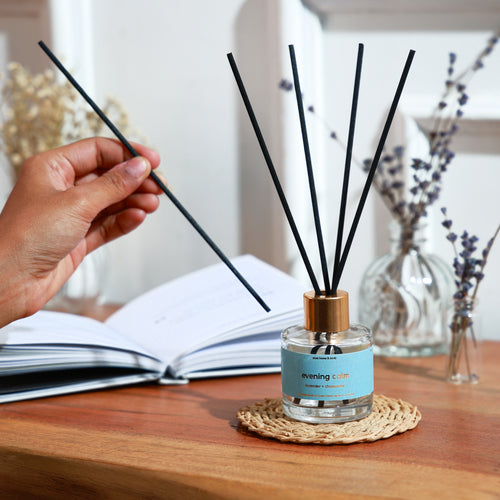 Passive · silent, no power₹799Shop →
When several passive diffusers are the correct purchase
I want these cases stated as clearly as the argument against, because they come up constantly and they are not consolation prizes. A long or L-shaped room used at both ends. If you have a bedroom with a working corner at one end and a bed at the other, or a living-dining space where people genuinely sit in two places, two bottles are the right answer — you are not trying to make one field, you are serving two occupied zones, and two point sources do that beautifully. Two rooms that are really one volume, joined by an open doorway, behave the same way; one machine will always favour the limb it is standing in.
Different scents in different places. This is the one people underrate. A home that smells identical throughout stops registering as a smell within about a week, because the nose habituates to a constant background; a home with a green study, a soft bedroom and a floral entrance keeps announcing itself at every transition. One machine cannot produce that. Three bottles can, at ₹749 to ₹849 each. And a budget short of a machine is a perfectly respectable reason: a 50ml at roughly ₹13–₹15 a day is a different kind of purchase from ₹1,899 in one go, and there is no virtue in spending more to solve a problem you do not have.
Two honest notes for the repeat buyer, since this comparison is usually made by someone on their second or third bottle. First, if you are tired of repurchasing, the 300ml refill at ₹2,399 is roughly six 50ml fills and tops up the bottle and reeds you already own — it is oil alone, so it is never a first purchase, but it is the sensible answer to consumption. Second, using three reeds rather than six roughly doubles how long each bottle lasts, and in a small bathroom two or three reeds can stretch a 50ml to nearly three months. Between those two things, the running-cost argument for a machine is weaker than most people assume — and I cannot compute the other side of it honestly anyway, because SOSA publishes no oil-consumption rate for its machines.
What to buy, in order — and the gap in our own range
The order I would actually spend in, whichever side of the scorecard you have landed on. The last row is the thing I cannot sell you at all.
| Buy | What it is | When it is the right answer | Price |
|---|---|---|---|
| 1. The free list, ending with the fan ★ | Reed count, distance, height, draught, door, ceiling fan on low in a closed room | Always first. The fan buys part of the active side’s advantage for nothing, at the cost of bottle life | ₹0 |
| 2. Two or three reeds, one per zone | 50ml up to about 150 sq ft, 6–8 weeks; 130ml above that, 14–18 weeks. Duos ₹1,498–₹1,598 | A long or L-shaped room used at both ends, two rooms that are one volume, or different scents per zone. Not for evenness in one open space | ₹749–₹1,598 |
| 3. Sukoon ₹1,899 ★ | Ultrasonic, 500ml, 270–320 sq ft, 16–18h on low, three 15ml Hotel Collection scents included | When evenness, control or timing is the row you cannot give up. Never skip it on the way to something dearer | ₹1,899 |
| 4. Safar ₹3,999, disclosed | Waterless cold diffusion of undiluted oil — no water, no dilution, no added humidity. 20ml, cordless, three speeds, 1 / 2 / 3-hour auto-off. Named and sold as a car and travel diffuser | The waterless mechanism at personal scale, if you can live with recharging it. Not set-and-forget | ₹3,999 |
| Two I would talk you out of | Megh ₹3,499: six litres and about 100 hours, but only about 215 sq ft — less than the Sukoon. Vaayu ₹11,999: 1000 m³, roughly 2,000–3,000 sq ft | Megh is a runtime and humidity machine, never a coverage upgrade. Vaayu is for a whole floor or an open-plan living-dining, never one bedroom | ₹3,499 / ₹11,999 |
| The honest gap | Between Safar and Vaayu there is no mid-sized waterless bedroom nebuliser in the SOSA range | Named plainly. Nothing here is “a Vaayu for one room” | — |
Versailles
I am wary of comparison pages that pretend to be even-handed and then quietly walk the reader to the dearer product. So let me be plain about my own house. I own both, and the bottles outnumber the machine. There is a reed on my bedside table, one in the bathroom and one on my desk, and each of them is a different scent, which is a thing no single device could give me. They make no noise, they need nothing from me except a flip on a Sunday, and they carried on quite happily through the last power cut.
What the machine does that they cannot is make one room read the same at both ends, on demand, at an intensity I choose rather than one the weather chooses. That is a genuinely different capability and it is worth ₹1,899 to anyone whose complaint is specifically about evenness. It is worth nothing at all to someone whose complaint is that their study and their bedroom smell the same.
So the honest answer to “which is better” is that the question is under-specified, and I would rather hand you the criteria than a verdict. Work the free list first — particularly the fan, which is the one free thing that buys part of the machine’s advantage. Then choose the row you care about. And if you do move to a machine, know before you pay that your favourite reed scent will not go into it; add rather than replace, and keep the bottle for the bedside. Everything is composed in Pune, and a part of every order funds a girl’s classroom through Nanhi Kali.
Frequently asked questions
- Even distribution across a bedroom — the head question, and the free method in order.
- Hot spots instead of consistency — why several sources make several peaks.
- The same strength at bed, desk and door — three sampling points on one gradient.
- One strong corner and three weak ones — the practical fixes, and the honest ceiling.
- Can active diffusion be more consistent? — the mechanism, explained rather than asserted.
- Fragrance in the air, not around the bottle — the vocabulary you need to search well.
- Distribution versus strength — the shape of the curve, not its height.
- Choosing by distribution, not bottle size — volume is duration, not coverage.
- Should I look beyond reed diffusers? — the family pillar, free fixes first.
- Brand: the SOSA founder story.
SOSA facts verified August 2026: Reed diffusers are supplied in 50ml and 130ml only — 50ml suits rooms up to about 150 sq ft and lasts 6–8 weeks, 130ml suits rooms above 150 sq ft and lasts 14–18 weeks, at roughly ₹13–₹15 a day. Six reeds is full projection; three is a soft bedside level and roughly doubles the life; two or three reeds in a 50 sq ft bathroom can make a 50ml last nearly three months; flip the reeds every 3–5 days. Morning Freshness ₹749 / ₹1,249 · Evening Calm ₹799 / ₹1,299 · Garden Bloom ₹799 / ₹1,299 · Mountain Breeze ₹849 / ₹1,349 · Fresh Brew ₹849 / ₹1,349. Duos: Day & Night ₹1,498, Fresh & Grounded ₹1,548, Warmth & Bloom ₹1,598 (50ml × 2); 130ml duos ₹2,498 / ₹2,548 / ₹2,598. Strength scale, perceived intensity rather than quality: Evening Calm 8.9 softest, Garden Bloom 8.9, Morning Freshness 9.0, Mountain Breeze 9.4, Fresh Brew 9.5 deepest. Six fibre reeds rather than rattan, heat-stable CCT carrier rather than DPG, alcohol-free, phthalate-free, paraben-free, IFRA-compliant, 0 ppm formaldehyde, refillable glass bottle, tested at 45°C and 85% RH, composed in Pune. Refills 300ml ₹2,399 (roughly six 50ml fills) and 500ml ₹3,499, oil only and never a first purchase. Machines: Boond ₹899 (300ml, up to about 150 sq ft, ~6h, USB, night light) · Sukoon ₹1,899 (500ml, 270–320 sq ft, 16–18h on low, three 15ml Hotel Collection scents included) · Megh ₹3,499 (6L, ~100h runtime but only ~215 sq ft, never a coverage upgrade) · Safar ₹3,999, a waterless cold-diffusion device named and sold as a car and travel perfume diffuser, with a 20ml bottle, a 2000 mAh battery, up to 10 hours continuous or about 30 hours intermittent per charge, three speeds and a 1 / 2 / 3-hour auto-off timer · Vaayu ₹11,999, a waterless cold-air nebuliser rated to 1000 m³, roughly 2,000–3,000 sq ft, with a 400ml tank, app and onboard control and under 38 dB operation, and the wrong purchase for one bedroom. Aangan ₹25,999 and Meenar ₹38,500 are commercial machines and are not home recommendations. No coverage figure is published for Safar and none is quoted here. Between Safar and Vaayu, SOSA has no mid-sized waterless bedroom nebuliser. Reed oil, the water-based Hotel Collection and pure fragrance oil are not interchangeable across these mechanisms, and the ₹299 Hotel Collection 15ml is a machine refill rather than a first purchase. No health, air-quality, allergy, sleep or mood claims are made anywhere on this page, and fragrance is not presented as a way to remove a smell. Free shipping above ₹499, and a portion of every order supports girl-child education through Nanhi Kali. SOSA is an independent Indian fragrance house; the Hotel Collection is SOSA's own interpretation inspired by the world's finest hotels and SOSA is not affiliated with or endorsed by any hotel brand. Prices subject to change — see the live product pages.