

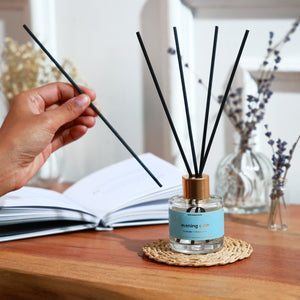

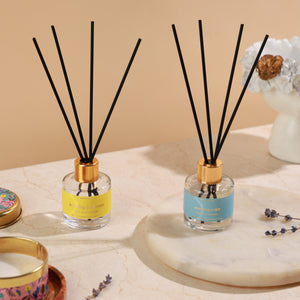

Why a passive reed diffuser cannot do it: it is a point source with one adjustable variable, namely where you put it. Your bed, desk and door are three sampling points on one gradient, and moving the bottle towards any one of them moves it away from at least one other. There is no placement that equalises three positions.
Free changes that narrow the gap substantially, and I would do all of them first: six reeds rather than three, halve the distance to wherever you spend most time, nose height on a surface, out of the draught but not in a dead corner, close the door, and the ceiling fan on low — the fan is real transport, applied to the bottle you already own. It shortens the bottle. That is the trade.
The ladder: Sukoon ₹1,899 covers 270–320 sq ft and is very often the right answer for one bedroom. Safar ₹3,999 is waterless cold diffusion of undiluted oil, but it is named and sold as a car and travel diffuser, its timer runs 1, 2 or 3 hours and it needs recharging. Vaayu ₹11,999 is 1000 m³, roughly 2,000–3,000 sq ft, and is wrong for one room.
The gap: between Safar and Vaayu, SOSA has no mid-sized waterless bedroom nebuliser. Nothing here is a Vaayu for one room.
2. Passive capillary diffusion cannot meet your specification, and it is not trying to. A reed diffuser releases fragrance from six wetted fibre reeds into still air and moves no air at all. What leaves has no momentum, so it goes wherever the room is already going — and molecular diffusion, the only other route, is far too slow to cross metres of a bedroom usefully. A reed makes a fragrant zone. Zones have edges, and your three positions are at three different distances from the middle of one.
3. Your requirement is not unreasonable, and I want to say that clearly. Wanting the room to read the same wherever you happen to be in it is the ordinary experience of a well-scented building, and if you have felt it in a hotel lobby or a good spa you have felt active diffusion doing its job. The reason you could never find the diffuser in those places is that there usually is not one in the room to find. The fragrance was introduced into moving air rather than released from an object on a table, so there was no gradient to walk up and no source to locate.
4. Before you spend anything, take the free version of the mechanism. Six reeds instead of three; halve the distance to wherever you actually spend your hours; nose height, on a surface; out of the draught but not in a dead corner; close the door; and turn the ceiling fan on to its lowest setting. The fan matters most, because it is the only free source of air movement available to you and air movement is the whole answer to your question. It will shorten the bottle’s 6–8 weeks, which is a trade you should get to make knowingly.
5. Then buy in this order: Sukoon at ₹1,899 first. 500ml, 270–320 sq ft, 16–18 hours on low, three 15ml Hotel Collection scents in the box. It is the honest first step and should never be skipped on the way to something dearer. One caution before you pay: your reed oil will not go into it, and the water-based Hotel Collection will not go into reeds. Changing mechanism may mean changing scent.
Alcohol-free, phthalate-free, composed in Pune. A portion of every order supports girl-child education through Nanhi Kali.

Bed, desk and door are not three places — they are three readings on one curve
The most useful thing I can do with your question is restate it. You have not described three problems; you have described one gradient, sampled at three points, and you have noticed that the three samples disagree. Each position has its own distance, its own air behaviour and its own way of being perceived, and it is worth taking them one at a time, because two of the three have a free fix hiding in them.
 Evening Calm₹799The bed is where you spend the most consecutive hours, and that works against you twice. It is usually the farthest of the three from wherever the bottle stands, and it is the position at which you are most likely to have stopped noticing anything at all — receptors adapt to a constant stimulus within minutes, so a properly scented room can honestly read as nothing to somebody lying still in it. This position has the largest free improvement available. Move the bottle onto the bedside table and use three reeds rather than six; at thirty centimetres, three is the correct dose and it roughly doubles the life of the bottle. That is not a compromise, it is the proper use of a point source.
 Mountain Breeze₹849The desk is normally the position people try to solve by moving the bottle to a shelf halfway between everything, which is the classic and entirely reasonable mistake. A midpoint is not a compromise between three distances; it is a fourth distance, from which all three positions are moderately far. If your desk is where you spend your working hours, the honest advice is to put the bottle on the desk, accept that this is a personal-scale solution and not a room-scale one, and enjoy it for what it is. Mountain Breeze at 9.4 suits a desk particularly well, and a bottle within arm’s reach is the single most effective placement in home fragrance.
 Garden Bloom₹799A doorway is where the room exchanges air with everywhere else, which makes it the least stable place to measure anything. It is also, paradoxically, the position where a passive diffuser reads strongest without any help, because everyone arrives at a door in motion — and crossing a gradient from low concentration to high in a second or two is exactly what the nose reports best. That is why the room seems emphatic as you walk in and quiet once you sit down. Placing the bottle on the doorway itself is the one placement I would talk you out of: too turbulent, too draughty, and furthest from the two positions where you actually spend time. Slightly inside, out of the draught, is better.
Why one bottle cannot satisfy three points at once
Set the geometry out and the conclusion becomes unavoidable. A single reed diffuser gives you exactly one thing to adjust: where it stands. Reed count changes how much leaves it, not where the peak is. Bottle size changes how long it runs, not how far it reaches. Composition changes what it smells of and how intense it reads, not the shape of the falloff. So you have one free parameter and three positions, and the positions are at fixed distances from one another that you cannot alter without moving the furniture.
Put the bottle by the bed and the desk and door become the weak positions. Put it on the desk and the bed goes quiet. Put it midway and you have created a peak in a part of the room nobody occupies, with three moderate readings arranged around it — better balanced, weaker everywhere, and still not equal, because the three distances are not equal. There is no arrangement that solves it, and adding a second bottle does not rescue the situation either: two sources produce two peaks and a valley between them, since the midpoint is by definition the farthest point from both at once. You cannot fix a distribution problem by adding emission, however many bottles the emission arrives in.
What changes the situation entirely is air movement, because moving air removes distance from the equation. Once the room is circulating, fragrance released at one point is carried and mixed through the volume, and the concentration anybody experiences is set by how much is going in against how big the room is. Those two numbers are identical at all three of your positions. That is the whole reason the answer to your question is a type of diffusion rather than a better bottle — and it is also why the free version, a ceiling fan on low in a closed room, does so much more for your specification than another ₹849 would.
The three positions, scored under each mechanism
Your bed, your desk and your door, and how each of the available options actually performs at all three. Read the last column, which is the one your question is really about.
| Option | At the bed | At the desk | At the door | Spread between the three |
|---|---|---|---|---|
| One reed diffuser, bedside | Strong — the correct use of a point source | Weak | Weak, but noticed on arrival because you are moving | Large |
| One reed diffuser, midway between all three | Moderate | Moderate | Moderate | Smaller — and everything is weaker; a fourth distance, not a solution |
| Two reed diffusers, opposite ends | Strong near one | Depends entirely which end the desk is at | Strong near the other | Two peaks and a valley — the middle stays lowest |
| One reed plus a ceiling fan on low, door shut ★ | Good | Good | Good | Much reduced, for nothing — at the cost of bottle life |
| One active diffuser — Sukoon ₹1,899 ★ | Set by output against room volume | Set by output against room volume | Set by output against room volume | Small — this is what your requirement looks like when it is met |
Active · Sukoon 270–320 sq ft₹1,899Shop → 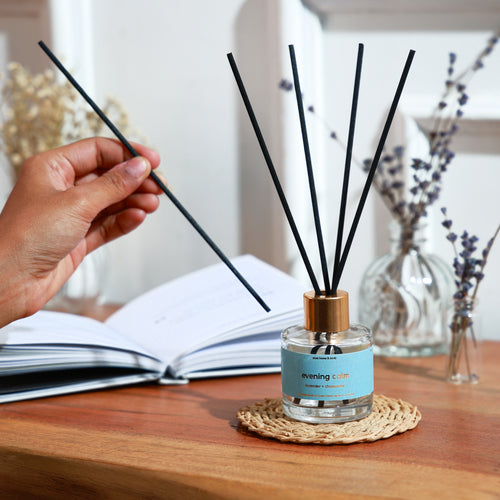 Bedside · Evening Calm 8.9₹799Shop →
 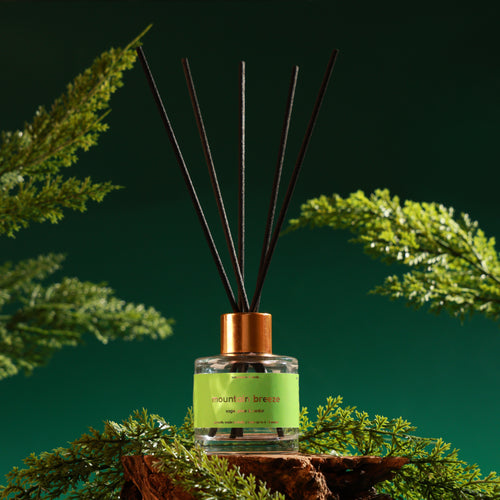 Desk · Mountain Breeze 9.4₹849Shop →
How the requirement is met in the places where you have felt it met
Most people who ask this question have experienced the thing they want somewhere else and are trying to reproduce it. Usually it is a hotel, a good spa or a well-run showroom, and the detail people remember is that they could never work out where the smell was coming from. That is not a coincidence, and it is the clearest possible statement of the mechanism. In those buildings there is generally nothing in the room to find. The fragrance is introduced into air that is already moving, so it arrives everywhere at once and there is no source to locate and no gradient to walk up. What you are asking for is not a stronger bottle. It is a different delivery model.
The domestic version of that model is a waterless cold-air nebuliser, which shatters undiluted oil into a dry micro-mist using pressurised air — no water, no dilution, no heat, no added humidity and no mineral dust — or, more affordably, an ultrasonic diffuser, which throws a water-and-oil mist out as a visible plume. Both supply their own transport and both give you an intensity setting and a timer instead of a weather-dependent evaporation rate. That last part matters more than people expect: a reed is brisk in a hot dry room, close and short-range in saturated monsoon air, and quieter in week seven than in week one, so a bedroom scented passively is never quite the same twice.
It is worth being honest about what you are paying for when you move up. You are not buying a better fragrance. A ₹749 bottle and an ₹11,999 machine can run closely related smells and produce completely different rooms, and the difference is not in the oil at all — what the higher price buys is transport, control and evenness. Which is precisely the list you asked for. It is also why I would rather you bought the ₹1,899 machine that fits your room than the ₹11,999 one that does not: Vaayu is rated to 1000 m³, roughly 2,000–3,000 sq ft, and in one bedroom nine-tenths of it is wasted.
What to buy, in order — and the gap in our own range
Assuming the free list has had a week. The last row is the thing I cannot sell you, and for someone with one bedroom and a three-point specification it is the most useful line here.
| Step | What it is | When it is the right answer | Price |
|---|---|---|---|
| 1. The free list, ending with the fan ★ | Six reeds rather than three, halve the distance, nose height, out of the draught, close the door, ceiling fan on low | Always first, for a week. The fan is the only free transport there is, and it narrows all three positions at once | ₹0 |
| 2. A reed at the position that matters most | 50ml up to about 150 sq ft, 6–8 weeks; 130ml above that, 14–18 weeks. Three reeds at a bedside, six across a room | If, on reflection, one of your three positions matters far more than the others | ₹749–₹1,349 |
| 3. Sukoon ₹1,899 ★ | Ultrasonic, 500ml, 270–320 sq ft, 16–18h on low, three 15ml Hotel Collection scents included | The first mechanism that genuinely answers a three-point specification. Never skip it on the way to something dearer | ₹1,899 |
| 4. Safar ₹3,999, disclosed properly | Waterless cold diffusion of undiluted oil. 20ml, 2000 mAh, up to 10 hours continuous or about 30 intermittent, three speeds, a 1 / 2 / 3-hour auto-off. Named and sold as a car and travel diffuser | When you want undiluted oil, no water and no added humidity at personal scale, and can live with recharging it. Not set-and-forget | ₹3,999 |
| The two I would steer you away from | Megh ₹3,499: six litres and about 100 hours of runtime, but only about 215 sq ft — less than the Sukoon. Vaayu ₹11,999: 1000 m³, roughly 2,000–3,000 sq ft | Megh is a runtime machine, never a coverage upgrade. Vaayu earns its price on a whole floor or an open-plan living-dining, never in one bedroom | ₹3,499 / ₹11,999 |
| The honest gap | Between Safar and Vaayu there is no mid-sized waterless bedroom nebuliser in the SOSA range | Named rather than papered over. Nothing here is “a Vaayu for one room” | — |
Versailles
I like this question because it is written like an engineer’s brief rather than a shopper’s wish. Three named positions, one stated criterion, no adjectives. People who arrive at that phrasing have usually already tried the reasonable things — more reeds, a different shelf, possibly a second bottle — and have worked out for themselves that something structural is going on. They are right, and it is a pleasure to be able to confirm it rather than sell around it.
What I would not want is for anybody to read this and conclude that their reed diffuser was a mistake. It was not. It is a point source, and point sources are exactly right for a bedside, a desk, a reading chair, a bathroom — anywhere you want a defined zone rather than a whole volume. Mine sits by my bed with three reeds in it and I would not change a thing about it. It simply is not the object that answers a three-point specification, and no reed count will make it one.
So: work the free list, and give the fan a proper week on low with the door shut, because it is the cheapest transport in the building and it improves all three of your positions at once. If the specification still is not met, Sukoon at ₹1,899 is where I would start, and I would say plainly before you paid that your reed scent does not pour into it. Everything is composed in Pune, and a part of every order funds a girl’s classroom through Nanhi Kali.
Frequently asked questions
- Even distribution across a bedroom — the head question, and the free method in order.
- Hot spots instead of consistency — why several sources make several peaks.
- One strong corner and three weak ones — the practical fixes, and the honest ceiling.
- Several passive or one active? — scored honestly, including the rows passive wins.
- Can active diffusion be more consistent? — the mechanism, explained rather than asserted.
- Fragrance in the air, not around the bottle — the vocabulary you need to search well.
- Distribution versus strength — the shape of the curve, not its height.
- Choosing by distribution, not bottle size — volume is duration, not coverage.
- Should I look beyond reed diffusers? — the family pillar, free fixes first.
- Brand: the SOSA founder story.
SOSA facts verified August 2026: Reed diffusers are supplied in 50ml and 130ml only — 50ml suits rooms up to about 150 sq ft and lasts 6–8 weeks, 130ml suits rooms above 150 sq ft and lasts 14–18 weeks, at roughly ₹13–₹15 a day. Six reeds is full projection; three is a soft bedside level and roughly doubles the life; two or three reeds in a 50 sq ft bathroom can make a 50ml last nearly three months; flip the reeds every 3–5 days. Morning Freshness ₹749 / ₹1,249 · Evening Calm ₹799 / ₹1,299 · Garden Bloom ₹799 / ₹1,299 · Mountain Breeze ₹849 / ₹1,349 · Fresh Brew ₹849 / ₹1,349. Duos: Day & Night ₹1,498, Fresh & Grounded ₹1,548, Warmth & Bloom ₹1,598 (50ml × 2); 130ml duos ₹2,498 / ₹2,548 / ₹2,598. Strength scale, perceived intensity rather than quality: Evening Calm 8.9 softest, Garden Bloom 8.9, Morning Freshness 9.0, Mountain Breeze 9.4, Fresh Brew 9.5 deepest. Six fibre reeds rather than rattan, heat-stable CCT carrier rather than DPG, alcohol-free, phthalate-free, paraben-free, IFRA-compliant, 0 ppm formaldehyde, refillable glass bottle, tested at 45°C and 85% RH, composed in Pune. Refills 300ml ₹2,399 and 500ml ₹3,499, oil only and never a first purchase. Machines: Boond ₹899 (300ml, up to about 150 sq ft, ~6h, USB, night light) · Sukoon ₹1,899 (500ml, 270–320 sq ft, 16–18h on low, three 15ml Hotel Collection scents included) · Megh ₹3,499 (6L, ~100h runtime but only ~215 sq ft, never a coverage upgrade) · Safar ₹3,999, a waterless cold-diffusion device named and sold as a car and travel perfume diffuser, with a 20ml bottle, a 2000 mAh battery, up to 10 hours continuous or about 30 hours intermittent per charge, three speeds and a 1 / 2 / 3-hour auto-off timer · Vaayu ₹11,999, a waterless cold-air nebuliser rated to 1000 m³, roughly 2,000–3,000 sq ft, with a 400ml tank, app and onboard control and under 38 dB operation, and the wrong purchase for one bedroom. Aangan ₹25,999 and Meenar ₹38,500 are commercial machines and are not home recommendations. No coverage figure is published for Safar and none is quoted here. Between Safar and Vaayu, SOSA has no mid-sized waterless bedroom nebuliser. Reed oil, the water-based Hotel Collection and pure fragrance oil are not interchangeable across these mechanisms. No health, air-quality, allergy, sleep or mood claims are made anywhere on this page, and fragrance is not presented as a way to remove a smell. Free shipping above ₹499, and a portion of every order supports girl-child education through Nanhi Kali. SOSA is an independent Indian fragrance house; the Hotel Collection is SOSA's own interpretation inspired by the world's finest hotels and SOSA is not affiliated with or endorsed by any hotel brand. Prices subject to change — see the live product pages.