


First hour: the surge proper. The room reads noticeably fuller and slightly brighter than it did yesterday.
That evening: the settle. Output drops back to a steady level — this is the plateau, and it is the product.
The mistake: judging the flip against the surge instead of against last week. Flip about an hour before you want a room at its best.
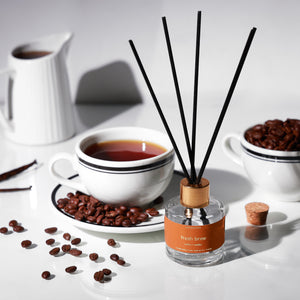
2. Ten to thirty minutes — the top notes report first. Whatever is lightest in the composition leaves first, so the room briefly reads brighter and cleaner than its usual character. A Fresh Brew smells more of coffee and less of vanilla for a while.
3. One to three hours — the surge. The whole room is fuller. This is the phase people notice, and it is the phase they mistakenly treat as the standard against which everything afterwards looks like failure.
4. That evening — the settle. Surplus oil has gone, a new evaporation boundary has formed a little way down the reed, and output drops to the rate at which oil can climb. Lower than the surge; higher than yesterday.
5. Next morning to day three — the plateau. Steady, consistent, and the level at which the composition was designed to sit at six reeds. This is the product. It is deliberately low, because a reed diffuser is a constant passive background rather than an event.
6. Days four to seven — the slow drift back. The gradient begins reforming, the exposed surface gradually loads with heavier material, and by the end of the week you are ready to do it again.
7. If nothing at all happens — no lift, no change by evening — the flip is not at fault. Either the reeds have reached the end of their working life, or the room's air is not moving at all, or your nose has adapted to a constant it stopped reporting days ago.
Composed and handmade in small batches in Pune, and a portion of every order supports girl-child education through Nanhi Kali.
Part one — the three things a single flip sets in motion
Turning a reed over looks like one action and is in fact three, running on three different clocks. Separating them explains almost every question I get about what to expect afterwards — including why the effect arrives faster than people assume and lasts less long than they hope.
 Fresh Brew₹849 · 9.5/10Once the surplus has gone, the reed settles into the only rate it can sustain: the speed at which oil climbs the fibre by capillary action, minus whatever the air is carrying away. A visible wet line establishes itself a little way above the oil and stays roughly there. This equilibrium is what the composition was dosed against — when I set a fragrance at six reeds, this steady state is the level I am tuning, not the first hour. In a warm room the boundary sits higher and the rate is faster; in a cold January room it sits lower and the rate is slower. Either way it is stable within a few hours, and the room you smell that evening is a fair sample of the week ahead.
Part two — the aftermath, hour by hour
This is the curve as customers describe it and as I have watched it in my own hall, on a 50ml at six reeds in an ordinary room with the bottle near a doorway. Times shift with heat: a 40°C afternoon compresses everything below and a cold room stretches it.
| Time after the flip | On the reed | In the room | What to do |
|---|---|---|---|
| 0–10 minutes ★ | Saturated fibre meets dry air; surplus oil begins leaving | Sharp and clear at close range; little effect beyond a metre | Wipe the neck and the tray, then leave it alone |
| 10–60 minutes | The lightest material departs first, in volatility order | Brighter and cleaner than the fragrance's usual character | Open an interior door so the room can distribute it |
| 1–3 hours | Surplus largely gone; the wet line begins forming | The surge — fullest the room will be all week | This is the window to have guests arrive |
| That evening | Evaporation and capillary climb reach balance | The settle: quieter than the surge, fuller than yesterday | Judge nothing yet; your nose has been in it all day |
| Next morning | Stable boundary, steady rate, correct proportions | The plateau — this is the honest level of the bottle | Walk in from outside and take one reading. That is your answer |
| Days 2–4 | Holding steady; the gradient has barely begun to reform | Consistent, and increasingly invisible to you specifically | Trust guests over your own nose |
| Days 5–7 | Heavy material accumulating at the exposed end again | Slightly flatter, warmer, more base-heavy by the weekend | Flip again. All six, gloves on |
| The honest caveat: the surge is not repeatable on demand. Flipping again in the same evening does almost nothing, because there is no surplus left to release — you will get a faint lift, a little oil on the tray and a marginally shorter bottle. If what you want is a room that can be made strong at will, before guests or after cooking, that is genuinely a different product: a Sukoon at ₹1,899 covers 270–320 sq ft with timers and switches on. Reeds cannot surge to order. That is their design, not their failing. | |||
Garden Bloom · 8.9/10from ₹799Shop → 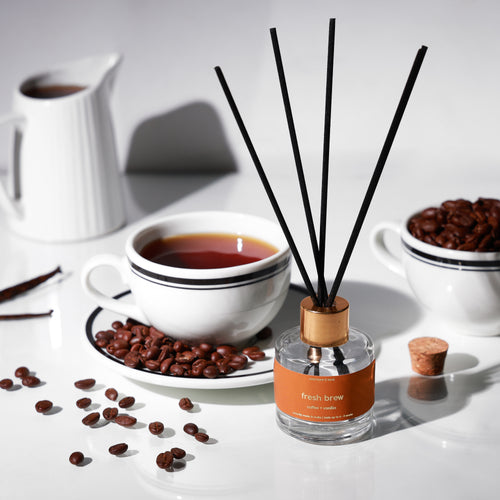 Fresh Brew · 9.5/10from ₹849Shop →
  Sukoon · scent on demand₹1,899Shop →
Part three — why the settle is the point, and the surge is not
There is an entire category of reed diffuser built to maximise the first hour. The method is not secret: raise the volatile fraction and use a solvent that pushes fragrance off the fibre hard. Phthalate carriers do this very well. You get a spectacular week one, a thinning week three, and by about week six — particularly in Indian heat — a composition that has degraded into something faintly acrid. SOSA is phthalate-free on a heat-stable coconut-derived CCT base, and I will state the trade rather than hide it: a smaller opening, a flatter and longer plateau. Our bottles do not win the first hour against that kind of product. They are still doing the same job in week six, at 45°C, which is the part I care about and the part you paid for.
This is also why I would gently push back on the instinct to chase the surge. Flipping twice a day, adding reeds on a Wednesday because Monday's flip has faded, buying a second bottle within a fortnight — these are all responses to a curve that was never going to stay at its peak. What a reed diffuser gives you is a constant, passive, deliberately low background: no fan, no heat, no switch. Almost every complaint I receive is a collision between that design and an expectation borrowed from a spray or a plug-in. Once you accept the plateau as the deliverable, the flip becomes what it should be — routine maintenance that keeps a steady thing steady, rather than a lever you keep pulling in hope.
And when you genuinely want a surge, buy a surge. If the requirement is a hall that can be made fragrant twenty minutes before people arrive, or a kitchen reset after cooking — extractor on, window open ten minutes, close up, wait half an hour, and only then scent the room — then a machine is the honest tool. A Sukoon at ₹1,899 covers 270–320 sq ft, runs 16–18 hours on low, has a remote and steady, two-hour and four-hour timers, and comes with three 15ml Hotel Collection fragrances in the box. It runs water-based Hotel Collection oil and never reed oil; reed oil never goes into a machine, and Hotel Collection never goes into a reed bottle. Most homes end up running both formats, because a background and an event are different requirements and no single product does both well.
Part four — reading your own flip
The most useful thing about the post-flip window is diagnostic. What happens in those first hours tells you which of the common problems you actually have, and it costs nothing to run. Flip on a morning when you can leave the house for a while, and read the result against this table.
| What you observed | What it means | Your next move | Cost |
|---|---|---|---|
| A clear surge, then a settle to a decent level ★ | Everything is working exactly as designed | Keep the weekly cadence and change nothing | Free |
| A big surge, then almost nothing by evening | The room is not carrying it — dead air, or a draught stripping it | Move to a console near a doorway, waist to chest height, clear of AC and sun | Free |
| No surge at all, reeds look dark and dry above the oil | The reeds are at the end of their working life, not the oil | Refresh the reeds; then refill the vessel rather than rebuying | Refill ₹2,399 |
| No surge, wet line barely above the oil | Not wicking — thick cold oil, or crowded reeds in the neck | Fan the reeds out; add one or two; check the room is not under 20°C | Free |
| A surge you can smell only when standing over it | Placement, almost certainly — a point source with nothing to carry it | Raise it and move it into gentle passing traffic | Free |
| Guests notice it; you do not | Olfactory adaptation. Your nose stopped reporting a constant | Believe the guests. Fifteen minutes outside and walk back in | Free |
| Everything correct, room still too quiet for the space | Beyond roughly 250–300 sq ft of connected volume, reeds are the wrong tool | Two bottles at opposite ends, or a Sukoon | From ₹1,498 · Sukoon ₹1,899 |
Versailles
The post-flip hour is the most flattering hour a reed diffuser has, and for a while I was tempted to build the marketing around it. Photograph the bottle, describe the surge, let people find out about the plateau on their own. Every brand in this category faces that temptation and a great many give in to it.
I decided against it for a simple reason: the surge lasts an hour and the bottle lasts six to eight weeks. If I sell you the hour, I have described about one per cent of what you are buying, and you will spend the other ninety-nine feeling mildly cheated. So we publish the curve — a spike, a settle, a plateau — and I would rather someone chose a machine because a reed was honestly described than bought a reed on the strength of an hour.
The version of this I like best is small and domestic. Flip the hall bottle on a Sunday morning while the coffee is brewing. By the time anyone arrives in the afternoon it has settled into something warm and unremarkable, and nobody says anything about the fragrance at all — which is precisely the result. Handmade in small batches in Pune, and a part of every order funds a girl's classroom through Nanhi Kali.
Frequently asked questions
- Should you flip reed diffuser sticks? — the residue gradient the flip exists to reverse.
- How often to flip and all the reeds or only some? — smoothing the surge out.
- Does flipping make it stronger? — where the ceiling sits, and how to find yours for free.
- The complete reed-flipping guide, and why can't I smell my reed diffuser?
- Brand: the SOSA founder story.
SOSA reed diffuser range & prices (verified August 2026): alcohol-free, phthalate-free, paraben-free and IFRA-compliant compositions on a heat-stable coconut-derived (CCT) carrier, low-VOC, supplied in a refillable glass bottle with six fibre reeds; 50ml lasts 6–8 weeks and 130ml lasts 14–18 weeks. Morning Freshness (Malabar lemon · peppermint · Nilgiri eucalyptus) 50ml ₹749 · 130ml ₹1,249 · 9.0/10; Garden Bloom (British rose · night-blooming jasmine) 50ml ₹799 · 130ml ₹1,299 · 8.9/10; Evening Calm (Kashmir lavender · chamomile) 50ml ₹799 · 130ml ₹1,299 · 8.9/10; Fresh Brew (Coorg coffee · Kerala vanilla) 50ml ₹849 · 130ml ₹1,349 · 9.5/10; Mountain Breeze (Himalayan pine · sage · Indian cedar) 50ml ₹849 · 130ml ₹1,349 · 9.4/10. Reed diffuser refills are oil only — you reuse your own vessel and reeds: 300ml ₹2,399 (roughly 8–11 months) · 500ml ₹3,499 (roughly 14–18 months), about ₹7–8 per ml against ₹15–17 per ml for a 50ml bottle. Duo sets ₹1,498–₹1,598 for 2 × 50ml and ₹2,498–₹2,598 for 2 × 130ml. Strength figures are positions on SOSA’s own internal strength scale, not an industry standard. Replacement reeds are not sold as a separate SKU; SOSA guidance is to refresh reeds every few months. The reed line is separate from the water-based Hotel Collection for ultrasonic machines (15ml ₹299 · 100ml ₹999 · 300ml ₹1,799) and the two are not interchangeable. Diffusers: Boond 300ml ₹899 · Sukoon 500ml ₹1,899 · Megh 6L ₹3,499 · waterless Vaayu ₹11,999. Composed and handmade in small batches in Pune, India; tested through 45°C summer heat and 85% monsoon humidity. Free shipping above ₹499. A portion of every order supports girl-child education through Nanhi Kali. Prices subject to change — see the live product pages.