
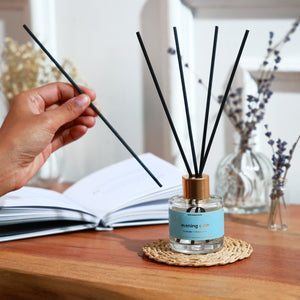



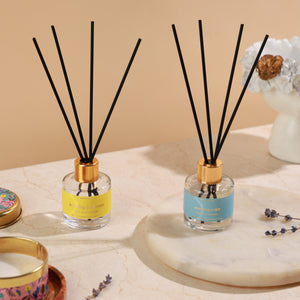
The alternative: staggered flipping — three reeds on Sunday, the other three on Wednesday, then swap. Same total number of flips, no extra cost, and the post-flip surge arrives as a gentle rise rather than a jump.
Who should stagger: anyone who finds the first evening after a flip too loud — small bedrooms, nurseries, sensitive noses, Evening Calm in a closed room.
Who should not: anyone whose bottle has stalled, and anyone with guests arriving. A partial flip is a partial repair.
2. Flip only some when your objection is to the surge, not to the level. The first evening after a full flip is the loudest the bottle will be all week. In a large living room nobody notices. In a small closed bedroom, or a nursery, or with a scent you already find generous, that evening can be genuinely too much — and halving the flip halves the step without lowering the plateau you actually live with.
3. The stagger that works is three and three, four days apart. Three reeds on Sunday, the other three on Wednesday, and next week the same two groups in the same order. Every reed still gets turned every seven days. You have changed the timing, not the total.
4. Do not stagger a bottle that has stalled. If the room has gone properly quiet, or a reed lifted out shows a wet line high and dark up the fibre, you need the full correction and you need it today. A three-reed flip on a stalled bottle produces half a recovery and leaves you unsure whether flipping works at all.
5. Do not stagger before guests. Hosting wants the step, not the slope. Flip all six the morning of and close the room for an hour before people arrive.
6. Never flip fewer than three of six as a standing pattern. Two at a time means each reed waits three weeks between turns — that is not smoothing, it is neglect with a schedule attached.
Composed and handmade in small batches in Pune, and a portion of every order supports girl-child education through Nanhi Kali.
Part one — the step, the slope, and why the choice is real
Think of each reed as a separate small source with its own little curve. Turn one over and that source rises over a few hours, holds through the evening and eases back over the next day or two towards the level it will keep until you touch it again. What you smell in the room is not one curve but the sum of six. When all six are inverted at the same moment, the six curves are perfectly in phase and the sum is a pronounced peak followed by a visible decline. When three are inverted on Sunday and three on Wednesday, the two groups are out of phase and the peaks partly fill each other's troughs. Same oil, same reeds, same number of hands turning things over. Completely different week.
 Garden Bloom₹799 · 8.9/10Split the six into two fixed groups of three and turn one group every three or four days. Each individual reed is still flipped once every seven days, so the total wicking work is unchanged and so, near enough, is the life of the bottle. What changes is the profile: while one group is climbing, the other is settling, and the room reads as one continuous level rather than a weekly announcement. This is the pattern I recommend for a small closed bedroom, a nursery, a reading corner, and for anyone who has told me a fragrance is lovely on most days but overwhelming on Sundays. It costs nothing and it is entirely reversible; if you dislike it, you are one full flip away from the default.
Part two — every flip pattern, compared honestly
Five patterns people actually run, what each does to the shape of the week, and who each one suits. The strength language here refers to positions on SOSA's own internal scale at six reeds — our scale, not an industry standard, and not a measure of concentration or quality.
| Flip pattern | Reeds turned each time | What the week's curve does | Who it suits | Effect on bottle life |
|---|---|---|---|---|
| All six, once a week ★ | 6 of 6 | A clear step up, then a settle to a steady plateau | Almost everyone — the calibrated default | The stated 6–8 weeks on a 50ml |
| Three and three, four days apart | 3 of 6 | Two offset rises that fill each other's dips — a near-flat line | Small closed bedrooms, nurseries, sensitive noses | Effectively the same; each reed is still turned weekly |
| Two, two and two across the week | 2 of 6 | Flattest of all, but demands you touch the bottle three times | People who genuinely enjoy the ritual and keep to it | The same again — more handling, not more throughput |
| All six, once a fortnight | 6 of 6 | A tall spike and a long slide into a quiet second week | Cool sealed rooms with four reeds; nobody else | Slightly longer, because the bottle spends half its time stalled |
| Three at a time, three weeks apart | 3 of 6 | No real curve — a permanently half-rate bottle | Nobody. This is the pattern to stop doing | Looks longer on the shelf, delivers far less to the room |
| The honest caveat: staggering changes the shape of the week, not the height of the plateau. If your room is quiet on every day of the week rather than only after a flip, no pattern on this table will fix it — that is placement, reed count or composition, and it is covered in does flipping make a diffuser stronger. | ||||
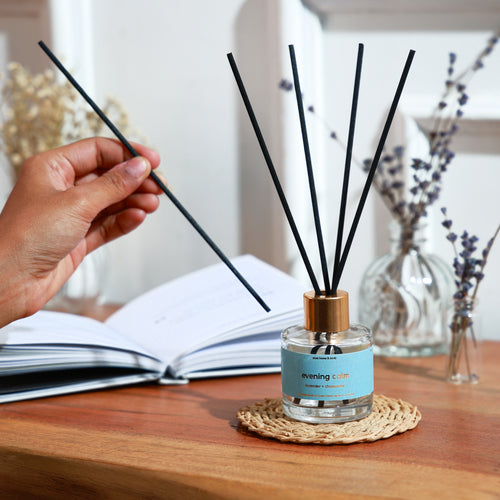
Evening Calm · 8.9/10from ₹799Shop → 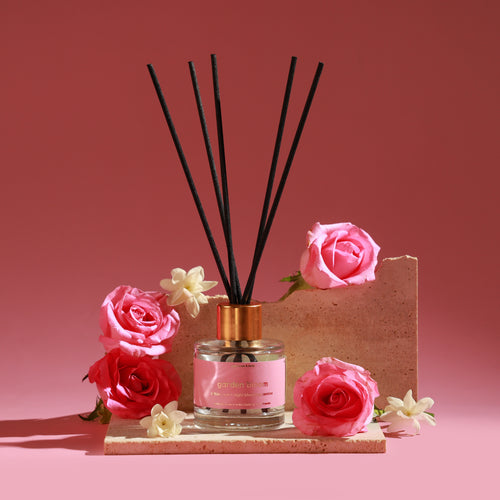 Garden Bloom · 8.9/10from ₹799Shop →
 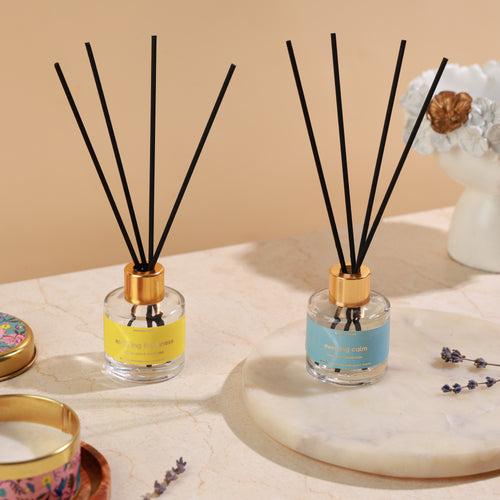 Day & Night duo₹1,498 / 2×50mlShop →
Part three — running a stagger without losing track of it
The objection to staggered flipping is not that it fails but that it is easy to muddle, and a muddled stagger degrades into the one-or-two-at-a-time pattern I asked you not to run. So make the two groups physically identifiable before you start. The simplest method is a dot of clear nail varnish or a fine permanent marker on one end of three reeds — put the mark near the very tip so it spends half its life buried in the oil and never becomes a decorative feature. Marked group on Sunday, unmarked on Wednesday, and after a month you will stop needing to think about it. If you would rather not mark anything, arrange the six as a front three and a back three in the neck of the bottle and keep the groups spatially consistent; a fibre reed is stiff enough to hold its position, and the bottle neck is narrow enough that the two ranks stay distinct.
Two practical points about the mechanics. First, always flip over the bottle, never over the furniture. A staggered pattern means twice as many handling events per week, and reed oil marks wood and stone permanently — lift the three reeds together, invert them as a bundle above the neck, set them back in. Gloves every time, a tray under the bottle whatever pattern you run, and the whole arrangement out of reach of children and pets. Second, do not swirl the bottle while you are in there. The oil is not stratified; the only thing agitation achieves is a film of concentrate around the inside of the neck that then creeps down the outside of the glass.
The last thing to say is where the technique stops. A stagger is a smoothing filter, and a filter cannot add anything that is not there. If the plateau itself is too low — pleasant at the console, absent at the sofa — you are looking at placement, reed count or composition, and the pattern of your flips is irrelevant to all three. Stand outside the room for fifteen minutes and come back in before you conclude anything, because your own nose stops reporting a constant within minutes and adapts hardest in your own home. Then flip all six, then move the bottle into gentle passing air near a doorway at waist to chest height, away from an AC vent and out of direct sun. Staggering is a refinement for a bottle that is already working, not a repair.
Part four — matching the pattern to the room, and what to buy
Everything above arranged as a decision. Notice how much of this table costs nothing: the pattern is free, and in three of the five rows the recommendation is a change of habit rather than a purchase.
| If you want | Run this pattern | The scent that rewards it | Price |
|---|---|---|---|
| A steady, unremarkable level all week ★ | Three and three, four days apart | Evening Calm at 8.9 in a bedroom | ₹799 / 50ml |
| A bottle brought back from silence | All six, today, then all six weekly | Mountain Breeze at 9.4 for a study | ₹849 / 50ml |
| A room that peaks for visitors | All six on the morning of, room closed an hour before | Garden Bloom at 8.9 in an entryway | ₹799 / 50ml |
| Two rooms on two different rhythms | Full flip in the living room, stagger in the bedroom | Day & Night duo — bright by day, soft by night | ₹1,498 / 2×50ml |
| Any pattern, run for a year without re-buying glass | Keep your vessel; replace the oil when it runs out | 300ml oil refill — oil only, roughly 8–11 months | ₹2,399 |
| Not a flip-pattern problem: scent on demand | No pattern produces a surge that lasts an evening and then stops | Sukoon ultrasonic · 270–320 sq ft, timers, remote | ₹1,899 |
Versailles
I came to staggered flipping the way most people come to a technique — by having the complaint first. We were testing an early version of the lavender composition in my own bedroom in Pune, and I noticed I was mildly irritated by it exactly once a week, on the evening I had flipped it. The fragrance was not too strong; the change was. A nose in a familiar room is extremely good at detecting difference and almost useless at detecting a constant, which is why you stop noticing your own diffuser by Tuesday and why the Sunday step is the thing you register.
Halving the flip removed the step without lowering anything I cared about. It is a small, unglamorous piece of technique that sells nothing, which is probably why no other brand mentions it. But the alternative people reach for — pulling reeds out, or moving to a softer scent they did not want — costs them either the plateau or another bottle.
What I would not want you to take from this page is that partial flipping is generally better. It is not. It is a refinement available to a bottle that is already placed well, already at the right reed count, and already delivering the level you want on an ordinary day. If any of those is untrue, flip all six and start at the beginning. Everything here is composed and handmade in Pune, and a part of every order funds a girl's classroom through Nanhi Kali.
Frequently asked questions
- Should you flip reed diffuser sticks? — the residue gradient, and why an unflipped reed becomes a reservoir.
- What happens after a flip — the first ten minutes, the first hour and the first evening, which is the surge this page is smoothing.
- Is once a week enough? and can you flip every day? — the two ends of the cadence question.
- The complete reed-flipping guide — this page and the eight around it, in one place.
- Brand: the SOSA founder story.
SOSA reed diffuser range & prices (verified August 2026): alcohol-free, phthalate-free, paraben-free and IFRA-compliant compositions on a heat-stable coconut-derived (CCT) carrier, low-VOC, supplied in a refillable glass bottle with six fibre reeds; 50ml lasts 6–8 weeks and 130ml lasts 14–18 weeks. Morning Freshness (Malabar lemon · peppermint · Nilgiri eucalyptus) 50ml ₹749 · 130ml ₹1,249 · 9.0/10; Garden Bloom (British rose · night-blooming jasmine) 50ml ₹799 · 130ml ₹1,299 · 8.9/10; Evening Calm (Kashmir lavender · chamomile) 50ml ₹799 · 130ml ₹1,299 · 8.9/10; Fresh Brew (Coorg coffee · Kerala vanilla) 50ml ₹849 · 130ml ₹1,349 · 9.5/10; Mountain Breeze (Himalayan pine · sage · Indian cedar) 50ml ₹849 · 130ml ₹1,349 · 9.4/10. Reed diffuser refills are oil only — you reuse your own vessel and reeds: 300ml ₹2,399 (roughly 8–11 months) · 500ml ₹3,499 (roughly 14–18 months), about ₹7–8 per ml against ₹15–17 per ml for a 50ml bottle. Duo sets ₹1,498–₹1,598 for 2 × 50ml and ₹2,498–₹2,598 for 2 × 130ml. Strength figures are positions on SOSA’s own internal strength scale, not an industry standard. Replacement reeds are not sold as a separate SKU; SOSA guidance is to refresh reeds every few months. The reed line is separate from the water-based Hotel Collection for ultrasonic machines (15ml ₹299 · 100ml ₹999 · 300ml ₹1,799) and the two are not interchangeable. Diffusers: Boond 300ml ₹899 · Sukoon 500ml ₹1,899 · Megh 6L ₹3,499 · waterless Vaayu ₹11,999. Composed and handmade in small batches in Pune, India; tested through 45°C summer heat and 85% monsoon humidity. Free shipping above ₹499. A portion of every order supports girl-child education through Nanhi Kali. Prices subject to change — see the live product pages.