

2. Scaling up with a 130ml reed or a 300ml refill lowers the per-week figure at larger premises. A 130ml bottle at ₹1,249–₹1,349 lasting 14–18 weeks, or a 300ml refill at ₹2,399 feeding several reed stations, brings the weekly cost down further than repeatedly buying 50ml bottles once a reception is large enough to need more than one or two of them.
3. Vaayu's ₹11,999 is a one-time hardware cost that spreads across years of daily use. Set against years rather than weeks, a single upfront cost looks very different from a bottle bought every six to eight weeks — though the fair comparison stops there, because Vaayu's ongoing refill economics are not yet settled and should be confirmed with SOSA before being treated as a completed calculation.
4. SOSA sells no room spray, and a spray is the weakest per-hour route of the three regardless of brand. A spray needs manual reapplication several times through an eight-to-ten-hour clinic day, each application inconsistent with the last and dependent on a staff member remembering to do it — a recurring labour cost with no automation, set against two routes that need no repeated manual action at all.
5. The honest comparison is not which route is cheapest, but which cost a clinic is willing to carry. A reed's cost is small and recurring; Vaayu's cost is larger and upfront with an unconfirmed running cost; a spray's true cost is mostly hidden in staff time — a clinic should choose the shape of the cost it prefers, not assume one route is simply cheaper than the others in every sense.
For a single small zone, a reed at ₹749–₹1,349 is the straightforward, low-cost answer; for a premises that needs years of consistent, controllable coverage across more than one room, Vaayu's ₹11,999 is the honest recommendation — and a room spray, which SOSA does not sell, is the weakest route of the three on cost as well as consistency.
Why sticker price is the wrong comparison
A reed at ₹749 looks obviously cheaper than a machine at ₹11,999 the moment the two prices sit side by side, and a clinic owner comparing sticker prices alone will conclude the reed wins every time. That comparison is honest as far as it goes and useless as a basis for a real decision, because it compares a bottle that lasts six to eight weeks against a machine built to run every working day for years.
The comparison that actually matters is cost over time, set against what each route manages to cover for that money. A reed bought every six to eight weeks at ₹749–₹849 is a small, recurring cost that stays proportionate to a single zone indefinitely — buy it once, buy it again, and the arithmetic never really changes. Vaayu is a different shape of cost entirely: a single, larger payment upfront, followed by a running cost this cluster cannot fully quote because the oil it takes and its price are not yet settled and should be confirmed with SOSA directly.
A room spray complicates the comparison further, because SOSA sells none and its real cost is mostly invisible on a receipt. A spray's price per bottle looks modest, but the true cost is the staff time spent reapplying it several times through a working day, plus the inconsistency of a scent that fades within an hour of each application — a cost that never shows up in a per-bottle price and is, once counted honestly, the weakest of the three routes regardless of which brand supplies it.
The three costs that actually matter
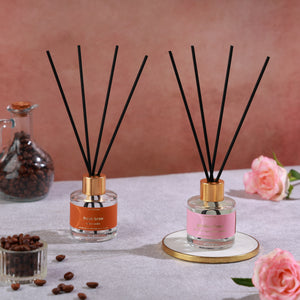
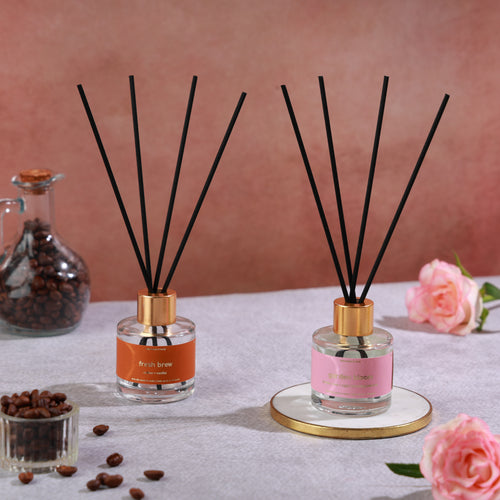
 Vaayu₹11,999A 50ml reed at ₹749–₹849 lasting 6–8 weeks suits a single small reception or cabin; a 130ml reed at ₹1,249–₹1,349 lasting 14–18 weeks, or a 300ml refill at ₹2,399 across several stations, is the better per-week figure once the reception is larger.
Comparing the routes over time
Every row compares what a route costs against what it actually keeps covered for that cost, over the timeframe each route is built for.
| Route | Cost | Roughly how long it covers one small zone | What it does not include |
| Reed 50ml | ₹749–₹849 | 6–8 weeks, six reeds | — |
| Reed 130ml | ₹1,249–₹1,349 | 14–18 weeks, larger zone | — |
| Reed refill 300ml | ₹2,399 | Feeds several reed stations at once | A new set of reeds and bottle, if not already owned |
| Vaayu, hardware | ₹11,999 once | Years of daily running, at clinic hours | Its refill cost — unconfirmed, to be checked with SOSA |
| Room spray: not a SOSA product. Its bottle price is modest, but repeated manual reapplication through a working day is a recurring staff-time cost this table cannot put a rupee figure on. | |||
 Vaayu · one upfront cost, years of use₹11,999Shop → Reed refill 300ml · lowest cost at scale₹2,399Shop →
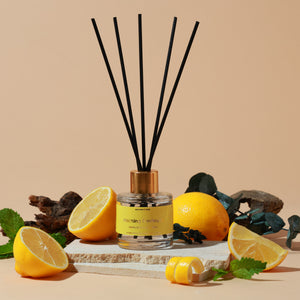
 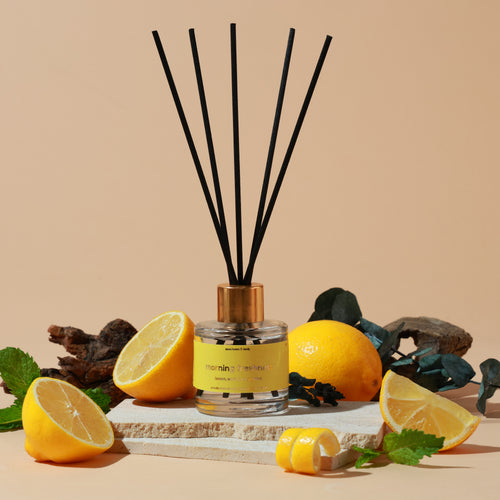 Morning Freshness reed · lowest entry cost₹749Shop →
Where each route earns its cost
A reed earns its low cost by doing one job well: a fixed, local presence in a single small zone, refreshed every six to eight weeks for 50ml or fourteen to eighteen for 130ml. It is the right economic answer wherever this cluster's zoning doctrine already calls for a single reception or one waiting area to be scented, and it should not be asked to do more than that — stretching a reed's reach with more bottles is a worse use of money than the per-week figure suggests.
Vaayu earns its larger upfront cost through control and years of running, not through beating a reed on a single week's arithmetic. A clinic that scents reception, a corridor and a waiting area for years without buying a new bottle every six weeks, without staff remembering to swap it, and with the option to run it only through clinic hours, is buying something a reed's per-week cost was never built to deliver.
A room spray does not earn its cost anywhere in a clinic, which is part of why SOSA does not sell one. Its bottle price looks like the cheapest line on the page, but the real cost — staff time spent reapplying it several times a day, and the inconsistency of a scent that fades within the hour — makes it the weakest per-hour route of the three once counted honestly, in a premium clinic or otherwise.
What to buy, and what it costs over time
Every route below is matched to how much zone it has to cover and how long a clinic wants that cost to last before it recurs.
| Route | Best suited to | Why | What it costs |
| Vaayu, one machine | A premises that wants years of consistent, controllable coverage across reception, a corridor and more than one room | The only route priced for years rather than weeks, with a running cost to confirm separately | ₹11,999 |
| Reed 130ml or 300ml refill | A larger reception or several reed stations at once | The better per-week cost once a single 50ml bottle is not enough zone | ₹1,249–₹2,399 |
| Reed 50ml | A single small reception or one consulting cabin | The lowest entry cost, proportionate to a genuinely small zone | ₹749–₹849 |
| Sukoon, one zone | A self-contained reception with no corridor to reach | A step up in reach from a reed at a modest fixed cost | ₹1,899 |
| Avoid: a room spray as the 'budget' route | Any clinic tempted by its low bottle price | The staff-time cost of repeated manual reapplication makes it the most expensive route once counted honestly | — |
Clinic owners ask me for 'the cheapest option that actually works' more often than they ask for the best one, and I take that question seriously rather than steering it toward the more expensive machine. Cheapest that works, for a single reception or one cabin, is very often a reed at ₹749 — I say so even when I am standing in front of the Vaayu display.
Where the conversation changes is cost horizon, not cost per bottle. An owner who wants to stop thinking about a reception's fragrance for years, not weeks, is paying for something a reed's low per-bottle price cannot offer at any quantity of bottles — and that is a legitimate reason to choose the larger upfront cost, provided the layout genuinely needs the reach.
I tell every owner who raises a room spray the same thing: I do not sell one, and I would not recommend one even if I did. A spray's price on the shelf hides the real cost, which is a staff member's time, several times a day, for a result that fades within the hour — that is not a cheap option in a clinic, whatever the bottle costs.
Questions clinic owners ask about cost
- Is Professional Scenting Worth It for a Solo Orthopaedic Doctor or Only for Large Clinics? — the room-count threshold behind this same cost comparison.
- Reed Diffuser vs Automatic Scent Machine for an Orthopaedic Waiting Room — the mechanism comparison behind the cost figures in this post.
- Why Are Multiple Reed Diffusers Still Barely Noticeable Across My Large Clinic? — what happens when a reed's low cost is stretched past its proportionate zone.
- I've Spent ₹10 Lakh+ on My Clinic Interior — Is Ambient Scent Worth Adding? — the proportion argument for weighing a machine's cost against the rest of a fit-out.
- Brand: the SOSA founder story.
SOSA products & prices (verified September 2026): Reed diffusers 50ml ₹749–₹849 (to 150 sq ft, 6–8 weeks at six reeds) · 130ml ₹1,249–₹1,349 (above 150 sq ft, 14–18 weeks) · reed refill 300ml ₹2,399. Ultrasonic: Boond ₹899 (~150 sq ft) · Sukoon ₹1,899 (270–320 sq ft, ships with three 15ml Hotel Collection fragrances) · Megh ₹3,499 (6L tank, ~100 hrs runtime, ~215 sq ft — a runtime machine, not a coverage upgrade). Waterless cold-air: Safar ₹3,999 (no published coverage figure) · Vaayu ₹11,999 (up to 1000 m³, roughly 2,000–3,000 sq ft; 400ml tank lasting about 90+ days; app and onboard control, 1h/4h/8h/24h run windows, adjustable intensity, key-lock, under 38 dB, freestanding or wall/HVAC mount, 5W, CE/RoHS/SGS) · Aangan ₹25,999 (8,000–10,000 sq ft). Hotel Collection water-based fragrance 15ml ₹299 · 100ml ₹999 · 300ml ₹1,799 is for ultrasonic machines; reed oil and Hotel Collection are not interchangeable. Reed diffusers are alcohol-free, phthalate-free, paraben-free, IFRA-compliant and low VOC, handmade in small batches in Pune. Every purchase funds a girl's education through Nanhi Kali. Prices and availability subject to change — see the live product pages.