

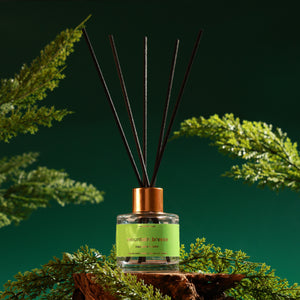
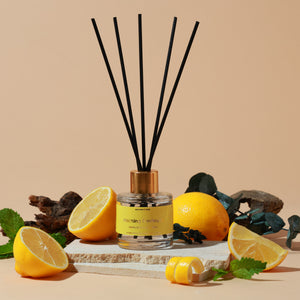
2. Placing five reeds across a floor produces five pockets, not one field. The space between each bottle's local zone remains exactly as unscented as it would be with no reed there — this is the direct, practical result of several separate passive points, and it is what a large floor mostly consists of.
3. A larger tank is not the same fix as wider reach. Megh's 6L tank buys roughly 100 hours of runtime between fills, not extra square footage — its own rated coverage, about 215 sq ft, is smaller than Sukoon's 270–320 sq ft, so swapping to a bigger-tank ultrasonic machine solves a maintenance problem, not a reach problem.
4. Adding bottles also adds running cost that a single machine's tank does not carry. Five reed bottles, each replaced every six to eight weeks, accumulate in cost and staff attention faster than one Vaayu tank lasting roughly 90 days — while still leaving the floor's gaps unaddressed.
5. A large clinic needs one mechanism that uses the floor's own air, not more static points. An actively distributed machine reaches a connected floor as one volume, using the room's own airflow or the building's ducting — the only real answer to a floor this size, once several reeds have already been tried.
Stop adding reed bottles and start counting the gaps between the ones already placed — a large floor needs one machine that moves air, not more points that do not.
Why several reeds never combine into floor-wide coverage
A reed diffuser's coverage figure describes a single, local zone around one bottle — typically up to roughly 150 sq ft for the 50ml size at six reeds, or somewhat more for the 130ml above that. This figure is not a modular unit that can be multiplied by the number of bottles placed on a floor. Put five reed bottles across a large reception, corridor and waiting area, and the result is five separate local zones of roughly that same individual size each — not a combined field covering five times the area. Nothing links one bottle's output to the next; each simply stops where its own evaporation rate runs out against the surrounding air.
This is precisely why a large clinic floor, scented with several reeds, so often reads as patchy or barely noticeable overall, even though each individual bottle may be performing exactly as its own coverage figure suggests it should. A patient walking from the entrance to a consulting room passes through several small pockets of scent separated by stretches of ordinary air — and the overall impression that stays with them is the ordinary air in between, not the pockets, because most of the walk is spent in the gaps rather than in any one bottle's zone.
A related mistake is reaching for a bigger tank rather than more bottles, assuming volume of oil solves a reach problem the same way it might solve a runtime problem. It does not. Megh, for instance, holds 6 litres and runs for roughly 100 hours between fills, but its own rated coverage is about 215 sq ft — smaller than Sukoon's 270 to 320 sq ft, despite the far larger tank. A bigger reservoir buys time before refilling. It does not buy square footage, and it is never a coverage upgrade over a smaller-tank machine with a wider rated reach.
The three decisions once several reeds have been tried
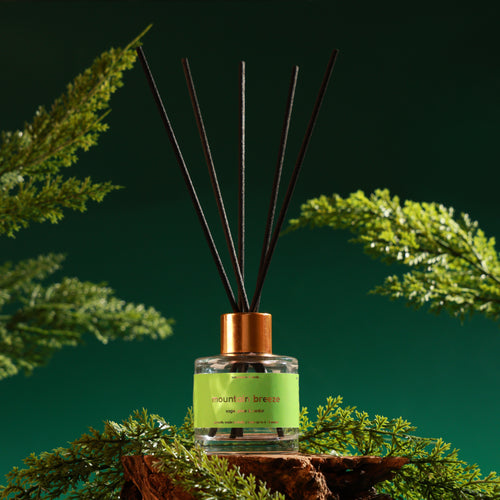
 Mountain Breeze₹849Stand at the midpoint between any two placed reed bottles and note honestly whether the air smells of anything. That gap, repeated across the floor, is usually most of the clinic's actual square footage.
Comparing several reeds to one active machine on a large floor
Every row is judged on whether it closes the gaps between coverage points, not on the total number of bottles or the size of any one tank.
| Option | Reach | Gaps between coverage | What it costs |
| Four to five reed bottles across the floor | Four or five separate local zones, each at roughly its own rated coverage | Substantial — most of a large floor sits between the bottles, not within any zone | ₹3,000–₹6,745 |
| Switching to a bigger-tank ultrasonic machine (e.g. Megh) | A larger reservoir and longer runtime, but rated coverage of only about 215 sq ft | Unchanged or worse — tank size does not translate into reach | ₹3,499 |
| Two Sukoon units at opposite ends of the floor | Two zones of 270–320 sq ft each, still with a gap between them on a genuinely large floor | Reduced, but not eliminated, depending on the distance between the two units | ₹3,798 |
| One Vaayu, wall-mounted centrally | Up to 1000 m³ as one connected volume, using the floor's own airflow | None, within its rated range, on one connected floor | ₹11,999 |
| One Vaayu, duct-mounted into central AC | The same range, distributed via the building's own supply air | None — ducting reaches areas free airflow alone would not | ₹11,999 plus contractor fitting |
| No combination of reed bottles, at any count, produces the same effect as one actively distributed machine — each bottle is a fixed local ceiling, and stacking several of them raises the number of ceilings, not the floor's overall coverage. | |||
 Vaayu · whole floor plate₹11,999Shop →
  Sukoon · single contained zone₹1,899Shop → Mountain Breeze · threshold accent only₹849Shop →
Zoning and intensity on a large floor
Scent the entrance, reception, waiting area and connecting corridors as one continuous plan, not as a series of separately scented points. Every consulting cabin, treatment room and X-ray room stays completely unscented under this cluster's standard zoning doctrine, regardless of how the front-of-house scenting is arranged. Keep intensity low enough that the register is noticed once on arrival and forgotten within a minute, across the whole connected space rather than peaking near any one point.
Where several reed diffusers are currently in use across a large floor, the practical fix is not to add another — it is to install one centrally placed Vaayu and retire most of the existing bottles, keeping one or two only as accents at consulting room thresholds, well outside the doors themselves. This combination, a single active machine plus occasional passive accents, is what this cluster recommends across every post in this size range.
If a bigger-tank ultrasonic machine has already been purchased in the hope of wider reach, check its rated square footage against the actual floor before assuming it has solved anything — Megh's 215 sq ft coverage, for instance, is a genuinely smaller number than Sukoon's 270 to 320, despite the larger tank, and neither approaches what a large, multi-room floor needs from a single unit.
What to buy, and why, on a large floor
Every route below is judged on whether it closes the gaps between coverage points on a genuinely large, connected floor.
| Route | Premises | Why | What it costs |
| One Vaayu, wall or duct-mounted centrally | A large, connected clinic floor where several reeds have already proved patchy | Reaches the floor as one connected volume, using its own airflow or the building's ducting | ₹11,999 |
| One Vaayu, plus one or two reeds kept as threshold accents | The same floor, with a deliberate marker at a cabin approach | Full-floor coverage from the machine, with a proportionate accent at the door only | ₹11,999 plus ₹849 each |
| Two Vaayu units, one per wing or zone | A floor genuinely split into two distinct sections or AC zones | Each section covered independently where one unit's airflow would not carry across the divide | ₹23,998 |
| Sukoon, single self-contained zone | A smaller, genuinely separate reception under roughly 300 sq ft | Real local coverage for that one zone alone, not the whole floor | ₹1,899 |
| Retiring several scattered reed bottles | A floor currently relying on four or more reeds with no central machine | Removes a running cost that has not been delivering floor-wide coverage in any case | Saves roughly ₹749+ per bottle, recurring |
The floors where I see the most reed bottles are usually the floors where the owner has tried hardest to solve the problem, which makes the pattern a little sad to point out — four or five bottles, replaced diligently every few weeks, and still a complaint that the clinic doesn't really smell of anything except right at the front desk. The effort was real. The mechanism was simply never going to deliver what a floor that size needed.
I ask an owner in this position to do one specific thing before buying a sixth bottle: walk the floor slowly, and at the midpoint between each pair of reeds, stop and notice the air honestly. Almost without exception, that midpoint is unscented, and there are several such midpoints on a floor of any real size. That walk usually does more to change the plan than any explanation I can give over a phone call.
The bigger-tank instinct is the other pattern I want to head off early, because it looks like the sensible next step and is not. A 6-litre reservoir sounds like it should out-cover a smaller one, and it does not — coverage is a separate spec from tank size, and I always ask an owner to check the square footage figure specifically before assuming a larger machine reaches further.
Questions clinic owners ask about this
- My reed diffuser works in the doctor's cabin but not the waiting area — why? — the same room-volume mechanics, worked through for a single bottle first.
- My reception reed diffusers are barely noticed unless patients sit nearby — is it the oil or the diffusion method? — the same diagnosis, focused specifically on a reception setting.
- One scent machine vs multiple smaller fragrance points for an orthopaedic clinic — the general architecture question this post answers for a large floor specifically.
- When does an orthopaedic clinic need an active waterless scent machine like SOSA Vaayu? — the concrete threshold for making the switch this post recommends.
- Brand: the SOSA founder story.
SOSA products & prices (verified September 2026): Reed diffusers 50ml ₹749–₹849 (to 150 sq ft, 6–8 weeks at six reeds) · 130ml ₹1,249–₹1,349 (above 150 sq ft, 14–18 weeks) · reed refill 300ml ₹2,399. Ultrasonic: Boond ₹899 (~150 sq ft) · Sukoon ₹1,899 (270–320 sq ft, ships with three 15ml Hotel Collection fragrances) · Megh ₹3,499 (6L tank, ~100 hrs runtime, ~215 sq ft — a runtime machine, not a coverage upgrade). Waterless cold-air: Safar ₹3,999 (no published coverage figure) · Vaayu ₹11,999 (up to 1000 m³, roughly 2,000–3,000 sq ft; 400ml tank lasting about 90+ days; app and onboard control, 1h/4h/8h/24h run windows, adjustable intensity, key-lock, under 38 dB, freestanding or wall/HVAC mount, 5W, CE/RoHS/SGS) · Aangan ₹25,999 (8,000–10,000 sq ft). Hotel Collection water-based fragrance 15ml ₹299 · 100ml ₹999 · 300ml ₹1,799 is for ultrasonic machines; reed oil and Hotel Collection are not interchangeable. Reed diffusers are alcohol-free, phthalate-free, paraben-free, IFRA-compliant and low VOC, handmade in small batches in Pune. Every purchase funds a girl's education through Nanhi Kali. Prices and availability subject to change — see the live product pages.