
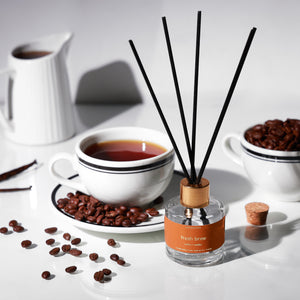
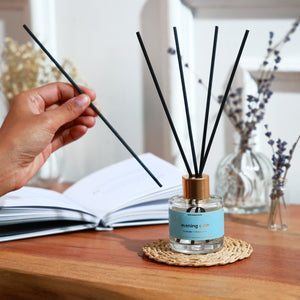

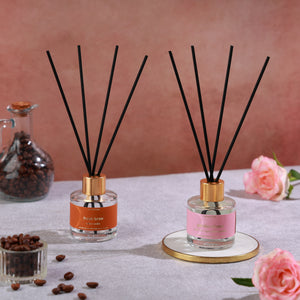

The legitimate long bottle: a 130ml at 14–18 weeks, or a deliberately low reed count, or a cold sealed room. All three still smell of something when you walk in from outside.
The one-question test: does a visitor who has just arrived notice it? If yes, you have a genuine long plateau. If no, you have a stall.
What it is not: a weak batch. Our compositions run flatter and longer by design because there are no phthalate solvents pushing them off the reed. The trade is a smaller opening for a longer plateau.
2. The usual culprit is a stall, and it is free to clear. Reeds that have not been turned accumulate the heavy, low-volatility fraction at the exposed end until the surface effectively seals. Flip all six, gloves on, and judge the room the next evening rather than in the next five minutes.
3. The second culprit is a reed count you chose without realising. Four reeds instead of six is a deliberate quiet setting: gentler room, longer bottle. If you removed two reeds to make it last, it lasted. That was the deal.
4. The third is dead air. A bottle in an alcove, behind a sofa or inside a cabinet holds its level well because nothing is carrying anything away. Move it into gentle passing traffic near a doorway, waist to chest height, several feet clear of an AC vent or fan.
5. Rule your own nose out before you rule the bottle out. Olfactory adaptation is the commonest cause of "it stopped working" and it bites hardest at home, on a constant, low background — which is precisely what this format produces. Ask someone who has just walked in.
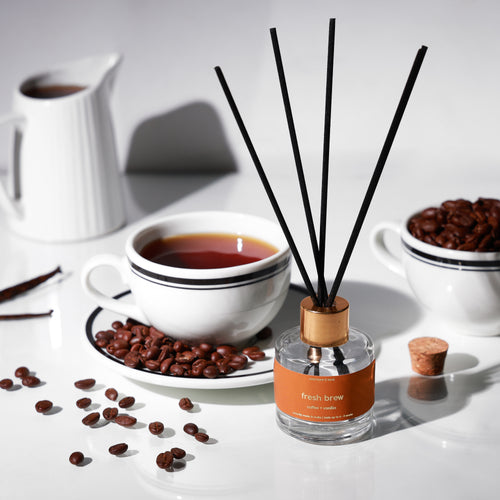
6. If a visitor smells it and you want more anyway, that is a composition decision. Evening Calm at 8.9 on our internal scale is the softest thing we make and is meant to be; Fresh Brew at 9.5 is a different room entirely.
7. Do not buy a 130ml to fix this. It lasts 14–18 weeks against 6–8 and at six reeds projects the same. You would be buying more of the quantity you already have too much of.
Composed and handmade in small batches in Pune, and a portion of every order supports girl-child education through Nanhi Kali.
Part one — one account, read from two ends
Think of the bottle as a bank balance and the room as the spending. There is no third place for the money to go. Whatever leaves the glass arrives in the air; whatever stays in the glass has not arrived anywhere. That sounds obvious written down, and yet the entire category is sold on the fiction that longevity and strength are separate features you might get more of at once. They are not. They are one number — throughput — with a plus sign on one side and a minus sign on the other, and every honest lever in this format moves both at once, in opposite directions. Once you accept that, "lasting well but smelling of nothing" stops being a puzzle and becomes a simple question: which side of the trade am I on, and did I choose it?
 Evening Calm₹799 · 8.9/10Our 50ml is rated 6–8 weeks and the 130ml 14–18, both at six reeds, flipped weekly, in an ordinary room without a draught. When somebody tells me their 50ml is on month four with oil to spare, I do not congratulate them. I assume the reeds stalled somewhere around week three and have been decorative ever since. The signature is unmistakable once you know it: the level almost unchanged for weeks, the reeds darker and heavier than they started, the wet line sitting high near the top, and a reed that smells thick and muted rather than clean when you hold it close. Nobody notices at the time, because the decline is gradual and your nose adapts along with it. What people notice is the anomaly in the accounts — the bottle that will not empty — and by then it has usually been quiet for a month.
Part two — the two ways a bottle reaches week twelve
Two bottles, same shelf, same date, both still holding oil at week twelve. One is healthy and one has stopped. Nothing in the level distinguishes them; almost everything else does. Read down the column that matches what you are seeing.
| Marker at week twelve | Genuinely lasting | Stalled | How to check it at home |
|---|---|---|---|
| A visitor's first reaction ★ | Notices the scent within a few seconds of coming in | Says nothing; says so honestly when asked | Ask outright, before you tell them what it should smell of |
| The reed held a few inches from your nose | Reads clearly as the composition you bought | Thick, dull, faintly like nothing in particular | Gloves on, lift one, hold it up, then put it back |
| Colour and feel of the reeds | Evenly tinted, still flexible | Noticeably darker at the exposed end, tacky | Compare against an unused reed if you kept one |
| Response to a flip | A modest lift for a day or two, then back to plateau | A pronounced return of scent within hours | Flip all six and judge the following evening |
| Which size it is | Usually a 130ml, rated 14–18 weeks | Usually a 50ml, rated 6–8 weeks, on month three | Check the bottle against its stated window |
| Coming back after an hour out | The room greets you | The room is neutral | Close the door for an hour, go out, come back in |
| The honest caveat: the strongest evidence on this table is other people's noses, and that is inconvenient advice. Your own nose is a poor instrument here — not because there is anything wrong with it, but because it is designed to stop reporting constants and it adapts hardest in your own home, where the background never changes. If you live alone and rarely have visitors, use the hour-out test instead, and take the reed test seriously. | |||
Part three — the plateau, and the pride that hides a stall
Every reed diffuser follows the same three-phase curve. Days one to three are a spike, because the reeds are dry and drinking hard and the lightest top notes are leaving all at once. Weeks one to two are a settle, as that first rush finishes and the composition finds its working level. Then comes the plateau, and the plateau is the product — a steady, low, constant background that should hold, with weekly flipping, right through to the end of the bottle. A healthy plateau is quiet by design. That is exactly what makes a stall so hard to catch: the difference between a working plateau and a dead one is not dramatic on any single day, and your nose is adapting to both.
This is where I have to be honest about a choice we made. Phthalate solvents push fragrance off a reed hard and fast; they win week one convincingly, and in Indian conditions they degrade in heat and turn acrid somewhere around week six. We do not use them. Our compositions sit on a heat-stable coconut-derived CCT base, alcohol-free and phthalate-free, and the trade we accepted is a smaller opening in exchange for a longer, flatter plateau that survives a 45°C summer and 85% monsoon humidity without turning. Some customers who have come from a hard-pushing imported diffuser read that flatness as weakness in the first fortnight. It is not weakness; it is the same total fragrance, spread more evenly and held stable rather than spent up front. But it does mean our bottles feel calm, and a calm bottle and a stalled bottle look similar from the sofa.
So the discipline I would ask for is this: judge by delivery, not by inventory. A slow-emptying bottle is a hypothesis, not a diagnosis. Test it with the reed in your hand and with somebody else's nose, and then act on what those tell you. If the tests say the bottle is delivering and you simply want more of it, the honest levers are the ones this brand keeps repeating — more reeds if you accept a shorter bottle, better placement if it is currently in dead air, a louder composition if the room needs one, or a second bottle at the other end of an open plan. And if what you actually want is a room that smells strongly on demand rather than constantly and quietly, the reed format is the wrong tool and a Sukoon at ₹1,899 is the right one. Most homes end up running both, because they do genuinely different jobs.
Part four — the output audit, and what each verdict buys
Run the four checks in the table above, then find your verdict below. Two of the five rows cost nothing at all, and they are the two that apply to most people who arrive at this article.
| Your verdict | What I would actually do | Price | Why not the obvious alternative |
|---|---|---|---|
| Reeds stalled — a flip brings it back ★ | Flip all six weekly, gloves on, and put it in the diary | Free | A new bottle would stall the same way in the same fortnight |
| Reeds old — a flip brings back nothing | Fresh reeds and top the oil to the neck | 300ml refill ₹2,399 · roughly 8–11 months | Replacing the oil alone leaves the worn part of the system in place |
| Dead air — strong at the bottle, absent at the sofa | Move to a console near a doorway, waist to chest height | Free | More oil into a still corner produces more still oil |
| Adaptation — visitors smell it, you do not | Nothing. Or alternate two scents between rooms | Free, or a duo at ₹1,598 | Buying stronger fragrance to beat your own nose is a losing race |
| Composition too quiet for the room | Fresh Brew 9.5 or Mountain Breeze 9.4 | From ₹849 · 50ml | A 130ml of the same scent gives you 14–18 weeks, not more volume |
| Room simply too large — beyond roughly 250–300 sq ft of open volume | Two bottles at opposite ends, or a Sukoon | From ₹1,498 for a duo · Sukoon ₹1,899 | A third reed bottle in the middle is the expensive way to learn this |
Versailles
Early on, we treated long bottle life as a selling point and put it near the top of the page. It tested well. Then I started reading the messages that came back six months later, and a pattern appeared that I did not enjoy: the customers who told us the bottle lasted longest were disproportionately the ones who could no longer smell it. We had accidentally taught people to be proud of a stall.
So we changed how we talk about it. Duration is now stated as a specification — 6–8 weeks for the 50ml, 14–18 for the 130ml, at six reeds, flipped weekly — rather than as a virtue. A bottle that beats those numbers substantially is not over-performing. It is under-delivering, and it is worth thirty seconds of your attention to find out which.
I would rather sell you a 50ml every seven weeks that fills your hallway than a 50ml every five months that sits there looking full. The oil is not the thing you bought. The room is the thing you bought. Everything is composed and handmade in small batches in Pune, and a portion of every order supports girl-child education through Nanhi Kali.
Frequently asked questions
- Why is my oil not going down? — the three states, and the thirty-second triage.
- Does slow evaporation mean it isn't working? — what to measure instead of the level.
- Barely evaporating? and reeds not absorbing enough oil.
- The complete guide to a diffuser that lasts too long, and the complete strength guide.
- Brand: the SOSA founder story.
SOSA reed diffuser range & prices (verified August 2026): alcohol-free, phthalate-free, paraben-free and IFRA-compliant compositions on a heat-stable coconut-derived (CCT) carrier, low-VOC, supplied in a refillable glass bottle with six fibre reeds; 50ml lasts 6–8 weeks and 130ml lasts 14–18 weeks. Morning Freshness (Malabar lemon · peppermint · Nilgiri eucalyptus) 50ml ₹749 · 130ml ₹1,249 · 9.0/10; Garden Bloom (British rose · night-blooming jasmine) 50ml ₹799 · 130ml ₹1,299 · 8.9/10; Evening Calm (Kashmir lavender · chamomile) 50ml ₹799 · 130ml ₹1,299 · 8.9/10; Fresh Brew (Coorg coffee · Kerala vanilla) 50ml ₹849 · 130ml ₹1,349 · 9.5/10; Mountain Breeze (Himalayan pine · sage · Indian cedar) 50ml ₹849 · 130ml ₹1,349 · 9.4/10. Reed diffuser refills are oil only — you reuse your own vessel and reeds: 300ml ₹2,399 (roughly 8–11 months) · 500ml ₹3,499 (roughly 14–18 months), about ₹7–8 per ml against ₹15–17 per ml for a 50ml bottle. Duo sets ₹1,498–₹1,598 for 2 × 50ml and ₹2,498–₹2,598 for 2 × 130ml. Strength figures are positions on SOSA’s own internal strength scale, not an industry standard. Replacement reeds are not sold as a separate SKU; SOSA guidance is to refresh reeds every few months. The reed line is separate from the water-based Hotel Collection for ultrasonic machines (15ml ₹299 · 100ml ₹999 · 300ml ₹1,799) and the two are not interchangeable. Diffusers: Boond 300ml ₹899 · Sukoon 500ml ₹1,899 · Megh 6L ₹3,499 · waterless Vaayu ₹11,999. Composed and handmade in small batches in Pune, India; tested through 45°C summer heat and 85% monsoon humidity. Free shipping above ₹499. A portion of every order supports girl-child education through Nanhi Kali. Prices subject to change — see the live product pages.