
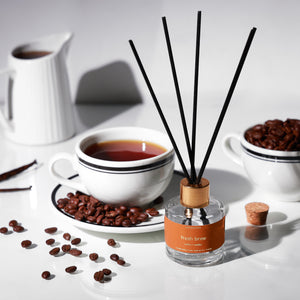


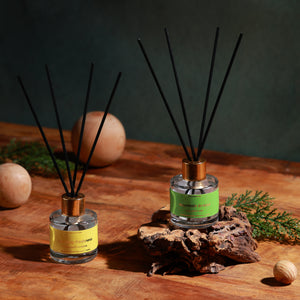

The thirty-second test: lift one reed and find the wet line. High and dark to the tip means saturated and stalled — flip. Barely above the oil means under-wicking — add reeds or refresh them.
The level is not the metric: a 50ml moves roughly six to eight millilitres a week, which is invisible before about week four.
The one innocent case: a cold, sealed, low-traffic air-conditioned room genuinely consumes slowly, and nothing is wrong.
2. Run the wet-line test before you touch anything. Gloves on, lift one reed, and find the boundary between the oil-soaked section and the dry section. High and dark right up to the exposed tip means saturated and stalled. Barely above the oil, with a reed that is nearly dry an inch up, means the reeds are not wicking. A clear line well above the oil with a damp buried length means the reeds are fine and the problem is in the room.
3. Flip all six, then wait a full day. Not three of them, and not for an hour. The hour after a flip carries a genuine surge as the newly exposed saturated end releases what it has been holding, and that surge is not the new baseline. Twenty-four hours is the honest reading.
4. Judge with the doorway test, never from the sofa. Your nose stops reporting a constant within minutes and adapts hardest at home. Fifteen minutes outside and a walk back in through the front door gives you the closest thing to a guest's first breath. A genuine guest is better still — say nothing about the diffuser and ask afterwards.
5. Then move the bottle before you buy anything. A console or open shelf near a doorway or walkway, waist to chest height, clear space around it, several feet from an AC vent or fan, out of direct sun. Dead air keeps fragrance within a foot of the glass; a draught strips the reeds and empties the bottle weeks early while the room smells of nothing.
6. Only then spend, and spend in the right place. Add reeds knowing the cost in weeks. Move up the composition scale. Add a second source. Do not buy a larger bottle expecting a larger room — a 130ml is duration, not reach, at the same six reeds.
7. Accept the one innocent verdict. A cold, sealed, low-traffic air-conditioned room really does consume slowly. If the wet line is healthy, the held reed is strong and a visitor notices the fragrance, then nothing is wrong and the extra weeks are a gift rather than a fault.
Composed and handmade in small batches in Pune, and a portion of every order supports girl-child education through Nanhi Kali.
Part one — why lasting forever and smelling of nothing are the same fault
A reed diffuser has no reservoir of stored output and no way to hold fragrance back for later. Oil climbs the fibre only to replace what has evaporated from the exposed length; the column moves because the tip is emptying. That makes consumption and delivery the same event, counted in two different units — millilitres in the glass and fragrance in the air. There is no mechanism by which a bottle can deliver normally while consuming slowly, which is why the pleasant-sounding report of a 50ml lasting four months should worry you rather than please you. What follows are the three ways that stalling happens, and they are the three things to check before anything else.
 Garden Bloom₹799 · 8.9/10The opposite failure looks similar in the glass and completely different on the reed. Three reeds where there should be six, or reeds leaning against the neck with barely a centimetre in the oil, cannot draw enough to supply the room — and the wet line stays stubbornly low, an inch or so above the surface, never climbing. Consumption falls, the bottle appears to last, and the room stays quiet. Under-wicking also wastes oil in a way people do not expect: the composition sits ageing in the bottle while you wait, and top notes are lost to time rather than to the room. Both causes are free to correct. Stand the reeds upright and deeper so a good length is immersed, and bring the count back to six — the number each SOSA composition is dosed for. If the line still will not climb after a couple of days, the fibre itself may have served its time.
Part two — the wet-line atlas
Everything in Part one can be distinguished by looking at a single lifted reed, which is why the wet line is the first instrument in this guide rather than the last. Put gloves on, draw one reed straight up, and hold it against a plain background. The boundary between the darker saturated section and the dry section above it is the whole reading. This table is the atlas — every pattern I see reported, what is happening inside the fibre, and the correction. Wipe the reed and stand it back the way it came out; you are diagnosing, not yet adjusting.
| What the reed looks like | Where the line sits | Inside the fibre | What the room does | The correction |
|---|---|---|---|---|
| Damp low down, dry above, clear boundary ★ | Well above the oil, roughly steady | Healthy capillary flow, oil replacing what leaves | Steady and low — the plateau | None. Flip weekly and leave it alone |
| Dark and glossy right to the exposed tip | At or near the very top | Saturated — heavy residue holding at the surface | Gone quiet, level frozen | Flip all six; judge at 24 hours |
| Almost dry an inch above the oil | Barely above the surface | Under-supplied — too few reeds or too shallow | Faint everywhere, including up close | Stand deeper and upright; return to six reeds |
| Tip darkened, stiff or slightly gritty | Low, and unmoved after a flip | Fouled — months of residue narrowing the channels | No response to anything free | Refresh the reeds; a new bottle brings six |
| Wet high up but the room is a draught | High, and the level is falling fast | Stripped — mechanical air pulling from the surface | Quiet and emptying weeks early | Move several feet clear of the AC or fan |
| Warm to the touch, oil thin, line high | High, level falling fast | Heated — sun or a hot shelf thinning the oil | Loud then abruptly finished | Out of direct sun, off the west wall |
| Healthy line, everything else normal | Well above the oil | Working correctly | Guests notice; you do not | Nothing — that is adaptation, not a fault |
| The honest caveat: the wet line tells you about supply, not about the room. A perfect reading with a silent room is not a contradiction — it is a proof that the fault lies downstream, in placement, room volume or your own adaptation. Read it as a filter that removes half the possible causes in thirty seconds, not as a verdict on the whole system. Wear gloves, and stand the bottle on a tray afterwards, because reed oil marks wood and stone. | ||||
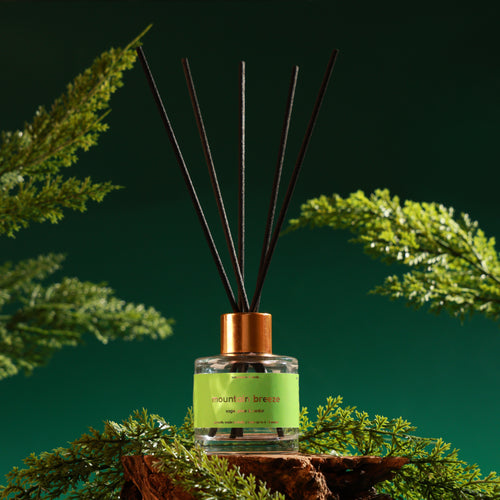 Mountain Breeze · 9.4/10from ₹849Shop →
 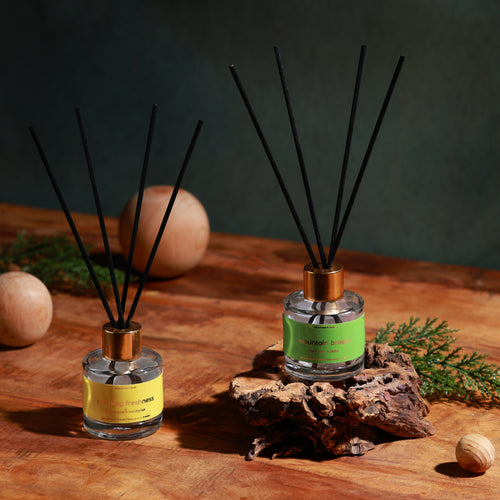 Fresh & Grounded duo · two sources₹1,548Shop →
  Sukoon · scent on demand₹1,899Shop →
Part three — why the oil level is the wrong instrument
Even once you accept that consumption and delivery are the same thing, the level in the glass remains a poor way to read them, and for a simple reason of scale. A 50ml bottle rated at six to eight weeks is spending somewhere around six to eight millilitres a week — that is arithmetic from the stated window rather than a measured figure, but it is close enough to plan by. Six millilitres is roughly an eighth of the bottle, spread across the width of the glass and read through a curved wall, above a printed label, in whatever light the room happens to have. One week of perfectly normal consumption is a band you could cover with a fingertip. The 130ml is worse: it consumes at roughly the same weekly rate, around seven to nine millilitres, because it carries the same six reeds — but that loss is a much shallower band in a larger, wider bottle, which is why 130ml owners are the people most likely to conclude that nothing is happening at all.
There is a second distortion at the start. When six dry fibre reeds first go into a fresh bottle they wick hard for a day or two and take up several millilitres on the way to equilibrium. Part of week one's apparent loss is therefore held inside the fibre rather than delivered to the room, and it stays there for the life of the bottle. That produces the familiar sequence where a new diffuser seems to drop, then seems to stop — and it happens at exactly the same moment as the days-one-to-three fragrance spike is fading into the settle. Two normal effects, arriving together, reading as a fault. Neither is one.
If you are going to use the level at all, use it properly: stick a strip of masking tape to the glass so its lower edge sits exactly at today's surface, pencil the date on it, and then leave it alone for a fortnight. Two weeks of consumption is roughly a quarter of a 50ml, which is a gap nobody can argue about. What you must not do is compare today's level against your memory of last week's, from a different height in different light, having in the interim formed an expectation. That is not a measurement; it is a mood. And it is where a very large share of the unnecessary purchases in this category begin — most often a bigger bottle, bought in the belief that the first was defective, which then behaves identically because it is the same six reeds standing in more oil.
Part four — the instruments, ranked by how much you should trust them
If the level is a poor instrument, what is a good one? Here is every method people actually use, with what it genuinely measures, how long it takes, and whether it deserves your confidence. The three at the top are the ones this whole cluster is built on; the three at the bottom are the ones that generate the most mistaken conclusions.
| Instrument | What it actually measures | Time | Trust it? | Where it misleads |
|---|---|---|---|---|
| The wet line on a lifted reed ★ | Supply — whether oil is still climbing | 30 seconds | Completely, for supply | Says nothing about the room |
| A reed held an inch from your nose | Emission and composition integrity | 10 seconds | Completely, for the bottle | Cannot tell you what the room receives |
| A visitor, unprompted | Distribution — what the space actually smells of | 2 minutes | Very high | Uncalibrated; ask neutrally, do not lead |
| Fifteen minutes out, then the front door | Distribution, with your own nose partly reset | 15 minutes | High | Only the first three seconds count |
| Tape on the glass with a date | Consumption, over a fortnight | 14 days | Good, but slow | Useless as a same-week check |
| Glancing at the oil level | Almost nothing before week four | 1 second | Low | A few millimetres a week is not visible |
| Sniffing the bottle neck | Vapour pooled in the neck, nothing more | 2 seconds | None | Passes even on a completely stalled bottle |
| Your own nose, from your own sofa | Your degree of adaptation, not the fragrance | Continuous | None | Adapts hardest exactly where you live |
| The honest caveat: none of these are laboratory methods and none of them produce a number. They are practical checks refined from in-house testing and customer correspondence, and their value is in the order you run them: supply first, emission second, distribution third. Running them out of order — or running only the last one, which is what nearly everybody does — is how a healthy bottle gets replaced. | ||||
Part five — the three states a static level can mean
With the instruments established, the diagnosis collapses into three states, and it is worth being able to name yours. The first is stalled. The reeds are saturated, the wet line runs dark to the tip, and both consumption and delivery have stopped together. This is the majority of cases, it usually follows two or three weeks without a flip, and it is fully reversible in ten seconds. The second is under-supplied: too few reeds, or reeds sitting too shallow to draw, so the wet line never climbs and the room never receives enough. Also free to correct, though it deserves a note of urgency — a bottle that sits half-used for months is losing its lighter notes to time rather than to your room, so waiting is not neutral.
The third state is the one I want to defend, because it is real and it is regularly misdiagnosed. A cold, sealed, low-traffic air-conditioned room genuinely slows evaporation, and nothing is wrong. Cooler air holds less vapour and the oil itself is more viscous when cool; a closed room with the unit off exchanges very little air; and if nobody walks past the bottle for hours, the envelope around it never clears. Every one of those effects reduces consumption legitimately. A guest bedroom in a Bengaluru flat, run at twenty-two degrees with the door shut, will make a 50ml go a very long way — and if the wet line is healthy, the held reed is strong and a visitor notices the fragrance on entering, then you have a bottle in excellent health in a room that simply does not ask much of it. The right response is to enjoy the extra weeks, not to correct something that is not broken.
Air conditioning is genuinely two-faced here, which is why it confuses people. A sealed cool room slows a bottle down in the benign way just described. A bottle sitting in the AC's actual air path does the opposite: it is stripped continuously, empties weeks early, and leaves the room smelling of nothing much, because the fragrance is carried away and diluted faster than the room can register it. Same appliance, opposite failures, and the deciding factor is only whether the bottle stands in the stream. If your level is falling unusually fast and the room is quiet, look for a vent or a fan before you look at anything else. If your level is barely moving and the room is quiet, look at the reeds. And if your level is barely moving and the room smells lovely to anyone arriving, look at nothing at all.
Part six — the full ladder, and the ceiling at the top of it
Here is the whole method as a sequence of decisions, ordered by cost. The first five rungs are free, the sixth costs weeks rather than rupees, and everything after that is a purchase. In my correspondence the great majority of cases are resolved before the paid rungs, which is why I insist on this order — and why the last row exists at all.
| Rung | What it fixes | How soon you can judge | Cost in weeks | Price |
|---|---|---|---|---|
| 1. Read the wet line ★ | Tells you which of the three states you are in | Immediately | None | Free |
| 2. Flip all six reeds, gloves on | Saturation — restores the designed delivery rate | 24 hours, from the doorway | A little, and worth paying | Free |
| 3. Deepen and straighten the reeds | Under-wicking from shallow immersion | 1–2 days | None | Free |
| 4. Move into gentle passing air | Dead air, or a draught — the two opposite failures | A day of ordinary traffic | Often adds weeks | Free |
| 5. Close the room for an hour, then walk in | Your own adaptation, and nothing else | 1 hour | None | Free |
| 6. Add reeds — six to nine | A genuinely quiet composition in a bigger room | Same evening | ≈ 5 weeks instead of 8 on a 50ml | Free |
| 7. Refresh tired reeds | Fouled fibre after several months | 2 days | None | Reeds are not sold separately — a new bottle brings six |
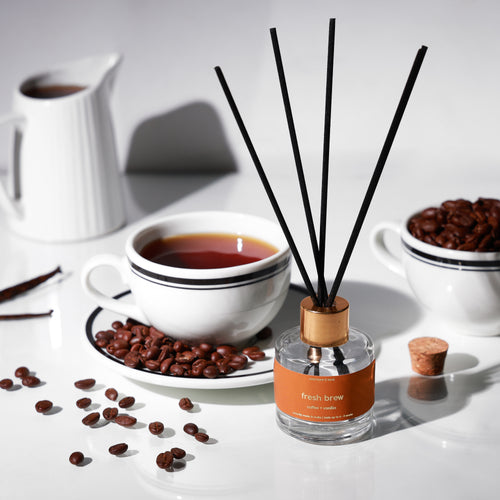
| 8. Move up the scale — Fresh Brew 9.5 or Mountain Breeze 9.4 | A composition quieter than the room needed | Judge at week two, not day one | None — same windows | From ₹849 |
| 9. Add a second source | An open plan no point source can cover | Immediately | None | Duo from ₹1,548 |
| 10. Change format | Scent on demand, or beyond ~250–300 sq ft | Same evening | Not applicable | Sukoon ₹1,899 · 270–320 sq ft |
| Never on the ladder: a bigger bottle | Nothing about the room — 14–18 weeks instead of 6–8 | — | Buys duration only | From ₹1,249 |
And then the ceiling, which belongs at the end of a guide like this rather than buried in it. A reed diffuser is constant, passive and deliberately low; it has no fan, no heat and no switch, and it cannot surge. Past roughly 250–300 sq ft of connected open volume, or when what you actually want is a room that smells strongly on demand — before guests arrive, after cooking, on some evenings and not others — you have reached the edge of what the format can do, and no further rung will get you there. At that point the honest recommendation is a Sukoon at ₹1,899, which covers 270–320 sq ft, runs 16–18 hours on low, has a remote and steady, two-hour and four-hour timers, and comes with three 15ml Hotel Collection scents in the box. I would rather write that than sell you a third reed bottle. Most homes end up running both formats, because they do genuinely different jobs — reeds for the constant background in bedrooms, entryways and studies, a machine for the room that has to perform on cue.
Versailles
Of all the messages that reach me, the ones about a bottle lasting too long are the hardest to answer well, because the customer is telling me something they believe is a compliment. Four months out of a fifty-millilitre bottle sounds like value. What it actually describes is a product that has been sitting in someone's home, doing nothing, while they wonder politely whether fragrance is simply not for them. That outcome bothers me more than a complaint does.
It is also the failure mode our formulation makes slightly more likely, and I would rather own that than skate past it. We are phthalate-free on a heat-stable coconut-derived carrier, which gives a smaller opening and a longer, flatter plateau than a solvent-carried diffuser — better at week six, quieter at week one. A calm, well-behaved bottle in a calm, sealed room can slip into a stall without ever producing the dramatic decline that would prompt someone to investigate. Hence the wet line. Hence the weekly flip. Hence this guide.
What I would ask is that you run the free rungs in order before you spend anything, and then spend on the composition or on a second source rather than on a larger bottle — the larger bottle is more weeks and never more room, and it is the purchase I most often see made for the wrong reason. If after all of it the space is simply too big, tell me and I will point you at a machine instead. Everything here is composed and handmade in small batches in Pune, tested through 45°C heat and 85% monsoon humidity, and a part of every order funds a girl's classroom through Nanhi Kali.
Frequently asked questions
- Why is my oil not going down? and lasting a long time but giving very little fragrance — the static level as a symptom, and the inverse pathology behind it.
- Why is it barely evaporating? and does slow evaporation mean it isn't working? — the cold sealed room, and why the level is not the metric.
- Why are my reeds not absorbing enough oil? and should the level go down every week? — immersion and count, and the weekly arithmetic.
- How do you know it is actually working? and should I replace the reeds if the oil isn't going down? — the three tests, and the flip-first decision tree.
- Lasting but too mild — the SOSA answer, plus why can't I smell my reed diffuser? and the full strength guide.
- Brand: the SOSA founder story.
SOSA reed diffuser range & prices (verified August 2026): alcohol-free, phthalate-free, paraben-free and IFRA-compliant compositions on a heat-stable coconut-derived (CCT) carrier, low-VOC, supplied in a refillable glass bottle with six fibre reeds; 50ml lasts 6–8 weeks and 130ml lasts 14–18 weeks. Morning Freshness (Malabar lemon · peppermint · Nilgiri eucalyptus) 50ml ₹749 · 130ml ₹1,249 · 9.0/10; Garden Bloom (British rose · night-blooming jasmine) 50ml ₹799 · 130ml ₹1,299 · 8.9/10; Evening Calm (Kashmir lavender · chamomile) 50ml ₹799 · 130ml ₹1,299 · 8.9/10; Fresh Brew (Coorg coffee · Kerala vanilla) 50ml ₹849 · 130ml ₹1,349 · 9.5/10; Mountain Breeze (Himalayan pine · sage · Indian cedar) 50ml ₹849 · 130ml ₹1,349 · 9.4/10. Reed diffuser refills are oil only — you reuse your own vessel and reeds: 300ml ₹2,399 (roughly 8–11 months) · 500ml ₹3,499 (roughly 14–18 months), about ₹7–8 per ml against ₹15–17 per ml for a 50ml bottle. Duo sets ₹1,498–₹1,598 for 2 × 50ml and ₹2,498–₹2,598 for 2 × 130ml. Strength figures are positions on SOSA’s own internal strength scale, not an industry standard. Replacement reeds are not sold as a separate SKU; SOSA guidance is to refresh reeds every few months. The reed line is separate from the water-based Hotel Collection for ultrasonic machines (15ml ₹299 · 100ml ₹999 · 300ml ₹1,799) and the two are not interchangeable. Diffusers: Boond 300ml ₹899 · Sukoon 500ml ₹1,899 · Megh 6L ₹3,499 · waterless Vaayu ₹11,999. Composed and handmade in small batches in Pune, India; tested through 45°C summer heat and 85% monsoon humidity. Free shipping above ₹499. A portion of every order supports girl-child education through Nanhi Kali. Prices subject to change — see the live product pages.