
My Reed Diffuser Works With the Windows Closed but Disappears When the Balcony Is Open — Is That Normal?

My Reed Diffuser Works With the Windows Closed but Disappears When the Balcony Is Open — Is That Normal?


★ ★ Completely normal — moving air removes scent faster than six reeds release it, and nothing is wrong with the bottleReed diffusers 50ml from ₹749 · 130ml from ₹1,249 · oil refill 300ml ₹2,399 · free shipping above ₹499A portion funds girl-child education
★ SOSA Reed Diffusers · why it goes quiet when you open up
This is the one complaint where the honest answer is that the product is working correctly and there is nothing to buy
★ ★ ★ ★ ★
★★★★★
"Thought I had been sold a weak bottle. Shut the balcony for an hour, went to the shops, came back in and the room was obvious. The bottle was fine all along."
Harsha B. Hennur
Diagnosed, bought nothing
★★★★★
"What I did not realise was that the draught was also emptying it. Oil was down by half at week four. Moved it two feet behind the partition and the level has behaved since."
Anjali P. Nagarbhavi
Moved out of the draught line
★★★★★
"I had added three extra reeds because of the open door. Evenings with everything shut then became far too much. Took them out and the flat is right again."
Vikram N. RT Nagar
Reeds removed, nothing bought
★★★★★
"The reed test was the useful part. Lifted one out, the wet line was where it should be, so I stopped suspecting the oil and suspected the window."
Sneha K. Bommanahalli
Wet-line check
★★★★★
"Being told plainly that a bigger bottle carries no further is not what I expected when I asked which one to upgrade to."
Aditi R. Mysuru
Talked out of a 130ml
★★★★★
"It reads strongly in the bedroom with the door shut and vanishes in the open living room. Same bottle, moved between them. Explained that way it stops being a mystery."
Kaushik S. Tumakuru
Same bottle, two rooms
★★★★★
"Thought I had been sold a weak bottle. Shut the balcony for an hour, went to the shops, came back in and the room was obvious. The bottle was fine all along."
Harsha B. Hennur
Diagnosed, bought nothing
★★★★★
"What I did not realise was that the draught was also emptying it. Oil was down by half at week four. Moved it two feet behind the partition and the level has behaved since."
Anjali P. Nagarbhavi
Moved out of the draught line
★★★★★
"I had added three extra reeds because of the open door. Evenings with everything shut then became far too much. Took them out and the flat is right again."
Vikram N. RT Nagar
Reeds removed, nothing bought
★★★★★
"The reed test was the useful part. Lifted one out, the wet line was where it should be, so I stopped suspecting the oil and suspected the window."
Sneha K. Bommanahalli
Wet-line check
★★★★★
"Being told plainly that a bigger bottle carries no further is not what I expected when I asked which one to upgrade to."
Aditi R. Mysuru
Talked out of a 130ml
★★★★★
"It reads strongly in the bedroom with the door shut and vanishes in the open living room. Same bottle, moved between them. Explained that way it stops being a mystery."
Kaushik S. Tumakuru
Same bottle, two rooms
✓ Airflow removes scent faster than reeds release it — that is physics, not a fault ✓ A bottle standing in a draught also empties weeks early: move it, do not replace it ✓ Free shipping above ₹499 · a portion of every order funds girl-child education


Founder Diaries · Bengaluru · A Normal Diagnosis
By Sonal Sahani · ISIPCA Versailles 9 min read Updated August 2026
Yes. It is normal, expected, and the single most predictable thing a reed diffuser does. A reed diffuser releases fragrance slowly and relies on the room to hold it. Open a balcony door and air moves through, carrying scent out faster than six reeds can put it in — so the level never builds. Nothing is wrong with your bottle, the oil has not gone off, and you have not been sold a weak composition. The proof takes an hour and costs nothing. There is one thing worth acting on: a bottle standing in that current also gives up its oil faster and will finish weeks early. Move it out of the draught line. That is the whole intervention, and this page ends in a purchase of nothing.
Quick answers — read this first
Yes, this is normal and the bottle is fine. Moving air removes fragrance from a room faster than a passive diffuser adds it. Closed rooms accumulate; open ones cannot.

Prove it in an hour. Shut the balcony and the room, go out for twenty minutes, and walk back in. If the room reads clearly, the bottle is working exactly as designed and the variable is the door.

Move the bottle out of the through-draught. In the line between the balcony door and a window it scents nothing and empties weeks early — you lose in both directions. A still corner at waist-to-chest height fixes it.

Do not add reeds, buy a 130ml or buy a machine for this. Extra reeds make closed evenings too strong; a bigger bottle lasts longer and reaches no further; a machine's mist leaves through an open door as readily as vapour does.
The short answer
Short answer: completely normal, and the correct action is to move the bottle rather than replace it. Take it out of the line between the balcony door and any window on the far side and stand it in a still pocket — the lee of the entry wall, an alcove, behind a partition — at waist-to-chest height, on a tray. Spend nothing. Then judge the room with the balcony shut, not open.
The mechanism, in one paragraph: oil climbs six fibre reeds by capillary action and evaporates from the exposed length at a low, roughly constant rate. In a closed room that output accumulates until you notice it. Open the balcony and the room is exchanging its air continuously, so the fragrance leaves at least as fast as it arrives and never reaches a noticeable level. The release rate has not changed. What changed is whether the room keeps anything.
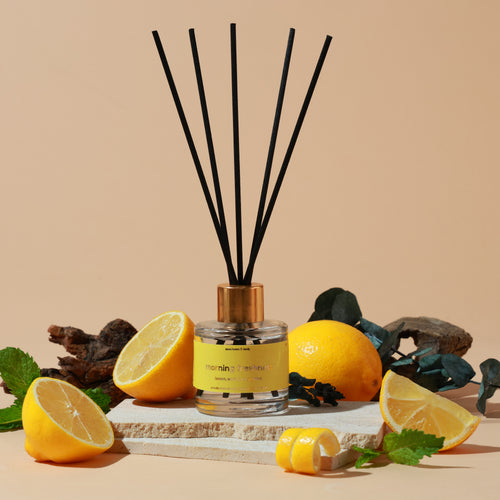
When there is something to buy: only if the bottle is genuinely finished — Morning Freshness 50ml ₹749, Evening Calm ₹799, Mountain Breeze ₹849 — or if you want a room genuinely scented, in which case buy for a bedroom with a door.
Straight answer
Is it normal for a reed diffuser to disappear when the balcony is open?
1. Yes, entirely normal, and it is not a defect. A reed diffuser is passive and low by design. It has no fan and no way to compete with a moving current. With the balcony open, the room exchanges its air faster than six reeds can scent it, so nothing accumulates.

2. The proof takes an hour and costs nothing. Close the balcony and the room, leave the flat for twenty minutes, then walk back in. Coming in from outside is the only reliable way to judge a room you live in — your own nose stops reporting a constant, which happens to everyone at home. If the room reads clearly on the way in, the bottle is fine.

3. Then check the reeds. Lift one out with gloves and find the boundary between the soaked part and the dry part. Well above the oil line means it is wicking properly; barely above it after a fortnight means it is not, and the reeds want refreshing.

4. Now the one thing worth doing: move the bottle. In the line between the balcony door and a window opposite, the current takes oil off the reeds faster than normal and carries the fragrance outside. Check the level against the calendar — a 50ml should last 6–8 weeks at six reeds. Half gone at week three means the draught is costing you money as well as scent.

5. Do not add reeds to compensate. It raises output while the door is open by an amount you will barely register, and then makes closed evenings heavier than you want. It also shortens the bottle in rough proportion to the reeds added.

6. Judge the flat with the doors shut. That is the condition a reed diffuser was designed for, and an hour with the balcony closed before people arrive does more than any purchase.

7. Buy nothing today. Not a stronger scent, not a 130ml, not a machine. If you want one room properly scented, spend on a bedroom with a door — a different decision from this one.

Everything is composed and handmade in small batches in Pune, tested through 45°C summer heat and 85% monsoon humidity, and a portion of every order supports girl-child education through Nanhi Kali.
TL;DR: normal, expected, and not a fault. Air moving through a room removes scent faster than six reeds release it. Shut the balcony for an hour and walk in from outside to prove the bottle is fine, move it out of the through-draught so it stops emptying early, and buy nothing.
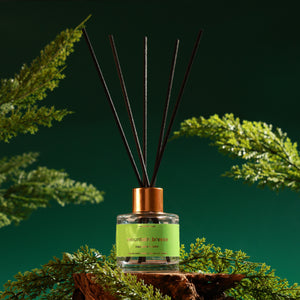
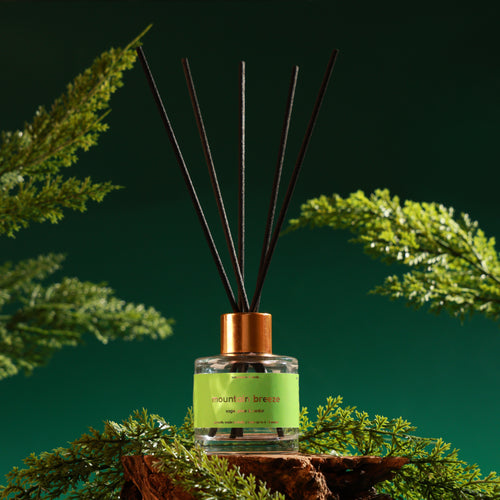
SOSA Mountain Breeze reed diffuser 50ml standing in a still corner away from a balcony draught
The bottle is not the variable — the door is
SOSA Mountain Breeze · Himalayan pine, sage & Indian cedar ₹849 / 50ml
At 9.4 on SOSA's own internal scale at six reeds this is one of the two loudest compositions we make — our scale, not an industry standard — and it disappears through an open balcony door just as readily as the quietest does. That is the point worth taking from this page: the composition is not the variable, and buying a stronger one changes nothing about airflow. Six fibre reeds, alcohol-free, phthalate-free and paraben-free on a heat-stable coconut-derived CCT carrier, 6–8 weeks at six reeds — less if it has been standing in a draught, which is worth checking before you conclude anything about the oil. The 130ml is ₹1,349 and buys 14–18 weeks, not extra distance.

Part one — why an open door empties a room of scent

The behaviour you are describing has three parts, and separating them is what turns a worrying observation into an ordinary one. Two of the three are simply physics; the third is the only one that costs you anything.

1
RELEASE IS SLOW AND CONSTANT; REMOVAL IS NOT
The bottle's output never changes — what changes is how long the room keeps it
A reed diffuser has one speed. Oil climbs the fibre and leaves the exposed length at a rate set by reed surface, temperature and the air passing over it, and that rate is low by design. A closed room lets that slow output pile up over hours until it reaches a level you register; an open one is being continuously flushed, so it never reaches that level. Both rooms receive the same amount of fragrance per hour from the same bottle. Only one is keeping any. Seen that way, the observation stops being about the product and becomes a description of your room — which is why the fix is never a stronger bottle.
The test: shut the balcony, go out for twenty minutes, walk back in. That is the whole diagnosis.
2
YOUR NOSE IS THE SECOND VARIABLE
Adaptation and airflow produce the same complaint and want different responses
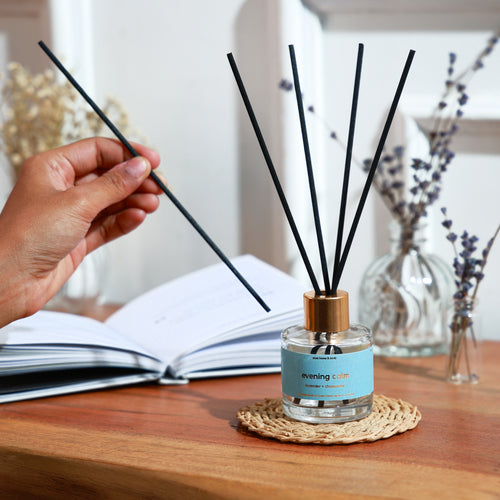
SOSA Evening Calm reed diffuser, Kashmir lavender and chamomileEvening Calm₹799 · 50mlNot noticing a constant fragrance at home is ordinary olfactory adaptation, strongest where you spend the most time. It produces the identical sentence — "I cannot smell it any more" — and is a completely different situation from an open door. The two are easy to tell apart, because adaptation does not care whether the balcony is open. If the room reads when you come in from outside with everything shut but not while you sit in it, that is your nose. If it reads to everyone with the doors shut and to nobody with them open, that is airflow. Neither has a purchase attached, and both are made worse by adding reeds.
The rule: judge on arrival from outside, or on what somebody who has just walked in says. Never from the sofa.
3
THE PART THAT ACTUALLY COSTS YOU
A bottle in the draught line empties weeks early and scents nothing on the way
Here is the one finding worth acting on. Air moving quickly across the reeds takes oil off them faster than still air does, so a bottle in the direct path between an open balcony door and a window on the far side consumes itself at an accelerated rate while delivering almost nothing to the room — the same current removes what it releases. Check the level against the calendar: a 50ml at six reeds should run 6–8 weeks. Noticeably below half at week three, in a flat open all day, and the position is the reason. Move it into a still pocket — behind a partition, in the lee of the entry wall, an alcove — at waist-to-chest height, on a tray, out of direct sunlight, which shortens a bottle for its own reasons. This costs nothing and recovers weeks of life.

Part two — the differential: what your bottle is telling you

Five patterns, told apart by what the room does shut against open. Find your row before concluding anything about the bottle.

Differential diagnosis · closed room against open room
What you observe in each condition, what it means, and what to do about it
What you observe With everything shut With the balcony open What it means, and what to do
Your case, most likely ★ Reads clearly when you walk in from outside Almost nothing, anywhere in the room Airflow. The bottle is correct. Move it out of the draught and buy nothing
Nothing in either condition, but a guest says the flat smells lovely Nothing to you Nothing to you Ordinary adaptation. Nothing to buy, and adding reeds is the classic mistake here
Loud for three days after opening, then much quieter for good Quieter, but present Very little The settling curve. Freshly soaked reeds are the loudest a bottle ever is; the plateau is the product
Room quiet and the oil is dropping unusually fast Quieter than you expect Nothing The bottle is in the current. Move it today — you are losing scent and weeks at once
Reeds barely damp above the oil line after two weeks Weak even shut Nothing Not wicking. Refresh the reeds; the oil is not the problem
The honest caveat: four of these five rows resolve to spending nothing, and the fifth runs into a real gap — SOSA does not sell replacement reeds separately, so refreshing them means the reeds that come with a new bottle. A gap I would rather name than talk around. Note too that the closed-room column assumes you are judging on arrival from outside; from the sofa, every row above reads as "nothing".
If and when you do buy
Not for this problem — for a room with a door on it
The SOSA principle
You cannot out-fragrance an airflow problem. The answer is position and expectation, never a stronger product.
Which makes this the rare page where the correct outcome is that you close the tab, move a bottle two feet, and spend nothing.

Part three — the four things not to buy because of this

Each of these is a purchase somebody makes after noticing what you have noticed, and none addresses it. Extra reeds first, because they are free and therefore the most tempting. Adding three raises output by roughly half — into a room being flushed, where you will barely register it. Then you shut the balcony against the rain and the room calibrated for a through-breeze is suddenly heavier than anyone wants. You have also shortened the bottle in rough proportion. Six reeds is our calibrated default; an open flat is a case for leaving all six in and accepting the pocket they make.

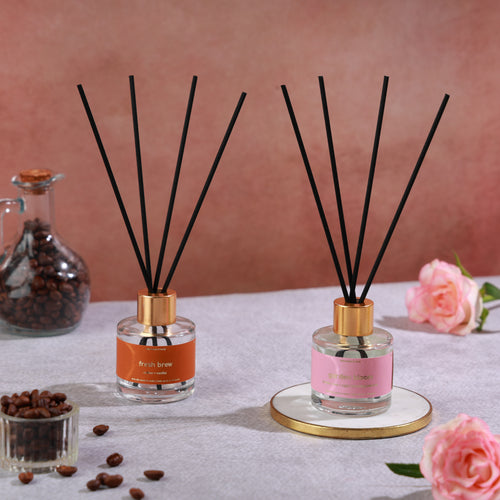
A 130ml is second. At ₹1,249–₹1,349 it holds nearly three times the oil, runs 14–18 weeks instead of 6–8, and at six reeds releases the same per hour and reaches exactly as far. Size is the duration control and reeds are the volume control; neither is a reach control. Buying up a size because a room went quiet is the most common wasted upgrade in this category. Third is a stronger composition. Mountain Breeze at 9.4 and Fresh Brew at 9.5 sit at the top of our internal scale and vanish through an open door just as Evening Calm at 8.9 does — the scale describes how a composition reads at six reeds in a room that holds air, and airflow is indifferent to it.

Fourth is a machine, and it deserves a fair hearing. A Sukoon at ₹1,899 covers 270–320 sq ft, runs 16–18 hours on low, has a remote and steady, 2H and 4H timers, and comes with three 15ml Hotel Collection fragrances. That figure describes a closed room, and its mist is carried out of an open one exactly as reed vapour is — a fan behind a plume does not defeat a through-draught. What it genuinely buys is control. If you want the living room scented for an hour before people arrive, close the balcony and either format will do it, the machine faster. Buy it for the timer, never as an answer to an open door. The 6L Megh at ₹3,499 is worse here on every count — about 215 sq ft, less than a Sukoon, a runtime and humidity machine and never a coverage upgrade.

A room with the balcony open is not failing to hold your fragrance. It is doing exactly what an open room does, to every fragrance, at every price.
— Sonal Sahani, SOSA

Part four — what to actually do, by diagnosis

Six versions of what you might be seeing. Four cost nothing, which is the honest shape of this question.

Diagnosis first, then action
What you have found, what to do about it, and what it costs
What you have found What to do What to buy Cost
Reads clearly with the balcony shut, nothing with it open ★ Nothing is wrong. Move it into a still pocket and judge the flat closed Nothing ₹0
Bottle is well below half before week four Take it out of the line between the balcony and the far window today Nothing — you are recovering weeks, not replacing a bottle ₹0
Guests notice it and you do not, in any condition Ordinary adaptation. Leave the reed count exactly as it is Nothing ₹0
You added extra reeds and closed evenings now feel heavy Take them back out and give the room a day to settle Nothing ₹0
You want one room genuinely scented rather than a pocket Buy for a bedroom with a door — a bounded volume behaves properly One Evening Calm 50ml ₹799
The bottle is genuinely empty and you liked the scent Refill your own glass and reeds — remove reeds, pour to the neck, return them, flip once Oil-only refill 300ml, about ₹7–8 per ml ₹2,399 ≈ 8–11 months
Honest notes for buyers: airflow carries scent away from the bottle, so an open balcony, a fan or an AC draught all mean less stays in the room. That is a distribution effect, not a fault, and it is not corrected by a stronger composition, a larger bottle or more reeds. Warmth raises the evaporation rate and moving air increases it further, so a bottle in a draught or a hot spot finishes sooner — a duration effect. Not noticing a constant fragrance at home is ordinary olfactory adaptation; the reliable checks are leaving the room and returning, or asking someone who has just arrived, and no timescale, percentage or technique is claimed for it. Reeds are the volume control and the bottle is the duration control: 50ml lasts 6–8 weeks and 130ml 14–18 at six reeds, both typical ranges rather than guarantees. SOSA has no 100ml reed diffuser. Refills are oil only — vessel and reeds not included, and replacement reeds are not sold separately; our guidance is to refresh reeds every few months. Reed oil never goes into an ultrasonic machine and the water-based Hotel Collection never goes into a reed bottle. Machine coverage figures are manufacturer specifications for a closed room. A reed diffuser adds fragrance to a room; it does not clean or filter air, remove any smell, or reduce humidity. Fragrance oil is flammable — keep bottles on a tray, out of direct sunlight, away from open flame, and out of reach of children and pets. Made in Pune; free shipping above ₹499, and a portion of every order supports girl-child education through Nanhi Kali.
SOSA reed diffuser oil-only refill 300ml bottle
The only purchase this page might end in — and only later
SOSA reed diffuser refill · oil only ₹2,399 / 300ml
If the draught has emptied your bottle early and you liked the composition, this is what to buy when it is finished — not a replacement bottle and not a bigger one. 300ml runs roughly 8–11 months at about ₹7–8 per ml against ₹15–17 per ml for a 50ml bottle; the 500ml is ₹3,499 and about 14–18 months. You reuse your own glass vessel and reeds: take the reeds out, pour to the neck, return them, flip once so both ends are coated. The honest gap is worth stating — replacement reeds are not sold separately, and since our guidance is to refresh them every few months, that is a limitation of the range rather than something I can sell around. Handle with gloves and stand the bottle on a tray.
SS
ISIPCA
Versailles
A note from Sonal

This is the message I am most pleased to receive and answer with the least selling. Somebody has noticed something real, described it accurately, and concluded that a product they paid for has failed. It has not, and saying so plainly is worth more to me than an order.

It feels like a fault because the change is so abrupt. Open a door and a room you had scented is unscented within minutes — that reads as a switch being flipped, and switches suggest breakage. What is happening is duller: the release rate is unchanged, and the room simply stopped keeping any of it. Nobody explains this at the point of sale, ourselves included until we started writing these pages.

What I do want people to act on is the level in the bottle. A diffuser standing where the air runs through gives up its oil quickly and gives you nothing for it — a genuine loss of weeks that a two-foot move prevents. Beyond that: judge the room on arrival from outside, leave the reed count alone, and enjoy the flat being open, because most of the country cannot. Made in Pune, and a part of every order funds a girl's classroom through Nanhi Kali.

Frequently asked questions

Is it normal for a reed diffuser to stop working when a window or balcony is open?
Yes, and it is the most predictable thing the format does. A reed diffuser releases fragrance slowly and needs a room that holds its air; with a balcony open the room exchanges air continuously and the fragrance leaves as fast as it arrives. Shut the balcony, step out for twenty minutes and walk back in — if the room reads, everything is working.
Should I add more reeds to compensate for the open door?
No. Extra reeds raise output by an amount you will barely notice in a room that is being flushed, and then make closed evenings heavier than you want — the day you shut everything against the rain, you will feel it. They also shorten the bottle roughly in proportion. Leave all six in and take the pocket of scent the bottle makes near it.
My diffuser is emptying much faster than eight weeks. Is that related?
Very likely, and the one thing here worth acting on. Air moving quickly across the reeds takes oil off them faster than still air does, so a bottle in the line between the balcony door and a far window consumes itself while delivering almost nothing to the room. Move it into a still pocket at waist-to-chest height, out of direct sunlight, and the level should behave.
Would a stronger scent or a bigger bottle help?
No to both. The compositions at the top of our internal scale disappear through an open door just as the softest does — airflow is indifferent to what is in the bottle. A 130ml at ₹1,249–₹1,349 runs 14–18 weeks instead of 6–8 while projecting the same at six reeds. Size buys duration, never reach. If you want a room genuinely scented, buy for a room with a door.
How do I tell airflow apart from simply not noticing it any more?
Ask whether the balcony makes a difference. If the room reads clearly when you come in from outside with everything shut and reads as nothing with the doors open, that is airflow. If it reads as nothing to you in both conditions while a visitor says the flat smells of something, that is ordinary adaptation — your nose stops reporting a constant, most strongly at home. Neither needs a purchase, and both are made worse by adding reeds.
Bengaluru · open balconies · 2026
Normal, expected, and nothing to buy — move the bottle two feet
Airflow removes scent faster than six reeds release it, so an open room never builds a level. Shut the balcony, step out for twenty minutes and walk back in to prove the bottle is fine; then take it out of the through-draught so it stops emptying weeks early. Do not add reeds, buy a 130ml or buy a machine. If you want one room properly scented, buy for a bedroom with a door — Evening Calm ₹799. Free shipping above ₹499; a portion of every order supports girl-child education through Nanhi Kali.
For a room with a door · ₹799 → Refill 300ml ₹2,399
Continue the read
More on Bengaluru flats, open windows and airflow
Editorial standards & sources
About this guide: Written by Sonal Sahani, ISIPCA Versailles-trained founder and perfumer at SOSA Home & Body, on why a reed diffuser reads clearly in a closed room and not in an open one. The mechanism described is ordinary physics — airflow carries scent away from the source — and no measurement, study or figure is claimed for it. Olfactory adaptation is described without a timescale, a percentage or any claim that a technique resets it. No claim is made that any fragrance product cleans air, removes a smell, or affects health, mood or air quality. The situation described is a general one Bengaluru readers may recognise; it is not drawn from any customer, forum or third-party discussion. No temperature, humidity or air-quality figure is quoted for any city — the only test conditions stated are SOSA's own, 45°C and 85% relative humidity. No competing product or brand is named, priced or rated.

SOSA range, specifications and prices used in this guide (verified from the live store, 27 August 2026): Reed diffusers — alcohol-free, phthalate-free, paraben-free and IFRA-compliant compositions on a heat-stable coconut-derived (CCT) carrier, low-VOC, in a refillable glass bottle with six fibre reeds; flip weekly. 50ml lasts 6–8 weeks and 130ml lasts 14–18 weeks; there is no 100ml reed diffuser size. Morning Freshness (Malabar lemon · peppermint · Nilgiri eucalyptus) 50ml ₹749 · 130ml ₹1,249; Garden Bloom (British rose · night-blooming jasmine) ₹799 · ₹1,299; Evening Calm (Kashmir lavender · chamomile) ₹799 · ₹1,299; Fresh Brew (Coorg coffee · Kerala vanilla) ₹849 · ₹1,349; Mountain Breeze (Himalayan pine · sage · Indian cedar) ₹849 · ₹1,349. Duo sets ₹1,498–₹1,598 for 2 × 50ml and ₹2,498–₹2,598 for 2 × 130ml. Oil-only refills 300ml ₹2,399 · 500ml ₹3,499 — the glass vessel and reeds are not included, and replacement reeds are not sold as a separate product. Machines: Boond 300ml ₹899 (~150 sq ft, about 6 hours a fill) · Sukoon 500ml ₹1,899 (270–320 sq ft, 16–18 hours on low, three 15ml fragrances included) · Megh 6L ₹3,499 (~215 sq ft — a runtime and humidity machine that covers less than a Sukoon, never a coverage upgrade) · waterless Vaayu ₹11,999 · Safar ₹3,999 (a car and travel product) · Aangan ₹25,999 · Meenar ₹38,500. The water-based Hotel Collection for ultrasonic machines (15ml ₹299 · 100ml ₹999 · 300ml ₹1,799 · pack of seven 15ml ₹1,799) cannot be used in a reed bottle or a Vaayu. Below ₹749: jar candles ₹379, Sandalwood or Smoked Oudh candle ₹449, wax melts ₹474 (a burner is required and not included), mugs ₹474, bubble and taper candles ₹569, Amber Rose candle ₹599, ceramic trinket dish and candle two-pack ₹664. A reed diffuser adds fragrance to a room. It does not clean, purify or filter air, remove or neutralise cooking, damp or smoke smells, reduce humidity, or change how anyone feels. A reed diffuser adds no moisture to the air; ultrasonic machines work by aerosolising water and therefore do. A persistent musty smell indicates moisture that needs finding and drying, and SOSA sells no dehumidifier or air purifier. Ventilate or extract first; add fragrance second. Evaporation rate rises with warmth and falls with humidity, and airflow carries scent away from the bottle — so performance varies with season, ventilation, ceiling height and room use; longevity figures are typical ranges, not guarantees. Not noticing a constant fragrance is ordinary olfactory adaptation; the reliable checks are leaving the room and returning, or asking someone who has just arrived. Strength figures are positions on SOSA’s own internal scale, not an industry standard. Fragrance oil is flammable — keep bottles away from open flame and out of direct sunlight, and out of reach of children and pets. Composed and handmade in small batches in Pune, India; tested through 45°C summer heat and 85% monsoon humidity. Free shipping above ₹499. A portion of every order supports girl-child education through Nanhi Kali. Prices subject to change — see the live product pages.
Back to blog