
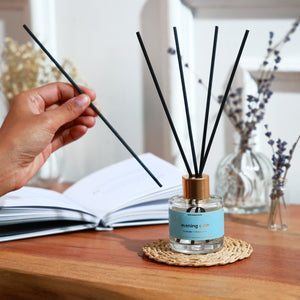

Why it makes the room uneven rather than simply weaker: a vent produces a directed jet, not general circulation. The jet carries the fragrance in a straight line to one wall and drops it there, so one part of the room is over-served and the rest is served by nothing at all. That is a distribution pattern, not a weakness.
Where to move it instead: out of the throw and into the room's return-air path — the air the unit is drawing back in. A surface at roughly nose height, a metre or two from where you actually sit or sleep, inside the circulation but not inside the jet. A closed air-conditioned room is genuinely one of the best environments a reed diffuser can be given, once the bottle is out of the blast.
What you have also been losing: weeks. Fast dry air over a wetted reed surface is the most aggressive evaporation condition in an ordinary home, so a 50ml quoted at 6–8 weeks has been running short. Moving it gives you back both the evenness and some of the life.
What not to buy over this: anything, yet. And never a bigger bottle for reach — volume is a duration specification, not a coverage one. The proof sits in our own range: Megh at ₹3,499 has a six-litre tank and covers only about 215 sq ft, less than the ₹1,899 Sukoon's 270–320.
2. The vent is stripping the reeds far faster than the room ever would. Evaporation from a wetted surface rises with the speed of the air passing over it and with how dry that air is, and a cooling vent supplies both conditions at once — fast air, and air that has had a good deal of its moisture condensed out of it on the way through the unit. A reed is a wetted fibre surface. Sitting one in a cooling jet is close to the most aggressive evaporation condition available in an ordinary home. If your bottle has been emptying faster than the 6–8 weeks a 50ml is quoted at, this is where those weeks went, and they went without buying you a better room.
3. The fragrant air is also ending up lower than you are. Air leaving a cooling vent is colder and therefore denser than the air already in the room, so it does not stay at ceiling level. It travels outwards and sinks as it goes, spreading along the floor before it warms and rises again at the walls. Fragrance riding that stream goes down with it. This is part of why the room can feel oddly patchy at head height while smelling perfectly obvious when you bend down to pick something up — the fragrant layer exists, it is simply not at the height where anybody is breathing.
4. The composition is arriving distorted as well as unevenly. A jet does not remove all the materials in a fragrance at the same rate. The lightest, most volatile molecules leave a reed surface fastest under any conditions, and forced airflow exaggerates that difference, so what reaches the room is skewed towards the top of the composition early and towards the base later. On a citrus or a mint that is noticeable. It is not the bottle changing character; it is the bottle being read out of order.
5. The move itself: out of the throw, into the return. The unit blows from its vent and draws air back in at its intake, and between those two points the room runs a large slow loop. You want the bottle in the loop and out of the jet. In practice that means somewhere along the side or back of the room rather than under the unit, on a surface at roughly nose height, ideally a metre or two from where you actually sit or sleep. A closed air-conditioned bedroom is one of the most favourable rooms a passive diffuser can be given — it is sealed, it is small, and it is being continuously stirred — but only once the bottle is standing in the stirring rather than in the nozzle.
Alcohol-free, phthalate-free, made in Pune. A portion of every order supports girl-child education through Nanhi Kali.
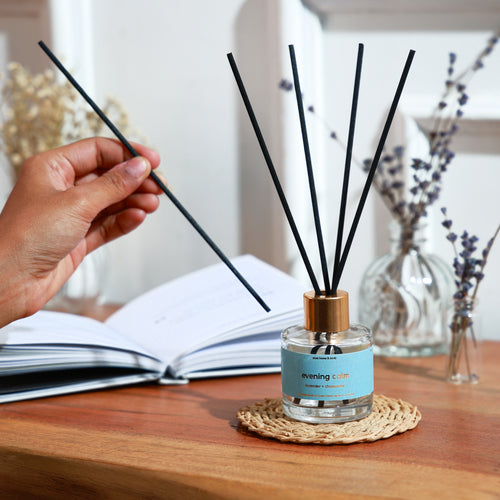
Why a jet and a breeze are different things, and why only one of them helps
People reasonably assume that any moving air is good for a reed diffuser, because moving air is the transport a reed does not supply and because we spend most of this cluster saying so. A ceiling fan on low is the best free change anybody can make. Yet a running air conditioner, which moves far more air than a fan on low, can make a room worse. The difference is not how much air is moving. It is whether the air is being mixed or aimed. Three things follow from that distinction, and they are the three separate harms of the position you are currently in.
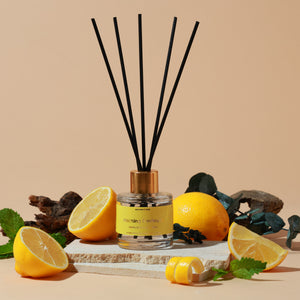
 Morning Freshness₹749Evaporation from a wet surface depends on how quickly the vapour immediately above that surface is carried away. Still air lets it build up, which slows the whole process down; moving air removes it continuously, which speeds it up. Dry air holds more before it is satisfied, which speeds it up again. A cooling vent supplies fast air and dry air simultaneously, and it supplies them straight at the reed surfaces rather than incidentally past them. That is why a bottle under a split unit runs down noticeably sooner than the same bottle on the other side of the same room. I will not put a percentage on it, because it depends on your unit, your setting and your room, and an invented figure would be worth nothing to you. The direction is certain.
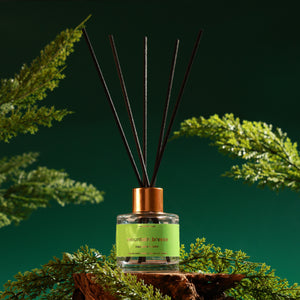
 Mountain Breeze₹849Air leaving a narrow vent at speed does not immediately disperse. It holds together as a stream, pulling some of the surrounding room air along with it, and it keeps its identity until it strikes something. Everything the reeds give up while sitting in that stream is loaded onto it and taken to the same place. This is why your problem reads as uneven rather than as faint. A weak diffuser gives you a low level everywhere. A diffuser in a jet gives you a high level along one line and very little elsewhere, which is a much stranger experience and much harder to diagnose from the inside. Guests often describe it as the room smelling of the fragrance in one spot, which is an unusual complaint and a very specific clue.
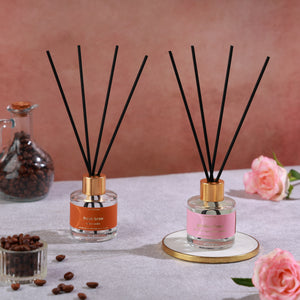
 Garden Bloom₹799A room is layers rather than a single uniform body of air, and temperature decides which layer things settle into. Cooled air is denser than the room's air, so a cooling stream falls as it travels, runs out along the floor and only rises again once it has warmed at the walls and the furniture. Fragrance carried on it goes where it goes. Some of what you believe has disappeared is simply below you. The tell is easy to check: if the room smells clearly stronger when you are sitting on the floor or reaching into a low cupboard than when you are standing, the fragrance is present and stratified, and the answer is a change of position rather than a change of product.
Finding the return-air path with nothing but your hand
You do not need a meter for this, and no meter would tell you anything you cannot feel. A split unit discharges from the vent along its lower face and draws air back in through the grille above, so the room is running a slow loop between those two points: out along the ceiling, down and across the floor, up the far wall, back along the ceiling to the intake. The jet is the fast, narrow, unmistakable part of that loop. Everything else is the useful part. Stand under the unit with the back of your hand raised and walk slowly away from it along the direction the louvres are pointing. Where you can feel a distinct cool stream on your skin, you are in the throw. Where you cannot feel anything on your skin but a light scarf or a tissue held loosely still drifts, you are in the circulation. That second place is where the bottle belongs.
In an ordinary bedroom the practical answer is usually a chest of drawers, a dressing table or a bedside table along a side wall, roughly a metre and a half or more out of the vent's line, at a height somewhere around your nose when you are seated. Height matters more than people expect and it costs nothing to correct. A bottle on the floor is spending its output on the stillest and lowest layer of the room; a bottle on top of a wardrobe is scenting the layer above your head. At or slightly below nose height, on a surface, is where a point source does the most good, and in a cooled room it also keeps the bottle out of the cold stream that is running along the floor.
Two things to avoid while you are rearranging. Do not simply move the bottle from the vent into a dead corner, behind a curtain or into an alcove between two pieces of furniture — out of the draught does not mean out of the room. A dead pocket makes a bottle last a very long time for the worst possible reason, which is that nothing is collecting what it emits. And do not put it on a sunny windowsill in an attempt to get it away from the AC. Direct sun heats the oil, accelerates evaporation and, in a diffuser built on the cheap solvent most brands use, can turn the composition bitter. Every SOSA reed sits on a heat-stable CCT carrier rather than DPG, which cracks above about 40°C, and the bottles are tested through 45°C heat and 85% humidity — but a windowsill is still a poor place for a different reason, which is that it is usually next to the opening through which the room's air leaves.
Every position relative to the vent, scored
The same bottle, the same six fibre reeds and the same room, in the positions people actually use. The last row is the one you are in now, and the starred row is where I would put it tonight.
| Where the bottle stands | What the air is doing there | What the room gets | Effect on bottle life |
|---|---|---|---|
| Side wall, out of the throw, nose height, door shut ★ | The slow return loop between vent and intake | The best free result in a cooled room — the unit distributes what the reeds emit | Shorter than a still room, because the air is dry. Use three reeds to buy most of it back |
| Near the intake grille, a little below and to one side | Air being gathered from the whole room | Good, and often surprisingly even, because everything drawn in is redistributed | Shorter. Keep it out of the immediate suction |
| Beside the bed, on a table, a metre or two from your head | Whatever the loop is doing, quietly | Strongest where you actually are, which is the honest use of a point source | Normal for a cooled room. Three reeds at close range rather than six |
| Centre of the room on a low table | The cold stream running along the floor | Fair geometry, poor height. The output goes into the layer beneath everybody | Shorter than it looks, because floor-level air in a cooled room moves |
| Dead corner, behind a curtain, in an alcove | Almost nothing | Poor. The fragrance pools within half a metre and never joins the room | The longest of any position, for the worst possible reason |
| Windowsill, or beside a balcony door left ajar | Air leaving the room, with the cooling working against it | Very poor — air that leaves takes the fragrance with it. The bottle is not weaker; the room is being flushed | Much shorter, and shorter again in sun |
| Directly under the vent, in the throw | A narrow, fast, cold, dry jet aimed at one wall | The one placement to avoid outright: uneven by construction, and lower than head height | Shortest of all |
Softest at 8.9 · Evening Calm₹799Shop → 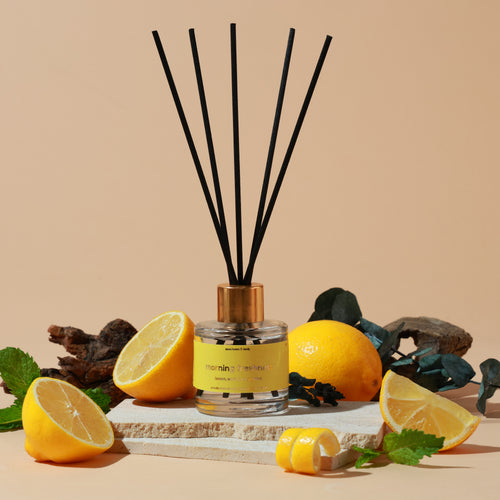 Bright · Morning Freshness₹749Shop →
 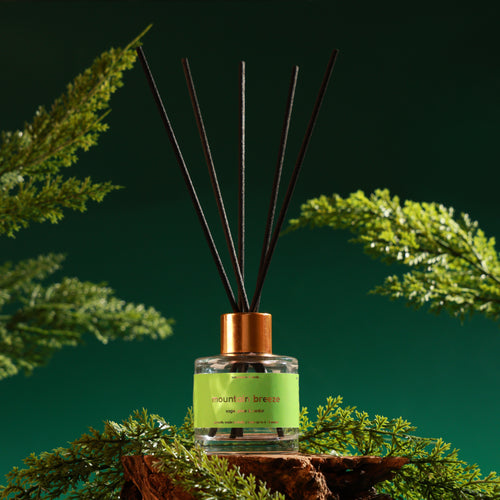 Most present at 9.4 · Mountain Breeze₹849Shop →
The move, and the four free adjustments to make while you are at it
Start with the move, because on its own it may be the whole answer. Take the bottle out of the vent's line and put it on a surface at nose height along a side wall or beside where you sit, then leave it entirely alone for four or five days. A reed diffuser that has been standing in a cooling jet has had its reed surfaces run dry at the tips, and it takes a little while to re-saturate and settle. Judging it the same evening is unfair to it. While you wait, do not add reeds and do not buy anything, because you will not know which change did the work.
Then four adjustments that cost nothing. The reed count is a volume dial and almost nobody uses it as one. Six reeds is full projection; three is a soft level that roughly doubles the life. In a closed cooled bedroom, where the air is being continuously recirculated for you, three is very often the right number and it recovers a good part of the weeks the vent had been taking. Distance is the strongest single lever you have — halving the distance between the bottle and where your head actually is does more than any change of scent, and a bedside table is the correct use of a point source rather than a compromise. Shut the door, which you are probably already doing if the AC is running, because containment is half of the equation and free. And flip the reeds every three to five days, not daily; a flip restores output for a few hours, and it adds no range at all.
One more free adjustment, and it is the best one in the range if your room has a ceiling fan. A ceiling fan on low, running alongside the AC or instead of it, mixes a closed room in a way a directional vent does not. A fan takes the air the room already has and turns it over gently and generally; that is the opposite operation to aiming a stream at a wall, and it is the transport a reed structurally lacks. It shortens the bottle too, for the same evaporation reason, and I would rather tell you that now than let you discover it in week five. Run three reeds with the fan on low and you keep most of the weeks and get most of the evenness.
And a word for the object itself, which spends this page being told where to stand. A reed diffuser is silent — no motor, no pump, no piezo plate humming at three in the morning, which in a bedroom is not a small thing. It needs no power, so it carries on working straight through a power cut when the AC and the fan have both stopped; it needs no water, no filling, no charging, no cleaning and no remembering; it runs at roughly ₹13–₹15 a day; it is an object rather than an appliance, which matters on a visible surface; and it has no service life, because a glass bottle with fibre reeds in it does not fail. Machines do. That is why a great many people keep a reed on the dresser long after buying a machine for the same room.
If you want that evenness without depending on the AC
Move the bottle first and give it a week. If the room is now what you wanted, you are finished and you should spend nothing. The situation in which a purchase becomes reasonable is narrower and more specific than most articles admit: it is when you want fragrance at a chosen level in the whole room on demand, rather than fragrance that behaves well while the cooling happens to be running and settles into a gradient the moment it stops. That is a control requirement, and control is the thing a passive object genuinely cannot supply at any price. One purchase to rule out before the ladder: a second bottle on the other side of the same room. Two passive sources make two concentration peaks with a valley between them, because the midpoint is the farthest point from both and neither of them moves air. Two bottles are genuinely right for a long or L-shaped room used at both ends, for two rooms that are really one volume, for different scents in different zones, or for a budget short of a machine — and they are the wrong answer when the goal is evenness across one open volume. Here is the ladder, with the gap in it named where it falls.
| Option | What it is | When it is right | Price |
|---|---|---|---|
| 1. Move it out of the throw, three reeds, nose height, door shut ★ | The bottle in the return loop instead of the jet, on a surface, near where you sleep | First, and for most people reading this it is the entire answer. Silent, no power, nothing to fill or charge, works in a power cut, roughly ₹13–₹15 a day, and it never breaks | ₹0 |
| 2. A ceiling fan on low alongside it | General mixing rather than a directed stream — the transport a reed lacks | Whenever the room has one. It shortens the bottle, and three reeds instead of six buys most of that back | ₹0 |
| 3. A bottle sized to the room | Evening Calm ₹799, Morning Freshness ₹749, Mountain Breeze ₹849 — 50ml up to about 150 sq ft, 130ml from ₹1,249 above that | When the room genuinely is larger than the bottle. The 130ml buys 14–18 weeks rather than 6–8; it buys weeks, not metres | ₹749–₹1,349 |
| 4. Sukoon | Ultrasonic, 500ml, 270–320 sq ft, 16–18 hours on low, three 15ml Hotel Collection scents included | Very often the correct bedroom answer, and never to be skipped on the way to something dearer. The oil is diluted in water, it adds humidity, it needs filling, and in a hard-water city it can leave a fine white mineral dust | ₹1,899 |
| Not this: a bigger tank or a bigger bottle bought for reach | Megh has a six-litre tank and about a hundred hours of runtime | Never a coverage upgrade — about 215 sq ft, less than the ₹1,899 Sukoon's 270–320. Volume is duration, not coverage, and the same is true of a 130ml reed against a 50ml | ₹3,499 |
| The honest gap: no mid-sized waterless machine | Safar ₹3,999 is waterless cold diffusion of pure undiluted oil — 20ml, cordless, three speeds, a 1 / 2 / 3-hour auto-off timer — and it is named and sold as a car and travel perfume diffuser, so it is not set-and-forget and it needs recharging. Vaayu ₹11,999 is rated to 1000 m³, roughly 2,000–3,000 sq ft | Nothing sits between them as a bedroom-sized waterless machine, and I would rather say so. Vaayu is the wrong purchase for one bedroom, where most of what it can do is wasted; it earns its price on a whole floor, an open-plan living-dining, a clinic or a showroom | — |

Versailles
Of all the questions in this cluster, this is the one where the reader is most often within a metre and a half of having no problem at all. There is exactly one placement I would call a mistake, and it is this one — everything else is a compromise with a reason behind it. So I want to be clear that the instruction here is to move the bottle, not to replace it. If you like the fragrance, and the phrasing of your question tells me you do, then you have already bought the right thing and put it in the wrong cubic metre.
The confusion is entirely understandable, and it comes from a piece of advice we ourselves give constantly, which is that moving air helps. It does. But there is a difference between air being mixed and air being aimed, and an air conditioner is the only appliance in an ordinary home that aims. A ceiling fan turns the room's air over generally and gently; a cooling vent picks a direction and commits to it. If the shorthand version of our advice sent you under the vent, that is a failure of our shorthand, and this page is the correction.
One last thing, because it comes up as soon as somebody moves the bottle and then starts worrying about whether it worked. You are the least reliable judge of your own room. Receptors adapt to a constant stimulus within minutes — the signal keeps arriving and the brain stops reporting it — so a person who lives with a fragrance is genuinely poor at detecting it. Leave the room for fifteen minutes and walk back in, and ask somebody who does not live there. A visitor is a better instrument than you are. If guests remark on it, it is working for everybody but you, and that is a well-behaved diffuser rather than a faulty one. Everything is composed in Pune, and a part of every order funds a girl's classroom through Nanhi Kali.
Frequently asked questions
- Where should I place a reed diffuser? — the full placement method.
- Near a ceiling fan? — yes, and it is the best free fix in this subject.
- Near an open window — yes, it disappears faster, and here is why.
- Weaker with the balcony door open — a much larger opening than a window.
- Does AC make it stronger or weaker? — both, and both matter.
- Door, window, bed or centre? — the four candidates, ranked.
- Cross-ventilation — a straight line through the room, and how to place off it.
- Why it performs differently with the fan on — reading the evidence you already have.
- Change the placement before you buy anything — the family pillar.
- Brand: the SOSA founder story.
SOSA facts verified August 2026: Reed diffusers are supplied in 50ml and 130ml only — 50ml suits rooms up to about 150 sq ft and lasts 6–8 weeks, 130ml suits rooms above 150 sq ft and lasts 14–18 weeks, at roughly ₹13–₹15 a day. Six reeds is full projection; three is a soft bedside level and roughly doubles the life; two or three reeds in a 50 sq ft bathroom can make a 50ml last nearly three months; flip the reeds every 3–5 days. Morning Freshness ₹749 / ₹1,249 · Evening Calm ₹799 / ₹1,299 · Garden Bloom ₹799 / ₹1,299 · Mountain Breeze ₹849 / ₹1,349 · Fresh Brew ₹849 / ₹1,349. Strength scale, perceived intensity rather than quality: Evening Calm 8.9 softest, Garden Bloom 8.9, Morning Freshness 9.0, Mountain Breeze 9.4, Fresh Brew 9.5 deepest. Six fibre reeds rather than rattan, heat-stable CCT carrier rather than DPG, alcohol-free, phthalate-free, paraben-free, IFRA-compliant, 0 ppm formaldehyde, refillable glass bottle, tested at 45°C and 85% RH, composed in Pune. Refills 300ml ₹2,399 and 500ml ₹3,499, oil only and never a first purchase. Machines: Boond ₹899 (300ml, up to about 150 sq ft, ~6h, USB, night light) · Sukoon ₹1,899 (500ml, 270–320 sq ft, 16–18h on low, three 15ml Hotel Collection scents included) · Megh ₹3,499 (6L, ~100h runtime but only ~215 sq ft, never a coverage upgrade) · Safar ₹3,999, a waterless cold-diffusion device named and sold as a car and travel perfume diffuser, with a 20ml bottle, a 2000 mAh battery, three speeds and a 1 / 2 / 3-hour auto-off timer · Vaayu ₹11,999, a waterless cold-air nebuliser rated to 1000 m³, roughly 2,000–3,000 sq ft, with a 400ml tank and app control, and the wrong purchase for one bedroom. No coverage figure is published for Safar and none is quoted here. Reed oil, the water-based Hotel Collection and pure fragrance oil are not interchangeable across these mechanisms. No health, air-quality, allergy, sleep or mood claims are made anywhere on this page. Free shipping above ₹499. SOSA is an independent Indian fragrance house; the Hotel Collection is SOSA's own interpretation inspired by the world's finest hotels and SOSA is not affiliated with or endorsed by any hotel brand. Prices subject to change — see the live product pages.