


A second, separate effect: a bottle actually standing on the sill has air moving across the reed surfaces, which speeds evaporation. So a windowsill costs you twice — once in the room and once in the bottle — and a sunlit sill costs a third time, because heat drives evaporation too.
The free fix, in full: move the bottle off the sill and out of the line between the window and the door; close the window for the hours you actually want the room to read; shut the door as well, because containment is half the equation; and put the ceiling fan on low, which circulates rather than exports.
The order that actually works: ventilate first, then close, then let the fragrance build. Fragrance does not remove a smell — deal with the source, then air the room, then scent it. Doing the last two at once cancels both.
What not to buy: a stronger bottle. This is a transport and containment problem, and emission does not fix it. Volume is a duration specification rather than a coverage one — the proof is in our own range, where Megh at ₹3,499 has six litres and covers about 215 sq ft, less than the ₹1,899 Sukoon's 270–320.
2. The second effect is local to the bottle, and it costs you weeks. Evaporation from a wetted surface rises with the speed of air moving across it, and a reed is a wetted fibre surface. A bottle on a sill therefore empties sooner than the 6–8 weeks a 50ml is quoted at in ordinary household conditions. Add direct sun, which heats both the glass and the oil, and you have three separate accelerators acting on one bottle in the single worst position in the house.
3. More reeds will not rescue it, and this is the part worth internalising. The loss through a window is proportional to the concentration in the room, so raising the emission raises the loss as well. You will pay for more output and post most of it outside. You cannot fix a containment problem by increasing emission, and this is the cleanest example of that rule in the whole subject.
4. What you actually have is a scheduling question, not a product question. A home with the windows open all day is not a fragrance environment during those hours, and it becomes one the moment they close. So decide which hours you want the room to read — the evening, the hour before people arrive, the time before bed — and close the window for those. Ventilate at other times without guilt. This also happens to be the correct order for a room that has a smell you want gone: deal with the source, then air the room properly, then let the fragrance build in the aired room. Fragrance does not remove a smell, and running the two operations at once cancels both.
5. And move the bottle, whatever you decide about the window. Off the sill, onto a surface at nose height near where you sit or sleep, and off the straight line between the window and the door — because two openings on opposite sides of a room behave like a channel and take everything on that line with them. Then shut the door and put the ceiling fan on low. A fan circulates the room's air rather than exporting it, which is the exact opposite of what the window is doing, and it supplies the transport a reed structurally lacks.
Alcohol-free, phthalate-free, made in Pune. A portion of every order supports girl-child education through Nanhi Kali.
The three separate losses an open window causes
People tend to treat this as one effect and it is three, with three different sizes and three different fixes. Two of them are about the room and one is about the bottle, and only one of the three requires you to close anything.
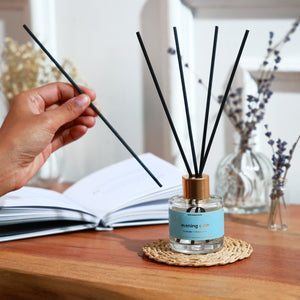
 Evening Calm₹799This is the big one and it happens whether the bottle is on the sill or on the far side of the room. A reed diffuser works by slow accumulation: it emits steadily, the room holds what it emits, and over hours the concentration climbs to something you can perceive. Ventilation resets that clock continuously. It is not that the window fights the diffuser; it is that the window is doing its job perfectly. A ventilated room and a fragranced room are two different states, and you cannot hold both at once. Worth knowing: this effect is stronger on a high floor, because wind speed rises with height, so an eighth-floor flat turns its air over faster than a ground-floor one for the same window opening. Nothing about the diffuser changes.
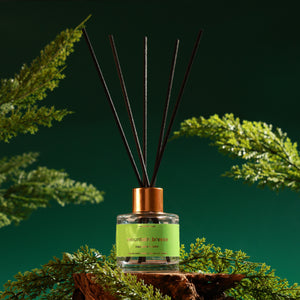
 Mountain Breeze₹849This one is specific to a bottle standing in the moving air rather than merely in the same room as it, and it shows up on your bank statement rather than in the room. Air moving over a wetted surface carries vapour away from that surface and lets more evaporate, which is why a fan shortens bottle life too. The difference between a fan and a window is what happens to the vapour next: the fan hands it to the room and the window hands it to the street. Same acceleration, opposite outcomes. That is the whole reason we recommend the first and warn about the second.
 Garden Bloom₹799The third accelerator arrives free with the first two, because the sunniest surface in most rooms is the sill. Heat speeds evaporation, so a bottle in an afternoon sunbeam empties faster than the same bottle two metres away in shade. What heat must not do is change the smell, and that is a formulation matter rather than a placement one: every SOSA reed sits on a heat-stable CCT carrier rather than DPG, which can crack and go bitter above 40°C, and the range is tested at 45°C and 85% relative humidity. So a sunlit bottle will run down sooner, but it should not turn. Faster is a placement problem. Different would be a product problem, and that is the one we engineered out.
Ventilated hours and fragrant hours are different hours
The most useful reframing I can offer is that this is a timetable problem rather than a product problem. Nobody would expect a room to stay cool with the windows open in May, and nobody should expect it to stay fragrant either — the two work by the same principle, which is that a room holds a condition only while it is closed enough to hold it. A home with the windows open all day is not a fragrance environment during those hours, and it becomes one the moment they close. Once you accept that, the question stops being "is my diffuser strong enough to beat the window" — nothing is — and becomes "which hours do I want this room to smell of something?" For most people the honest answer is the evening, and the evening is also when Indian windows tend to close anyway.
This also settles the order of operations for a room with a smell you would rather be rid of, which is a question I get constantly and which is answered wrongly almost everywhere. Fragrance does not remove a smell. It mixes with it, and the mixture is frequently worse than either component. The order that works is: deal with the source, then ventilate properly with the windows wide, then close the room, then let the fragrance build in the cleared air. Doing the last two simultaneously is the commonest mistake in home fragrance — the ventilation removes the fragrance and the fragrance does not remove the smell, so both operations fail and you conclude the diffuser is weak. It is worth noting that cooking has a long tail for this reason: aerosols condense onto soft furnishings and re-release for hours after the airborne fraction has been cleared in minutes. That is a laundry and wipe-down job, not a diffuser job.
And while we are on the subject of not wasting a bottle: every millilitre leaves through the reeds whether anyone is in the room or not. That is not a flaw, it is the mechanism, and it means the only real waste in a reed diffuser is oil evaporating into a room nobody is occupying. A bottle running full tilt in an empty guest room with the window open all afternoon is being spent twice over. Move it to the room you use, or fit three reeds instead of six while it waits for visitors — three is a soft level that roughly doubles the life.
Window states, and what each one does
Every arrangement I get asked about, and what it does to the room and to the bottle. The first row is the arrangement I would use, and the last is the one that costs the most money for the least fragrance.
| Arrangement | What happens to the room's fragrance | What happens to the bottle | Cost to change |
|---|---|---|---|
| Window shut, door shut, fan on low, bottle at nose height near you ★ | The room keeps what it makes and the fan distributes it. The best free result available | Shorter than still air because of the fan. Use three reeds rather than six to compensate | ₹0 |
| Window shut, door shut, no fan | Retained but not distributed — a fragrant zone with an edge | Full 6–8 weeks on a 50ml with six reeds | ₹0 |
| Window open, bottle across the room from it | Continuously diluted. The room resets as fast as it builds | Close to normal — the bottle is not in the draught | ₹0 to close the window for the evening |
| Window open, bottle on the sill | Worst case. Most of the output goes straight back out | Noticeably shorter, and shorter again in sun | ₹0. Move it, tonight |
| Window and door both open, bottle on the line between them | The room is a channel. Everything on that line is exported | Short — this is the strongest airflow in the room | ₹0. Place off the line between the two openings |
| High floor, window open | Faster still — wind speed rises with height, so the air turns over more often | Shorter, for the same reason | ₹0, and nothing about the diffuser is different |
| More reeds to compensate for an open window | Loss is proportional, so you lose more rather than gain more | Much shorter, for no benefit to the room | Not recommended at any price |
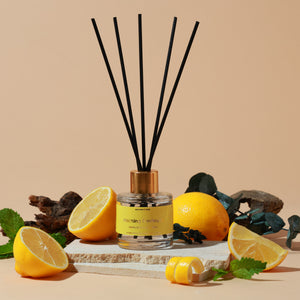
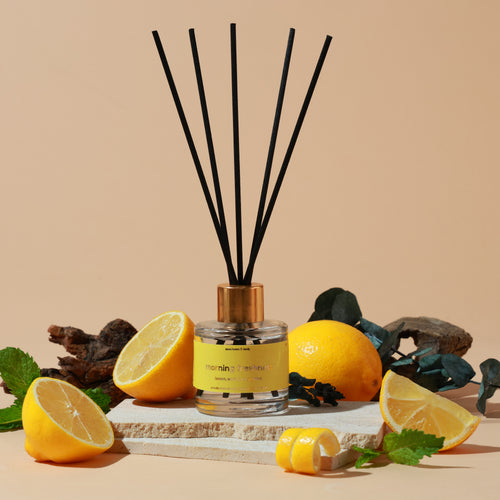
Bright · Morning Freshness₹749Shop → 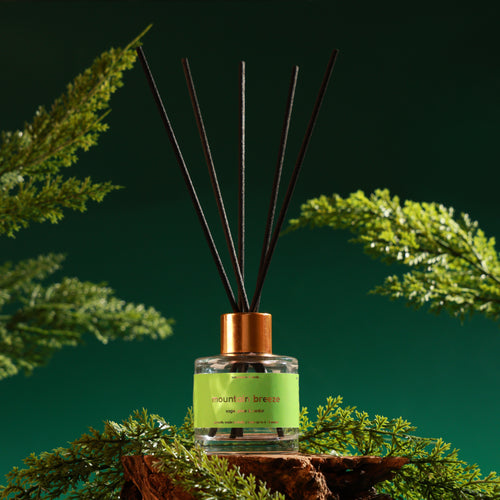 Most present at 9.4 · Mountain Breeze₹849Shop →
 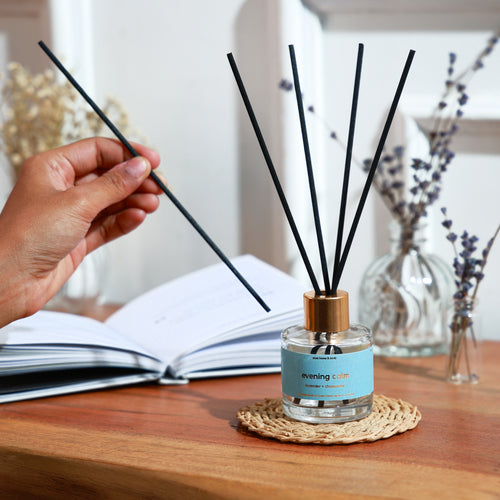 Softest at 8.9 · Evening Calm₹799Shop →
The free fix, in the order I would do it
First, move the bottle off the sill. This costs nothing, takes ten seconds and stops two of the three losses immediately. Put it on a surface at or slightly below nose height, near where you actually sit or sleep, out of direct sun, and — this is the part people miss — off the straight line between the window and the door. Two openings opposite each other turn a room into a channel, and anything standing in that channel is being ventilated rather than distributed. Place to one side of the line, in the part of the room where air circulates rather than passes through.
Second, decide your hours and close the window for them. Not all day, not on principle, just for the stretch you want the room to read: the evening, the hour before guests, the time before bed. Close the door as well. Containment is half the equation and it costs nothing, and a bedroom with its door open is not a 150 sq ft room at all but a 150 sq ft room continuously exchanging air with the whole flat. Then give it time. A reed builds a room slowly, so shutting up a room and expecting an immediate result will disappoint you; shutting it up while you cook dinner and walking in afterwards will not.
Third, put the ceiling fan on low. This is the change most people never think of because it seems to belong to the same category as the window, and it does not. A window exchanges the room's air with outside; a fan circulates the room's own air within it. The fan is the transport a reed structurally lacks — it is the best free change in this entire subject, and it is genuinely more useful than anything I could sell you at the same price. It shortens the bottle, for the same evaporation reason as the draught does, so run three reeds instead of six while it is going, and run it for the hours that matter rather than continuously. If the room is now doing what you wanted, stop here and keep the money. A large share of the people who write to us about this never need to spend anything.
If the window genuinely cannot close
Some rooms cannot be shut. A kitchen that must vent while you cook, a flat that relies on cross-ventilation for most of the year, a room with a window that does not seal, a household where somebody else decides. In those rooms the honest position is that a passive diffuser is working against a continuous loss it cannot win, and no bottle size or reed count changes that. Here is the ladder, with the counterweights attached and the gap in our own range named.
| Option | What it is | When it is right | Price |
|---|---|---|---|
| 1. Off the sill, closed for the hours that matter, fan on low ★ | The whole free method on the bottle you already own | First, and it is the complete answer for most people. Silent, no power, nothing to fill or charge, works in a power cut, roughly ₹13–₹15 a day, and it never breaks | ₹0 |
| 2. Three reeds instead of six in a ventilated room | The reed count is a volume dial: six is full projection, three is a soft level that roughly doubles the life | When a room cannot be closed and you would rather have the weeks than pour output out of a window | ₹0 |
| 3. A 50ml in a room that can close | Morning Freshness ₹749, Evening Calm ₹799, Mountain Breeze ₹849, each up to about 150 sq ft | Often the better answer than fighting the ventilated room — a small closed bedroom or bathroom will do more with the same bottle than an open living room ever will | ₹749–₹849 |
| 4. Sukoon, or Boond for a smaller room | Ultrasonic. Sukoon: 500ml, 270–320 sq ft, 16–18 hours on low, three 15ml Hotel Collection scents included. Boond: 300ml, up to about 150 sq ft, roughly six hours, USB | When you want fragrance on demand rather than accumulated slowly, so a shorter build against a continuous loss is viable. Sukoon is very often the correct bedroom answer and should never be skipped for something dearer. Water-diluted, adds humidity, needs filling, and in a hard-water city it can leave white mineral dust | ₹1,899 / ₹899 |
| Not this: a bigger tank or bottle bought for reach | Megh has a six-litre tank and about a hundred hours of runtime | Never a coverage upgrade — about 215 sq ft, less than the ₹1,899 Sukoon's 270–320. Volume is duration, not coverage, and a 130ml reed against a 50ml works the same way | ₹3,499 |
| The honest gap: no mid-sized waterless machine | Safar ₹3,999 is waterless cold diffusion of undiluted oil, 20ml, cordless, three speeds, a 1 / 2 / 3-hour auto-off timer — and it is named and sold as a car and travel perfume diffuser, needing recharging rather than running unattended. Vaayu ₹11,999 is rated to 1000 m³, roughly 2,000–3,000 sq ft | Nothing exists between them as a bedroom-sized waterless machine. Vaayu is the wrong purchase for one bedroom and earns its price on a whole floor, an open-plan living-dining, a clinic or a showroom | — |

Versailles
The windowsill is where beautiful bottles go to die, and I understand exactly why they end up there. It is the best light in the room, the glass looks lovely with the sun behind it, and the sill is often the only clear horizontal surface in a small flat. It is also, simultaneously, the draughtiest and the hottest place in the room and the one with a hole in the wall next to it. Three accelerators and an exit. If somebody wrote to me describing a bottle that seemed to be emptying quickly and smelling of nothing, my first guess before reading any further would be a sunlit sill, and I would be right more often than not.
What I would not want anybody to take from this page is guilt about opening their windows. Indian homes are ventilated homes and should be — mornings, after cooking, whenever the air outside is worth having. The reframing is simply that these are different hours doing different jobs. Ventilate in the morning, close in the evening, and let the room build while you are in it. That sequence costs nothing, it is how the product is meant to be used, and it turns a complaint into a routine.
The other thing I would say is about heat, since a sill delivers plenty of it. Heat speeding evaporation is a nuisance and it is survivable — you lose weeks. Heat changing the smell is not survivable, and it is the failure most people have actually experienced with a cheap diffuser in an Indian summer: the thing goes sour, sharp or bitter rather than merely quiet. That is usually the carrier rather than the fragrance, because DPG can crack above 40°C. Every SOSA reed sits on a heat-stable CCT instead, and we test at 45°C and 85% humidity for exactly the room you are describing. It will still empty faster on that sill. It should not turn. Everything is composed in Pune, and a part of every order funds a girl's classroom through Nanhi Kali.
Frequently asked questions
- Where should I place a reed diffuser? — the full placement method.
- Should I put it near a ceiling fan? — yes, and it is the best free fix there is.
- Weaker with the balcony door open — a much larger opening than a window.
- Does AC make it stronger or weaker? — both, and both matter.
- Directly under the AC — the one placement to avoid outright.
- Door, window, bed or centre? — the four candidates, ranked.
- Cross-ventilation — a straight line through the room, and how to place off it.
- Why it performs differently with the fan on — the mechanism behind the observation.
- Change the placement before you buy anything — the family pillar.
- Brand: the SOSA founder story.
SOSA facts verified August 2026: Reed diffusers are supplied in 50ml and 130ml only — 50ml suits rooms up to about 150 sq ft and lasts 6–8 weeks, 130ml suits rooms above 150 sq ft and lasts 14–18 weeks, at roughly ₹13–₹15 a day. Six reeds is full projection; three is a soft bedside level and roughly doubles the life; two or three reeds in a 50 sq ft bathroom can make a 50ml last nearly three months; flip the reeds every 3–5 days. Morning Freshness ₹749 / ₹1,249 · Evening Calm ₹799 / ₹1,299 · Garden Bloom ₹799 / ₹1,299 · Mountain Breeze ₹849 / ₹1,349 · Fresh Brew ₹849 / ₹1,349. Strength scale, perceived intensity rather than quality: Evening Calm 8.9 softest, Garden Bloom 8.9, Morning Freshness 9.0, Mountain Breeze 9.4, Fresh Brew 9.5 deepest. Morning Freshness uses a eucalyptus globulus base that slows lemon evaporation three to four times; Garden Bloom holds indole below the fecal threshold so the jasmine stays floral above 30°C. Six fibre reeds rather than rattan, heat-stable CCT carrier rather than DPG, alcohol-free, phthalate-free, paraben-free, IFRA-compliant, 0 ppm formaldehyde, refillable glass bottle, tested at 45°C and 85% RH, composed in Pune. Refills 300ml ₹2,399 and 500ml ₹3,499, oil only. Machines: Boond ₹899 (300ml, up to about 150 sq ft, ~6h, USB, night light) · Sukoon ₹1,899 (500ml, 270–320 sq ft, 16–18h on low, three 15ml Hotel Collection scents included) · Megh ₹3,499 (6L, ~100h runtime but only ~215 sq ft, never a coverage upgrade) · Safar ₹3,999, a waterless cold-diffusion device named and sold as a car and travel perfume diffuser, with a 20ml bottle, a 2000 mAh battery, three speeds and a 1 / 2 / 3-hour auto-off timer · Vaayu ₹11,999, a waterless cold-air nebuliser rated to 1000 m³, roughly 2,000–3,000 sq ft, with a 400ml tank and app control, and the wrong purchase for one bedroom. No coverage figure is published for Safar and none is quoted here. Reed oil, the water-based Hotel Collection and pure fragrance oil are not interchangeable across these mechanisms. No health, air-quality, allergy, sleep or mood claims are made anywhere on this page. Free shipping above ₹499. SOSA is an independent Indian fragrance house; the Hotel Collection is SOSA's own interpretation inspired by the world's finest hotels and SOSA is not affiliated with or endorsed by any hotel brand. Prices subject to change — see the live product pages.