


The arithmetic: 14 weeks is 2,352 hours and 18 weeks is 3,024 — ₹1,349 ÷ 2,352 = about ₹0.57 an hour, ÷ 3,024 = about ₹0.45. A Sukoon at ₹1,899 run four hours a day gives 1,460 hours in a year: ₹1.30 an hour before any fragrance.
The caveat I have to state: SOSA publishes no per-fill fragrance consumption rate for the Sukoon, so any running cost for it is a floor, not a measurement.
Buy the Sukoon for control. Remote, steady, 2H and 4H timers, 270–320 sq ft, 16–18 hours on low. That is what ₹1,899 buys — not more scent.
- The straight answer
- Part one — what an evening-only AC does to each format
- Part two — cost per scented hour, computed
- Part three — the same year, counted on hours you are in the room
- Part four — when neither purchase is the answer
- Part five — running both, and in which order
- Part six — six versions of this flat
- A note from Sonal
- FAQs
2. Your evening is the reed diffuser's best window, not its weakest. A closed, air-conditioned room has almost no air exchange, so a constant low output accumulates instead of escaping through open windows. You would be buying a machine to solve the four hours that are already solved.
3. The hot open day is the part that costs you — warmth raises the evaporation rate, so the bottle is spent faster between noon and seven while fans and open balconies carry much of it away. That is a duration and distribution problem, and a machine that is switched off all day does nothing about it either.
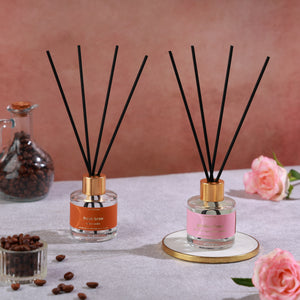
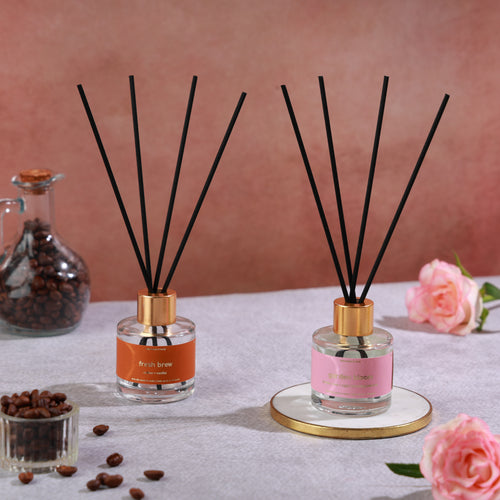
4. Cost per scented hour, reeds: a 130ml at ₹1,349 runs 14–18 weeks — 2,352 to 3,024 hours — which is ₹0.45 to ₹0.57 an hour. A 50ml at ₹749 over 6–8 weeks is 1,008 to 1,344 hours, or ₹0.56 to ₹0.74.
5. Cost per scented hour, Sukoon: at four hours a day, a year is 1,460 hours. ₹1,899 ÷ 1,460 = ₹1.30 an hour in hardware alone, before fragrance, water or electricity. Over two years it halves to about ₹0.65.
6. The honest limit on that number. SOSA publishes no per-fill fragrance consumption rate for the Sukoon, so I cannot tell you what the fragrance adds per hour. Every Sukoon figure on this page is a stated floor, not a measurement.
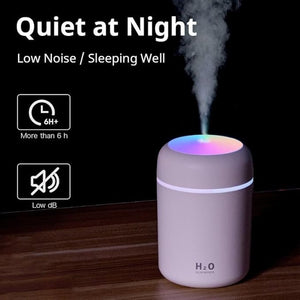
7. Buy the Sukoon for control. ₹1,899 buys 270–320 sq ft, a 500ml tank, 16–18 hours on low, a remote, steady, 2H and 4H timers, and three 15ml Hotel Collection fragrances in the box. That is a real and useful product — for scent on demand, at an hour you choose.
8. Two machines to rule out now. The Megh at ₹3,499 covers about 215 sq ft, less than a Sukoon's 270–320 — a runtime and humidity machine, never a coverage upgrade. The Vaayu at ₹11,999 is a commercial waterless nebuliser and absurd in a flat.
Everything is composed and handmade in small batches in Pune, tested through 45°C summer heat and 85% monsoon humidity, and a portion of every order supports girl-child education through Nanhi Kali.

Part one — what an evening-only AC does to each format
A flat with the air-conditioner on only in the evening is really two flats in one day, and the two formats experience them very differently. The mistake is to shop for the evening flat while living in the daytime one.
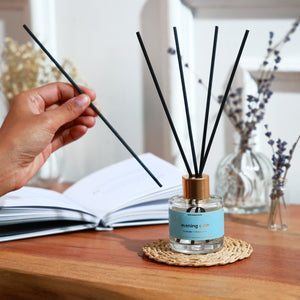
 Evening Calm₹799 · 50mlThe other twenty hours are where the money goes. In a flat that stays warm from mid-morning, evaporation from the reeds runs faster than it would in a mild room, so the level drops steadily — a duration effect. At the same time, fans running and a balcony door open mean much of what leaves the reeds is carried out of the room rather than around it — a distribution effect. The result is the familiar southern complaint: the bottle empties at the short end of its range while the room reads modest for most of the day. The thing that matters here is that a Sukoon switched off does nothing about either. If the daytime is what bothers you, the answer is a second bottle or a larger one, not a machine.
Part two — cost per scented hour, computed
All arithmetic on listed prices, all longevity figures the published ranges. The last column is where the honest uncertainty lives.
| What you buy | Price | Hours of scented room | Cost per scented hour | Not in the number |
|---|---|---|---|---|
| Mountain Breeze 130ml ★ | ₹1,349 | 14–18 weeks × 168 h = 2,352–3,024 | ₹0.45–₹0.57 | Nothing. No power, no water, no consumable but the reeds |
| Morning Freshness 50ml | ₹749 | 6–8 weeks × 168 h = 1,008–1,344 | ₹0.56–₹0.74 | The refill economics you get from bottle two onwards |
| Oil refill 300ml, your own glass | ₹2,399 | Roughly 8–11 months continuous ≈ 5,832–8,016 | ₹0.30–₹0.41 | Reeds — not sold separately; refresh yours every few months |
| Sukoon, 4 hours a day, year one | ₹1,899 | 4 × 365 = 1,460 | ₹1.30, hardware only | Fragrance, water, electricity at your state tariff |
| Sukoon, 4 hours a day, across two years | ₹1,899 | 2,920 | ₹0.65, hardware only | The same three things, twice over |
| Sukoon plus one 100ml fragrance, year one | ₹1,899 + ₹999 = ₹2,898 | 1,460 | ₹1.99 — a floor, not a measurement | How long 100ml actually lasts at your setting |
| The honest caveat, and it is a real one: SOSA publishes no per-fill fragrance consumption rate for the Sukoon — no millilitres per hour, no hours per tank. So the ₹1.99 figure assumes a single 100ml bottle covers a year of four-hour evenings, and I cannot verify that. If it lasts less, the real figure is higher; it cannot be lower, because ₹1,899 and ₹999 are fixed. That is why every Sukoon number here is a floor. The reed figures do not have that problem: 6–8 and 14–18 weeks are published ranges for a bottle that runs continuously, and the arithmetic is weeks × 168 hours. Those ranges are typical rather than guaranteed and sit at the short end in warm flats. Electricity and water are not included anywhere. | ||||
Mountain Breeze 130ml · constant, passive, no water₹1,349Shop →  Sukoon · 270–320 sq ft, remote, 2H and 4H timers₹1,899Shop →
  Oil refill 300ml · about 30–41 paise an hour₹2,399Shop →
Part three — the same year, counted on hours you are in the room
There is a fair objection to all of that, and I would rather make it myself. A bottle's 3,024 hours include the hours you are asleep, at work or out of the flat — hours in which the room smells lovely to nobody. Counted that way the comparison narrows sharply, so here it is on the harsher basis.
| Accounting basis | Mountain Breeze 130ml ₹1,349 | Sukoon ₹1,899 at 4 h a day | What it tells you |
|---|---|---|---|
| Every hour the room is scented ★ | 2,352–3,024 h · ₹0.45–₹0.57 an hour | 1,460 h in year one · ₹1.30 hardware only | The bottle is two to three times cheaper per hour |
| Only hours somebody is in the room, at 8 h a day | 112 days × 8 = 896 h · ₹1,349 ÷ 896 ≈ ₹1.51 | All 1,460 h are attended · ₹1.30 hardware only | The gap nearly closes on hardware alone |
| Same, with one 100ml fragrance ₹999 added | Unchanged at about ₹1.51 | ₹2,898 ÷ 1,460 ≈ ₹1.99 — a floor | With fragrance in, the bottle is ahead again |
| Which hours you actually get | All of them, including arriving home to a scented flat | Only the hours you switch it on for | The machine's hours are a subset of the bottle's |
| Year two, same room | Refill ₹2,399 into your own glass · about ₹0.30–₹0.41 an hour | ₹0 hardware, plus fragrance you cannot cost in advance | Reeds get cheaper; the machine's unknown stays unknown |
| The honest caveat: eight hours a day of occupancy is my assumption, not a measurement of your flat — put your own number in and the arithmetic follows the same way. The point is not that one format wins by a landslide. It is that on the harshest basis I can construct for the bottle, the machine only draws level on hardware and falls behind once fragrance is counted, and it still delivers a subset of the same hours. Every Sukoon figure remains a floor because no per-fill consumption rate is published. All totals are arithmetic on listed prices, not quotations. | |||
Part four — when neither purchase is the answer
Before ₹1,349 or ₹1,899 leaves your account, three things are worth ruling out, and all three are free. The first is your own nose. You stop registering a constant smell in a room you live in — ordinary olfactory adaptation, hardest at home on a fragrance you chose yourself — which is the commonest reason people conclude a diffuser has stopped working and start shopping for a machine. I will not give it a timescale or promise a technique that resets it. The reliable checks are free: leave the flat and walk back in, or ask whoever arrives next what they notice at the door. Equally misread is the curve. The first three days of any new bottle are the loudest it will ever be — freshly soaked reeds, the lightest materials leaving at once — then a settle, then a plateau that holds to the end. The plateau is the product, and it is not a reason to spend ₹1,899.
The second is the free ladder, which almost nobody works through before buying. Do the fifteen-minute doorway test — leave, come back, and judge from the door rather than the sofa. Flip all six reeds with gloves so both ends are coated. Move the bottle off any sunlit sill, off the fridge, out of the vent's throw and away from an open balcony line, onto an inner surface at waist-to-chest height on a tray. Close the room for an hour before judging. Only then does adding reeds make sense, and it costs weeks: nine reeds is roughly five weeks instead of eight on a 50ml. Every rung is free, and most "I need a machine" conclusions are settled somewhere on it.
The third is where nothing SOSA sells is the answer. If the reason you are comparing formats is a smell you want gone — a drain, a bin, a damp cupboard, cooking settled into soft furnishings — then neither a bottle nor a machine is the tool, and the more expensive one is not the better guess. A reed diffuser adds a fragrance that sits alongside whatever is already in your air. It does not remove, neutralise, absorb, mask, purify or filter anything, and neither does an ultrasonic. SOSA sells no air purifier and no dehumidifier. Find the source, ventilate or extract, then add fragrance. On cooking — extractor on, window open ten minutes afterwards, close up, wait half an hour. And a room still smelling musty a day after cleaning is telling you something is wet, which is a building question — and precisely where an ultrasonic, which adds water, is the wrong instinct.
Part five — running both, and in which order
Most homes that take this question seriously end up owning both formats, and there is a sensible order. Reeds first, in the rooms that should smell of something continuously. They start cheaper, need no socket, work while the flat is empty, add no water, and get cheaper in year two once you own the glass and buy oil at roughly ₹7–8 per ml against ₹15–17. In a flat sealed for part of every day they are helped by the architecture rather than fought by it. For many southern flats that is the entire answer.
The Sukoon comes second, and only for one want: a room scented at particular hours and deliberately not at others. ₹1,899 buys 270–320 sq ft of one connected zone, a 500ml tank, 16–18 hours on low, a remote, steady, 2H and 4H timers, and three 15ml Hotel Collection fragrances in the box. The living room switched on before people arrive; the study for the hours you are working in it; a heavier hotel-style scent you would not want running through the night. Buy it for control, never for coverage, and never as a stronger reed diffuser — the two are not interchangeable in either direction. If your budget stretches to only one, and what you asked was whether the room could smell better, the bottle is the answer.
Three machines I would steer you away from here. The Megh at ₹3,499 is what people reach for after a Sukoon, because six litres and roughly 100 hours of runtime read as the serious option; it covers about 215 sq ft, less than a Sukoon's 270–320, so it is a runtime and humidity machine and never a coverage upgrade. The Boond at ₹899 is a useful small machine at about 150 sq ft and roughly six hours a fill, but it will not reach across a living room. The Vaayu at ₹11,999 is a commercial waterless nebuliser, and the Safar at ₹3,999 is a car and travel product. Naming what does not belong is more useful than pretending a range scales smoothly upward.
Part six — six versions of this flat
The same evening-AC situation in six variations, with totals shown as arithmetic on listed prices.
| Your evening | What you actually want | What to buy | The total |
|---|---|---|---|
| AC four hours, one living-dining zone, out all day ★ | A constant background that is there when you get home | Mountain Breeze 130ml, six reeds, off the vent line | ₹1,349 · about ₹0.45–₹0.57 an hour |
| AC in the bedroom only, from ten at night | Something quiet in a small sealed room | Evening Calm 50ml, four reeds | ₹799 · four reeds also lengthens the bottle |
| Hall and bedroom both used in the evening | Two sources, because output per bottle is fixed | Fresh & Grounded duo, 2 × 50ml | ₹1,548 · or ₹2,548 for 2 × 130ml |
| You genuinely want it scented at eight and not at four | A switch, a timer and a remote | Sukoon — and read the fragrance caveat first | ₹1,899 · ₹1.30 an hour year one, hardware only |
| You want both, and can spread it over two purchases | Background first, control later | Bottle now, machine after one full bottle | ₹1,349 now · ₹1,899 later = ₹3,248 |
| Smallest sensible spend, deciding later | To test whether you want this at all | Morning Freshness 50ml, six reeds | ₹749 · 6–8 weeks, ₹0.56–₹0.74 an hour |
Versailles
We sell both of these, so a page that talks somebody out of the more expensive one needs a reason, and the reason is arithmetic rather than modesty. A machine running four hours a day is being asked to justify ₹1,899 against a bottle that runs every hour of every day for four months. On cost per scented hour there is no version of that comparison the machine wins.
I want to be precise about one weakness in my own numbers, because it would be easy to hide. We do not publish a per-fill fragrance consumption rate for the Sukoon — how many millilitres an hour it uses at a given setting. That means I cannot give you a true running cost for it, only a floor built from the hardware price and one bottle of fragrance. If you see anyone quote a confident per-hour figure for an ultrasonic without that number, they have invented it. I would rather show you the gap in what I know.
The other thing worth saying is about the evening itself. When the AC goes on and the doors close, a flat stops exchanging air, and that is the condition under which a low, constant, passive product finally accumulates. Your evening is not the reed diffuser's weak spot — it is the part of the day it was designed for. The hot, open afternoon is where you are losing oil, and no machine sitting switched off helps with that.
So: bottle first, and a Sukoon later if you find you want a switch. Made in small batches in Pune, tested through 45°C heat and 85% humidity, and a part of every order funds a girl's classroom through Nanhi Kali.
Frequently asked questions
- Does heat make the oil evaporate faster? — why a hot flat costs you weeks rather than strength.
- How many bottles a 700 sq ft 2BHK needs — the honest count, which is lower than the room count.
- Where the bottle should stand in a hot flat and which scent family survives a hot afternoon.
- A bedroom that is cool and damp at once — the format question where water decides it.
- Brand: the SOSA founder story.
SOSA range, specifications and prices used in this guide (verified from the live store, 27 August 2026): Reed diffusers — alcohol-free, phthalate-free, paraben-free and IFRA-compliant compositions on a heat-stable coconut-derived (CCT) carrier, low-VOC, in a refillable glass bottle with six fibre reeds; flip weekly. 50ml lasts 6–8 weeks and 130ml lasts 14–18 weeks; there is no 100ml reed diffuser size. Morning Freshness (Malabar lemon · peppermint · Nilgiri eucalyptus) 50ml ₹749 · 130ml ₹1,249; Garden Bloom (British rose · night-blooming jasmine) ₹799 · ₹1,299; Evening Calm (Kashmir lavender · chamomile) ₹799 · ₹1,299; Fresh Brew (Coorg coffee · Kerala vanilla) ₹849 · ₹1,349; Mountain Breeze (Himalayan pine · sage · Indian cedar) ₹849 · ₹1,349. Duo sets ₹1,498–₹1,598 for 2 × 50ml and ₹2,498–₹2,598 for 2 × 130ml. Oil-only refills 300ml ₹2,399 · 500ml ₹3,499 — the glass vessel and reeds are not included, and replacement reeds are not sold as a separate product. Machines: Boond 300ml ₹899 (~150 sq ft, about 6 hours a fill) · Sukoon 500ml ₹1,899 (270–320 sq ft, 16–18 hours on low, three 15ml fragrances included) · Megh 6L ₹3,499 (~215 sq ft — a runtime and humidity machine that covers less than a Sukoon, never a coverage upgrade) · waterless Vaayu ₹11,999 · Safar ₹3,999 (a car and travel product) · Aangan ₹25,999 · Meenar ₹38,500. The water-based Hotel Collection for ultrasonic machines (15ml ₹299 · 100ml ₹999 · 300ml ₹1,799 · pack of seven 15ml ₹1,799) cannot be used in a reed bottle or a Vaayu. Below ₹749: jar candles ₹379, Sandalwood or Smoked Oudh candle ₹449, wax melts ₹474 (a burner is required and not included), mugs ₹474, bubble and taper candles ₹569, Amber Rose candle ₹599, ceramic trinket dish and candle two-pack ₹664. A reed diffuser adds fragrance to a room. It does not clean, purify or filter air, remove or neutralise cooking, damp or smoke smells, reduce humidity, or change how anyone feels. A reed diffuser adds no moisture to the air; ultrasonic machines work by aerosolising water and therefore do. A persistent musty smell indicates moisture that needs finding and drying, and SOSA sells no dehumidifier or air purifier. Ventilate or extract first; add fragrance second. Evaporation rate rises with warmth and falls with humidity, and airflow carries scent away from the bottle — so performance varies with season, ventilation, ceiling height and room use; longevity figures are typical ranges, not guarantees. Not noticing a constant fragrance is ordinary olfactory adaptation; the reliable checks are leaving the room and returning, or asking someone who has just arrived. Strength figures are positions on SOSA’s own internal scale, not an industry standard. Fragrance oil is flammable — keep bottles away from open flame and out of direct sunlight, and out of reach of children and pets. Composed and handmade in small batches in Pune, India; tested through 45°C summer heat and 85% monsoon humidity. Free shipping above ₹499. A portion of every order supports girl-child education through Nanhi Kali. Prices subject to change — see the live product pages.