



Why the spike is what makes it smell inexpensive: almost any composition at too high a concentration flattens into one sweet or sharp impression. That flattening is what people mean by “air freshener smell”, and it is a dose effect rather than a quality effect. The same oil at a lower, steadier level reads as layered, because the nose has room to resolve the separate materials.
What to use instead: a reed diffuser at ₹749–₹849 for a continuously fragrant zone with no button to press — about ₹13–₹15 a day. Sukoon ₹1,899 if you want the whole room, 270–320 sq ft on 16–18 hours of low. Safar ₹3,999 for undiluted oil through cold-air nebulising, which is the mechanism hotels actually run.
Two honest gaps. First: SOSA sells no room spray at all, so if what you want is a one-second top-up before guests arrive, we do not make that product and I am not going to recommend a competitor’s. Second: between Safar — named and sold as a car and travel diffuser, with no published room-coverage figure — and the ₹11,999 Vaayu at 1000 m³, SOSA has no mid-sized waterless bedroom nebuliser.
And the thing no format fixes: fragrance does not remove a smell. Source, then ventilation, then fragrance — in that order, always.
2. Use less than you think, because the dose is what reads as cheap. The single most reliable way to make a good composition smell like an air freshener is to over-concentrate it. At too high a dose almost any fragrance collapses into one flat sweet or sharp impression; at a lower dose the same materials separate and the nose can hear them individually. This is why the reed count is a volume dial — six reeds for full projection in a living room, three for a soft bedside level, which also roughly doubles the life of the bottle. Restraint costs nothing and it is the difference between lovely and too much.
3. If you want the whole room rather than a zone, you need moved air. A reed emits but does not transport, so concentration is highest at the bottle and falls with distance. Sukoon at ₹1,899 is ultrasonic water mist — a piezo plate turning an oil-and-water mixture into a visible plume that moves air as it rises. 500ml, 270–320 sq ft, 16–18 hours on low, three 15ml Hotel Collection scents in the box. The honest costs: the oil is diluted in water, the output adds humidity, it needs filling, and hard water can leave a fine white mineral dust.
4. The genuinely hotel-grade version is waterless cold-air nebulising. Pressurised air shatters undiluted oil into a dry micro-mist that travels with the room’s own airflow — no water, no heat, no dilution, no added humidity, no dust. Because the payload per droplet is neat oil rather than oil suspended in water, the same composition reads as considerably more present. Safar at ₹3,999 is this at personal scale: 20ml bottle, 2000 mAh Type-C battery, up to 10 hours continuous or around 30 intermittent, three speeds, a 1, 2 or 3-hour auto-off timer, 6.9 cm. It is named and sold as a car perfume diffuser, with bedside and hotel room also among its stated uses, and SOSA publishes no room-coverage figure for it.
5. Do not ask any of this to do the job the aerosol was really bought for. Most cans in most Indian homes are bought to cover something — cooking, damp, a bathroom, a bin. Fragrance does not remove a smell. Adding a pleasant odour to an unpleasant one produces a mixture rather than a cancellation, and the mixture is frequently worse because the brain now tracks two things instead of one. Source, then ventilation, then fragrance, and the order is not negotiable.
Alcohol-free, phthalate-free, paraben-free, IFRA-compliant, 0 ppm formaldehyde. Free shipping above ₹499, and a portion of every order supports girl-child education through Nanhi Kali.
Peak-and-crash versus continuous, properly explained
The concentration of fragrance in a room at any moment is a simple balance: what is being added, minus what is leaving. Things leave by air exchange — doors, windows, gaps, extraction — and by adsorbing onto surfaces, which is why fabric-heavy rooms hold scent differently from bare ones. The whole difference between an aerosol and a diffuser is what the “being added” term looks like over time. An aerosol is a single enormous value for one second and zero thereafter. A diffuser is a small value held constant for six weeks. Everything else follows from that, including the two experiences people describe most often: a spray that is overwhelming and then gone, and a diffuser that seems to disappear.
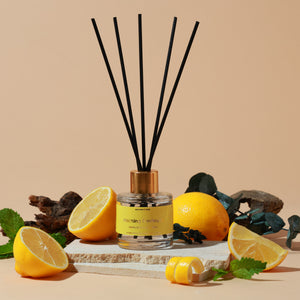
 Morning Freshness₹749A pressurised can releases a fine aerosolised dose in one action. For a few seconds the concentration in the room is far higher than any diffuser can produce — genuinely higher, which is why a spray feels effective and why it is the right tool for a bathroom in an emergency. Then two things happen at once. Air exchange dilutes what is airborne, quickly in a ventilated room and more slowly in a shut one. And the heavier materials settle out onto curtains, cushions, upholstery and walls, where they release slowly and out of balance with the composition as designed. So the fragrance you smell ten minutes later is not a quieter version of the one you sprayed; it is a different, heavier, less complete version of it. That drift is a large part of why a sprayed room can smell faintly stale by evening.
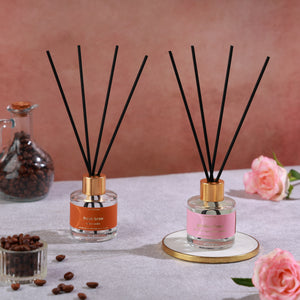
 Evening Calm₹799A reed diffuser emits a very small quantity per hour, but it emits it every hour, including the hours you are asleep and the hours you are out. Within a few days the room reaches a steady state: emission balances removal, and the concentration simply sits there. Nothing peaks, so nothing crashes, and the composition arrives in the proportions it was designed in rather than as whatever is left after the light materials have gone. This is why a diffused fragrance is normally described as smelling like a place, and a sprayed one as smelling like a product. It is also why the first week runs hot and week three feels quieter — the reeds saturate first and the lightest, most volatile materials leave first, so week three is the heart and base as composed. That is settling, not fading, and flipping the reeds every three to five days restores projection without opening a new bottle.
 Sukoon₹1,899There is one respect in which a spray genuinely beats a reed, and it is worth conceding rather than hiding. A spray puts fragrance in the far corner of the room instantly, because you walk over there and press the button. A reed cannot do that at any price, because it moves no air; its concentration is highest at the bottle and falls with distance. If evenness is what you liked about spraying, the answer is not a better reed, it is a machine. Sukoon at ₹1,899 covers 270–320 sq ft because its mist plume moves air; Safar at ₹3,999 nebulises undiluted oil into the room’s own airflow. Both are continuous and transported, which is the combination a hotel runs and neither a can nor a reed can offer alone.
Why the spike is the thing that smells inexpensive
People assume “premium” is a property of the oil, and it partly is — a real cold-pressed Malabar lemon is a different object from the reconstruction in a surface cleaner, and a real rose is not the rose in a bar of soap. But in a room, dose does more of the work than material quality does, and this is the single most useful thing I know about home fragrance. Almost any composition, however well made, flattens at high concentration into a single sweet or sharp impression. The separate materials stop being distinguishable and the nose files the whole thing under one heading, which is exactly the heading people mean when they say something smells like an air freshener. Reduce the same oil to a lower steady level and it reads as layered, because there is room to resolve the parts.
An aerosol lives at the wrong end of that curve by design. Its entire delivery model is a brief moment of very high concentration, and the sensation that a room has been “done” comes from precisely that overshoot. So even a genuinely fine fragrance, delivered as a burst, spends its first minute in the register where all fragrances read the same. Meanwhile the diffuser you thought was too subtle is sitting at the concentration where the composition is legible. Restraint is free and it is most of what separates the two experiences. In practice: three reeds rather than six in a bedroom, six only in a living room or a large kitchen, and the acceptance that a fragrance you can smell continuously in your own home has overshot the room.
The second half of “premium” is consistency, and it is the part nobody sells because it cannot be packaged. A hotel keeps one scent for years. Guests recognise it on a second stay; the space reads as designed rather than as recently freshened. A home that is sprayed with whatever is at hand, in whatever quantity the moment seems to call for, produces a series of unrelated events instead of a character. If I had to give one instruction for a premium result at ₹799, it would be this: choose a single scent for the room people enter first, keep it for a year, and refill rather than rotating. A 300ml refill at ₹2,399 exists for exactly that, and it is the only sense in which buying oil alone is good value — you must already own the bottle and reeds.
| Format | How it puts scent into the air | Shape over time | What it gives a room | Price |
|---|---|---|---|---|
| Aerosol room freshener | Propellant releases an aerosolised dose in one action; no reservoir feeding the room | A spike, then decay by air exchange and settling — repeated by hand | Instant reach into any corner, then nothing. Wins the first sixty seconds, loses the evening | — |
| Passive capillary — reed diffuser ★ | Oil climbs six fibre reeds and evaporates. No propellant, no power, no air moved | A flat line for 6–8 weeks on a 50ml, running whether you are home or not | A fragrant zone at a legible dose, about ₹13–₹15 a day, with nothing to press | ₹749–₹849 |
| Ultrasonic water mist — Boond, Sukoon, Megh | A piezo plate shatters oil diluted in water into a visible wet mist that moves air | Continuous or intermittent, under your control, 16–18 hours on low for the Sukoon | Real coverage — Sukoon 270–320 sq ft, Boond up to ~150, Megh only ~215. Adds humidity; may leave white dust | ₹899 / ₹1,899 / ₹3,499 |
| Waterless cold-air nebulising — Safar, Vaayu | Pressurised air shatters undiluted oil into a dry micro-mist. No water, no heat | Scheduled — Safar 1/2/3-hour auto-off; Vaayu 1h/4h/8h/24h windows by app | The mechanism hotels use. Safar is a car and travel diffuser with no published room coverage; Vaayu is rated to 1000 m³ and is wrong for one bedroom | ₹3,999 / ₹11,999 |
| Two honest gaps: SOSA does not make a room spray or home spray of any kind — every SOSA spray is a car perfume — so if a one-second top-up is genuinely what you want, this range does not contain it. And between Safar at personal scale and Vaayu at 2,000–3,000 sq ft, there is no mid-sized waterless bedroom nebuliser. | ||||
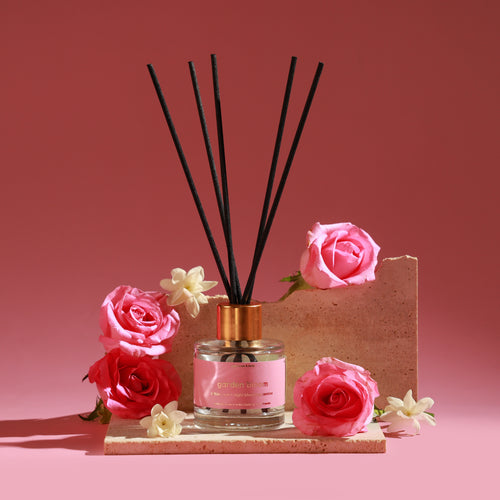
Drawing room · Garden Bloom₹799Shop → 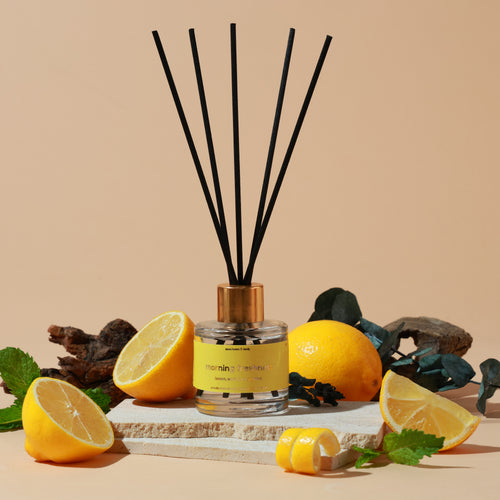 Kitchen · Morning Freshness₹749Shop →
  For the room · Sukoon₹1,899Shop →
The thing an aerosol is usually bought to do — and cannot
I would be doing you a disservice if I let this page end without saying it. Most cans in most homes are bought reactively: something has happened in the kitchen, the bathroom has been used, the bin needs emptying, the flat has been shut for a week. Fragrance does not remove a smell. Adding a pleasant odour to an unpleasant one produces a mixture rather than a cancellation, and the mixture is often worse than either component, because your brain now has two things to track instead of one. No diffuser I sell changes this, and no diffuser anybody else sells changes it either. The sequence is source, then ventilation, then fragrance, and the order is not a preference.
The cooking case deserves its own paragraph because it is the most common one in an Indian home and it behaves in a way people find genuinely confusing. Cooking aerosols condense onto curtains, upholstery and walls and then re-release slowly for hours. Ventilation clears the airborne fraction within minutes; the deposited fraction comes back. That is why a flat can smell of last night’s tadka at eleven the next morning despite having been aired at eight. Spraying over it puts a second signal into the same air. Extraction while cooking, soft furnishings washed on their own schedule, and then fragrance in a room that is already clean and aired — that is the sequence that works, and it is also the sequence in which a ₹799 reed outperforms a much more aggressive product.
There is a related trap worth naming: mopping. A freshly mopped floor makes a house smell of surfactant and of pine or citrus solvent, which the brain reads as clean by association rather than because odour has been removed — and that signal is largely gone within the hour. The nine-o’clock-wonderful, eleven-o’clock-ordinary experience is not the fragrance failing; it is a cleaning signal decaying on schedule. Home fragrance is a different job with a different time constant, and the two are often confused when people are deciding whether their house “smells nice”.
What to buy, in order — and the two things this range does not contain
In cost order, free step first. The last row carries both honest gaps, because a page that will not name what its own range lacks is not worth reading.
| Do this | What it is | When it is the right answer | Price |
|---|---|---|---|
| 1. Fix the source, then ventilate ★ | Extraction while cooking, bins and drains dealt with, soft furnishings washed, windows open before the room is fragranced rather than after | Always first. Fragrance does not remove a smell, and layering one over another gives a mixture rather than a cancellation | ₹0 |
| 2. Replace the can with a reed | A 50ml reed diffuser — six fibre reeds, refillable glass, 6–8 weeks, rooms up to about 150 sq ft. Morning Freshness 9.0 is the only one I would put in a kitchen; Garden Bloom 8.9 suits a drawing room | When you want a level rather than an event, and nothing to press. Three reeds in a bedroom, six in a living room | ₹749–₹849 |
| 3. Add transport for the whole room | Sukoon — ultrasonic water mist, 500ml, 270–320 sq ft, 16–18 hours on low, three 15ml Hotel Collection scents included | When what you liked about spraying was reaching the far corner. You accept dilution, added humidity and refilling | ₹1,899 |
| 4. The hotel mechanism, undiluted | Safar — cold-air nebulising of neat oil. 20ml bottle, 2000 mAh Type-C, up to 10 hours continuous or ~30 intermittent, 3 speeds, 1/2/3-hour auto-off, 6.9 cm. Named and sold as a car and travel diffuser | When you want pure oil and full control of when it runs. No published room-coverage figure; it needs recharging and its longest timer is three hours | ₹3,999 |
| Not a coverage upgrade: Megh | 6L tank, around 100 hours of runtime, about 215 sq ft of coverage | Less coverage than the ₹1,899 Sukoon. Buy it for runtime and humidity, never for reach | ₹3,499 |
| The honest gaps, twice over | SOSA makes no room spray or home spray — every SOSA spray is a car perfume, so the instant top-up simply is not a product here — and no mid-sized waterless bedroom nebuliser exists between Safar and Vaayu ₹11,999, which is rated to 1000 m³ and is wrong for one bedroom | Both said plainly, and no competitor’s product is priced or recommended anywhere on this page | — |
Versailles
I want to be honest about my own position here, because it makes the rest more credible. SOSA does not make a room spray. Every spray we sell is a car perfume. So when I say a can is the wrong shape of delivery for a home, understand that I am not steering you towards our version of one — there is no version of one, and I am not going to price somebody else’s to make a point.
What I will say is that the complaint people bring me about sprays is almost never “it did not work”. It is that it worked too well for two minutes and then made them responsible for the rest of the evening. That is a delivery problem wearing the costume of a fragrance problem, and it is the same misdiagnosis I see in the hotel questions: people go looking for a stronger smell when what they are missing is a steadier one.
The advice I would give a friend is unglamorous. Buy one 50ml at ₹749 for the room people walk into first. Use fewer reeds than you expect — three, not six, in a bedroom. Keep the same scent for a year and refill it rather than trying the next one. And do the boring things first: extract while you cook, wash what has absorbed the cooking, open a window before you fragrance rather than after. That sequence produces the thing you are calling premium far more reliably than anything I could sell you at four times the price. Everything is composed in Pune, and part of every order funds a girl’s classroom through Nanhi Kali.
Frequently asked questions
- Without burning candles — four good reasons, and which of them a reed actually solves.
- Without incense or bakhoor — combustion, smoke, and why loudness is not presence.
- Without a plug-in — the socket decides the placement, and composition is the other half.
- Without adding water every day — how often you really refill, and the waterless answer.
- Without spraying constantly — effort and repetition as the real cost.
- Without leaving a reed running all day — the reed’s one genuine design limitation.
- No flame, no smoke, no incense — the whole format question in one place.
- The lowest-maintenance option — and why it is also the least noticeable one.
- On when I am home, off when I leave — the control question answered by mechanism.
- Brand: the SOSA founder story.
Facts verified August 2026: Three diffusion mechanisms are described — passive capillary (reed diffusers), ultrasonic water mist (Boond ₹899, 300ml, up to ~150 sq ft, ~6 hours, USB, night light; Sukoon ₹1,899, 500ml, 270–320 sq ft, 16–18 hours on low, three 15ml Hotel Collection scents included; Megh ₹3,499, 6L tank, ~100 hours runtime, ~215 sq ft, which is less coverage than Sukoon and never a coverage upgrade) and waterless cold-air nebulising (Safar ₹3,999, 20ml bottle, 2000 mAh Type-C battery, up to 10 hours continuous or around 30 hours intermittent, 3 speeds, 1/2/3-hour auto-off timer, 6.9 cm, named and sold as a car and travel diffuser with car, handbag, desk, bedside and hotel room among its stated uses, no published room-coverage figure; Vaayu ₹11,999, coverage up to 1000 m³ or roughly 2,000–3,000 sq ft, 400ml refillable tank lasting up to about 90+ days, Bluetooth app and onboard buttons, 1h/4h/8h/24h run windows, adjustable intensity, key-lock, under 38 dB, freestanding or wall/HVAC mount, 5W, CE, RoHS, SGS). SOSA reed diffusers: five scents, 50ml ₹749–₹849 lasting 6–8 weeks and suiting rooms up to ~150 sq ft, 130ml ₹1,249–₹1,349 lasting 14–18 weeks, six fibre reeds included and flipped every 3–5 days, six reeds for full projection and three for a soft bedside level, about ₹13–₹15 a day, heat-stable CCT carrier rather than DPG, alcohol-free, phthalate-free, paraben-free, IFRA-compliant, 0 ppm formaldehyde, refillable glass bottle, climate-tested at 45°C and 85% RH, composed in Pune. Morning Freshness’s eucalyptus globulus base slows lemon evaporation 3–4 times; Garden Bloom’s indole is held below the threshold at which jasmine reads animalic above 30°C. Duos are two 50ml bottles at ₹1,498–₹1,598; 130ml duos ₹2,498–₹2,598; refills 300ml ₹2,399 and 500ml ₹3,499, oil only and never a first purchase. SOSA strength scale: Evening Calm 8.9, Garden Bloom 8.9, Morning Freshness 9.0, Mountain Breeze 9.4, Fresh Brew 9.5. Hotel Collection fragrance oils are water-based and ultrasonic-only at 15ml ₹299 (a refill), 100ml ₹999, 300ml ₹1,799 and a pack of seven at ₹1,799; they cannot be used in reed diffusers and reed oil cannot be used in ultrasonic machines, so no hotel-inspired reed diffuser exists. Between Safar and Vaayu there is no mid-sized waterless bedroom nebuliser in the SOSA range. Fragrance does not remove a smell — source, then ventilation, then fragrance. Free shipping above ₹499. A portion of every order supports girl-child education through Nanhi Kali. SOSA is an independent Indian fragrance house; the Hotel Collection scents referenced here are SOSA’s own interpretations inspired by the world’s finest hotels, and SOSA is not affiliated with, endorsed by or a supplier to any hotel brand. Prices subject to change — see the live product pages.