
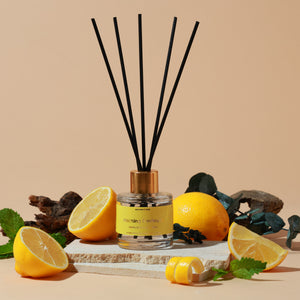



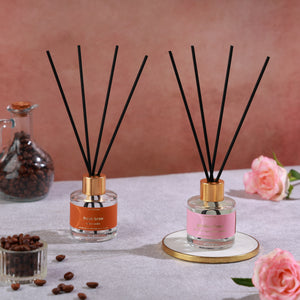
The second reason, and the one nobody says out loud: you are partly chasing your own nose. Olfactory receptors stop reporting a constant stimulus within minutes, so the room can be perfectly well scented at the moment you decide it needs another spray.
What to buy instead, by how much of the room you want: a reed diffuser from ₹749 for a continuous fragrant zone with no action required at all; Sukoon ₹1,899 for genuine room coverage of 270–320 sq ft; Safar ₹3,999 for undiluted oil in a dry mist, with the disclosure that it is named and sold as a car and travel diffuser and has no published room-coverage figure.
Said plainly, twice: SOSA does not make a room spray or a home spray — every SOSA spray is a car perfume — so this page is not steering you off one product and onto ours. And between Safar and the ₹11,999 Vaayu at 2,000–3,000 sq ft, SOSA has no mid-sized waterless bedroom nebuliser.
2. Understand what you are giving up, because it is real. A spray beats every diffuser on the first sixty seconds. Nothing else puts that much material into the air that fast, which is why people reach for it before guests arrive. What it cannot do is the next four hours. If your genuine requirement is a violent hit at a moment of your choosing and nothing before or after, a spray is the correct tool and I will not pretend otherwise. If your requirement is a room that smells the same at nine as it did at seven, it is the wrong one.
3. For a whole room rather than a zone, you have to add air movement. A reed emits but does not transport — concentration is highest at the bottle and falls with distance, which is the design rather than a defect. Ultrasonic water mist does both: a piezo plate vibrates a water-and-oil mixture into a visible wet mist and the plume moves air. Sukoon at ₹1,899 covers 270–320 sq ft, holds 500ml, runs 16–18 hours on low and includes three 15ml Hotel Collection scents. The costs are dilution in water, added humidity, refilling, and possible white mineral dust in a hard-water city.
4. For the mechanism a hotel actually uses, you want no water in the system at all. Waterless cold-air nebulising uses pressurised air to shatter undiluted oil into a dry micro-mist that travels with the room’s airflow — no heat, no dilution, no added humidity, no white dust. Safar at ₹3,999 is that mechanism at personal scale: a 20ml bottle, a 2000 mAh Type-C battery good for up to 10 hours continuous or around 30 intermittent, three speeds, a 1, 2 or 3-hour auto-off timer, 6.9 cm across. Say the awkward part first: it is named and sold as a car and travel diffuser, SOSA’s own page also lists desk, bedside and hotel room among its uses, and no room-coverage figure has been published for it. Treat it as personal and small-space scenting.
5. Do the free things first, because two of them are probably why you have been spraying. Close the door of the room you want scented for the hours you are in it — cutting air exchange raises concentration more reliably than anything you can buy. Move the bottle out of the draught and slightly into the room rather than at the entrance. And before you conclude a room needs another spray, leave it for a quarter of an hour and walk back in, because you stop smelling a constant scent within minutes and it has not gone anywhere.
Alcohol-free, phthalate-free, paraben-free, IFRA-compliant, 0 ppm formaldehyde. Free shipping above ₹499, and a portion of every order supports girl-child education through Nanhi Kali.
The peak-and-crash curve, drawn properly
Picture the concentration of fragrance in your room as a line on a chart against time. A spray draws a spike. In the two seconds you hold the nozzle down, a very large mass of volatile material is dispersed as fine droplets, most of which evaporate almost immediately, and the concentration in that room goes from nothing to a great deal. Then the source term becomes zero, because there is no source any more — and from that instant three separate processes start removing what you put in. Air leaves the room and takes fragrance with it. Molecules adsorb onto curtains, upholstery, walls and the cool surface of a window and come out of the air. And the heaviest droplets that never fully evaporated simply fall. The line falls away from its peak and keeps falling, and nothing in the system opposes it.
A diffuser draws a plateau instead. A reed, an ultrasonic machine and a cold-air nebuliser all have one property in common that a spray does not: they are still emitting an hour later. Because emission continues while removal continues, the room approaches a steady state — a level at which the two roughly balance — and then it sits there. The peak is much lower than a spray’s. The area under the line over an evening is enormously larger. This is the entire difference between the two categories and it is the reason the comparison people make on the shelf, which is which of these smells stronger when I test it, is the wrong test. You are not buying an instant. You are buying an evening.
It also explains something readers report constantly and rarely connect to the physics: the spray smells wonderful in the air and wrong on the sofa. When a large mass of material is dispersed at once, the fraction that lands on soft furnishings is disproportionately the heavier, less volatile part of the composition, because the light top notes evaporate before they reach anything. What you then live with for the next several hours is not the fragrance you smelled — it is the residue of its base, released slowly from fabric. A diffuser, emitting slowly and continuously, keeps the whole composition in balance in the air, which is why a well-dosed reed or machine reads as a character the room has rather than as something that was applied to it.
 Evening Calm₹799Here is the constraint that makes the format genuinely unsuitable for what you are describing. An aerosol requires a person in the room at the moment the fragrance is wanted. That means it can never scent a bedroom before you walk into it, never scent a living room while you are still on the road home, and never do the thing that makes a hotel corridor feel the way it does — be already finished when you arrive. Every other format on this page works on an empty room, which is most of the point of them. A reed diffuser has been working all day whether anybody was there or not; an ultrasonic machine runs 16–18 hours on low; Safar has a 1, 2 or 3-hour auto-off timer so it finishes without you.
 Garden Bloom₹799This is the part of the habit nobody examines. Olfactory receptors adapt to a constant, unchanging stimulus within minutes — the molecules keep arriving, and the brain stops reporting them because nothing has changed. So the moment at which you decide the room needs freshening again is very often a moment when the room is perfectly well scented and you have simply stopped receiving it. Spraying then does not restore the room; it raises it, for everybody but you. The test is not to sniff harder. Leave the room for fifteen minutes and walk back in, or ask somebody who has just come in from outside, because a visitor is a better instrument than you are.
 Sukoon₹1,899Every other format has a dial. A reed diffuser has the most literal one in the category: six reeds is full projection, three is a soft bedside level and roughly doubles the life of the bottle, and you change between them in five seconds with no tools. Safar has three speeds. Vaayu has adjustable intensity in an app. A can has one setting, which is all of it, applied for however long your finger stays down, into a room whose current level you cannot perceive because of the adaptation above. That is a control loop with no feedback, and control loops with no feedback overshoot. Which is exactly what the next section is about.
Effort is the price of a spray, and nobody puts it on the label
I want to be careful here, because SOSA does not sell a room spray or a home spray of any kind — every spray we make is a car perfume — so I am not comparing my product against a category I compete in, and I am not going to price anybody else’s. What I can do honestly is describe the format. An aerosol is the only home fragrance format whose running cost is measured partly in actions rather than entirely in rupees. A reed diffuser at ₹749 costs about ₹13–₹15 a day and asks you to flip six reeds every three to five days, which takes ten seconds. An ultrasonic machine asks for a refill. A spray asks for a decision, a walk to the cupboard and a physical act, every single time you want the room to smell of something — and, critically, it asks for it again ninety minutes later.
That labour compounds in a way people underestimate, because it lands on the person who cares most. In almost every household I hear from, one person notices the smell of the house and everybody else benefits from it. If the format requires an action, that action is that person’s, every time, forever. A diffuser transfers the work from a recurring human task to a one-off purchase and a slow consumable, and I think that transfer is the real product. What you are buying when you leave the spray behind is not a stronger fragrance. It is the end of a chore you never agreed to.
There is a second and quieter cost, which is that a repeated action becomes a repeated judgement. Every spray is a decision about how much, and because you cannot perceive the current level in your own home, that decision is made badly — usually upwards. A diffuser makes the judgement once, when you choose three reeds or six, or a speed setting, and then holds it whether or not you are paying attention. Consistency of that kind is unglamorous and it is most of what separates a room that smells designed from a room that smells freshened.
| Format | How it puts scent in the air | The shape of the result | What it asks of you | Price |
|---|---|---|---|---|
| Aerosol or pump room freshener | A single dispersed dose of droplets; no source afterwards | A high peak within seconds, then continuous decay to nothing | Your presence and a physical act, repeated every time. No dose control and no feedback | — |
| Passive capillary — reed diffuser ★ | Oil climbs six fibre reeds and evaporates from their surface. No power, no air moved | A continuous fragrant zone around the bottle, held for 6–8 weeks on a 50ml | Flip the reeds every 3–5 days. Nothing else. Silent, unpowered, about ₹13–₹15 a day | ₹749–₹849 |
| Ultrasonic water mist — Boond, Sukoon, Megh | A piezo plate shatters oil diluted in water into a visible wet mist that moves air | A held plateau across a real room — Sukoon 270–320 sq ft, Boond up to ~150, Megh only ~215 | Filling, plus a power lead. Adds humidity; hard water can leave white mineral dust | ₹899 / ₹1,899 / ₹3,499 |
| Waterless cold-air nebulising — Safar, Vaayu | Pressurised air shatters undiluted oil into a dry micro-mist. No water, no heat | The mechanism hotels use. Vaayu is rated to 1000 m³, roughly 2,000–3,000 sq ft | Safar: recharging, and it is a car and travel diffuser with no published room coverage. Vaayu: far too much for one room | ₹3,999 / ₹11,999 |
| The honest gap, twice: SOSA has no room spray or home spray at all — every SOSA spray is a car perfume — so there is no like-for-like SOSA product to move you onto. And between Safar at personal scale and Vaayu at 2,000–3,000 sq ft there is no mid-sized waterless bedroom nebuliser in the range, which is why the honest recommendation for one room is a choice between accepting water with Sukoon and accepting personal scale with Safar. | ||||
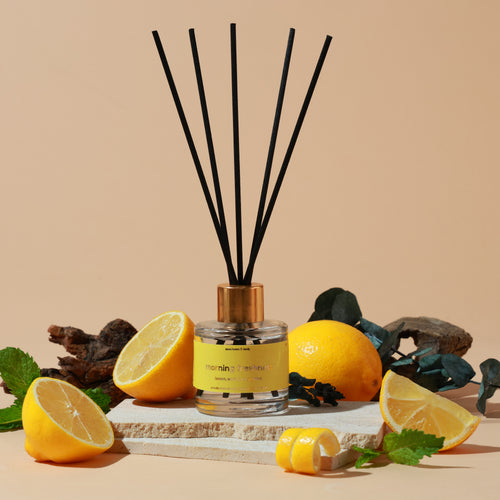
The zone · Morning Freshness₹749Shop →  The room · Sukoon₹1,899Shop →
  The oils · Hotel Collection₹999Shop →
Why repeated spraying is the fastest way to make a room smell inexpensive
This is the part I most want people to take away, because it costs nothing and it changes the result immediately. Dose, not composition, is what makes a fragrance read as cheap. Almost any perfume — including very fine ones — flattens into a single sweet or sharp impression when the concentration in the air is too high, because the nose loses the ability to resolve the separate materials and reports one lump instead. That flattened impression is precisely what people mean when they say something smells like air freshener. The same composition at a lower concentration reads as layered and considered, because there is room to hear the parts.
Now combine that with the two costs above. You cannot perceive the current level in your own home, because you have adapted to it. You have no dial, because a can has one setting. So the natural rhythm of spraying is: fail to smell it, apply a full dose, overshoot, adapt again within minutes, fail to smell it, apply another. The room spends most of the evening above the concentration at which the fragrance sounds good, and the only people who can tell are the ones who walk in from outside. This is not a criticism of anybody’s taste. It is a control problem, and it has a mechanical solution, which is to hand the dosing to something that does not adapt.
It is also why I would push back gently if the real motive here is covering something. A great many people who describe themselves as spraying constantly are not chasing pleasure, they are chasing a smell they do not like — last night’s cooking, a damp cupboard, a bin. Fragrance does not remove an odour. Adding a pleasant molecule to an unpleasant one produces a mixture, not a cancellation, and the mixture is often worse because the brain now tracks two things instead of one. Cooking aerosols in particular condense onto curtains and upholstery and re-release for hours, which is why a flat can smell of dinner again long after it was aired. The order is source, then ventilation, then fragrance, and no product on this page changes that order.
What to buy, in order — and the rung that does not exist
In cost order, because the first row is free and settles more of this than anybody expects. The last row is the gap in our own range, and there are two of them on this page, which I would rather set down plainly than leave you to discover.
| Do this | What it is | When it is the right answer | Price |
|---|---|---|---|
| 1. Run the fifteen-minute test, then close the door ★ | Leave the room for a quarter of an hour and walk back in before deciding anything is missing. Then shut the door of the room you want scented for the hours you are in it | First, always. A large share of “it wore off” is adaptation, and cutting air exchange raises concentration more reliably than any purchase | ₹0 |
| 2. Swap the dose for a source | A 50ml reed diffuser — six fibre reeds, refillable glass, 6–8 weeks, suits rooms up to about 150 sq ft. Six reeds for full projection, three for a soft level and roughly double the life | When you want the room to have a character rather than a recent event. Silent, unpowered, nothing to remember, about ₹13–₹15 a day | ₹749–₹849 |
| 3. Add transport for the whole room | Sukoon — ultrasonic water mist, 500ml, 270–320 sq ft, 16–18 hours on low, three 15ml Hotel Collection scents included | When a zone is not enough and you want the plateau across the room. You accept dilution in water, added humidity and refilling | ₹1,899 |
| 4. Undiluted oil, and a timer instead of an arm | Safar — waterless cold-air nebulising, 20ml, 2000 mAh Type-C, up to 10 hours continuous or ~30 intermittent, 3 speeds, 1/2/3-hour auto-off, 6.9 cm. Named and sold as a car and travel diffuser, with desk, bedside and hotel room among its stated uses | When you want the hotel mechanism at personal scale and something that finishes without you. No published room-coverage figure, and it needs recharging | ₹3,999 |
| Not a coverage upgrade: Megh | 6L tank, around 100 hours of runtime, about 215 sq ft of coverage | Less coverage than the ₹1,899 Sukoon. Buy it for runtime, never for reach | ₹3,499 |
| The honest gap, twice over | SOSA makes no room spray or home spray — every SOSA spray is a car perfume — so nothing here is a like-for-like replacement for the can you already own. And no mid-sized waterless bedroom nebuliser exists between Safar and Vaayu ₹11,999, which is rated to 1000 m³ and is the wrong purchase for one bedroom | Both stated because both change what you should expect after you have bought | — |
Versailles
I should be straightforward about my position: SOSA does not make a room spray, so I have no product to sell you in that category and no commercial reason to be rude about it. Every spray we make goes in a car. What I do have is a fairly clear view of why the format frustrates the people who use it most, and it is not about quality. It is that an aerosol is a dose and a room is a continuous process, and putting a dose into a continuous process means repeating the dose forever.
The thing that surprised me when I started reading these letters properly was how much of the repetition is driven by adaptation rather than by the room. Somebody sprays at seven, cannot smell anything by seven-fifteen, and concludes the product is weak — when in fact the concentration is still perfectly good and their receptors have simply stopped mentioning it. If you take one free thing from this page, take the fifteen-minute walk-out test. Leave the room, come back, and judge it then. I would guess a third of the people who write to me about weak fragrance do not have a weak fragrance.
And then the practical order, which I would follow in this sequence rather than jumping to the end. Close the door before you buy anything. If you want a character in a corner of the room, a ₹749 reed does that with nothing to remember and nothing to repeat, and its inability to be switched on is the same property as its never needing to be. If you want the whole room, you need moved air, and ₹1,899 is the honest price of that. And if water is the problem, then you are in cold-air nebulising, where I will tell you plainly that our small device is sold as a car diffuser with no published room coverage and our big one is built for a floor. Everything is composed in Pune, and part of every order funds a girl’s classroom through Nanhi Kali.
Frequently asked questions
- Without burning candles — flame, attendance, and an event rather than an ambience.
- Without incense or bakhoor — combustion is a different process, and a much louder one.
- No aerosol fresheners — the same curve, argued from the premium end.
- Without a plug-in — what the format is, and what SOSA reeds are formulated without.
- Without adding water — and why “every day” overstates it.
- Without leaving a reed running all day — the reed cannot be switched off, and what that means.
- No flame, no smoke, no incense — the format page, described physically.
- The lowest-maintenance way — where two requirements genuinely conflict.
- On when I come home, off when I leave — the control question, answered by mechanism.
- Brand: the SOSA founder story.
Facts verified August 2026: Three diffusion mechanisms are described — passive capillary (reed diffusers), ultrasonic water mist (Boond ₹899, 300ml, up to ~150 sq ft, ~6 hours, USB, night light; Sukoon ₹1,899, 500ml, 270–320 sq ft, 16–18 hours on low, three 15ml Hotel Collection scents included; Megh ₹3,499, 6L tank, ~100 hours runtime, ~215 sq ft, which is less coverage than Sukoon and never a coverage upgrade) and waterless cold-air nebulising (Safar ₹3,999, 20ml bottle, 2000 mAh Type-C battery, up to 10 hours continuous or around 30 hours intermittent, 3 speeds, 1/2/3-hour auto-off timer, 6.9 cm, named and sold as a car and travel diffuser with car, handbag, desk, bedside and hotel room among its stated uses, no published room-coverage figure; Vaayu ₹11,999, coverage up to 1000 m³ or roughly 2,000–3,000 sq ft, 400ml refillable tank lasting up to about 90+ days, Bluetooth app and onboard buttons, 1h/4h/8h/24h run windows, choice of days, adjustable intensity, key-lock, under 38 dB, freestanding or wall/HVAC mount, 5W, CE, RoHS, SGS). SOSA reed diffusers: five scents, 50ml ₹749–₹849 lasting 6–8 weeks and suiting rooms up to ~150 sq ft, 130ml ₹1,249–₹1,349 lasting 14–18 weeks and suiting above 150 sq ft, six fibre reeds included and flipped every 3–5 days, six reeds for full projection and three for a soft bedside level with roughly double the life, about ₹13–₹15 a day, heat-stable CCT carrier rather than DPG, alcohol-free, phthalate-free, paraben-free, IFRA-compliant, 0 ppm formaldehyde, refillable glass bottle, climate-tested at 45°C and 85% RH, composed in Pune. Duos are two 50ml bottles at ₹1,498–₹1,598; 130ml duos ₹2,498–₹2,598; refills 300ml ₹2,399 and 500ml ₹3,499, oil only and never a first purchase. SOSA strength scale: Evening Calm 8.9, Garden Bloom 8.9, Morning Freshness 9.0, Mountain Breeze 9.4, Fresh Brew 9.5. Hotel Collection fragrance oils are water-based and ultrasonic-only at 15ml ₹299 (a refill), 100ml ₹999, 300ml ₹1,799 and a pack of seven at ₹1,799; they cannot be used in reed diffusers and reed oil cannot be used in ultrasonic machines, so no hotel-inspired reed diffuser exists. Between Safar and Vaayu, SOSA has no mid-sized waterless bedroom nebuliser. Fragrance does not remove a smell — source, then ventilation, then fragrance. Free shipping above ₹499. A portion of every order supports girl-child education through Nanhi Kali. SOSA is an independent Indian fragrance house; the Hotel Collection scents referenced here are SOSA’s own interpretations inspired by the world’s finest hotels, and SOSA is not affiliated with, endorsed by or a supplier to any hotel brand. Prices subject to change — see the live product pages.