

Hot months: heat raises the evaporation rate, so bottles run short. Favour the 130ml at ₹1,249–₹1,349 for its 14–18 weeks, drop to four or five reeds, and choose dry woods or cold citrus.
Wet months: the house closes and the air stops moving. Four or five reeds again, cold and green registers, and ten minutes of cross-ventilation a day.
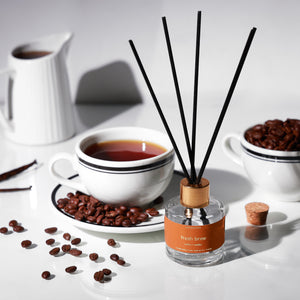
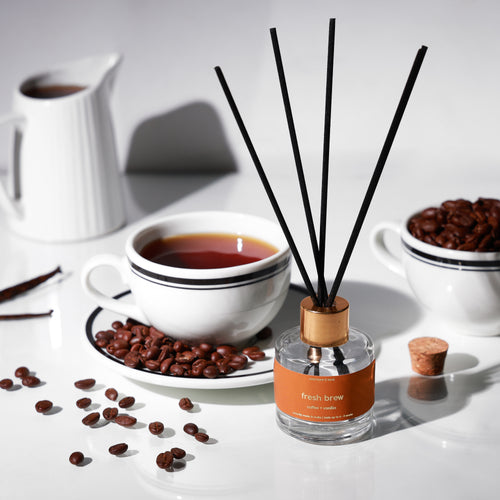
Cool months: cold, dense, still air both preserves the bottle and suppresses the room. This is when a 50ml genuinely lasts, when six or seven reeds makes sense, and when a warm composition such as Fresh Brew at 9.5 is at its best.
2. Turn the register dial twice. Once as the heat arrives, from warm to cold or dry. Once as the air cools, back again. Two changes a year is enough, and it has a second benefit: rotation defeats olfactory adaptation, which is the commonest reason a scent seems to stop working.
3. Turn the reed dial with it. Six fibre reeds is the dose each composition is balanced around. Four or five through the hottest and dampest weeks — in heat because the rate is already elevated, in damp because fragrance accumulates in a closed room. Six, or seven in a cold still room, through winter.
4. Buy size for the season ahead, not for strength. A 130ml is not louder than a 50ml at the same reed count. It lasts 14–18 weeks against 6–8, which is exactly what you want going into the months that empty bottles fastest.
5. Use the refill as the backbone of the year. The 300ml at ₹2,399 runs roughly 8–11 months and works out around ₹7–8 per millilitre against ₹15–17 for a fresh 50ml. You reuse your own glass vessel and reeds; refresh the reeds every few months.
6. Keep placement seasonal too. Interior walls and out of the sun in the hot months; away from a damp sill in the wet ones; near a doorway all year, because a reed diffuser has no fan and depends on the room to carry it.
Composed and handmade in small batches in Pune, and a portion of every order supports girl-child education through Nanhi Kali.
Part one — the three dials, and how far to turn each one
The reason seasonal advice usually fails is that it is written as a long list of small adjustments, and nobody keeps up with a long list. So reduce it to three settings on one bottle. Everything you will ever need to change about a reed diffuser through an Indian year is size, reed count and register — and only the middle one changes more than twice. Before the specifics: the seasons and months named on this page are general climate framing, not SOSA measurements, and the country is far too varied for a single calendar. Kochi, Jaipur and Shillong will each read this table differently, and should.
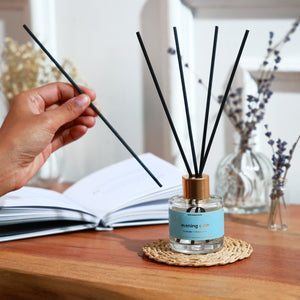
 Evening Calm₹799 · 8.9/10Six fibre reeds is a dose, not a default — each composition is balanced around exactly that number. Moving away from it is a deliberate act, it takes ten seconds, and it is completely reversible. In the hottest weeks I drop to four or five, because heat has already raised the rate and six reeds in a 42°C afternoon is a bottle disappearing in front of you. In the wet weeks I do the same for a different reason: a closed damp room does not clear itself, so a lower rate reads as definition rather than as weakness. In a cold, still, shut-up winter room I go the other way — six, sometimes seven, because dense cold air both slows release and suppresses what does reach you. Adding reeds costs bottle life roughly in proportion, which in winter you can afford.
Part two — the twelve-month plan
What follows is how I would run a flat through a typical northern-plains year, which is the pattern the largest number of our customers live in. Treat the month names as shorthand for conditions, not as instructions: on the Konkan coast the wet column runs far longer, in the hills the cool column dominates, and in the far south the hot column barely closes. The reed counts assume a 50ml or 130ml bottle at ordinary room sizes and are SOSA working guidance rather than measured figures.
| Month (approx.) | What the air is doing | Composition I would run | Size | Reeds |
|---|---|---|---|---|
| January ★ | Cold, dry and very still; windows shut for warmth | Fresh Brew 9.5 — the warmest register we have | 130ml | 6–7 |
| February | Cool and dry, windows beginning to open again | Fresh Brew, or Garden Bloom as the air lightens | 130ml | 6 |
| March | Warming, breezy, the best distribution of the year | Garden Bloom 8.9 — florals travel beautifully now | 50ml or 130ml | 6 |
| April | Hot and dry; sun strong on west walls all afternoon | Mountain Breeze 9.4 — presence with no sweetness | 130ml | 5–6 |
| May | Hottest weeks; AC on; bottles run fastest of the year | Mountain Breeze, or Evening Calm in bedrooms | 130ml | 4–5 |
| June | Heat breaking; humidity climbing steeply | Morning Freshness 9.0 — switch register now | 130ml | 5 |
| July | Full rains; the house closes; air stops moving | Morning Freshness — cold citrus against damp | 50ml or 130ml | 4–5 |
| August | Humidity at its highest; the room grows its own smell | Mountain Breeze in living rooms, Morning Freshness elsewhere | 130ml | 4–5 |
| September | Rains easing, muggy, windows opening in gaps | Morning Freshness, with the balcony door open daily | 50ml | 5 |
| October | Drying out, festival weeks, guests in the house | Garden Bloom — the hosting scent, entryway first | 130ml | 6, and 8–9 for a party weekend |
| November | Cool, clear and settled; air still carries well | Fresh Brew — turn the register back to warm | 130ml | 6 |
| December | Cold and still; rooms shut; everything reads quieter | Fresh Brew, Evening Calm 8.9 in bedrooms | 130ml | 6–7 |
| The honest caveat: this calendar is general climate framing, not a measurement, and it is written from a northern-plains pattern. Coastal homes should read the wet column as running from roughly June to September or later and the cool column as barely existing; hill homes should treat most of the year as the cool column and add a reed rather than remove one; the far south may never turn the register back to warm at all. Read your own air. Nothing here is worth following against the evidence of your own windows. | ||||
Fresh Brew · 9.5/10from ₹849Shop → 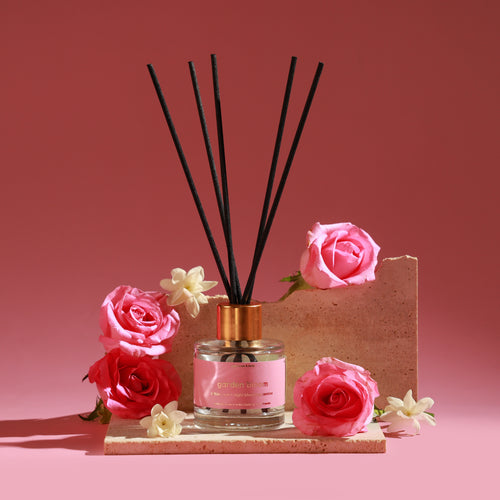 Garden Bloom · 8.9/10from ₹799Shop →
 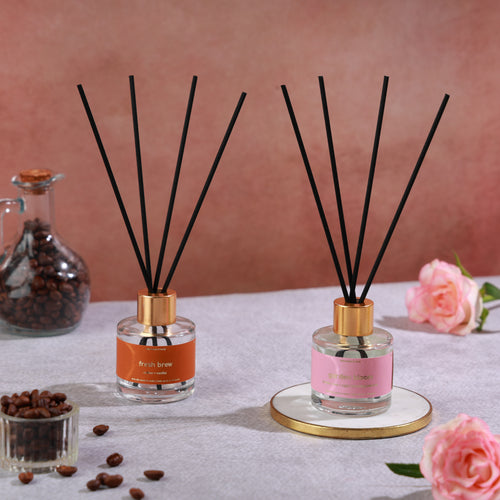 Oil refill · 300ml₹2,399Shop →
Part three — what a year actually costs to run
Let me put numbers on it, because the seasonal plan above sounds like it might be expensive and it is not. A single room run continuously at six reeds gets through roughly one 50ml every six to eight weeks, or one 130ml every fourteen to eighteen. The cheapest way to hold that is not to keep buying fresh bottles — it is to keep the glass vessel you already own and buy oil. A 300ml refill at ₹2,399 covers around 8–11 months and works out at roughly ₹7–8 per millilitre against ₹15–17 for a 50ml bottle, which is up to about 55% less. The 500ml at ₹3,499 runs 14–18 months. Refilling is four steps: remove the reeds, pour to the neck, return the reeds, and flip once so both ends are coated.
The honest gap in that plan is the reeds. Fibre reeds are the consumable in this system and the oil is the stable part, which is the reverse of what most people assume — they replace the oil faithfully and keep the same six sticks for a year. We do not currently sell replacement reeds as a separate item, and I would rather say that plainly than let you discover it at the moment you need them. Our guidance is to refresh reeds every few months, which in practice means using the fresh set that comes with a new bottle when you buy one, and keeping the old vessel and old reeds as the second, gentler source somewhere else in the house.
Which leads to the thing most seasonal plans get wrong: they assume one bottle per home. Output per bottle is fixed, so the only way to raise the total fragrance in a space is another source — two 50ml at opposite ends of an open living-dining will always beat one 130ml in the middle. That is also why the duo sets are priced as they are: Warmth & Bloom at ₹1,598 for 2 × 50ml gives you two sources that share a warm register, so the flat reads as one place rather than two. And past roughly 250–300 sq ft of connected open volume, or when what you want is scent on demand rather than constantly, the honest answer is a machine — a Sukoon at ₹1,899 covers 270–320 sq ft with timers. Most homes end up running both formats, in different rooms, for different reasons.
Part four — the buying calendar
The same year expressed as purchases, so you can see how few there are. Most homes need two bottles and one refill, and the timing matters more than the quantity — buying the right size just before the season that eats bottles is the whole trick.
| Buy around | What | Why at that point in the year | Price |
|---|---|---|---|
| Late February ★ | Mountain Breeze 130ml | Duration bought ahead of the fastest-burning months, and a dry register before the heat | ₹1,349 |
| Late May or early June | Morning Freshness 50ml or 130ml | Turn the register cold before the air turns wet, not after | ₹749 / ₹1,249 |
| Mid-monsoon | 300ml oil refill | The cheapest oil we sell, and a quiet month to top up a vessel | ₹2,399 · 8–11 months |
| Early October | Garden Bloom 130ml | Festival weeks and guests; a fresh set of six reeds arrives with it | ₹1,299 |
| November | Fresh Brew 130ml | Cold still air rewards a warm register; carries to February | ₹1,349 |
| Whenever a second room needs covering | Warmth & Bloom duo | Two sources that share warmth, so there is no seam in the hallway | ₹1,598 / 2 × 50ml |
| Once every year or so | 500ml oil refill | The lowest per-millilitre price in the range, if you have settled on a scent | ₹3,499 · 14–18 months |
Versailles
I did not set out to build a seasonal range. I set out to build five good compositions, and it was our own customers who taught me that an Indian year needs more than one answer. The clearest signal was in the correspondence: the same person writing in December to say Fresh Brew was the best thing in their house, and again in August to ask whether the batch had changed. It had not. Their air had.
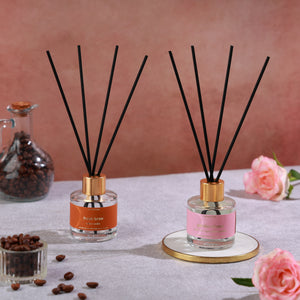
So the five sit deliberately across registers rather than clustering where the sales are. Two warm, one floral, one bright and cold, one dry and woody. If we had made five variations on coffee we would probably sell more in the cool months and lose those customers entirely by July.
The advice I most want to give about the year is the least commercial one. Do not buy your way through the seasons. Turn the reed count down when it is hot and wet, turn it up when it is cold, move the bottle off the sunny sill in April and off the damp one in July, and change register twice. That is nearly all of it, and none of it costs anything. Composed and handmade in small batches in Pune, and a part of every order funds a girl's classroom through Nanhi Kali.
Frequently asked questions
- Do reed diffusers evaporate faster in summer? and do they last longer in winter? — the two halves of the year.
- How the Indian monsoon affects reed diffusers — the closed house, and 85% humidity.
- Where to keep a diffuser in hot weather — the summer placement audit.
- The complete weather and climate guide — this page and the eight around it, in one place.
- Brand: the SOSA founder story.
SOSA reed diffuser range & prices (verified August 2026): alcohol-free, phthalate-free, paraben-free and IFRA-compliant compositions on a heat-stable coconut-derived (CCT) carrier, low-VOC, supplied in a refillable glass bottle with six fibre reeds; 50ml lasts 6–8 weeks and 130ml lasts 14–18 weeks. Morning Freshness (Malabar lemon · peppermint · Nilgiri eucalyptus) 50ml ₹749 · 130ml ₹1,249 · 9.0/10; Garden Bloom (British rose · night-blooming jasmine) 50ml ₹799 · 130ml ₹1,299 · 8.9/10; Evening Calm (Kashmir lavender · chamomile) 50ml ₹799 · 130ml ₹1,299 · 8.9/10; Fresh Brew (Coorg coffee · Kerala vanilla) 50ml ₹849 · 130ml ₹1,349 · 9.5/10; Mountain Breeze (Himalayan pine · sage · Indian cedar) 50ml ₹849 · 130ml ₹1,349 · 9.4/10. Reed diffuser refills are oil only — you reuse your own vessel and reeds: 300ml ₹2,399 (roughly 8–11 months) · 500ml ₹3,499 (roughly 14–18 months), about ₹7–8 per ml against ₹15–17 per ml for a 50ml bottle. Duo sets ₹1,498–₹1,598 for 2 × 50ml and ₹2,498–₹2,598 for 2 × 130ml. Strength figures are positions on SOSA’s own internal strength scale, not an industry standard. Replacement reeds are not sold as a separate SKU; SOSA guidance is to refresh reeds every few months. The reed line is separate from the water-based Hotel Collection for ultrasonic machines (15ml ₹299 · 100ml ₹999 · 300ml ₹1,799) and the two are not interchangeable. Diffusers: Boond 300ml ₹899 · Sukoon 500ml ₹1,899 · Megh 6L ₹3,499 · waterless Vaayu ₹11,999. Composed and handmade in small batches in Pune, India; tested through 45°C summer heat and 85% monsoon humidity. Free shipping above ₹499. A portion of every order supports girl-child education through Nanhi Kali. Prices subject to change — see the live product pages.