

Humidity: works on the reed rather than the oil. Damp fibre wicks a little more slowly; damp rattan swells and clogs, which is exactly why SOSA ships six fibre reeds and not rattan.
Air movement: two opposite failures. Dead air means no distribution; a direct draught from an AC, a fan or an open window strips the reeds and empties the bottle weeks early.
The three dials you control: reed count (free, instant, costs bottle life), placement (free), and register — warm compositions for cold still air, cold and dry ones for heat and damp.
- The straight answer
- Part one — the three climate forces
- Part two — every condition, and what it does
- Part three — why the base matters more than the notes
- Part four — a setting for every Indian climate
- Part five — diagnosing a seasonal change
- Part six — the buying edit, and where reeds stop
- A note from Sonal
- FAQs
2. Heat can also change the smell — but only in the wrong formula. Diffuser oils carried on phthalate solvents project hard for a fortnight and then degrade under sustained heat, turning faintly acrid around week six. Our reed range is phthalate-free on a heat-stable coconut-derived CCT base, tested through 45°C. The trade is a smaller opening and a longer, flatter plateau, and I would rather state it than hide it.
3. Humidity acts on the reed, not the oil. Damp air accepts new molecules more slowly, so output dips gently. Natural rattan does worse than that — its pores swell and clog, and the stick stops working altogether. Every SOSA bottle ships with six fibre reeds for exactly this reason, tested through 85% humidity.
4. A closed house is the biggest single factor in the wet months. A reed diffuser has no fan; it releases and waits for the room to carry. Shut every window for a fortnight and the fragrance pools within a foot of the glass. Ten minutes of cross-ventilation a day changes more than any purchase.
5. Cold still air preserves the bottle and suppresses the room. Winter is when a 50ml comfortably beats its window and simultaneously reads quieter. That is the moment to add a reed or two, not to conclude the bottle has failed.
6. Draught is the failure that looks like weather but is not. A bottle under a split AC, in front of a fan or beside an open window is being stripped: a weak room and a bottle empty weeks early, at the same time.
7. Adjust before you buy, always. Reed count, placement and ventilation are free and reversible. Composition is the paid lever and the last one. Size is not a strength lever at all — a 130ml lasts 14–18 weeks against 6–8 and at the same six reeds projects the same.
Composed and handmade in small batches in Pune, and a portion of every order supports girl-child education through Nanhi Kali.
Part one — the three climate forces, separated
People experience weather as one thing — it is horrible outside — but a diffuser experiences three, and they can pull in opposite directions in the same week. A May afternoon in Delhi is hot and bone dry; a May afternoon in Chennai is hot and wet; a July night in Mumbai is warm, saturated and utterly still; a January morning in Shimla is cold, dry and moving. Each combination produces a different bottle and a different room, and the corrections are not the same. Everything in this section is SOSA working guidance from in-house testing and years of customer correspondence rather than laboratory measurement, and the one number that is a verified specification is the envelope our compositions are tested through: 45°C and 85% relative humidity.
 Garden Bloom₹799 · 8.9/10Air that is already close to saturated is a reluctant customer: it takes up new fragrance molecules more slowly, so the reed's output dips. On fibre that is a gentle narrowing you would struggle to detect week to week. On natural rattan it is often terminal, because rattan's pores are organic — they absorb moisture, swell, and then trap the heavy fraction of the composition until the stick is a decoration. This single fact is why every SOSA reed diffuser ships with six fibre reeds rather than the rattan you will find in most imported bottles, and why our compositions are tested through 85% humidity. Moisture also changes what you perceive: a damp room already has weight of its own, so cold sharp notes read clear against it and warm sweet ones simply add to it.
Part two — every weather condition, and exactly what it does
The whole cluster compressed into one table. Find the row that matches your week and the correction is in the last column. Bottle-life effects are described as directions rather than promises, because room volume, ceiling height, ventilation and construction move them considerably.
| Condition | Effect on the rate | Effect on the reed | How the room reads | The correction |
|---|---|---|---|---|
| Dry heat, 40–45°C ★ | Sharply up — a 50ml can finish in 4–5 weeks | Wicks fast; wet line sits high | Full, and top-heavy early on | Drop to 4–5 reeds; interior wall; out of all sun |
| Monsoon damp, up to 85% RH | Gently down; bottles often outlast their window | Fibre narrows; rattan swells and clogs | Strong at the bottle, absent at the edges | Ten minutes' cross-ventilation daily; 4–5 reeds |
| Warm and humid together | Roughly level — the two effects partly cancel | Wicks steadily; residue builds faster at the tip | Heavy and close; sweet scents become oppressive | Flip weekly without fail; switch to a cold, dry register |
| Cool, dry, still winter air | Down — a 50ml comfortably beats 6–8 weeks | Slow, even wicking; very little residue | Quiet, because dense cold air suppresses reach | Go up to 6–7 reeds; warm register; keep flipping |
| Sealed air-conditioned room | Down if the bottle is away from the vent | Normal, unless it is in the airflow | Even and long-lasting — genuinely a good environment | Keep several feet clear of the vent; six reeds |
| Direct draught — AC, fan or open window | Up steeply, and wastefully | Stripped; dry above the wet line within days | Weak, despite the bottle emptying fast | Move it. This is the worst value in the category |
| Direct sunlight on the glass | Up, and unevenly across the day | Heated oil, faster loss of the lightest notes | Thin and unbalanced; short bottle | Any shaded interior surface. Check at 2pm and 4pm |
| The honest caveat: a reed diffuser is a weather instrument in one direction only. It responds to the climate; it cannot change it. It will not lower humidity, dry a damp wall, cool a room or clear cooking smoke, and used as cover for any of those it makes a real problem harder to notice. Deal with the room first — extractor, window, dehumidifier, repair — and let the fragrance be fragrance. | ||||
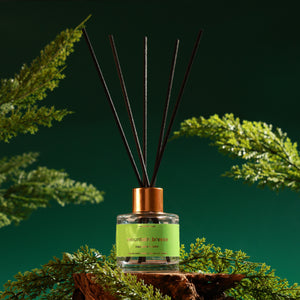
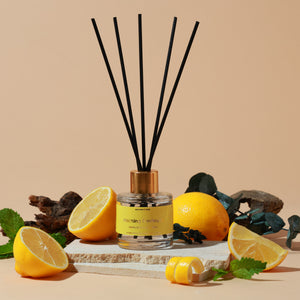
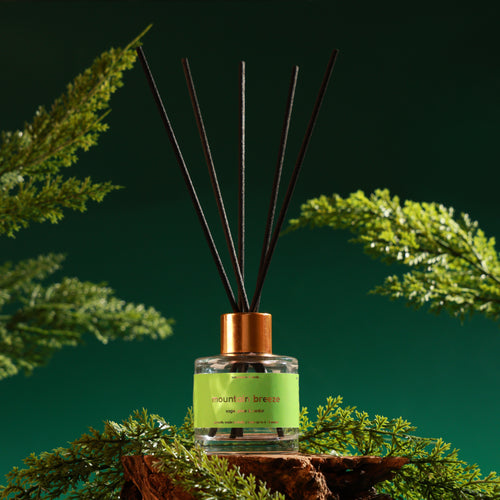
Mountain Breeze · 9.4/10from ₹849Shop → 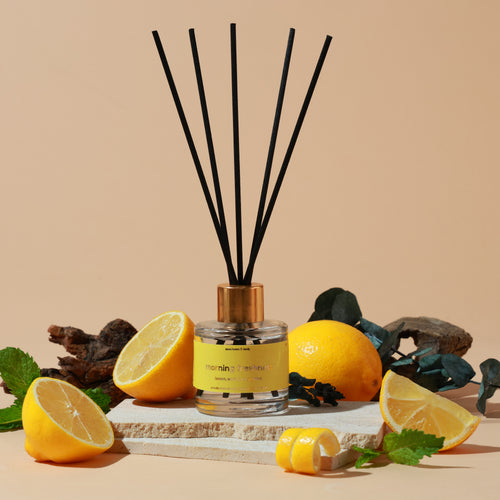 Morning Freshness · 9.0/10from ₹749Shop →
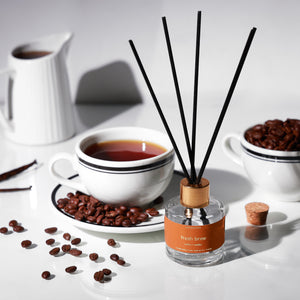
 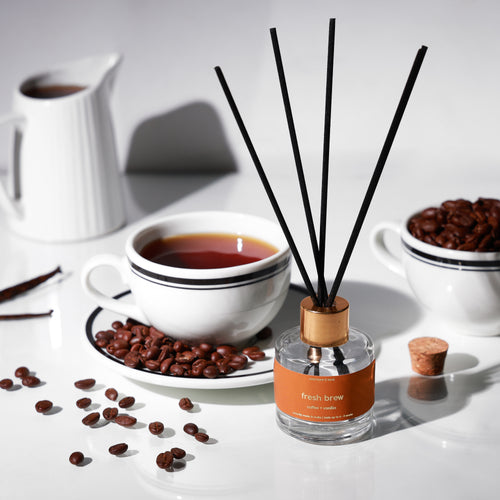 Fresh Brew · 9.5/10from ₹849Shop →
Part three — why the base matters more than the notes
Here is the trade that the industry rarely says out loud. Phthalate solvents are extremely good at one job: they push fragrance off a reed hard and fast, which produces a spectacular first week and a diffuser that seems to outperform its price. What they also do is degrade under sustained heat, and in an Indian April or a Delhi June that is not a hypothetical — it is a fortnight away. The arc is familiar to anyone who has bought a cheap diffuser or plug-in: thrilling on day one, thin by day ten, and faintly acrid by around week six, with a sharpness at the edge of the smell that was not in the composition when it was made.
Our reed range is phthalate-free, alcohol-free, paraben-free, low-VOC and IFRA-compliant, built on a coconut-derived CCT carrier chosen specifically because it is heat-stable, and tested through 45°C summer heat and 85% monsoon humidity. The trade is real and it goes both ways. We give up some of that opening spike — a SOSA bottle will not out-shout a phthalate-carried one in its first three days — in exchange for a longer, flatter plateau that holds its character to the end of the bottle. The three-phase curve applies whatever the weather: a days-one-to-three spike as dry reeds saturate and the top notes depart, a settle over the first week or two, and then a plateau. The plateau is the product. Everything before it is packaging.
The same reasoning produced the reeds. Rattan is cheaper and entirely traditional, and it fails in Indian humidity because its pores are organic and swell shut. We ship six fibre reeds with every bottle because a consistent engineered pore structure keeps wicking through a monsoon. The honest gap belongs alongside the honest choice: we do not sell replacement reeds as a separate item, so the practical way to refresh them is the fresh set that arrives with each new bottle, every few months. Reeds are the consumable here and the oil is the stable part — the reverse of what most people assume, and why an oil refill with a tired set of reeds disappoints so often.
Part four — a setting for every Indian climate
India is not one climate and a single recommendation would be useless. Below is how I would set a bottle in each broad pattern. Please read these as descriptions of conditions rather than of postcodes — the pattern that fits you may not be the one your city is listed under, and the boundaries are general climate framing rather than anything we have measured.
| Climate pattern | The dominant challenge | Size I would buy | Reeds | Composition that copes best |
|---|---|---|---|---|
| Northern plains — hot, wet, then cold ★ | The widest swing of the lot; three genuinely different seasons | 130ml before summer, 50ml for winter trials | 4–5 hot · 4–5 wet · 6–7 cold | Rotate: Mountain Breeze then Fresh Brew |
| West coast — humid nearly all year | Damp on damp; the cool season barely arrives | 130ml, for duration through a long wet stretch | 4–5 for most of the year | Morning Freshness — cold citrus against damp |
| Deccan plateau — mild, with a sharp dry summer | Pleasant most months, then a fierce April and May | 50ml is genuinely enough for much of the year | 6 as standard; 4–5 in April–May | Anything. This is the kindest climate for the format |
| Eastern coast — hot and humid, long summer | Heat and moisture together for most of the year | 130ml, and plan on a refill rather than new bottles | 4–5 nearly always | Morning Freshness, or Mountain Breeze in living rooms |
| Eastern plains — heavy monsoon, muggy shoulders | The closed house for months; the room's own damp smell | 130ml through the rains, 50ml in the cool weeks | 4–5 wet · 6 cool | Morning Freshness; Garden Bloom only where air moves |
| Hills — cold, still, long winters | Cold dense air suppresses the room; bottles last and last | 50ml, because it will comfortably outlast its window | 6–7, occasionally 8 in a large cold room | Fresh Brew at 9.5, or Evening Calm in bedrooms |
| The honest caveat: these patterns are general climate framing and the reed counts are SOSA working guidance, not measurements. Two flats in the same building can behave differently — a top floor under a concrete slab, a north-facing second floor and a ground-floor flat with a shaded courtyard are three different climates. Trust the wet-line test and your guests' noses over any table, including this one. | ||||
Part five — diagnosing a change that arrived with the season
When a bottle behaves differently and the weather has just turned, the temptation is to treat it as a fault. Run three checks instead, in this order, and you will almost always land on the cause in under five minutes. First, the doorway test. Step outside for fifteen minutes and walk back in. Your nose stops reporting a constant within minutes and adapts hardest at home, and you are indoors far more in extreme weather than in mild — this single test settles more seasonal complaints than everything else on this page combined. If the room greets you on the way in, nothing is wrong with the bottle and the problem was your own adaptation.
Second, the wet-line test. Lift one reed with gloves on and find the boundary between the oil-soaked part and the dry part. A high, dark line means the reed is saturated and stalled — heavy molecules have accumulated at the exposed end while the light ones have left — and the answer is to flip all six. A line barely above the surface of the oil means the reed is not wicking properly, which in the wet months is your signal that the reeds are old, and on a rattan diffuser is usually terminal. A normal line with a quiet room points you at the third check.
Third, the airflow check. Stand where you usually sit and ask whether any air passes the bottle in an ordinary hour. If the answer is no, move it: a console or shelf near a doorway or walkway, waist to chest height, clear space around it. If the answer is that a great deal of air passes it — an AC vent, a fan, an open balcony — move it the other way. Only after all three should you consider spending. And know the ceiling honestly: past roughly 250–300 sq ft of connected open volume, or when what you want is scent on demand, reeds are the wrong tool. A Sukoon at ₹1,899 covers 270–320 sq ft, runs 16–18 hours on low, and comes with three 15ml Hotel Collection scents in the box; in a humid month, run it in bursts on the timer. The 6L Megh at ₹3,499 gives about 100 hours a fill but only around 215 sq ft — a runtime and humidity machine, never a coverage upgrade.
Part six — the buying edit, and where reeds stop
Everything above arranged as a spending decision, in the order I would spend it. The first four lines cost nothing at all, and in my experience most people never need to reach the fifth.
| Do this | The weather problem it answers | What it costs you | Price |
|---|---|---|---|
| 1. Move it — interior wall, no sun, clear of vents ★ | Heat, draught and dead air, all three at once | Nothing, and it often adds weeks to the bottle | Free |
| 2. Flip all six reeds weekly, gloves on | Stalled reeds in humid or hot weather | Slightly shorter bottle — the correct trade | Free |
| 3. Change the reed count with the season | Fast burn in heat; accumulation in damp; silence in cold | Proportional bottle life in the direction you choose | Free |
| 4. Ten minutes of cross-ventilation daily | The closed monsoon or air-conditioned house | Nothing | Free |
| 5. Change register with the season | Warm scents oppressive in damp; cold ones austere in winter | A new bottle, and a change of character | From ₹749 |
| 6. Buy the 130ml before the fast months | Running out mid-May, not weak scent | Duration only — it is not louder at six reeds | From ₹1,249 |
| 7. A second bottle, sharing a note | Length and division that one point source cannot cover | Two bottles on two timelines, or a duo set | From ₹1,498 |
| 8. 300ml or 500ml oil refill | The running cost of a climate that eats bottles | Nothing — it is the cheapest oil we sell | ₹2,399 · ₹3,499 |
| Where reeds stop: a Sukoon | Scent on demand, or 250–300+ sq ft of open volume | Said plainly rather than selling you a third bottle | ₹1,899 |
Versailles
The training I had in Versailles assumed a room I do not live in. Twenty-odd degrees, moderate humidity, a window that opens without letting in a wall of heat. Everything I have learned since about home fragrance in India has come from the gap between that room and a Pune flat in May, or a Mumbai one in August. The gap is not small, and it is why so many beautiful imported diffusers disappoint here through no fault of their composition.
So we made a series of unglamorous decisions early. Fibre reeds rather than rattan, because rattan swells and clogs in our damp. A coconut-derived CCT carrier rather than a phthalate solvent, because the solvent wins the first week and loses the sixth once heat gets into it. Testing through 45°C and 85% relative humidity, because those are the real conditions, not the comfortable ones. None of that shows up on a shelf, and all of it shows up in week six of an Indian summer.
What I would ask, if you have read this far, is that you stop treating weather as a defect report. Your diffuser is doing exactly what a passive, constant, deliberately low-output object does when the air around it changes — and you have three free dials to answer with. Turn the reed count down when it is hot and wet and up when it is cold; move the bottle off the sunny sill and the damp one; open the windows for ten minutes when the rain pauses. Composed and handmade in small batches in Pune, and a part of every order funds a girl's classroom through Nanhi Kali.
Frequently asked questions
- Does hot weather affect reed diffusers? and does humidity affect performance? — the two forces, one at a time.
- Do they evaporate faster in summer? and do they last longer in winter? — the bottle-life halves of the year.
- How Indian summer affects reed diffusers and how the monsoon does — 45°C and 85% RH in detail.
- Where to keep a diffuser in hot weather and how to perform better in humid weather — placement and register.
- Using SOSA diffusers across Indian seasons — the twelve-month plan — and the airflow and placement guide.
- Brand: the SOSA founder story, and why can't I smell my reed diffuser? — the diagnostic that starts everything.
SOSA reed diffuser range & prices (verified August 2026): alcohol-free, phthalate-free, paraben-free and IFRA-compliant compositions on a heat-stable coconut-derived (CCT) carrier, low-VOC, supplied in a refillable glass bottle with six fibre reeds; 50ml lasts 6–8 weeks and 130ml lasts 14–18 weeks. Morning Freshness (Malabar lemon · peppermint · Nilgiri eucalyptus) 50ml ₹749 · 130ml ₹1,249 · 9.0/10; Garden Bloom (British rose · night-blooming jasmine) 50ml ₹799 · 130ml ₹1,299 · 8.9/10; Evening Calm (Kashmir lavender · chamomile) 50ml ₹799 · 130ml ₹1,299 · 8.9/10; Fresh Brew (Coorg coffee · Kerala vanilla) 50ml ₹849 · 130ml ₹1,349 · 9.5/10; Mountain Breeze (Himalayan pine · sage · Indian cedar) 50ml ₹849 · 130ml ₹1,349 · 9.4/10. Reed diffuser refills are oil only — you reuse your own vessel and reeds: 300ml ₹2,399 (roughly 8–11 months) · 500ml ₹3,499 (roughly 14–18 months), about ₹7–8 per ml against ₹15–17 per ml for a 50ml bottle. Duo sets ₹1,498–₹1,598 for 2 × 50ml and ₹2,498–₹2,598 for 2 × 130ml. Strength figures are positions on SOSA’s own internal strength scale, not an industry standard. Replacement reeds are not sold as a separate SKU; SOSA guidance is to refresh reeds every few months. The reed line is separate from the water-based Hotel Collection for ultrasonic machines (15ml ₹299 · 100ml ₹999 · 300ml ₹1,799) and the two are not interchangeable. Diffusers: Boond 300ml ₹899 · Sukoon 500ml ₹1,899 · Megh 6L ₹3,499 · waterless Vaayu ₹11,999. Composed and handmade in small batches in Pune, India; tested through 45°C summer heat and 85% monsoon humidity. Free shipping above ₹499. A portion of every order supports girl-child education through Nanhi Kali. Prices subject to change — see the live product pages.