
The formulation part: most of a reed diffuser bottle is carrier, not perfume. Phthalate solvents — still the category default — push fragrance hard off a reed and then degrade in heat, turning acrid by around week six. That sour, faintly bitter note is a carrier failing, not a perfume fading.
What SOSA does: a heat-stable coconut-derived CCT carrier, phthalate-free, alcohol-free, paraben-free, low-VOC and IFRA-compliant, tested through 45°C summer heat and 85% monsoon humidity. Composed and handmade in small batches in Pune.
The trade, said out loud: a CCT bottle opens smaller than a phthalate one. You give up week-one theatre and you get a flatter plateau that still smells like itself in August.
2. It puts the carrier on trial, and that part is where products actually fail. The carrier is the majority of the liquid in the bottle. Under sustained high temperature, phthalate solvents degrade and develop a sour, faintly bitter, slightly chemical note of their own. Customers describe it as the diffuser having gone off. Something has gone off — the thing carrying the perfume.
3. That failure has a recognisable shape. A phthalate-carried bottle is at its most impressive in week one, because pushing fragrance hard off a reed is exactly what those solvents are good at. The problem is week six. If you have ever loved a diffuser for a fortnight and quietly disliked it by the second month of summer, you have met this arc.
4. SOSA's answer is the base, not the notes. Every reed composition we make sits on a heat-stable coconut-derived CCT carrier — phthalate-free, alcohol-free, paraben-free, low-VOC and IFRA-compliant — tested through 45°C summer heat and 85% monsoon humidity.
5. And the honest cost of that choice. A CCT bottle opens smaller. It does not perform the dramatic week-one flourish. What it gives instead is a flatter, longer plateau, and the plateau is the product — that is where a bottle spends most of its life.
Composed and handmade in small batches in Pune, and a portion of every order supports girl-child education through Nanhi Kali.
Part one — the carrier is most of the bottle, and nobody talks about it
Pick up any reed diffuser and read the front of the box. You will find notes, a story, possibly a country of origin, and almost never the one piece of information that determines how it behaves in an Indian home. Perfume oil is the minority of what is in the bottle; the carrier is the majority. Its job is to dilute the fragrance to a workable concentration, to travel up the fibre reeds by capillary action, and to release the perfume at a controlled rate. Three properties follow from that choice: how hard the fragrance is pushed off the reed, how evenly it is released across the bottle's life, and whether the carrier itself stays chemically quiet at temperature. In a temperate climate the third barely matters. Here it is decisive.
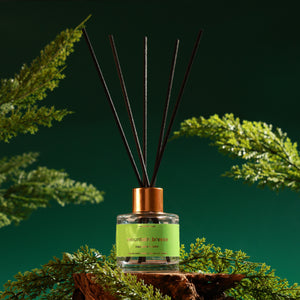
 Mountain Breeze₹849 · 9.4/10Phthalate solvents earned their place honestly: cheap, able to dissolve a wide range of perfume materials, and able to push fragrance off a reed with real force. The first week of a phthalate-carried diffuser is genuinely impressive. Sustained heat is where the bargain unravels — those solvents degrade, and the degradation products have their own smell: sour, faintly bitter, a little chemical, sitting underneath whatever the perfume was meant to be. By around the sixth week of a hot Indian summer that undertone is usually the dominant impression, and it is the specific smell most people mean by "my diffuser turned funny". Note what has happened: the perfume did not spoil. The solvent did, and dragged the perfume down with it. A sealed flat with sun on a west wall accelerates this, because the glass itself is warming the liquid.
Part two — two bottles through one hot season
This is the arc as customers describe it to me and as the chemistry predicts, set out week by week. Read it as an illustration of two different design decisions rather than as a measurement — I have not run a competitor's bottle in a laboratory, and I am not going to pretend otherwise on a page that is arguing for honesty.
| Point in the bottle | Phthalate-carried diffuser | SOSA CCT-carried diffuser | What a room notices |
|---|---|---|---|
| Days one to three ★ | Loud and immediate — dry reeds plus a solvent built to push | A smaller, more measured opening | The phthalate bottle wins the unboxing, decisively |
| Weeks one to two | Settling, still forward; top notes departing fast in heat | Settling onto its working level | The gap narrows and most people stop noticing it |
| Weeks three to five | Noticeably thinner than it was; character shifting | Flat plateau — the level it was designed to hold | The two are now roughly comparable in the room |
| Around week six | Sour, bitter or faintly chemical undertone appearing | Still the same fragrance, gradually thinner | The point at which people stop liking the cheap one |
| The last third of the bottle | Frequently poured away rather than finished | Worth using — same composition to the end | Value, measured in oil actually used rather than bought |
| How fast the level falls in the heat | Fast | Also fast — no advantage claimed here at all | Both need placement and reed-count management |
| The honest caveat: the week markers above are illustrative general framing based on how phthalate carriers behave under sustained heat and on what customers report, not a controlled comparison — bottles differ, formulations differ, and homes differ enormously. The one figure we stand behind is our own: SOSA compositions are tested through 45°C summer heat and 85% monsoon humidity on a coconut-derived CCT carrier. Bottle-life windows of 6–8 weeks for a 50ml and 14–18 for a 130ml at six reeds are SOSA working guidance across an ordinary Indian year. | |||
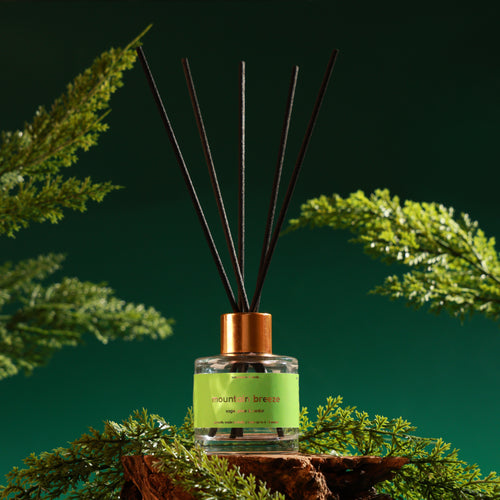 Mountain Breeze · dry woodyfrom ₹849Shop →
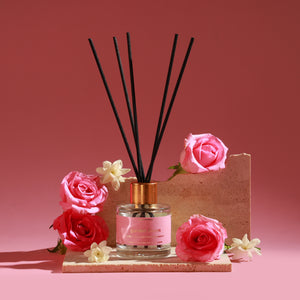
 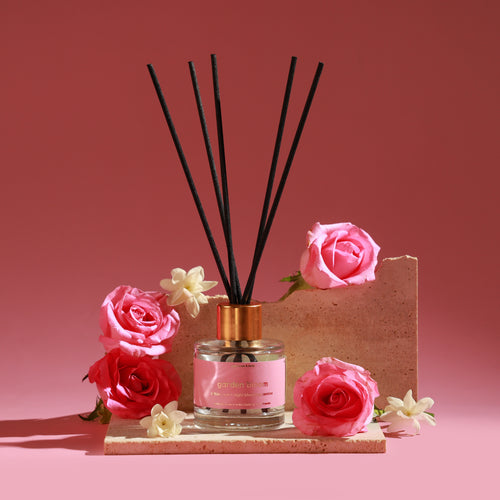 Garden Bloom · rounded floralfrom ₹799Shop →
 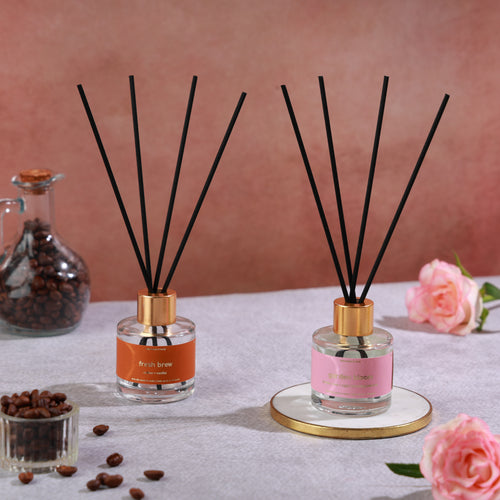 Oil refill · same base, less per ml₹2,399Shop →
Part three — the trade I made, stated plainly
I would rather you understood the decision than simply trusted it, because it is a real trade with a real cost and you are entitled to weigh it yourself. When you remove phthalates and put a composition on a heat-stable coconut-derived carrier, you give up push. The bottle opens smaller. Stand a SOSA reed diffuser next to a well-made phthalate-carried one on day one and the other bottle will very likely fill the room faster. That is not a failure of our compositions; it is the predictable consequence of the carrier decision, and any brand claiming to have removed phthalates with no effect on opening intensity is being economical with the truth.
What you get in exchange is duration of character rather than duration of oil — two different things that are easy to confuse. The oil in either bottle disappears at broadly similar speed in a hot Indian flat; the difference is what it smells like on the way out. Our compositions are dosed to sit at a level they can hold for the entire life of the bottle, which produces the three-phase curve we describe throughout this blog: a modest spike in the first few days as dry reeds saturate and top notes depart, a settle across the first fortnight, and then a long flat plateau that runs to the last of the oil. The plateau is the product. Almost nobody buys a diffuser hoping for a spectacular fortnight, yet that is what the category's default carrier optimises for.
There is a quieter reason for the choice too. A reed diffuser in an Indian home runs continuously for months in rooms where people sleep, children play and windows stay shut for weeks. That is a demanding brief for anything you are asking people to breathe. Alcohol-free, phthalate-free, paraben-free, low-VOC and IFRA-compliant is the specification I was willing to put in my own flat, and heat stability is part of the same argument — a carrier that stays chemically quiet at 45°C is a carrier that is not producing new compounds in a closed bedroom in June. Everything is composed and handmade in small batches in Pune. The usual precautions apply: out of direct sunlight, on a tray because the oil marks wood and stone, reeds flipped weekly with gloves, away from children and pets.
Part four — how to read a diffuser label before an Indian summer
A practical buying filter, whether or not the bottle you are considering is ours. These are the things I would check, in order, and what each one is actually telling you.
| Look for this | Why it matters in Indian heat | SOSA's answer | What it does not fix |
|---|---|---|---|
| "Phthalate-free" stated explicitly ★ | Phthalate carriers degrade in sustained heat and turn acrid | Phthalate-free across the whole reed range | Nothing about how fast the bottle empties |
| Named carrier, not just "fragrance oil" | The carrier is most of the bottle and governs delivery | Coconut-derived CCT, chosen for thermal stability | The opening will be smaller than a solvent-pushed one |
| A stated heat test, with a temperature | "Long-lasting" is not a claim about heat behaviour | Tested through 45°C heat and 85% humidity | Placement — sun on the glass still costs you weeks |
| Alcohol-free | Alcohol flashes off fast and unevenly in a hot room | Alcohol-free, plus paraben-free and low-VOC | Reed count — six is dosed, four is a summer setting |
| Reed material specified as fibre | Rattan's pores clog in Indian humidity, often within weeks | Six fibre reeds in every bottle | Draught — fibre strips in an AC stream like anything else |
| A refill option that is oil only | Summer running costs are the real expense here | 300ml ₹2,399 · 500ml ₹3,499 · about ₹7–8 per ml | Reeds — refills do not include them and we do not sell them separately |
| An honest account of what the range lacks | Stretching the nearest product to fit is how people get disappointed | No oud, no musk-forward scent, no aquatic. Said plainly. | Wishing otherwise |
Versailles
At Versailles, heat stability was a technical footnote. It became the first line of my own brief the moment I started composing for Indian homes. A formula that is elegant in a European flat comes apart in a Delhi living room in June, and in a particular way: the loudest materials shout, the quiet ones vanish, and if the carrier is wrong, something sour arrives underneath and stays.
So I chose the base before I chose a single note, and I accepted what that costs. Our bottles open smaller than the imported ones next to them on a shelf. Every so often somebody writes to tell me so in the first week, and they are not wrong. I ask them to write again in the eighth week, and the second email usually reads differently.
What I will not do is dress the heat itself up as something I have solved. A hot summer will empty your bottle faster than a cool winter, ours included, and the honest levers for that are free ones — get it out of the sun, off the west wall, away from the fridge, and take a reed or two out until the weather turns. Everything is composed and handmade in small batches in Pune, tested through 45°C heat and 85% humidity, and a part of every order funds a girl's classroom through Nanhi Kali.
Frequently asked questions
- Does hot weather affect reed diffusers? — the rate effect and the balance effect, separated.
- How does the Indian monsoon affect reed diffusers? — the other half of the Indian year.
- Where to keep one in hot weather and do they evaporate faster in summer?
- The complete weather and climate guide — this page and the eight around it, in one place.
- Brand: the SOSA founder story.
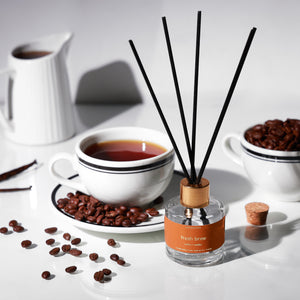
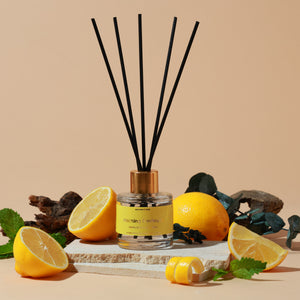
SOSA reed diffuser range & prices (verified August 2026): alcohol-free, phthalate-free, paraben-free and IFRA-compliant compositions on a heat-stable coconut-derived (CCT) carrier, low-VOC, supplied in a refillable glass bottle with six fibre reeds; 50ml lasts 6–8 weeks and 130ml lasts 14–18 weeks. Morning Freshness (Malabar lemon · peppermint · Nilgiri eucalyptus) 50ml ₹749 · 130ml ₹1,249 · 9.0/10; Garden Bloom (British rose · night-blooming jasmine) 50ml ₹799 · 130ml ₹1,299 · 8.9/10; Evening Calm (Kashmir lavender · chamomile) 50ml ₹799 · 130ml ₹1,299 · 8.9/10; Fresh Brew (Coorg coffee · Kerala vanilla) 50ml ₹849 · 130ml ₹1,349 · 9.5/10; Mountain Breeze (Himalayan pine · sage · Indian cedar) 50ml ₹849 · 130ml ₹1,349 · 9.4/10. Reed diffuser refills are oil only — you reuse your own vessel and reeds: 300ml ₹2,399 (roughly 8–11 months) · 500ml ₹3,499 (roughly 14–18 months), about ₹7–8 per ml against ₹15–17 per ml for a 50ml bottle. Duo sets ₹1,498–₹1,598 for 2 × 50ml and ₹2,498–₹2,598 for 2 × 130ml. Strength figures are positions on SOSA’s own internal strength scale, not an industry standard. Replacement reeds are not sold as a separate SKU; SOSA guidance is to refresh reeds every few months. The reed line is separate from the water-based Hotel Collection for ultrasonic machines (15ml ₹299 · 100ml ₹999 · 300ml ₹1,799) and the two are not interchangeable. Diffusers: Boond 300ml ₹899 · Sukoon 500ml ₹1,899 · Megh 6L ₹3,499 · waterless Vaayu ₹11,999. Composed and handmade in small batches in Pune, India; tested through 45°C summer heat and 85% monsoon humidity. Free shipping above ₹499. A portion of every order supports girl-child education through Nanhi Kali. Prices subject to change — see the live product pages.