


What a reed offers: only the first two. It adds no air, so it relies entirely on transport it did not create.
What a hotel adds: the third, permanently, at a set intensity, into a building that is already moving air.
The overlooked half: ventilation also carries fragrance out. An open window is a transport system pointing away from you. Occupancy hours and a closed door matter more than dose.
The honest gap: if this sends you looking for a waterless machine sized to one bedroom, SOSA has none. Safar ₹3,999 is personal scale and is named and sold as a car and travel diffuser; Vaayu ₹11,999 is rated to 2,000–3,000 sq ft.
2. A hotel supplies the current deliberately. A waterless cold-air nebuliser uses pressurised air to shatter undiluted oil into a dry mist, and that mist is released into air the building is already conditioning and pushing — frequently at the air handler itself. The ventilation is the delivery network. Scent goes where air goes, and in a hotel the air goes everywhere.
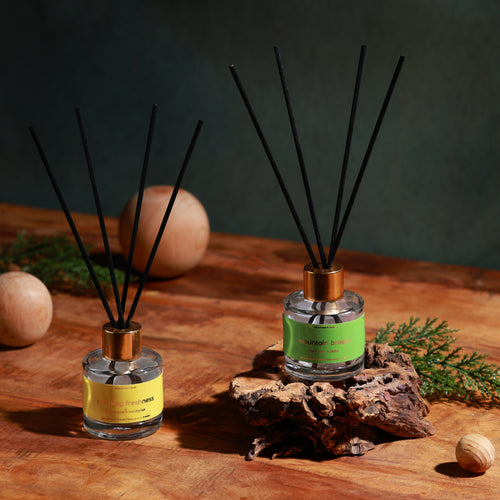
3. A reed supplies no current whatever. Oil climbs six fibre reeds and evaporates from the wetted surface, and then the molecules are on their own. In a closed room with nothing stirring, that produces exactly what people describe: unmistakable at the bottle, softer at a metre, absent at the door. It is passive capillary diffusion behaving correctly.
4. Dryness decides how long the passenger stays on board. An ultrasonic machine sends out a wet, visible mist that tends to settle out onto the nearest surface; a nebuliser sends out a dry mist that stays suspended longer and therefore covers more ground before it lands. More time airborne is more distance travelled — which is the second, quieter reason hotels choose waterless equipment.
5. And transport works in both directions, which nobody accounts for. Every current that brings fragrance to you also carries it away. Open windows, an extractor fan and a door left ajar are all transport systems pointing out of the room. Choosing when the room is closed is frequently more effective than choosing a stronger fragrance, and it is free.
Alcohol-free, phthalate-free, IFRA-compliant, six fibre reeds in a refillable glass bottle. Free shipping above ₹499, and a portion of every order supports girl-child education through Nanhi Kali.
The three ways a molecule crosses a room
This is the physics that decides everything downstream, and it takes two minutes to learn. Once you can name which of the three is operating in your bedroom, you will know immediately whether the problem is the bottle, the placement or the mechanism — and you will stop typing “strongest” into a search box, because strength is not one of the three.
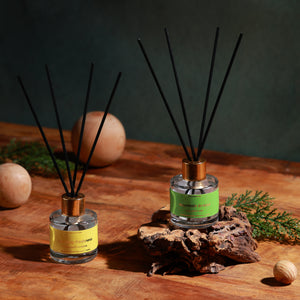
 Garden Bloom₹799In perfectly still air a fragrance molecule still gets about, by colliding with its neighbours and being knocked in an arbitrary direction. Over a centimetre this is quick. Over four metres it is a long, aimless journey, and by the time much of it has arrived the concentration is negligible. This is the only transport a reed can absolutely count on, and it is why the smell at the bottle is a completely different experience from the smell at the door. It is also why holding the reeds to your nose proves nothing about the room: you are sampling the headspace immediately around the source, which is always rich, in every product, at every price.
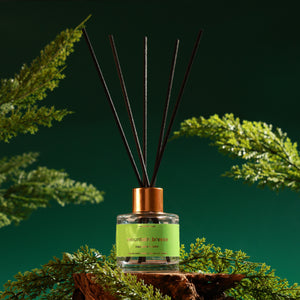
 Morning Freshness₹749No room is truly still. Warm bodies, a sunlit wall, a laptop, a fridge, a doorway between two rooms at different temperatures — all of these set up slow circulation, and in practice this is what actually carries a reed diffuser’s output around a bedroom. It is genuine transport and it is worth working with rather than against: place the bottle where air already travels, near a doorway, on a hall console, on a counter about a metre from where you stand, rather than in a recess or behind a curtain where the air is trapped. The one exception is the direct blast of a running split AC, which will strip the top notes within days and leave you living with the base alone. Humidity matters here too — heavily saturated air carries fragrance poorly, which is why a coastal August bedroom feels flat and a dry Pune evening feels generous with the same bottle.
 Sukoon₹1,899Give the molecules a vehicle and the distance problem disappears. This is the only category of transport that is fast, directional and repeatable, and every machine that produces a plume is buying it for you. Sukoon ₹1,899 does it with a wet ultrasonic mist and covers 270–320 sq ft — real transport, at the cost of dilution, added humidity, refilling and possible white mineral dust in hard-water cities. Safar ₹3,999 and Vaayu ₹11,999 do it with pressurised air and undiluted oil, which is the hotel mechanism proper. Vaayu can be wall or HVAC mounted, runs under 38 dB on 5W and is rated to 1000 m³ — roughly 2,000–3,000 sq ft, which makes it the wrong purchase for one bedroom. Safar is named and sold as a car and travel diffuser and has no published room-coverage figure, and you should know both facts before buying rather than after.
The half nobody counts: fragrance travelling out
Every conversation about scent reaching the far wall ignores the fact that air also leaves. A room is not a sealed box, and the same currents that distribute a fragrance are steadily replacing the air that holds it. An open window is a transport system pointing away from you; so is a bathroom extractor, so is a kitchen chimney, and so is a door left open onto a stairwell. If you have ever wondered why the same diffuser seems generous in a closed air-conditioned bedroom and absent in a room with the balcony door open, this is the entire explanation, and no change of fragrance will alter it.
Hotels handle this by controlling the air exchange rather than by fighting it, which is a luxury a flat with monsoon windows does not have. What a home can do is choose its hours. Decide when you actually want the room to smell, and close it during those hours. If the answer is the evening, then ventilate freely all day and shut the room an hour before you want it, rather than running a fragrance into an open room from eight in the morning. This is the reasoning behind every scheduled machine in this category: Vaayu offers 1, 4, 8 or 24-hour windows with a choice of days, and Safar offers three speeds and a 1, 2 or 3-hour auto-off. A reed cannot participate in this at all, because a reed cannot be switched off — that is its one genuine design limitation and pretending otherwise costs trust.
There is also a question worth putting to yourself before you spend money on making fragrance travel further, and hardly anyone does. Do you actually want it to travel? A great many readers describe wanting a hotel-like bedroom and, in the same message, mention that they do not want the whole flat to smell of it. Those two wishes pull in opposite directions. Transport is not selective: a machine strong enough to fill a bedroom through an open door will scent the corridor, and one sized for a floor will reach rooms you never thought about. If containment matters to you, a closed door plus a reed is not a compromise — it is the correct engineering answer, and it is the cheapest one on this page.
| Format | Transport it supplies | Transport it borrows | Practical reach | Control over when |
|---|---|---|---|---|
| Reed diffuser from ₹749 | None — no fan, no plume, no pressure | Convection, and whatever the fan or AC is doing | A fragrant zone. 50ml is specified up to ~150 sq ft, 130ml above it | None — it cannot be switched off. But it also never surges, and it never creeps into the next room |
| Boond ₹899 | A small wet plume | The room’s circulation | Up to ~150 sq ft, 300ml, about 6 hours | On or off, and it stops when the tank empties |
| Sukoon ₹1,899 ★ | A genuine wet plume — the value answer for transport | The room’s circulation, which it also stirs | 270–320 sq ft, 500ml, 16–18 hours on low | On demand; three 15ml Hotel Collection scents included |
| Megh ₹3,499 | A wet plume and a great deal of humidity | The room’s circulation | Only ~215 sq ft — less than Sukoon, and never a coverage upgrade | About 100 hours from a 6L tank. Buy it for runtime |
| Safar ₹3,999 | Pressurised air, undiluted oil, dry mist | The room’s circulation | Personal and small-space scenting. No published coverage figure. Named and sold as a car and travel diffuser | 3 speeds and a 1/2/3-hour auto-off; needs recharging |
| Vaayu ₹11,999 | Pressurised air, and it can feed the HVAC | The building’s entire airflow | Up to 1000 m³ — roughly 2,000–3,000 sq ft. Wrong for one bedroom | 1h/4h/8h/24h windows, chosen days, adjustable intensity, key-lock |
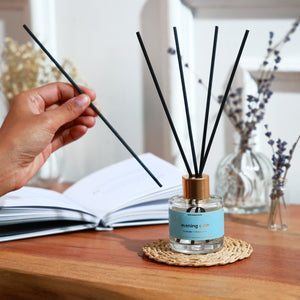
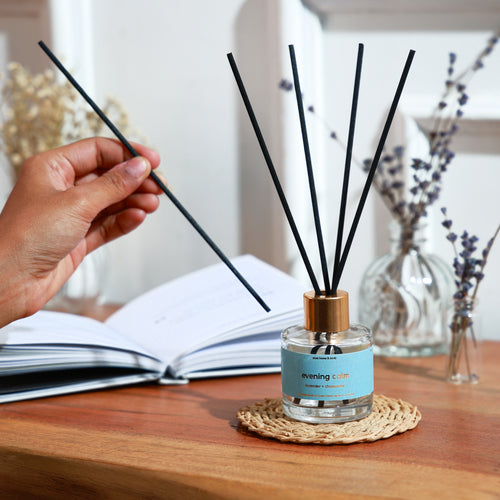
Borrowed · Evening Calm₹799Shop →  Bought · Sukoon₹1,899Shop →
  The passenger · Hotel Collection₹999Shop →
Adding transport for nothing, before adding it for money
Work through these in order and reassess after each. Stir the air. A ceiling fan on its lowest setting, or a split AC left recirculating, converts a room from still to circulating and will do more for reach than a second bottle. Close the door. A small closed volume reaches a perceptible concentration far more readily than an open-plan floor, and this is the single respect in which your bedroom has an advantage over a hotel lobby. Reposition the source into the path the air already takes and out of recesses, corners and curtain folds — but not into the direct stream of a running AC. Use all six fibre reeds, because six is full projection and three is a soft bedside level with roughly double the life, and the reed count is the only output control a reed has. Flip them every three to five days for a noticeable lift that costs nothing.
Then size honestly. A 50ml reed is specified for rooms up to about 150 sq ft and a 130ml for above it, so a small bottle in a large living room is under-specified and will disappoint no matter where it stands or how the air moves. And if the room is long, or L-shaped, or interrupted by a wardrobe, treat it as two volumes rather than one: two reeds in two places genuinely is often the cheaper right answer, and it gives you two zones rather than one uniformly scented space, which for many homes is the more pleasant outcome anyway.
Finally, measure it properly, because you are not a reliable instrument in your own home. Olfactory adaptation removes a constant smell from your awareness within minutes, so the person best placed to tell you whether fragrance is reaching the far side of the room is somebody who has just walked in from outside. Ask a guest. It costs nothing and it is more accurate than any amount of research. If a visitor notices the scent from the doorway, your transport is adequate and what you are experiencing is adaptation rather than a weak product. If they notice nothing after the free adjustments above, then the mechanism is the limit, and buying a machine is the honest next step rather than a stronger bottle.
What to buy for reach, in order of cost
Transport first, dose second, machine third. The last row is the honest gap in the range, and on a transport page it is unavoidable.
| Step | What it is | When it is the right answer | Price |
|---|---|---|---|
| 1. Fan on low, door closed, bottle in the moving air, all six reeds in ★ | Borrowed transport, used properly — the cheapest reach there is | Always first, and it resolves a large share of these questions | ₹0 |
| 2. The right-sized reed | 50ml ₹749–₹849 up to ~150 sq ft; 130ml ₹1,249–₹1,349 above it. Six fibre reeds, flipped every 3–5 days | When the bottle is under-specified for the room — and when you want zoning rather than reach | ₹749–₹1,349 |
| 3. Two reeds, two ends | Two sources beat one stronger source in a long or interrupted room | When the space is really two volumes with furniture between them | from ₹1,498 |
| 4. Sukoon | Bought transport at the sensible price: a moving plume, 270–320 sq ft, 16–18 hours on low, three 15ml Hotel Collection scents included | When the free adjustments were not enough and you can accept water, dilution, humidity and filling | ₹1,899 |
| 5. Safar | Dry undiluted transport at personal scale — 20ml bottle, 3 speeds, 1/2/3-hour auto-off, 2000 mAh, up to 10 hours continuous. Named and sold as a car and travel diffuser, with bedside and hotel room among its stated uses | When water is ruled out and you want it running only during chosen hours. No room-coverage figure has been published, and it needs recharging | ₹3,999 |
| The honest gap | There is no mid-sized waterless bedroom nebuliser at SOSA. Vaayu ₹11,999 is rated to 1000 m³ and is nine-tenths wasted in one room | Said plainly, because “real reach, one bedroom, no water” is the request this range cannot fully answer | — |
Versailles
Perfumery school teaches you to think about a fragrance as a structure in time — what arrives first, what holds, what remains. It does not teach you to think about it as a structure in space, and that omission is behind most of the disappointment in home fragrance. A composition can be flawless and still never reach the other side of a room, because nothing carried it there.
The sentence I now find myself writing most often is that molecules go where the air goes. It sounds too simple to be useful and it is the most useful thing in this whole cluster. It tells you why the same bottle behaves differently in a sealed Gurgaon bedroom and a Mumbai flat with the windows open. It tells you why a fan on its lowest speed is a better purchase than a second diffuser. And it tells you why hotels spend their money on equipment rather than on exotic oils.
The part I want to leave you with, though, is the opposite one. Sometimes not travelling is the point. A reed sitting quietly on a bedside table, scenting the space around it and nothing else, disturbing nobody in the next room, needing no plug and no water and no attention beyond a flip on a Sunday — that is not a lesser version of a hotel machine. It is a different and rather lovely thing, and it is why the reed remains what we make best. Everything is composed in Pune, and part of every order funds a girl’s classroom through Nanhi Kali.
Frequently asked questions
- How hotels do it — the four decisions behind a signature.
- What luxury hotels use — the equipment answer.
- Everywhere in a hotel, nowhere at home — the mechanism page.
- Strong and even — evenness as a mixing property.
- Do hotels use reed diffusers? — the honest answer, fairly given.
- The fragrance cloud on entry and why hotel scent feels more present.
- Oil or system? — the thesis, with the oil defended.
- Recreating it at home — the complete ladder.
- Brand: the SOSA founder story.
Facts verified August 2026: Passive capillary — SOSA reed diffusers in five scents, 50ml ₹749–₹849 for rooms up to ~150 sq ft lasting 6–8 weeks and 130ml ₹1,249–₹1,349 for above 150 sq ft lasting 14–18 weeks; six fibre reeds included, six for full projection and three for a soft bedside level with roughly double the life; flipped every 3–5 days; about ₹13–₹15 a day; heat-stable CCT carrier rather than DPG; alcohol-free, phthalate-free, paraben-free, IFRA-compliant, 0 ppm formaldehyde; refillable glass bottle; tested at 45°C and 85% RH; composed in Pune. Duos ₹1,498–₹1,598 in 50ml × 2 and ₹2,498–₹2,598 in 130ml × 2; refills 300ml ₹2,399 and 500ml ₹3,499. Ultrasonic water mist — Boond ₹899 (300ml, up to ~150 sq ft, ~6 hours, USB, night light), Sukoon ₹1,899 (500ml, 270–320 sq ft, 16–18 hours on low, three 15ml Hotel Collection scents included), Megh ₹3,499 (6L tank, ~100 hours, ~215 sq ft, less than Sukoon and never a coverage upgrade). Waterless cold-air nebulising — Safar ₹3,999 (20ml bottle, 2000 mAh Type-C, up to 10 hours continuous or around 30 hours intermittent per charge, 3 speeds, 1/2/3-hour auto-off, 6.9 cm, named and sold as a car and travel diffuser with car, handbag, desk, bedside and hotel room among its stated uses, and no published room-coverage figure) and Vaayu ₹11,999 (up to 1000 m³ or roughly 2,000–3,000 sq ft, 400ml refillable tank lasting up to about 90+ days, Bluetooth app plus onboard buttons, 1h/4h/8h/24h run windows, choice of days, adjustable mist intensity, key-lock, under 38 dB, freestanding or wall/HVAC mount, 5W, CE, RoHS, SGS). Hotel Collection oils are water-based and ultrasonic-only — 15ml ₹299 (a refill), 100ml ₹999, 300ml ₹1,799, pack of 7 ₹1,799 — and cannot be used in reed diffusers, nor reed oil in ultrasonic machines; there is no hotel-inspired reed diffuser. No health, air-quality or antimicrobial claims are made, and fragrance does not remove a smell: source, then ventilation, then fragrance. Free shipping above ₹499. A portion of every order supports girl-child education through Nanhi Kali. SOSA is an independent Indian fragrance house; the Hotel Collection scents referenced here are SOSA’s own interpretations inspired by the world’s finest hotels, and SOSA is not affiliated with, endorsed by or a supplier to any hotel brand. Prices subject to change — see the live product pages.