



Why not: a reed works by passive capillary action. Oil climbs six fibre reeds and evaporates from their wetted surface, with no energy going in and no air being moved. Concentration is therefore highest at the bottle and falls away with distance. A lobby needs the opposite — the same concentration forty feet from the source as four.
What the reed is genuinely better at: silence, no power, no water, no charging, nothing to schedule, about ₹13–₹15 a day, and an object on a console rather than an appliance on a wall. No machine in our range does any of that, and I would not want one to.
The honest gap: if this page convinces you to move up from a reed for one bedroom, note that SOSA has no mid-sized waterless bedroom nebuliser. Between Safar ₹3,999 — personal scale, and named and sold as a car and travel diffuser — and Vaayu ₹11,999 at 2,000–3,000 sq ft, the middle rung is empty.
2. The signature you smell at the entrance is not coming from a bottle with sticks in it. It is coming from waterless cold-air nebulising — pressurised air breaking undiluted fragrance oil into a dry micro-mist, released into air the building is already moving. That is the technology hotels actually use for the large public spaces, and it is the honest answer to almost every question in this cluster.
3. The reed is also there because it is an object. This matters more than people credit. A hotel is designing a room, not just scenting it, and a glass bottle with six reeds reads as considered in a way a plastic housing with a power lead does not. A machine has to be hidden. A reed can sit in the open next to the folded towels, which is exactly where you have seen one.
4. Nothing a hotel does makes a reed reach further. There is no professional trick, no different oil, no hotel-grade stick. A reed’s hourly output is set by the wetted surface of six fibre reeds and the room’s temperature, humidity and airflow, and it adds no air of its own. The ceiling is structural. If your reed is strong at the bottle and faint at the door, it is performing to specification and the room is simply larger than the zone.
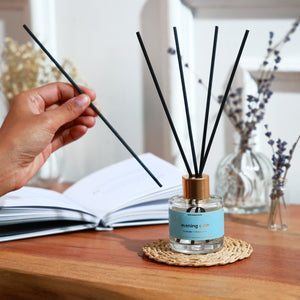
5. Which means the useful question is not “which reed do hotels use” but “which of my rooms is a hotel bathroom”. Small, enclosed, doors mostly shut, one or two people in it at a time. Put the reed there and it will do the job it does better than anything with a motor. Ask it to do a living room and you will be disappointed by physics rather than by the bottle.
Alcohol-free, phthalate-free, IFRA-compliant, six fibre reeds in a refillable glass bottle. Free shipping above ₹499, and a portion of every order supports girl-child education through Nanhi Kali.
The three places a reed genuinely appears in a five-star hotel
I have spent a fair amount of time in hotel corridors looking at the furniture rather than at the view, which is an occupational condition rather than a virtue. What follows is not a secret and it is not a trade claim — it is simply what the format is good for, and hotels have worked it out because they have had to. In each of these three places the reed is doing something no machine in our range would do better, and in none of them is it being asked to fill a volume.
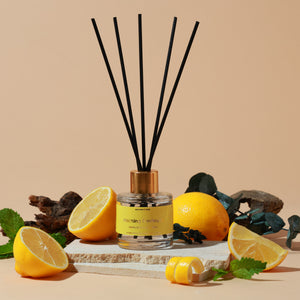
 Morning Freshness₹749A hotel bathroom is small, enclosed, hard-surfaced and entered for short periods by one person. Every one of those conditions favours passive capillary diffusion. The volume is small enough that a bounded zone reaches the whole of it; the door stays shut for most of the day so the air does not turn over; and there is no power point anyone wants to give up to a diffuser. It is also the room where a machine’s hum would be least welcome. Morning Freshness is our version of the register hotels tend to choose here — cold-pressed Malabar lemon, peppermint, a eucalyptus globulus base — and it belongs in a bathroom for the same reason it belongs in theirs.
 Garden Bloom₹799The second reason a hotel reaches for a reed has nothing to do with physics. A suite entrance table, a spa reception, a treatment room, a reading corner off a corridor — these are places where the guest is meant to notice the arrangement, and a glass bottle with six reeds is an arrangement. An appliance is not. There is also a maintenance argument that housekeeping cares about a great deal more than guests do: a reed has no tank to fill, no plate to descale, no battery to charge and no schedule to keep. It is refilled every few weeks and otherwise ignored, which across a few hundred rooms is the difference between a policy and a burden.
 Sukoon₹1,899You may well see reeds in a lobby. They will be on a side table, and they will not be what you are smelling. A lobby is an enormous volume with doors opening constantly and air being turned over by a ventilation system, and the only way to hold a consistent concentration across it is to put fragrance into the air that system is already moving. That is waterless cold-air nebulising: undiluted oil shattered by pressurised air into a dry mist, on a schedule, at a set intensity, in the same composition year after year. In our range the same category sized for a building rather than a chain is Vaayu at ₹11,999, rated to 1000 m³ — roughly 2,000 to 3,000 sq ft.
Why no reed diffuser, at any price, can be the lobby system
It is worth being precise here, because the internet is full of people searching for a “stronger hotel reed diffuser” and there is nothing cruel about telling them the product does not exist. A reed diffuser has two separate limits and both of them are structural. The first is output: fragrance leaves from the wetted surface of six fibre sticks and nowhere else, so the amount that can enter the air in an hour is capped by geometry. You can add reeds and raise that ceiling slightly, at the cost of the bottle’s life — six reeds is full projection, three is a soft bedside level and roughly doubles how long it lasts. What you cannot do is raise it by an order of magnitude, and an order of magnitude is what a public space needs.
The second limit is the one that actually decides the argument. A reed adds no air. Once a molecule has evaporated it has to cross the room on whatever currents the room already has, and on a still closed afternoon that amounts to very little. This is why concentration is highest at the bottle and falls away with distance, and why you can always walk towards a reed diffuser and never towards a hotel’s scent. A nebuliser hands its output to air that is already travelling, which means distance is solved before it becomes a problem. Output ceiling and transport are two different failures, and fixing one does not touch the other.
There is a third reason hotels could not run a signature on reeds even if the first two were solved, and it is the least glamorous: consistency. Evaporation follows the room. A reed is generous in a warm dry May and reticent in a cold air-conditioned January, stronger by the door where the air moves and weaker in the corner. A machine on a schedule at a set intensity ignores all of that, which is why a hotel smells the same at nine in the morning and nine at night, and the same this year as it did three years ago. Recognition across years is a large part of what a signature is, and it is not available from a format whose output is decided by the weather.
Which mechanism actually appears where, across a hotel
A working map of the building. The point of the last two columns is that every one of these jobs has a home equivalent, and the mechanism is what carries across — not the brand of the oil, and certainly not the price of it.
| Space | Mechanism actually doing the work | Why that one | The equivalent at home | From |
|---|---|---|---|---|
| Guest bathroom | Passive capillary — a reed | Small enclosed volume; the zone is the room. No power, no noise, nothing to service | A 50ml reed, two or three reeds in, in your own bathroom | ₹749 |
| Suite console, spa reception, treatment room | Passive capillary — a reed, chosen partly as an object | The diffuser is meant to be seen; an appliance would have to be hidden | A reed on a console or bedside, three reeds for a soft level | ₹749 |
| A single guest room | Usually carry-over from the corridor, plus a light local source | A closed room of that size reaches a perceptible level easily | A reed, or Sukoon ₹1,899 at 270–320 sq ft if you want it switchable | ₹1,899 |
| Corridors and lift landings | Nebulised mist carried by the building’s airflow | Long thin volumes with constant air exchange; nothing static reaches | No home equivalent worth buying — scent the rooms, not the passage | — |
| Lobby — the signature | Waterless cold-air nebulising, undiluted oil, into moving air | Huge volume, constant doors, needs the same level everywhere on a schedule | Vaayu ₹11,999, 1000 m³ — a whole floor, not one bedroom | ₹11,999 |
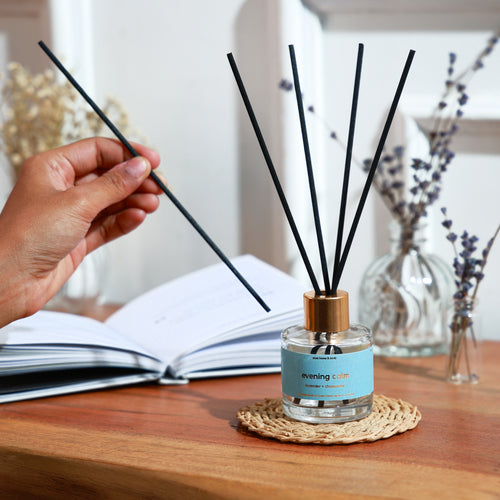
Bedside · Evening Calm₹799Shop → 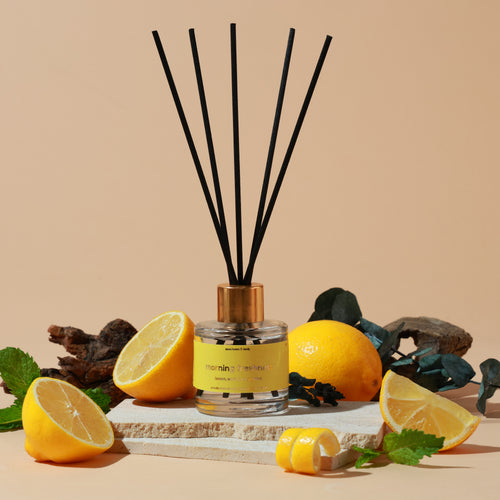 Bathroom · Morning Freshness₹749Shop →
  Whole room · Sukoon₹1,899Shop →
The small-enclosure lesson, applied to your own home
The genuinely useful thing to take from a hotel is not the fragrance. It is the allocation. Somebody sat down and decided which spaces get a passive source and which get an active one, and they decided it on volume and air exchange rather than on how much they liked each smell. You can do exactly the same thing on a Sunday afternoon for nothing. Walk the flat and sort every room into two piles: small and mostly closed, or large and open. Bathrooms, bedsides, a reading corner, a wardrobe end of a dressing room, a small study — those are reed spaces, and a 50ml with three reeds will hold them properly. A living-dining that runs into a kitchen is not a reed space, and no bottle you can buy will make it one.
There are two free adjustments worth making before you conclude anything. The first is placement. A reed relies entirely on air the room already has, so it wants to sit in the path that air takes — a metre inside a doorway, on a console in the circulation route, near where you actually stand — and not in a still corner, not on a windowsill in sun, and not directly under a running split air conditioner, which strips the top notes in days and leaves you with the base. The second is reed count, which almost nobody treats as the volume dial it is. Six for a living room, three or four for a bedroom, two or three for a small bathroom. Most complaints that a fragrance is “too much” are over-dosing, and most complaints that it is weak are a room larger than the bottle was specified for.
And there is a diagnosis you should run before spending anything at all, because a meaningful number of people who write to me about hotel projection do not have a projection problem. Olfactory receptors stop reporting a constant unchanging stimulus within minutes — which is why you smell your own home only after being away from it, and why you arrive at a hotel with a completely fresh nose and a suitcase. Leave the room for a quarter of an hour and walk back in. Better still, ask a guest. If visitors remark on your fragrance and you cannot detect it, the diffuser is working for everyone except you, and a machine will not change that.
What to buy for each of those jobs — and the gap in the middle
In the order I would actually spend, starting with the option that costs nothing. The last row is the thing this range does not contain, said plainly rather than papered over, because a reader who finds out after paying ₹3,999 will be right to be annoyed with me.
| Do this | What it is | When it is the right answer | Price |
|---|---|---|---|
| 1. Placement, reed count and the fifteen-minute test | Move the bottle into the airflow, set the reeds to the room, then leave and come back | First, always. A large share of “it stopped working” is adaptation or a still corner | Free |
| 2. A 50ml reed diffuser | Passive capillary, six fibre reeds, refillable glass, 6–8 weeks, about ₹13–₹15 a day | Bathrooms, bedsides, small studies — the rooms a hotel would put one in | ₹749–₹849 |
| 3. A 130ml reed | The same mechanism, more oil, for rooms above about 150 sq ft; 14–18 weeks | A larger bedroom or a hall, where a 50ml would read as under-specified | ₹1,249–₹1,349 |
| 4. Sukoon | Ultrasonic water mist, 500ml, 270–320 sq ft, 16–18 hours on low, three 15ml Hotel Collection scents included | When you want an actual room covered and switchable. Accept that the oil is diluted in water and that it adds humidity | ₹1,899 |
| 5. Vaayu | Waterless cold-air nebulising, undiluted oil, 1000 m³ — roughly 2,000–3,000 sq ft, app scheduling, under 38 dB | A whole floor, an open-plan living-dining, a villa, a clinic or a salon. Not one bedroom — in 120 sq ft nine-tenths of it is wasted | ₹11,999 |
| The honest gap | There is no mid-sized waterless bedroom nebuliser at SOSA. Safar ₹3,999 is the hotel mechanism at personal scale, but it is named and sold as a car and travel diffuser, has a 1/2/3-hour auto-off and needs recharging, and SOSA publishes no room-coverage figure for it. Vaayu is the next rung and it is a building’s machine | Said out loud rather than stretched to fit. Also note: Megh ₹3,499 is a runtime and humidity machine at ~215 sq ft — less than Sukoon — and is never a coverage upgrade | — |
Versailles
The reed diffuser is the product this house was built on and it is still the thing we sell most of, so I have every commercial reason to tell you that hotels run on reeds. They do not, and saying otherwise would cost me more than it earned. What hotels actually demonstrate is where the format is unbeatable — a small closed room, a surface you want to look at rather than hide, and nobody available to fill a tank on a Tuesday.
I think the reason this question comes up so often is that the reed is the only diffuser a guest can see. The machine is in a duct or a plant room, so there is no object to find and no gradient to walk up, and the mind quite reasonably attributes the smell to the visible thing on the console. That absence of a findable source is, in fact, a large part of why hotel fragrance reads as designed rather than as added — and it is the single hardest thing to reproduce at home, because at home there is always an object.
So my advice is unromantic. Give the reed the bathroom, the bedside and the small study, use three reeds rather than six, flip them on a Sunday, and let it be the quiet, powerless, maintenance-free thing it is — at about ₹13 to ₹15 a day, which is a different purchase from a ₹749 object. If after all that you still want the room to change state when you open the door, that is a mechanism decision and I would rather you made it knowingly than bought a fourth bottle hoping. Everything is composed in Pune, and a part of every order funds a girl’s classroom through Nanhi Kali.
Frequently asked questions
- How hotels do it — the decisions behind a signature.
- What luxury hotels use — the equipment, sized honestly.
- Everywhere there, barely here — a bounded surface against a pump.
- Strong and even — the word “even”, taken seriously.
- How fragrance travels across a room — the transport page.
- The fragrance cloud on entry — droplet size and how long mist stays up.
- Why hotel scent feels more present — the three components of presence.
- Oil or system? — with the oil’s role properly defended.
- Recreating it at home — the whole ladder, gap included.
- Brand: the SOSA founder story.
Facts verified August 2026: SOSA reed diffusers — five scents, 50ml ₹749–₹849 suiting rooms up to ~150 sq ft and lasting 6–8 weeks, 130ml ₹1,249–₹1,349 suiting above 150 sq ft and lasting 14–18 weeks; six fibre reeds included, six for full projection and three for a soft bedside level with roughly double the life; flipped every 3–5 days; about ₹13–₹15 a day; heat-stable CCT (caprylic/capric triglyceride) carrier rather than DPG; alcohol-free, phthalate-free, paraben-free, IFRA-compliant, 0 ppm formaldehyde; refillable glass bottle; tested at 45°C and 85% RH; composed in Pune. Duos ₹1,498–₹1,598 (50ml × 2). Refills 300ml ₹2,399, 500ml ₹3,499. Ultrasonic water mist — Boond ₹899 (300ml, up to ~150 sq ft, ~6 hours, USB, night light), Sukoon ₹1,899 (500ml, 270–320 sq ft, 16–18 hours on low, three 15ml Hotel Collection scents included), Megh ₹3,499 (6L tank, ~100 hours, ~215 sq ft, less than Sukoon and never a coverage upgrade). Waterless cold-air nebulising — Safar ₹3,999 (20ml bottle, 2000 mAh Type-C, up to 10 hours continuous or around 30 hours intermittent, 3 speeds, 1/2/3-hour auto-off, 6.9 cm, named and sold as a car and travel diffuser with bedside and hotel room among its stated uses, no published room-coverage figure) and Vaayu ₹11,999 (up to 1000 m³ or roughly 2,000–3,000 sq ft, 400ml tank lasting up to about 90+ days, Bluetooth app and onboard buttons, 1h/4h/8h/24h windows, adjustable intensity, key-lock, under 38 dB, freestanding or wall/HVAC mount, 5W, CE, RoHS, SGS). Hotel Collection oils are water-based and ultrasonic-only — 15ml ₹299 (a refill), 100ml ₹999, 300ml ₹1,799 — and are not interchangeable with reed oil in either direction; there is no hotel-inspired reed diffuser. No health, air-quality or antimicrobial claims are made, and fragrance does not remove a smell: source, ventilation, then fragrance. Free shipping above ₹499. A portion of every order supports girl-child education through Nanhi Kali. SOSA is an independent Indian fragrance house; the Hotel Collection scents referenced here are SOSA’s own interpretations inspired by the world’s finest hotels, and SOSA is not affiliated with, endorsed by or a supplier to any hotel brand. Prices subject to change — see the live product pages.