
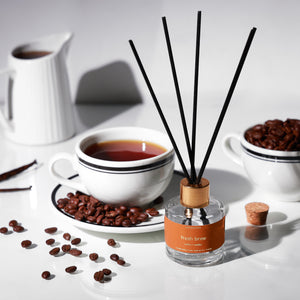

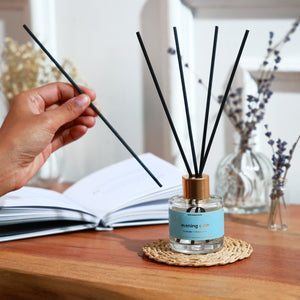
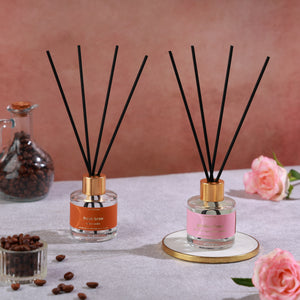

The ranking that matters: heat and direct sun first, draught second, reed count third, then flip cadence — which is much the smallest of the four and the one people wrongly blame.
The free ladder: mark the level with a date · move it out of the sun · move it out of the draught · check reed count is six · flip weekly. Only then buy anything.
When to spend: buy duration with volume — 130ml from ₹1,249, or the oil-only 300ml refill at ₹2,399 for roughly 8–11 months. Never buy a bigger bottle expecting a louder room.
2. Remove heat first — it is the largest accelerant. Direct sun, a marble or granite ledge that stores warmth, the top of a fridge, a shelf on an unshaded west wall. Warm oil is thinner, climbs faster and evaporates faster; our working guidance is that a genuinely hot position can cost a 50ml a third to a half of its rated life.
3. Then remove draught — the only accelerant that also steals presence. An AC vent, a ceiling fan on high, an open window. Forced air keeps evaporation running at maximum and carries the fragrance away before it distributes, which produces the classic complaint of a falling level and a silent room.
4. Then count the reeds. Six is the calibrated count each SOSA composition is dosed for. Nine in a 50ml runs closer to five weeks than eight; ten gives roughly four to five. If somebody in the house added reeds to make it louder, that is your answer and it is reversible in ten seconds.
5. Flip cadence is fourth and small. Weekly is the calibration. Daily flipping shortens a bottle slightly and makes a mess; never flipping makes a bottle "last" by quietly ceasing to work, which is not longevity at all.
6. Only now consider buying, and buy volume rather than restraint. A 130ml at ₹1,249–₹1,349 lasts 14–18 weeks against 6–8 and projects the same at six reeds — duration, never a strength upgrade. The 300ml refill at ₹2,399 runs roughly 8–11 months at about ₹7–8 per millilitre.
7. And know where the format ends. Past roughly 250–300 sq ft of connected open volume, or when you want scent on demand rather than a constant background, a Sukoon at ₹1,899 is the honest answer rather than a third bottle. Composed and handmade in small batches in Pune, and a portion of every order supports girl-child education through Nanhi Kali.
Part one — where the stated weeks come from, and the two clocks
Every longevity complaint is a comparison against a number, so it is worth being precise about what that number is. Six to eight weeks for a 50ml and fourteen to eighteen for a 130ml are figures measured at six fibre reeds, flipped weekly, in an ordinary Indian room, with no draught across the bottle and no direct sunlight on the glass. That is a specification, not a promise, and publishing the conditions alongside it is the only honest way to state it. Change any condition and the number moves — sometimes by days, sometimes by weeks. The three cards below are the mental model that makes the rest of this guide usable.
 Mountain Breeze₹849 · 9.4/10A bottle has two independent lifespans and people conflate them constantly. The oil clock is the one on the label — how many weeks until the glass is empty. The reed clock is how long the fibre keeps wicking properly before residue, dust and oxidation slow it down. Reeds are the consumable and oil is the stable part, which is the reverse of how most households treat them: people buy fresh oil and keep the reeds that came with the bottle two years ago. If your oil level has stopped moving and the room has gone quiet, that is usually the reed clock, not the oil clock, and no amount of new oil poured through spent fibre will fix it. We do not sell replacement reeds separately — an honest gap in the range — and our guidance is to refresh them every few months.
Part two — every accelerant, ranked by what it costs you
This is the master table of the sub-cluster, and each row has a full guide of its own. The cost figures are SOSA's own working guidance from in-house testing through 45°C heat and 85% monsoon humidity and from years of customer correspondence — they are not laboratory measurements, and the ranges are deliberately wide. Use the table to decide what to change first, not to predict your bottle to the day.
| Accelerant | Mechanism | Rough cost to a 50ml's 6–8 weeks | Does it cost presence too? | Free to fix? |
|---|---|---|---|---|
| 1. Direct sunlight on the glass ★ | Heats the oil far above room temperature; thins it and drives off the lightest notes | A third to a half in a hot month | Eventually — the composition drifts base-heavy | Yes — move it out of the beam |
| 2. A draught across the reeds | Strips the saturated air layer continuously, so evaporation never self-limits | One to two weeks, more in a small room | Yes, badly — the fragrance leaves before it distributes | Yes — several feet of separation |
| 3. Ambient heat without sun | Warm stone, appliance heat, a shut-up west-facing room | A week or two through summer | No — the room smells strong while it lasts | Yes — a different surface or wall |
| 4. Reed count above six | More exposed fibre surface, so a higher delivery rate | Nine ≈ five weeks; ten ≈ four to five | No — this one buys presence with weeks | Yes, and reversible in ten seconds |
| 5. Dry air, chiefly from air conditioning | A wider gradient between the wet reed and the room | Days rather than weeks, across a season | No | No — it is a property of the room |
| 6. A wide bottle neck or reeds splayed at the rim | More liquid surface and more fibre exposed above the glass | Days | No | Yes — keep the reeds gathered and upright |
| 7. Frequent flipping | Restores the designed delivery rate more often than the calibration assumes | Small — much less than any of the above | No — it returns presence you paid for | Yes, but weekly is already correct |
| 8. A room opened to outdoors all day | Air exchange dilutes fragrance into the street | Weeks in an open-window household | Yes — the worst return of any position | Yes — move inward, away from the opening |
| 9. Cold and stillness (the reverse case) | Thick oil, slow climb, no air movement | Lengthens the bottle beyond the window | Yes — the room reads faint | Not a fault; flip weekly and be patient |
| The honest caveat: every figure in the third column is SOSA working guidance rather than measurement, and the accelerants compound rather than add — a sunlit sill by an open window in May is all three of the top accelerants at once, which is why that single position accounts for so many of the messages we receive. Equally, do not read row nine as a bonus. A bottle that lasts unusually long is often one that has stopped delivering, and that is failure that looks like thrift. | ||||
300ml refill · 8–11 months₹2,399Shop → 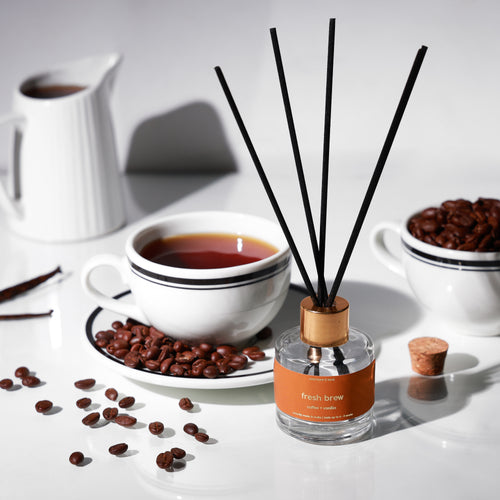 130ml · 14–18 weeksfrom ₹1,349Shop →
  Sukoon · past the reed ceiling₹1,899Shop →
Part three — the free ladder, in the order I would work it
Nothing in this guide should be read as an invitation to buy something. The ladder below takes about a week of elapsed time and almost none of your attention, and it settles most cases. Step one: mark and date the level. A chinagraph line or a strip of tape on the glass, the date beside it, and a second mark seven days later. That single habit converts an anxiety into a number. Step two: find the sun. Stand in the room at four in the afternoon rather than at breakfast, and look for the beam. If it touches the bottle at any point in the day, move the bottle two feet inward — not a curtain, a move, because ledges store heat and give it back long after the beam has gone.
Step three: find the draught. Hold the back of your hand where the bottle stands for ten seconds. A split unit's throw travels across the ceiling and descends at the far end of a room, so "not directly under the vent" is not the same as "out of the airstream". If you can feel movement, so can the reeds; move to a side wall, or better, to a console near a doorway where gentle incidental traffic distributes rather than strips. Step four: count the reeds and look at the wet line. Six is the calibrated number. If there are nine because someone wanted a louder room, that is your explanation. Lift one reed and find the boundary between oil-soaked and dry fibre: high and dark means saturated and wants flipping, barely above the oil means it has stopped wicking and the fibre is spent.
Step five: flip all six, weekly, with gloves, and then leave it alone. This is the step people over-apply. Flipping is fourth on the accelerant list and by some distance the smallest of the four; it costs a little bottle life and buys back the fragrance you have already paid for, which is the correct trade. Daily flipping gains you little, shortens the bottle and puts oil on your furniture. Never flipping produces a full bottle that has quietly stopped working. Weekly is the calibration, and the compositions are dosed around it. Work all five steps before you spend a rupee — and if the bottle is still emptying faster than you would like while the room smells wonderful, nothing is wrong. You are receiving the fragrance faster than the average room does, and the answer is more oil rather than any change of behaviour.
Part four — longevity through an Indian year
A single number for bottle life cannot survive the Indian calendar, and the same 50ml on the same shelf will behave like three different products across twelve months. Summer is the fast season. Heat thins the oil, raises evaporation and — where there is sun on the glass — drives off the lightest materials first. A bottle that comfortably makes eight weeks in October can struggle toward five in a Rajasthan or Gujarat May. This is also the season in which the carrier matters most: our compositions sit on a heat-stable coconut-derived CCT base, tested through 45°C, precisely so that the fragrance still smells like itself in week seven rather than turning sharp. Phthalate solvents, which most inexpensive reed oils use, do the opposite — a thrilling first fortnight, then degradation in heat and a faintly acrid week six. We accept a smaller opening in exchange for a flatter plateau that holds.
The monsoon is the slow season, and it fools people in the opposite direction. Humid air narrows the gradient that drives evaporation, so the level barely moves and the room reads a little muted; bottles routinely outlast their window in July and August. That is not a fault and it is not thrift — it is the same fixed quantity of fragrance spread over more weeks. What the monsoon does damage is the reeds. Damp, heavy, dust-laden air combines with the residue that naturally accumulates at the exposed ends, and this is exactly where rattan fails: its natural pores swell and clog at 85% humidity, which is why so many imported diffusers die in week two of a Mumbai monsoon. We specify fibre reeds for that single reason. If you refresh reeds once a year, the fortnight after the monsoon ends is the moment to do it.
Winter in the north produces the quietest complaint of all: nothing appears to be happening. Cold thickens the oil, the climb slows, the level holds for a fortnight and the room reads faint. Nothing is wrong. Flip weekly, keep six reeds, and add reeds if you want more presence in that season rather than concluding the bottle has failed. The seasonal trap worth naming is the reverse of the summer one: people raise reed counts in December for a quiet room, forget, and then wonder in April why the bottle is disappearing. Reed count and heat compound, and April is when they meet.
Part five — realistic windows, room by room
The most practical table in this guide. Every row assumes six fibre reeds flipped weekly, and every window is SOSA working guidance from testing and customer reports rather than a measurement — your ceiling height, door traffic and season will move them.
| Room and how it is used | Accelerants usually present | Reeds I would run | Realistic 50ml window | Realistic 130ml window | The first move |
|---|---|---|---|---|---|
| Entrance hall or foyer ★ | Brief door draughts only | Six | The full 6–8 weeks | The full 14–18 weeks | Nothing — this is the reference position |
| Living room, 150–200 sq ft, evening AC | Draught if the console faces the unit | Six, nine for a hosting weekend | Around 6–7 weeks | Around 13–16 weeks | Move off the AC's path to a doorway console |
| Open living-dining past 250–300 sq ft | Volume, not accelerants | Six in each of two bottles | Normal per bottle — the room is the problem | Normal per bottle | Two sources at opposite ends, or a Sukoon |
| Master bedroom, eight hours of night AC | Draught and dry air | Six — do not drop to four to economise | Close to 6–8 weeks once out of the throw | Close to 14–18 weeks | Chest of drawers, not the sill or the vent wall |
| Small bedroom or nursery, sealed at night | Stillness; very little else | Four to five, deliberately | Comfortably beyond eight weeks | Beyond eighteen weeks | Choose a gentle composition and leave it alone |
| Home office or cabin, cooled all day | Dry air, long AC hours | Six | Often nearer 5–7 weeks | Often nearer 12–16 weeks | Side wall out of the airstream; buy the 130ml |
| Kitchen | Hob heat, extractor pull, cooking vapour | Six, well away from the cooking zone | Around 5–7 weeks | Around 12–16 weeks | Never diffuse over live cooking — air the room first |
| Bathroom with a ventilator | Continuous extraction to outside | Four to six; bright scents read well here | Around 5–7 weeks | Around 12–16 weeks | Opposite wall from the extract point |
| West-facing study, afternoon sun | Sun, radiant heat, warm outer wall | Six | Can fall well below the window in summer | Proportionally shorter | Out of the beam, off the outer wall, off stone |
| The honest caveat: these are working ranges for planning, not guarantees, and they assume a weekly flip and six reeds unless stated. Two adjacent rooms scented at once need compositions that share a note or you will hear a seam where they meet — Mountain Breeze and Morning Freshness meet on green eucalyptus, Fresh Brew and Garden Bloom on warmth and soft musk. | |||||
Part six — cost, refills and the ceiling I will not sell past
When the position is right and the reed count is six and the bottle still empties faster than you would like, the question has stopped being a fault and become a budget. Here is every legitimate answer, with what each one does and — as importantly — what it does not.
| What you are trying to achieve | The right move or purchase | What it gives you | What it does not do | Price |
|---|---|---|---|---|
| Stop losing weeks to the room ★ | Shade, distance from draughts, off warm stone | Weeks back with the room unchanged or better | Nothing — this is the only free lunch here | ₹0 |
| More weeks per bottle | The 130ml of the scent you already use | 14–18 weeks instead of 6–8, same six reeds | It does not make the room louder — ever | From ₹1,249 |
| Lower running cost | 300ml oil refill into your own vessel | About 8–11 months at roughly ₹7–8 per ml | It does not include reeds — refresh those yourself | ₹2,399 |
| Lowest cost per millilitre we sell | 500ml oil refill | About 14–18 months in the same glass | It is not a stronger oil; it is more of the same oil | ₹3,499 |
| Cover a bigger room | Two bottles at opposite ends, or a duo set | A second source — the only way to raise a room's total | It does not make either bottle project further | Duos ₹1,498–₹1,598 for 2 × 50ml |
| A quieter room that lasts longer | Four to five reeds instead of six, deliberately | Beyond eight weeks on a 50ml, gently | It is not free — you are paying in presence | Free, but a trade |
| Scent on demand, or past 250–300 sq ft | Sukoon 500ml ultrasonic | 270–320 sq ft, 16–18 hrs on low, remote and timers, three 15ml Hotel Collection scents in the box | It does not take reed oil, ever | ₹1,899 |
| A small desk or bedside machine | Boond 300ml | About 150 sq ft, roughly 6 hrs a fill, USB, night light | It is not a whole-flat solution | ₹899 |
| Very long unattended runtime | Megh 6L | Roughly 100 hours of runtime and useful humidity | It is not a coverage upgrade — about 215 sq ft, less than the Sukoon | ₹3,499 |
Versailles
The nine articles this page draws together were written because of one recurring message, always phrased as an accusation and almost never deserving to be one: it finished too fast. When I began replying individually I assumed I would be defending the product. Instead I spent two years learning about Indian homes — which shelf the bottle is on, which wall gets the four o'clock sun, whether the split unit is above the sofa or beside the door, how many reeds somebody's mother added when nobody was looking.
Roughly nine times in ten the answer was in the room, not in the glass, and the fix was free. That is not a comfortable thing for a shop to discover, because the commercially convenient answer to "it finished fast" is to sell a bigger bottle, and the commercially convenient answer to "it is too quiet" is to sell a stronger one. Both of those sales are available to us and we turn most of them down, because a customer who buys a 130ml expecting a louder room comes back disappointed, and rightly.
So the position we take is the one on this page. Duration is bought with oil. Presence is bought with reeds, air and composition. Heat and draught steal from you for free and can be stopped for free. And when the room is simply larger than the format — past that 250–300 sq ft of connected volume — I would rather tell you to buy a ₹1,899 machine than a third reed bottle that will not do the job. Everything is composed and handmade in small batches in Pune, tested through 45°C heat and 85% humidity, and a part of every order funds a girl's classroom through Nanhi Kali.
Frequently asked questions
- Why is my reed diffuser finishing so quickly? and why is it evaporating faster than expected? — the six accelerants, and where the stated weeks come from.
- How to make your reed diffuser last longer — the conservation list, with the cost of every item on it.
- Do more reeds finish the oil faster? and does frequent flipping? — the arithmetic of reed count, and why cadence is the smallest lever.
- Does heat make it finish faster? and does air conditioning? — the largest accelerant, and the two independent ways AC costs you weeks.
- Is a window really the worst spot? and how do I last longer without going too mild? — the compound case, and the balance point.
- Brand: the SOSA founder story.
SOSA reed diffuser range & prices (verified August 2026): alcohol-free, phthalate-free, paraben-free and IFRA-compliant compositions on a heat-stable coconut-derived (CCT) carrier, low-VOC, supplied in a refillable glass bottle with six fibre reeds; 50ml lasts 6–8 weeks and 130ml lasts 14–18 weeks. Morning Freshness (Malabar lemon · peppermint · Nilgiri eucalyptus) 50ml ₹749 · 130ml ₹1,249 · 9.0/10; Garden Bloom (British rose · night-blooming jasmine) 50ml ₹799 · 130ml ₹1,299 · 8.9/10; Evening Calm (Kashmir lavender · chamomile) 50ml ₹799 · 130ml ₹1,299 · 8.9/10; Fresh Brew (Coorg coffee · Kerala vanilla) 50ml ₹849 · 130ml ₹1,349 · 9.5/10; Mountain Breeze (Himalayan pine · sage · Indian cedar) 50ml ₹849 · 130ml ₹1,349 · 9.4/10. Reed diffuser refills are oil only — you reuse your own vessel and reeds: 300ml ₹2,399 (roughly 8–11 months) · 500ml ₹3,499 (roughly 14–18 months), about ₹7–8 per ml against ₹15–17 per ml for a 50ml bottle. Duo sets ₹1,498–₹1,598 for 2 × 50ml and ₹2,498–₹2,598 for 2 × 130ml. Strength figures are positions on SOSA’s own internal strength scale, not an industry standard. Replacement reeds are not sold as a separate SKU; SOSA guidance is to refresh reeds every few months. The reed line is separate from the water-based Hotel Collection for ultrasonic machines (15ml ₹299 · 100ml ₹999 · 300ml ₹1,799) and the two are not interchangeable. Diffusers: Boond 300ml ₹899 · Sukoon 500ml ₹1,899 · Megh 6L ₹3,499 · waterless Vaayu ₹11,999. Composed and handmade in small batches in Pune, India; tested through 45°C summer heat and 85% monsoon humidity. Free shipping above ₹499. A portion of every order supports girl-child education through Nanhi Kali. Prices subject to change — see the live product pages.