
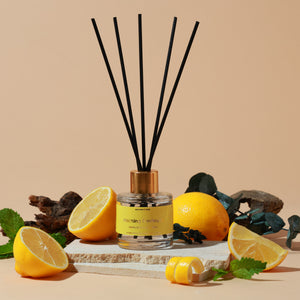
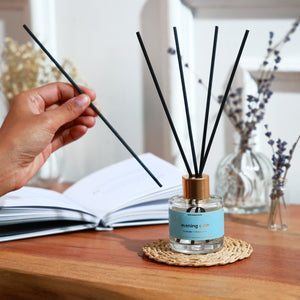

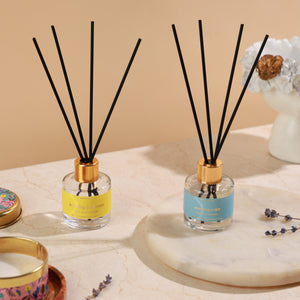
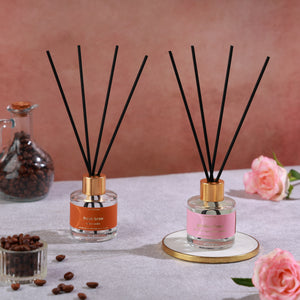
The expensive one is the draught. A bottle standing in the throw of a split unit empties fast and leaves the room smelling of very little, because the fragrance is being carried off before it can distribute.
The quiet one is the dryness. Even out of the airstream, a dried room raises the evaporation gradient at the reed tips. Our working guidance is that this alone can take days off a 50ml over a season of daily use.
The fix costs nothing: keep the bottle several feet out of the vent's path, ideally near the doorway where the room's return air moves gently. Do not reduce reed count to compensate — that trades presence you did not need to spend.
2. The draught is the one to fix, because it is free to fix. Several feet of separation between the bottle and the throw of the split unit is usually enough. Near a doorway is better still, because the gentle return-air movement there is exactly the incidental traffic a reed diffuser is designed for.
3. The dryness you keep. You are not going to run a humidifier for the sake of a diffuser, and I would not suggest it. Our working guidance is that a room in daily AC use costs a 50ml days rather than weeks, once the bottle is out of the airstream.
4. Do not answer AC by removing reeds. That is the one conservation move that genuinely costs presence, and an AC room is already reading quieter than it should. Keep six, fix the position, and buy duration if you need it.
5. Buy weeks, not strength. A 130ml at ₹1,249–₹1,349 lasts 14–18 weeks against 6–8. At the same six reeds it projects the same; it simply survives an AC season better because there is more oil in the glass.
6. And know the ceiling. Past roughly 250–300 sq ft of connected, cooled, sealed volume, reeds are the wrong tool and a Sukoon at ₹1,899 is the honest answer. Composed and handmade in Pune; a portion of every order supports girl-child education through Nanhi Kali.
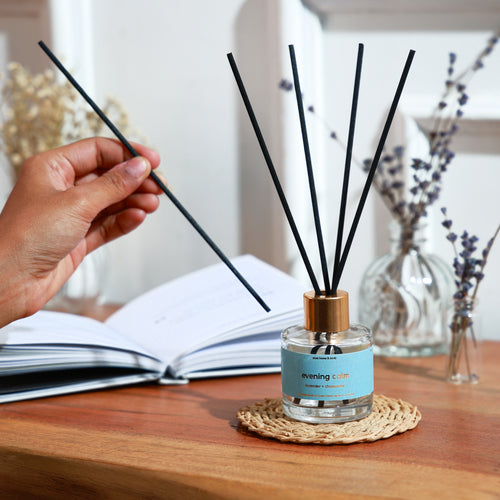
Part one — two effects, not one, and they do not overlap
Almost every article on this subject collapses air conditioning into "draught" and stops there. That is half the story, and the missing half explains the cases that otherwise make no sense — the bottle across the room from the vent that still runs down early, the sealed winter cabin in Delhi where nothing is blowing on anything and a 50ml still finishes in five weeks. Moving air and dry air are separate accelerants that an air conditioner supplies together. Understanding which one you have determines whether the fix is free.
 Morning Freshness₹749 · 9.0/10An air conditioner cools by passing room air over a cold coil, and water condenses out of that air onto the coil and drains away. That is why there is a pipe out of your wall. The consequence for a diffuser is that the room's relative humidity falls, and evaporation from a wet surface is driven by the difference between the surface and the surrounding air. Drier air widens that difference, so the same reeds give up more oil per hour even in perfectly still conditions. It is the mirror image of the monsoon, when everybody notices their bottle lasting unusually well and their room reading a little muted. Nothing is positional here; you cannot move away from it inside the same room.
Part two — where to stand a bottle in an air-conditioned room
A split unit throws a directed stream that travels much further than people assume, usually across the ceiling before descending at the far end of the room. That is why "it is not directly under the vent" is not the same as "it is out of the draught". The positions below are ordered by how much they cost you, and the figures are SOSA's own working guidance rather than measurements.
| Position relative to the split unit | Air movement at the reeds | Air dryness around the bottle | Net effect on the bottle | What the room smells like |
|---|---|---|---|---|
| Directly beneath or in front of the vent ★ | Forced and continuous | Driest air in the room, straight off the coil | The most expensive position there is | Very little — it is swept away before it spreads |
| Across the room where the throw descends | Stronger than it looks or feels | Room average | Costs weeks, and people rarely suspect it | Thin, and inconsistent through the day |
| Side wall, out of the stream's path | Gentle, incidental | Room average | Close to the rated window | Even and steady — the reference case |
| Console near the doorway | Gentle return-air movement plus foot traffic | Room average, slightly less dried | Rated window, best distribution | Strongest of any position, at the same cost |
| Inside a closed AC room, low traffic, alcove | Effectively none | Dry | Lasts long, sometimes beyond the window | Faint — the opposite failure, dead air |
| AC off, monsoon, windows shut | Still | Humid — evaporation is suppressed | Comfortably beyond the rated window | Quiet but present; flip weekly to keep it moving |
| The honest caveat: the two airflow failure modes are opposites and both are common, which is why "move it" is not advice unless the direction is specified. A draught empties the bottle and silences the room; dead air preserves the bottle and silences the room. If your level is falling fast, look for the draught. If your level has barely moved in three weeks, look for the alcove. | ||||
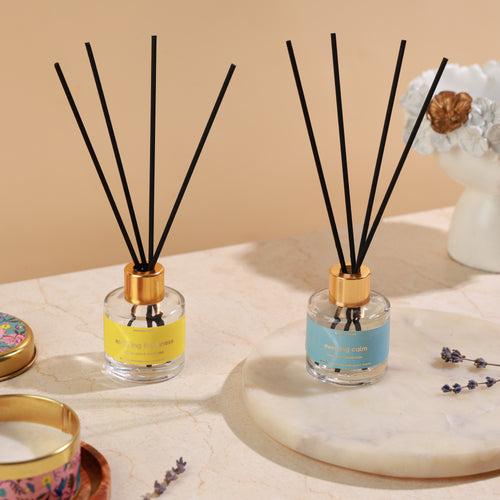 Day & Night duo · 2 × 50ml₹1,498Shop → Evening Calm · AC bedroomsfrom ₹799Shop →
  Sukoon · past 250–300 sq ft₹1,899Shop →
Part three — what a season of air conditioning actually costs
I want to put a number on this without pretending to a precision we do not have. Our stated 6–8 weeks for a 50ml assumes six reeds, weekly flipping, an ordinary Indian room and no draught — and "ordinary" in that sentence does not exclude air conditioning, because most of our customers run it. What it excludes is the bottle standing in the airstream. Our working guidance is that the positional error — bottle in the throw of a split unit running eight hours a day — is worth roughly one to two weeks off a 50ml, and more in a smaller room where the air turns over faster. The dryness effect, with the bottle correctly placed, is smaller: days rather than weeks across a season. Both figures are estimates from in-house testing and customer correspondence, and I would rather give you the ranking than a false decimal.
The ranking is what matters anyway, because it tells you what to do. Draught first, always, because it is the only accelerant on the list that takes away presence at the same time as weeks. Every other conservation move you might make is a trade — fewer reeds means a quieter room, a cooler position means a slower bottle in both senses — but taking a bottle out of a draught gives you back weeks and a better-smelling room simultaneously. There are not many free lunches in this format. That is one of them, and it is why it sits at the top of every ladder we publish.
Then there is the case I get most often from people working from home in a cooled cabin: everything is right, the bottle is nowhere near the vent, and a 50ml still runs out around week five. That is genuinely the dryness, and it is not a fault. The correct response is not to reduce reeds, which would make a room that already reads quiet quieter still. It is to accept the rate and buy the volume — 130ml at ₹1,349 for 14–18 weeks, or the 300ml oil refill at ₹2,399 which runs roughly 8–11 months in a vessel you already own at about ₹7–8 per millilitre against ₹15–17. Buying more oil is the honest answer to a fast room; buying more reeds is not. And if the cooled space is really an open living-dining beyond 250–300 sq ft, no number of reeds will cover it — two bottles at opposite ends will do better than one, and a Sukoon at ₹1,899 will do better than either.
Part four — configuration by how you actually use your AC
Five common Indian patterns, with what I would run in each. Reed counts assume the bottle is already out of the airstream; if it is not, fix that before reading the rest of the row.
| Your AC pattern | Where to stand the bottle | Reeds I would run | Realistic 50ml window | What to buy |
|---|---|---|---|---|
| Bedroom, eight hours a night ★ | Chest of drawers or bedside, out of the throw | Six — do not drop to four to save it | Close to the stated 6–8 weeks | Evening Calm ₹799 |
| Work cabin, cooled all day | Side wall away from the unit, waist to chest height | Six | Nearer five to seven weeks in our experience | Mountain Breeze 130ml ₹1,349 |
| Living room, AC evenings only | Console by the doorway, where people pass | Six on ordinary days, nine before guests | Around the stated window at six reeds | Fresh Brew ₹849 |
| Sealed cooled room, nobody in it most of the day | Anywhere with clear air around it, not an alcove | Six, flipped without fail every week | Often beyond eight weeks — dead air, not thrift | Nothing. Open the door more often |
| Open cooled living-dining past 250–300 sq ft | Two bottles at opposite ends, not one in the middle | Six in each | Each behaves normally; the room is the issue | A duo set ₹1,548, or a Sukoon ₹1,899 |
Versailles
When I began testing reed compositions for Indian homes rather than for the European rooms I trained in, air conditioning was the variable that changed my mind about the most things. In Versailles a room's air is fairly stable. In a Gurugram flat in May, the same room is a different environment at two in the afternoon than at two in the morning, and the split unit is doing three things to my bottle at once — moving air, drying air, cooling air — two of which shorten it and one of which lengthens it.
That is why I refuse to publish a single number for how long a bottle lasts without publishing the conditions with it. Six to eight weeks for a 50ml is real, and it is real at six reeds, flipped weekly, in a room where nothing is blowing on the glass. Put the same bottle in the throw of a split unit and it is a different product, and no amount of reformulation would rescue it.
The advice I give friends is the shortest version I know: stand where the bottle stands and hold the back of your hand out for ten seconds. If you can feel the air moving, so can the reeds. Move it to the wall by the door instead, where people passing stir the air a few times an hour, and let the room do the distributing. Everything is composed and handmade in small batches in Pune, and a part of every order funds a girl's classroom through Nanhi Kali.
Frequently asked questions
- Does heat make it finish faster? — the largest accelerant, and the free fix.
- Is a window the worst spot? — sun, heat and moving air in one place.
- Evaporating faster than expected? — where the stated weeks come from.
- The complete longevity troubleshooting guide — this page and the eight around it, in one place.
- Brand: the SOSA founder story.
SOSA reed diffuser range & prices (verified August 2026): alcohol-free, phthalate-free, paraben-free and IFRA-compliant compositions on a heat-stable coconut-derived (CCT) carrier, low-VOC, supplied in a refillable glass bottle with six fibre reeds; 50ml lasts 6–8 weeks and 130ml lasts 14–18 weeks. Morning Freshness (Malabar lemon · peppermint · Nilgiri eucalyptus) 50ml ₹749 · 130ml ₹1,249 · 9.0/10; Garden Bloom (British rose · night-blooming jasmine) 50ml ₹799 · 130ml ₹1,299 · 8.9/10; Evening Calm (Kashmir lavender · chamomile) 50ml ₹799 · 130ml ₹1,299 · 8.9/10; Fresh Brew (Coorg coffee · Kerala vanilla) 50ml ₹849 · 130ml ₹1,349 · 9.5/10; Mountain Breeze (Himalayan pine · sage · Indian cedar) 50ml ₹849 · 130ml ₹1,349 · 9.4/10. Reed diffuser refills are oil only — you reuse your own vessel and reeds: 300ml ₹2,399 (roughly 8–11 months) · 500ml ₹3,499 (roughly 14–18 months), about ₹7–8 per ml against ₹15–17 per ml for a 50ml bottle. Duo sets ₹1,498–₹1,598 for 2 × 50ml and ₹2,498–₹2,598 for 2 × 130ml. Strength figures are positions on SOSA’s own internal strength scale, not an industry standard. Replacement reeds are not sold as a separate SKU; SOSA guidance is to refresh reeds every few months. The reed line is separate from the water-based Hotel Collection for ultrasonic machines (15ml ₹299 · 100ml ₹999 · 300ml ₹1,799) and the two are not interchangeable. Diffusers: Boond 300ml ₹899 · Sukoon 500ml ₹1,899 · Megh 6L ₹3,499 · waterless Vaayu ₹11,999. Composed and handmade in small batches in Pune, India; tested through 45°C summer heat and 85% monsoon humidity. Free shipping above ₹499. A portion of every order supports girl-child education through Nanhi Kali. Prices subject to change — see the live product pages.