

What that means for you today: if the far corner is still quiet on six reeds, going back down to three costs you almost nothing you were actually enjoying and hands you weeks of life back. That is a free change, and it is the right one for most bedrooms.
The free fix that does add reach: a ceiling fan on low in a closed room. A fan supplies the transport a reed structurally lacks, which no stick count can. It will shorten the bottle further — that is the honest trade, and it is still the best free change in this cluster.
The honest gap: nobody, us included, publishes a figure for how far a reed diffuser projects, because it depends on a room we have never seen. Any brand quoting you a number in feet is quoting a number for somebody else’s flat.
2. The numbers you can act on. A SOSA 50ml is built for rooms up to about 150 sq ft and runs 6–8 weeks with all six reeds in. Take three out and it runs roughly double. The 130ml, for rooms above 150 sq ft, runs 14–18 weeks on six. Those are duration figures. None of them is a coverage figure, and a bigger bottle does not reach further — it lasts longer.
3. What you actually bought with reeds five and six. A stronger near field. The first metre around the bottle is more concentrated, the walk-past is more emphatic, and the room takes less time to reach its steady state after you open a window. Those are worth having in a living room. They are worth very little if your complaint was the far wall, and they are worth negative money if the room reads as over-dosed.
4. The change I would make this evening, at no cost. Go back to three reeds. In a bedroom you will lose almost nothing you were enjoying, and you will roughly double the weeks left in the bottle — which halves what it costs you per day. Then move the bottle closer to where you actually sit or sleep, put it at nose height on a surface rather than on the floor, and shut the door for an hour before you judge it.
5. Then, if reach is still the requirement, change mechanism rather than dose. The ceiling fan on low is free and it is the single most effective thing in this article, because it supplies transport. If you want it without a fan running, that is an active diffuser: Sukoon ₹1,899, 270–320 sq ft, which does move air. The reed keeps doing what only it does — silent, no power, nothing to fill or charge, working straight through a power cut.
Alcohol-free, phthalate-free, IFRA-compliant, composed in Pune. A portion of every order supports girl-child education through Nanhi Kali.
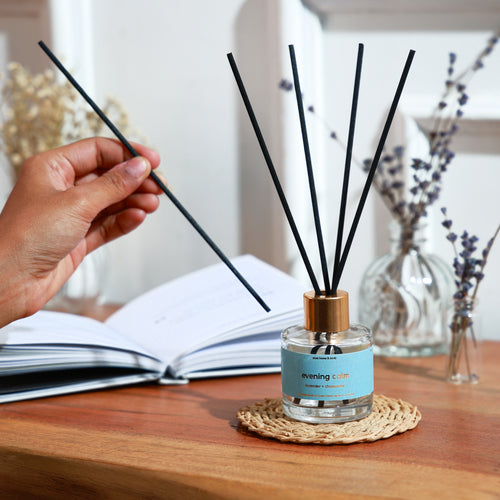
The bottle is a ledger, not a lamp
People treat a reed diffuser as though it had a brightness setting, and it does, but the setting is drawn against a fixed account. There are fifty millilitres in the bottle. Every one of them will leave through the reeds — that is what the reeds are for, and it is why an empty bottle is a finished product rather than a wasted one. The only thing under your control is the rate at which the account is drawn down. Six reeds is a fast withdrawal, three is a slow one, and the total is identical.
This is why the question in the title has a clean answer. Over-reeding does not add anything to the account; it spends it sooner. In a 50ml that is the difference between 6–8 weeks and roughly double, which in daily terms is the difference between about ₹13–₹15 a day and roughly half of that. Nothing has been wasted in either case. But if the reason you added reeds five and six was to reach the far end of the room, then you have converted weeks into an intensity you were not asking for, in a place you were already standing.
I would rather you knew that than found out over three bottles. A great many people write to us in week five wondering whether they were sold a small bottle, and the answer is nearly always that they are running a bedroom at living-room dose. The fix takes ten seconds and costs nothing, which is the sort of advice I would want from a brand before I would trust it about anything more expensive.
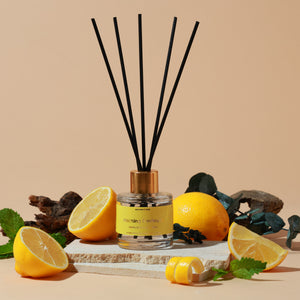
 Morning Freshness₹749Emission is set by evaporating surface, temperature, humidity and the oil itself. Reed count is the part you hold in your hand: each additional reed adds wetted surface, and a wetted surface evaporates. This is a real lever and I do not want to talk you out of it — six reeds in a 200 sq ft living room is correct, and the 130ml at ₹1,249 with all six is what a large kitchen wants. What emission cannot do is decide where the vapour ends up. It fills the account faster; it does not widen the room.
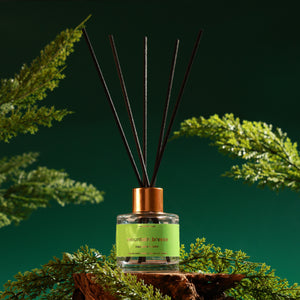
 Mountain Breeze₹849Once a molecule is in the air it travels two ways. Molecular diffusion, which is far too slow to cross metres of a room in any useful time, and bulk air movement, which does effectively all of the work. A reed contributes nothing to the second. That is not a flaw in the design — it is the reason it is silent, needs no socket and never has to be switched on. It also means the reach of your diffuser is mostly a property of your room, and your room is the thing you can change for free: shut the door, and turn the fan on low.
 300ml refill₹2,399Time is the quantity nobody counts, and it is the one you are actually spending when you add reeds. Six reeds in a 50ml: 6–8 weeks. Three: roughly double. Two or three in a 50 sq ft bathroom: close to three months. If you have decided you like a scent enough to keep it running permanently, the 300ml refill at ₹2,399 is roughly six 50ml fills — but it is oil alone, so it is only for someone who already owns the bottle and the reeds, and it is the item on our shelf most often bought by mistake.
Why the curve rises but its shape does not change
Here is the part that is genuinely counter-intuitive, and it is the reason adding reeds feels as though it ought to work. More reeds does raise the concentration everywhere in the room, including at the far wall. It is not that the extra vapour stops at some invisible line. What happens is that the concentration profile around a point source falls away steeply with distance, and multiplying a steep curve by a modest factor moves the point at which it drops below your detection threshold by very little. You lift the whole curve; you do not change its shape. The peak at the bottle goes up handsomely. The tail at the far wall goes up by an amount your nose is not equipped to notice.
Perception then does something unhelpful on top of that. The nose reports change far better than it reports steady state, so the gradient — which is physically smooth — is experienced as a corner with an edge to it. Walk across the room and you cross that edge in a second or two and register it clearly. Sit still on the far side of it and your receptors adapt within minutes, and the room reports as unscented even while the fragrance is arriving exactly as designed. Adding reeds does not move the edge much. It makes the near side of the edge stronger.
There is also a limit worth naming in the other direction, because dose has a wrong end as well as a weak one. Almost any composition, pushed to too high a concentration, flattens into a single sweet or sharp impression — which is precisely what people mean when they say something smells like air freshener. That effect has nothing to do with the quality of the materials. It is dose. A reader who keeps adding reeds in pursuit of the far wall can arrive at a room that is simultaneously too much where they sit and still quiet where they wanted it. Restraint costs nothing and is usually the more elegant room.
Six reeds against three, scored on the things you actually care about
The same 50ml bottle, the same 120 sq ft bedroom, the same scent. Only the stick count changes. I have scored the row that matters most last, because it is the row that answers the title.
| What changes | Six reeds | Three reeds | What it means |
|---|---|---|---|
| How long the bottle lasts | 6–8 weeks | Roughly double | The clearest difference of the lot, and the one nobody is told about |
| What it costs you per day | ~₹13–₹15 | Roughly half that | Same bottle, same price, spread over about twice as many days |
| Intensity in the first metre | Full — the living-room setting | Soft — the bedside setting | Real and worth having, in the right room |
| Strength of the walk-past | Emphatic | Gentle but clearly present | Both work; six is the one guests notice on arrival |
| Risk of reading as over-dosed | Present in a small closed bedroom | Very low | “Cloying” is almost always a dose word, not a quality one |
| Reach across the room | Effectively unchanged | Effectively unchanged | Neither count moves air, so neither adds transport. This is the row that answers your question |
Softest at 8.9 · Evening Calm₹799Shop → 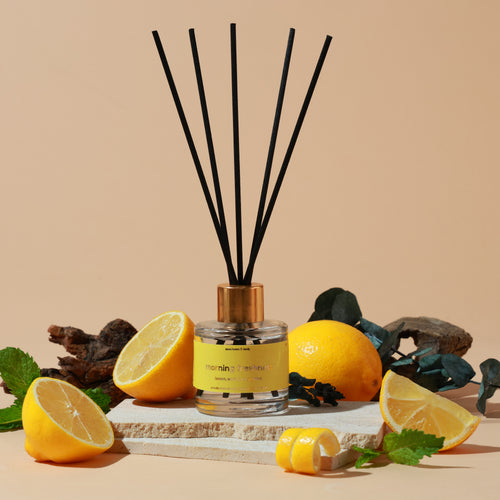 Bright at 9.0 · Morning Freshness₹749Shop →
 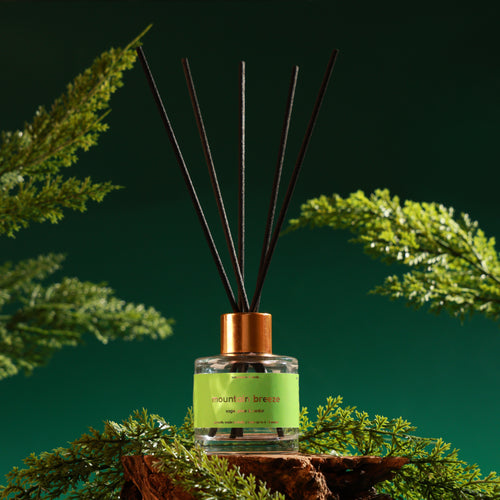 Deep green at 9.4 · Mountain Breeze₹849Shop →
The changes that do add reach, in the order I would make them
Every one of these is free, and I would work through the lot before spending a rupee. Halve the distance. Moving the bottle from the far console to the table beside you does more than any change of scent, any change of size and certainly any change of stick count, because you are moving yourself up the gradient rather than trying to drag the gradient to you. Get the height right. At or slightly below nose height, on a surface. On the floor the vapour has to climb to reach you; on a high shelf it sits above your head and you never meet it. Shut the door. Containment is half the equation and it costs nothing — it is exactly why the same bottle feels powerful in a small bathroom and modest in a bedroom.
Get it out of the draught but not into a dead corner. An open window or balcony door removes fragrance, because air that leaves takes it with it; the bottle has not weakened, the room is being flushed. Directly in the blast of a running split AC is the one placement I would rule out outright, since it strips the reeds and throws everything at one wall. But a dead corner behind a curtain is no better, because a point source with no air around it stays a point source.
And then the one that actually answers the question you came with. Turn the ceiling fan on low, in a closed room. This is the best free advice in this entire cluster, and I say so knowing it competes with things we sell. A fan is transport. It is precisely the quantity a reed does not supply, delivered by a device already screwed to your ceiling. Not directly under the blades at full speed, which merely disperses everything upward and dries the reeds; low, with the door shut, so that the room's air turns over gently and repeatedly past the bottle. The honest cost is that a faster-moving airstream over the reeds evaporates more oil, so the bottle finishes sooner — the same trade as adding reeds, except that this one buys you reach as well. Three reeds plus a fan on low is, in my experience, the best-value configuration a reed diffuser has.
What to do next, in order — and what not to buy
In buying order, from the change that costs nothing to the change that changes mechanism. The last row is the thing I would not buy in your position, and it is a product of ours.
| Step | What it does | When it is the right answer | Cost |
|---|---|---|---|
| 1. Drop to three reeds ★ | Roughly doubles the remaining weeks, and costs you very little of what you were enjoying | Immediately, in any bedroom, before anything else | Free |
| 2. Halve the distance, fix the height, shut the door | Moves you up the gradient instead of trying to move the gradient | Before you conclude anything about the product | Free |
| 3. Ceiling fan on low, room closed | Supplies transport, which no reed count supplies | When reach rather than intensity is the complaint | Free, minus some bottle life |
| 4. 300ml refill, if the scent is settled | Roughly six 50ml fills for the bottle and reeds you own | Only once you know which scent you keep going back to | ₹2,399 |
| 5. Sukoon ultrasonic | Moves air and covers 270–320 sq ft — a genuine change of mechanism, on demand | When you want the room occupied rather than a corner scented | ₹1,899 |
| The one I would not buy for this: Megh ₹3,499 | Six-litre tank, about 100 hours of runtime — and only about 215 sq ft of coverage, less than the ₹1,899 Sukoon | Never as a coverage upgrade. It is a runtime and humidity machine, and it is the clearest example in our own range that volume is a duration specification, not a coverage one | ₹3,499 |

Versailles
The question in the title arrives in our inbox more often than any other reed-count question, and it usually arrives apologetically, as though the reader had done something silly. They have not. Adding reeds is the only control the object gives you, so of course you turned it up. Anybody would. The awkward part is that the control is wired to the wrong quantity for the problem, and nothing on the packaging says so.
So let me put the trade on the record plainly. Six reeds is the living-room setting and it will give you 6–8 weeks from a 50ml. Three is the bedroom setting and it will give you roughly double. Neither number is a distance. If somebody sells you a reed diffuser with a projection figure printed on it, they have measured a room that is not yours — we publish no such figure for ours, because I do not know your ceiling height, your door or whether your window is open.
And if you take one thing away, take the fan. Three reeds, the bottle where you actually sit, the door shut and the ceiling fan on low is a better room than six reeds and no fan, and it costs less than the six-reed version because the bottle lasts longer. It is not lost on me that the best advice on this page is free. That is rather the point of writing it down. Everything is composed in Pune, and a part of every order funds a girl's classroom through Nanhi Kali.
Frequently asked questions
- Will more reed sticks reach further? — higher, not further.
- All the sticks in, and it still stays near the bottle — why the ceiling is structural.
- Projection, or just evaporation? — the deflating but honest answer.
- Five reeds to ten, and still nothing across the room — what to change instead.
- How many reeds do I actually need? — six, three, and the bathroom exception.
- More reeds against better diffusion — the two scored side by side.
- Every reed in the box and still not enough — a completed experiment with a useful result.
- Adding reeds for monster projection? — why no stick count produces it.
- When to stop adding reeds altogether — the stopping rule, as a checklist.
- Brand: the SOSA founder story.
SOSA facts verified August 2026: Reed diffusers in 50ml and 130ml only — Morning Freshness ₹749 / ₹1,249, Evening Calm ₹799 / ₹1,299, Garden Bloom ₹799 / ₹1,299, Mountain Breeze ₹849 / ₹1,349, Fresh Brew ₹849 / ₹1,349. 50ml suits rooms up to about 150 sq ft and lasts 6–8 weeks; 130ml suits above 150 sq ft and lasts 14–18 weeks. Six fibre reeds included; three reeds roughly doubles bottle life; two or three reeds in a 50 sq ft bathroom can stretch a 50ml to nearly three months; flip reeds every 3–5 days. Approximately ₹13–₹15 a day for a 50ml. Refills 300ml ₹2,399 and 500ml ₹3,499 are oil only. All alcohol-free on a heat-stable CCT carrier rather than DPG, phthalate-free, paraben-free, IFRA-compliant, 0 ppm formaldehyde, refillable glass, tested at 45°C and 85% RH, composed in Pune. Machines: Boond ₹899 (300ml, up to about 150 sq ft), Sukoon ₹1,899 (500ml, 270–320 sq ft, 16–18h on low), Megh ₹3,499 (6 litres, about 100h runtime, about 215 sq ft — a runtime machine, never a coverage upgrade), Safar ₹3,999 (named and sold as a waterless car and travel perfume diffuser; 20ml, 2000 mAh, up to 10 hours continuous per charge, three speeds, 1/2/3-hour timer — no room coverage figure is published for it and none is implied here), Vaayu ₹11,999 (up to 1000 m³, roughly 2,000–3,000 sq ft, 400ml tank, under 38 dB). Between Safar and Vaayu there is no mid-sized waterless bedroom machine in the range. Reed oil and the water-based Hotel Collection are separate products and are not interchangeable in either direction; there is no hotel-inspired reed diffuser. Free shipping above ₹499. SOSA is an independent Indian fragrance house; the Hotel Collection is SOSA's own interpretation inspired by the world's finest hotels, and SOSA is not affiliated with or endorsed by any hotel brand. Prices subject to change — see the live product pages.