


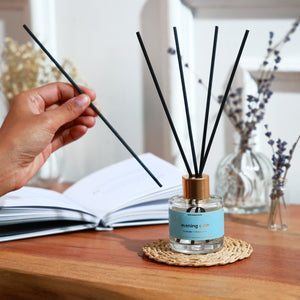

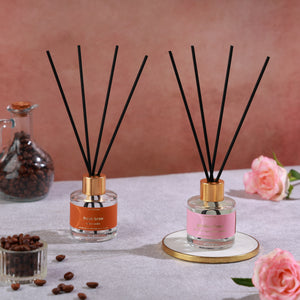
What does increase range, for free: a ceiling fan on low. A fan supplies the moving air a reed has no way of producing, and it is the single most effective free change in this whole subject. It will shorten the bottle’s life, which is a fair trade to make knowingly.
The other free ones: halve the distance between the bottle and where you actually sit; put it at or just below nose height on a surface; keep it out of a draught but not in a dead corner; and close the door.
The honest gap: no reed count produces even fragrance across a large open room. If that is the requirement, the answer is a machine that moves air, and the cheapest honest one is Sukoon at ₹1,899 — not something dearer.
2. You will notice a small change in range, and I would rather name it than pretend it does not exist. Raising the whole concentration curve does push the point where it drops below your detection threshold a little further out. In practice that is a matter of a step or two, not a change of category — you do not go from a fragrant corner to a fragrant room by adding reeds, and you should not spend a bottle’s life finding that out.
3. The free fix that actually adds range is a ceiling fan on low. A fan is transport. It is the one thing in an ordinary Indian bedroom that supplies exactly what a reed structurally lacks, it costs nothing, and it works immediately. It will shorten the bottle’s life, because moving air over the reeds evaporates them faster. That is a trade worth making deliberately rather than a reason to skip it.
4. Then halve the distance, fix the height, and close the door. Moving the bottle from a far shelf to the table beside where you actually sit does more than any change of scent or any extra reed. Put it at or slightly below nose height, on a surface rather than the floor or a high shelf. Keep it out of a direct draught but not in a dead corner. Containment is half the equation and shutting a door costs nothing.
5. Use the reed count as a dial, not as an accelerator. Six reeds is full projection. Three is a soft bedside level and roughly doubles the bottle’s life. Two or three in a 50 sq ft bathroom can make a 50ml last close to three months. Flip the reeds every three to five days rather than daily — a flip restores output for a few hours and adds no range at all.
Alcohol-free, phthalate-free, IFRA-compliant, 0 ppm formaldehyde, six fibre reeds, refillable glass bottle, composed in Pune. Free shipping above ₹499, and a portion of every order supports girl-child education through Nanhi Kali.
Higher and further are two different axes, and reeds only move one of them
Picture the fragrance in your room as a curve rather than a cloud. On the horizontal axis is distance from the bottle. On the vertical axis is how much fragrance is in the air at that distance. The curve is tall where the bottle is and it slopes downward as you walk away, and somewhere along that slope it crosses the line below which your nose stops registering it. That crossing point is what you experience as the edge of the fragrant zone.
Adding reeds raises the whole curve vertically. It does not stretch it horizontally. Doubling the number of wetted fibres roughly doubles the surface from which oil can evaporate, so more molecules per hour enter the air right at the bottle — the peak goes up. But the falloff is governed by something the reeds have no part in: how quickly the room’s air dilutes and disperses what has been released. That process is unchanged, so the curve keeps precisely the same shape as it descends. What has happened is that a taller curve crosses your threshold slightly later, which is why the edge shifts outward by a step or so rather than staying put. That is a real effect and it is a small one, and it is the entire honest gain from adding reeds.
The reason it is small is that the slope near the bottle is steep. A reed diffuser is a point source: concentration falls away sharply in the first metre because the released vapour is immediately being mixed into a very much larger volume of room air. To move the edge of the zone by a metre you would have to raise the peak by far more than doubling — which the six reeds in the box cannot do, and which nothing else you can put in a bottle can do either. You are pushing on a vertical lever and asking for a horizontal result.
 Evening Calm₹799Emission is the quantity you can genuinely control from the bottle, and it has four inputs: how many reeds are in the oil, how warm the room is, how dry the air is, and what the oil itself is made of. Reed count is the only one you can change in ten seconds. Six fibre reeds is full projection. Three is a soft bedside level and, because you are drawing the oil up through half the surface, it roughly doubles how long the bottle lasts. This is why Evening Calm at 8.9 on our strength scale — the softest thing we compose — is very often run at three reeds in a small bedroom and is perfectly present there.
 Sukoon₹1,899Once a molecule has left a reed it has two ways of getting anywhere. The first is molecular diffusion, which is genuinely far too slow to cross metres of a room in a useful time. The second is being carried by air that is already in motion — convection off a warm wall, a fan, a running AC, a draught under a door. The second does effectively all the work, and it is not something the bottle contributes to. This is the whole reason a fan changes everything and a seventh reed would change almost nothing. It is also why an active diffuser is a different category of object rather than a stronger version of the same one: Sukoon at ₹1,899 puts out a mist under pressure and moves air while doing it.
 Morning Freshness₹749Before you add a single reed, rule out the possibility that the fragrance is reaching you and you have stopped reporting it. Olfactory receptors adapt to a constant stimulus within minutes: the signal keeps arriving and the brain stops forwarding it. Someone can sit in a correctly scented room and honestly say they smell nothing. Walking across the room is different, because crossing a gradient is a change, and change is what the nose is built to notice. The test is free: leave for fifteen minutes and walk back in, and ask whoever comes to the door. A visitor is a better instrument than a resident, and if guests remark on it, it is working for everyone except the person who lives with it.
Why a reed has no way of pushing, however many you put in
A reed diffuser has no moving parts, no fan, no pump and no energy input at all. Oil climbs the fibres by capillary action and evaporates off their exposed surface at whatever rate the room’s temperature, humidity and airflow allow. Nothing in that description produces a push. There is no stage at which the device imparts velocity to anything — the fragrance simply appears at the top of the reeds and waits for the room to do something with it. That is the design, not a defect, and it is inseparable from the reasons people choose one: it is silent, it needs no socket, there is nothing to fill or charge or remember, it works in a power cut, and it never breaks. About ₹13–₹15 a day buys an object on a table rather than an appliance on a table, and no machine in our range or anyone else’s will ever give you that.
Which means the honest framing for a reed is that it produces a fragrant zone rather than a fragranced room. The zone can be small or large depending on the room, it can be strong or soft depending on the reed count, and it can be positioned wherever you like. What it cannot be made to do is spread itself evenly across a volume, because spreading is transport and transport requires moving air. Every reader who has tried to fix a reach problem by adding reeds, buying a bigger bottle, choosing a stronger scent or adding a second diffuser has run the same experiment with the same result, and the result is not their fault. All four of those changes raise emission. None of them adds transport.
There is one more thing worth knowing before you decide the bottle is underperforming, and it is about weeks rather than metres. The first days of any reed diffuser run hot, because the fibres are still saturating and the lightest materials in the composition leave first. By week three you are smelling the heart and the base — the composition as it was designed to sit in a room. People read that settling as fading and reach for extra reeds at exactly the point when the fragrance has become what it is meant to be. If your bottle is two or three weeks old, flip the reeds, give it a day, and judge it then.
What each lever actually changes — emission, transport, or your bottle’s life
This is the table I wish every reed diffuser shipped with. Read it as three separate columns rather than one: a change can raise output, extend reach, or cost you weeks, and most changes do only one of the three. The rows are ordered by what I would try first, and the free ones are at the top for a reason.
| Change | Effect on output | Effect on reach | Effect on bottle life | Cost |
|---|---|---|---|---|
| Ceiling fan on low ★ | Slight increase | The only free change that genuinely adds reach | Shortens it — moving air evaporates the reeds faster | Free |
| Halve the bottle-to-person distance | None | Large — you move up the gradient instead of moving the gradient | None | Free |
| Close the door | None | Improves it by containment rather than transport | Lengthens it slightly | Free |
| Three reeds to six | Roughly doubles it | Shifts the edge outward by a step, no more | Roughly halves it | Free, then weeks |
| 50ml to 130ml | None at the same reed count | None — volume is a duration figure, not a coverage figure | 14–18 weeks instead of 6–8 | About ₹500 |
| Move to an active diffuser | Higher and controllable | The one change that adds transport, because the machine moves air | Not comparable — a different consumable | ₹1,899 upwards |
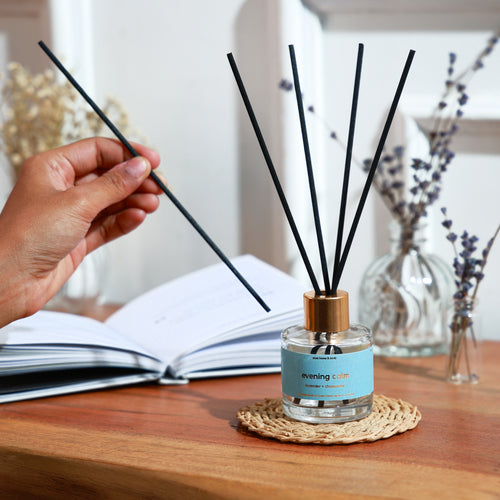 Three reeds · Evening Calm₹799Shop →
 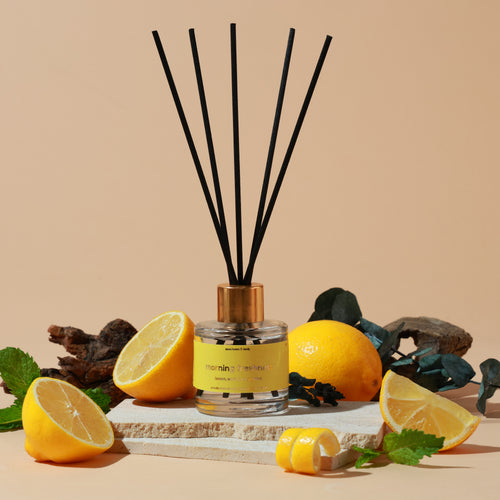 Six reeds · Morning Freshness₹749Shop →
  Moving air · Sukoon₹1,899Shop →
The free fixes, in the order I would actually try them
Start with the fan. If there is a ceiling fan in the room, run it on its lowest setting with the door closed and the bottle out of the direct downdraught, and give it half an hour. This is the best free advice in the whole subject, because a fan supplies exactly the thing a reed cannot: it takes the vapour sitting above the bottle and puts it into a slow circulation that reaches the rest of the room. It is not a subtle improvement. It is also not free of consequence — a bottle in moving air empties faster, so a 50ml that would have run eight weeks may run closer to six. I would rather you knew that and chose, than have you never told.
Then close the distance. Halving the gap between the bottle and where you actually spend your time does more than any change of fragrance, and it is the single most reliable adjustment in this entire cluster. A reed produces a zone, so the sensible thing is to put yourself inside the zone rather than to demand that the zone come to you. Bedside table, the end table by the sofa, the corner of the desk. Height matters as well: at or slightly below nose height, on a surface — not on the floor, where the fragrance sits below you, and not on a high shelf, where you are standing under it and never in it.
Then think about where the air goes. Not on a windowsill and not beside an open balcony door, because air that leaves the room takes the fragrance with it and the bottle is not weaker, the room is being flushed. Not in the direct blast of a split AC, which strips the reeds and throws everything at one wall. But not in a sealed dead corner behind a wardrobe either, where there is no circulation at all to pick it up. What you want is somewhere the room’s own air already passes through gently. And close the door — containment is half the equation, and a closed 120 sq ft bedroom behaves completely differently from the same bedroom open to a corridor.
Only then touch the reeds. If you are running three and the room is genuinely under-dosed, go to six. If you are already at six, adding more is not a plan — SOSA bottles ship with six because six is the useful top of the dial, and stacking a bottle with a dozen sticks from an old set produces a room people describe as cloying rather than strong. Flip them every three to five days rather than every morning; a flip lifts output for a few hours by presenting fresh saturated fibre to the air, and it adds no range whatsoever.
If you do want to buy something — the honest ladder, cheapest first
Most people who arrive at this question are fixed for nothing, which is why the free fixes came first and at length. But some readers genuinely want fragrance present across a whole room at a level they do not have to walk towards, and that is a legitimate requirement that a passive device is not designed to meet. If that is you, here is the ladder in the order I would climb it, with the gap in our own range named rather than hidden.
| Buy | What it is | When it is the right answer | Price |
|---|---|---|---|
| 1. Nothing ★ | Fan on low, door closed, bottle halved in distance and set at nose height | First, for a large share of readers. It costs nothing and it settles the question | Free |
| 2. A 50ml reed, all six reeds in | Six fibre reeds, refillable glass, up to ~150 sq ft, 6–8 weeks | When the room is within size and you want a strong, positioned zone | ₹749–₹849 |
| 3. A 130ml reed | The same fragrance for longer — 14–18 weeks, suits rooms above 150 sq ft | When the problem is repurchasing, not reach. It lasts longer, it does not travel further | ₹1,249–₹1,349 |
| 4. Sukoon ultrasonic | 500ml, 270–320 sq ft, 16–18 hours on low, three 15ml Hotel Collection scents included | When you want the room rather than the corner, on demand and switchable off | ₹1,899 |
| 5. Safar waterless | Undiluted oil, no water, cordless, three speeds, a 1 / 2 / 3-hour timer. Named and sold as a car and travel diffuser — SOSA also lists desk, bedside and hotel room, and publishes no room coverage figure for it | When you want waterless cold diffusion at personal scale and will accept recharging and a timer that stops | ₹3,999 |
| The honest gap: there is nothing between them | SOSA has no mid-sized waterless nebuliser for one bedroom. Vaayu at ₹11,999 is rated to 1000 m³, roughly 2,000–3,000 sq ft, and is the wrong purchase for a single room — nine-tenths of it would be wasted | Said plainly, because Sukoon at ₹1,899 is very often the correct bedroom answer and should never be skipped on the way to something dearer | ₹1,899 |
Versailles
This question arrives in my inbox more often than any question about a fragrance, and it almost always carries a compliment inside it. Nobody asks how to make a scent reach further unless they like the scent. You are not telling me you bought the wrong thing. You are telling me you want more of the right thing, in more of your house. That is a different conversation and a much happier one.
What I would ask you to take from this page is the two-axis idea, because once you have it you will never again spend money along the wrong one. More reeds, a bigger bottle, a stronger composition and a second diffuser are all the same move — they raise how much leaves the glass. A fan, a closed door and a shorter walk are the other move — they change what happens to it afterwards. Nearly every disappointment in home fragrance is somebody pressing the first lever and expecting the second result.
And be fair to the object while you are at it. A reed diffuser is silent, needs no power, has nothing to fill or charge, cannot be forgotten, works through a power cut and never breaks, for about ₹13 to ₹15 a day. Every machine I sell is better at reach and worse at all of that. Everything is composed in Pune, and a part of every order funds a girl’s classroom through Nanhi Kali.
Frequently asked questions
- I added all the reed sticks and it still stays near the bottle — what your experiment actually proved.
- Projection or just evaporation? — where the extra oil really goes.
- Five reeds to ten and still nothing — why doubling the dose does not double the sensation.
- How many reeds do I actually need? — a dosing method rather than a number.
- Does over-reeding just finish it faster? — the arithmetic, shown.
- More reeds vs better diffusion — the comparison, scored.
- Every reed in the box, still not strong — a completed experiment with a useful result.
- Keep adding for monster projection? — no, and here is what that word actually describes.
- When to stop adding reeds — the stopping rule as a checklist.
- Brand: the SOSA founder story.
SOSA facts verified August 2026: Reed diffusers in 50ml and 130ml only — Morning Freshness ₹749 / ₹1,249, Evening Calm ₹799 / ₹1,299, Garden Bloom ₹799 / ₹1,299, Mountain Breeze ₹849 / ₹1,349, Fresh Brew ₹849 / ₹1,349. 50ml suits rooms up to ~150 sq ft and lasts 6–8 weeks; 130ml suits above 150 sq ft and lasts 14–18 weeks; roughly ₹13–₹15 a day. Six fibre reeds, not rattan, in a refillable glass bottle on a heat-stable CCT carrier, alcohol-free, phthalate-free, paraben-free, IFRA-compliant, 0 ppm formaldehyde, tested at 45°C and 85% RH, composed in Pune. Refills 300ml ₹2,399 · 500ml ₹3,499, oil only and never a first purchase. Machines: Boond ₹899 (300ml, ≤~150 sq ft, ~6h), Sukoon ₹1,899 (500ml, 270–320 sq ft, 16–18h on low, three 15ml Hotel Collection scents included), Megh ₹3,499 (6L, ~100h runtime, only ~215 sq ft), Safar ₹3,999 (waterless cold diffusion of undiluted oil, 20ml, 2000 mAh, up to 10 hours continuous or ~30 hours intermittent, three speeds, 1 / 2 / 3-hour timer, 6.9 cm — named and sold as a car and travel diffuser, with no published room coverage figure), Vaayu ₹11,999 (up to 1000 m³, roughly 2,000–3,000 sq ft, 400ml, under 38 dB). Hotel Collection oils are water-based and ultrasonic-only; reed oil cannot be used in an ultrasonic machine and there is no hotel-inspired reed diffuser. No health, air-quality or allergy claim is made or implied. Free shipping above ₹499. SOSA is an independent Indian fragrance house and is not affiliated with or endorsed by any hotel brand. Prices subject to change — see the live product pages.