

What it does: it inverts the gradient that builds along a standing reed, putting the loaded end back into the oil and a fresh surface into the air. Delivery returns to the designed rate within a few hours.
What it cannot do: exceed that rate. If a freshly flipped bottle is still too quiet, you have a placement, reed-count or composition problem — and you now know that for free.
What it costs: a modest number of days off the bottle, and that is the correct trade. A stalled bottle "lasts longer" only because it has stopped working.
2. Understand what you are buying: a repair, not a raise. Flipping restores the delivery rate the composition was dosed for. It has a ceiling, and the ceiling is the designed rate. This is the single most useful thing to know about the gesture.
3. Deviate upward only for heat, high reed counts and hosting. Twice a week through a 45°C fortnight or with nine to ten reeds in a 50ml, and one extra flip on the morning guests arrive. Nothing else genuinely moves the interval.
4. Do not increase the cadence for the monsoon. SOSA bottles carry six fibre reeds rather than rattan cane precisely because rattan's natural pores swell shut at 85% humidity. Weekly is right in August.
5. Flip all six to fix; flip three and three to smooth. If your only objection is the loud first evening after a flip, split the reeds into two groups of three turned four days apart. Every reed is still flipped weekly and the week reads as one flat line.
6. Daily flipping is a poor trade. The gradient a flip inverts takes days to form, so a reed flipped yesterday returns almost nothing today. You get seven times the handling, oil on the furniture, tired reeds and a slightly shorter bottle.
7. Yes, flipping shortens the bottle — that is the point. A bottle that lasts unusually long has usually stopped delivering. Flipping trades a modest number of days for the fragrance you already paid for, which is the correct direction of trade.
8. When a fresh flip changes nothing, stop flipping and start diagnosing. Lift a reed and read the wet line, do the fifteen-minute doorway test, then move the bottle into passing air. Only after those three does a purchase make sense.
Composed and handmade in small batches in Pune, and a portion of every order supports girl-child education through Nanhi Kali.
Part one — what a flip actually does, and what it cannot do
A reed diffuser has no fan, no heat and no switch. What it has is a set of wicks standing in oil, and the only part of that system you can touch without spending money is which end of each wick is in the air. Flipping is therefore not one technique among several — it is the entire maintenance schedule of the format, and understanding precisely what it moves is what stops people spending money on the wrong thing. Three ideas do nearly all the work: the gradient that makes flipping worthwhile, the ceiling that limits it, and the reed material that sets how often it is needed.
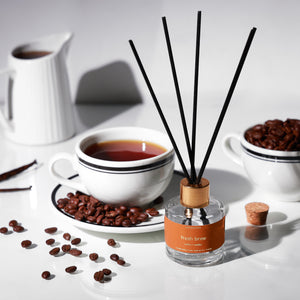
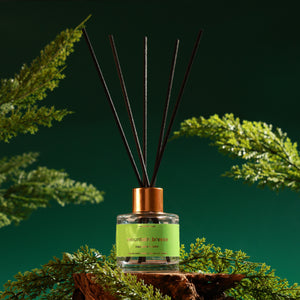
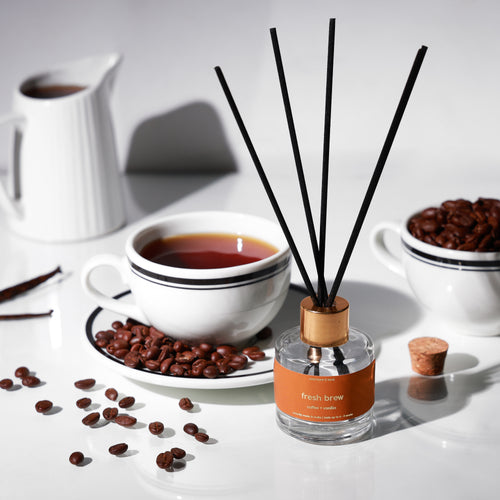
 Mountain Breeze₹849 · 9.4/10People flip hoping for a raise and receive a repair, and the disappointment is real even though the outcome is usually the one they needed. The maximum a bottle can deliver is set by the composition, the reed count and the room's air — flipping simply returns you to it. That makes the flip an unusually good diagnostic: if you have turned all six reeds and the room is still not what you want twenty-four hours later, you have eliminated the free variable and you now know, at no cost, that the answer is placement, more reeds, or a composition that plateaus higher. Mountain Breeze at 9.4 and Fresh Brew at 9.5 exist for exactly that conclusion.
Part two — the complete cadence matrix
Every configuration people actually run, with the flip interval that suits it and the one other change worth making. Figures assume a bottle out of direct sunlight and several feet clear of a vent; they are SOSA's own working guidance from in-house testing and customer correspondence rather than laboratory measurement.
| Your setup | Room condition | Reeds | Flip every | Also do this |
|---|---|---|---|---|
| Ordinary flat, ordinary week ★ | Mixed traffic, no direct sun | Six — the calibrated count | 7 days, all six | Nothing. This is the specification |
| Air-conditioned bedroom | Sealed, cool, low traffic | Four to six | 7–10 days | Place where the airflow reaches last, not on the bedside table |
| Peak summer, April to June | 45°C, warm walls, thin oil | Six | 3–4 days | Move it off any west-facing shelf before changing cadence |
| Monsoon, June to September | 85% humidity, still air | Six | 7 days — unchanged | Check reed age rather than cadence if it stalls |
| Kitchen or bathroom | Extractor governs the air | Six | 3–4 days | Never diffuse over live cooking; vent first, then wait half an hour |
| Running it loud | Large living-dining, hosting often | Nine to ten in a 50ml | 7 days without exception | Expect four to five weeks, not six to eight |
| Deliberately gentle | Nursery, reading corner, sensitive nose | Three to four | 10 days is fine | Pair with Evening Calm at 8.9, the softest we make |
| Hosting on Saturday | Doors closed, guests at eight | Six, or nine from Friday | Usual weekly flip, plus one on the morning | Close the room for an hour beforehand |
| Refill day | Any | Existing set, if still wicking | One flip immediately after filling | Reeds out, pour to the neck, reeds back, flip once |
| The honest caveat: not one row of this table raises the height of the plateau. Cadence is maintenance; volume is a matter of placement, reed count and composition. If the room is quiet on the day after a flip, the answer is not in this table — it is in does flipping make a diffuser stronger and in the ladder in Part six. | ||||
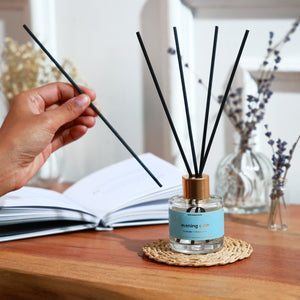
Fresh Brew · 9.5/10from ₹849Shop → 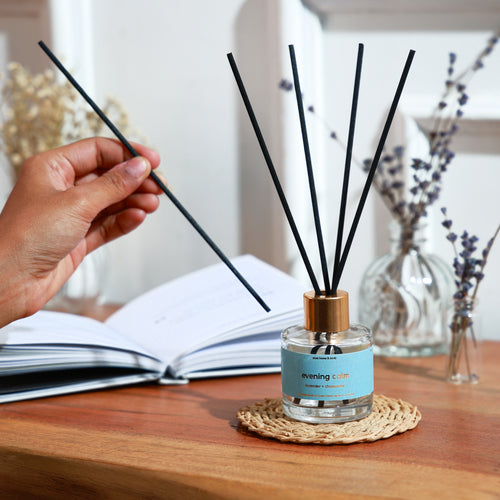 Evening Calm · 8.9/10from ₹799Shop →
 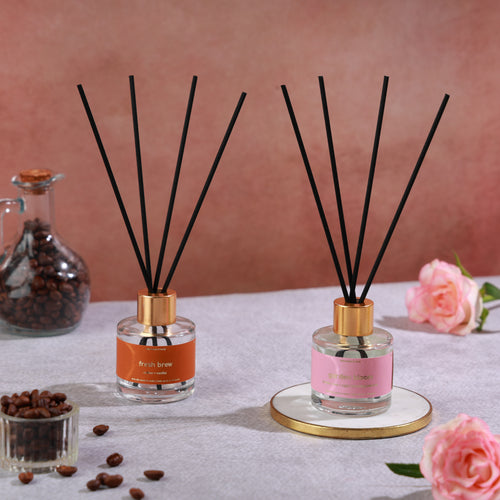 Oil refill · oil only₹2,399Shop →
Part three — the hours after a flip, and what to expect
The first ten minutes are almost always underwhelming, and this is where people decide flipping does not work. Nothing has reached the room yet — the freshly raised length is coated in oil and beginning to evaporate, but a room is a large volume of still air and the fragrance has to be carried into it rather than pushed. Give it two to four hours. What you get then is the loudest the bottle will be all week: a rise that is genuinely above the level you had been living with, sometimes noticeably so if the reeds had been standing for a fortnight. By the following evening it eases. That easing is not a failure and it is not the fragrance running out; it is the film on the outside of the fibre finishing and the reed settling into its steady capillary rate.
The settled level is the product. It is worth saying that plainly, because the same shape appears at the start of a bottle's life and confuses people in exactly the same way. A new bottle spikes for days one to three, settles over weeks one and two, and then holds a plateau to the end of the fill — dry reeds drinking hard, and the top notes of the composition departing first. Neither the opening spike nor the post-flip surge is the baseline. They are transitions. If you judge a fragrance by its first evening you will be permanently disappointed by every reed diffuser you ever own, including the good ones, and you will be tempted to fix a perfectly healthy bottle by flipping it again the next morning.
There is one more actor in this, and it is you. Olfactory adaptation is the commonest cause of "it stopped working" — your nose stops reporting a constant within minutes, and it adapts hardest at home where the background is familiar and continuous. This is precisely why a flip feels so effective: you have introduced a change, and change is the thing a nose is built to detect. It is also why the surge appears to fade faster than it really does. Before you touch the bottle again, spend fifteen minutes out of the room somewhere with a smell of its own and attend to the first three seconds when you return. Better still, ask someone who does not live with you. Guests are honest instruments, and they will frequently describe a room you have not been able to smell since Tuesday.
Part four — every flipping pattern, and who each one is for
Six ways people arrange the same set of flips. The differences between them are real but they are differences of shape, not of level — a point worth holding on to while reading the table.
| Pattern | In one line | The room or occasion | The failure mode |
|---|---|---|---|
| The standard flip ★ | All six reeds, once a week, on a fixed day | Almost every room and every composition | Nothing — start here and stay here unless you have a reason |
| The staggered flip | Three reeds, then the other three four days later | Small closed bedrooms, nurseries, sensitive noses | Keep the two groups identifiable or it decays into neglect |
| The hosting flip | All six on the morning of, room closed an hour before | Dinners, festivals, viewings, anyone arriving at eight | It is a single extra flip, not a change of cadence |
| The refill flip | One flip immediately after pouring a fresh fill | Every refill, without exception | Skip it and a good fill appears to start weak |
| The daily flip | Turning all six every morning | Nobody — the gradient has not formed in 24 hours | Oil on furniture, tired reed tips, no detectable gain |
| The fortnightly flip | All six, every second week | Four reeds in a cool, sealed, low-traffic room only | Elsewhere it means half of every cycle spent stalled |
| The honest caveat: the pattern that ruins bottles is not on this list, because nobody chooses it deliberately — turning one or two reeds whenever you happen to think of it. With six reeds and two turned a week, each reed waits three weeks between flips. If you want gentler, take reeds out and flip the rest properly. | |||
Part five — what flipping costs the bottle, and why it is the right trade
Flipping does shorten a bottle. It would be strange if it did not: the whole purpose of the gesture is to keep delivery at its designed rate rather than allowing it to slide, and delivery is what consumes oil. The mistake is treating a long-lasting bottle as evidence of quality. A 50ml that has quietly gone eleven weeks has almost certainly spent five of them in a state where the reeds were congested, the room was quiet and the oil was sitting in the glass doing nothing but ageing. You did not save anything. You bought a fragrance and left most of it in the bottle.
Set against the other things that shorten a bottle, flip frequency is a minor accelerant, and it is worth knowing the ranking so you spend your worry correctly. Direct sunlight, a west-facing shelf and an AC draught cost far more weeks than any flip schedule, and reed count costs more still — six reeds is calibrated, nine gets you closer to five weeks than eight on a 50ml, and ten sits at about four to five. Heat is the largest single factor: warm oil is thinner and moves faster, which is why a bottle on a sunny sill can finish in a fraction of its stated window. Against that background, a weekly flip is inexpensive, and the difference between weekly and twice-weekly during a heat wave is a handful of days.
If you have decided to run a bottle hard — nine reeds in a busy living room, twice-weekly flips through a Pune May — then the sensible response is not to flip less but to change how you buy the oil. The oil-only refill is ₹2,399 for 300ml and ₹3,499 for 500ml, roughly ₹7–8 per millilitre against ₹15–17 for a fresh 50ml bottle — up to about 55% less, because you are reusing your own glass vessel and your own reeds. A 300ml keeps a vessel going for roughly eight to eleven months and a 500ml for fourteen to eighteen. What the refill does not include is reeds, and it is worth repeating that we do not sell them separately either. Pouring fresh oil through a set of reeds that stopped wicking in March is the single commonest way to be disappointed by a refill, and it is a genuinely avoidable mistake.
Part six — where flipping stops, and the SOSA edit
Flipping is the first rung of a ladder, and the ladder matters more than any single rung. Every free move comes before every paid one, because a purchase made to solve an unflipped reed leaves you with an unflipped bottle of something more expensive. Here is the whole sequence, and a good share of readers never reach the fourth line.
| Rung | What to do | What it buys | What it costs | Price |
|---|---|---|---|---|
| 1 · The doorway test ★ | Fifteen minutes out of the room, then judge the first three seconds | Tells you whether there is a problem at all | A quarter of an hour | Free |
| 2 · The flip | All six reeds, end for end, gloves on, over the bottle | Restores the designed delivery rate within hours | A modest number of days off the bottle | Free |
| 3 · Move and raise it | Console near a doorway, waist to chest height, clear space | Lets passing traffic distribute what the reeds release | Nothing — and it often lengthens the bottle | Free |
| 4 · Close the room | Shut the door for an hour before you want it at its best | The single best free move before guests or bedtime | An hour of planning | Free |
| 5 · Add reeds | Six to nine, reversibly, and flip weekly without fail | The only true volume control the format has | Roughly five weeks instead of eight on a 50ml | Free |
| 6 · A composition that plateaus higher | Fresh Brew 9.5 or Mountain Breeze 9.4 | Real strength, where strength actually lives | A new bottle and a change of character | ₹849 / 50ml |
| 7 · A second source | Two 50ml at opposite ends beat one 130ml in the middle | Raises the total output, which one bottle cannot | Two bottles to flip on the same Sunday | Duos from ₹1,498 |
| 8 · Refill rather than re-buy | 300ml ₹2,399 or 500ml ₹3,499, oil only | Makes running it hard affordable long term | Nothing — but it does not include reeds | ₹2,399 · 8–11 months |
| 9 · Change format | Sukoon ultrasonic, 270–320 sq ft, timers and remote | Scent on demand, which no reed can produce | A plug socket and a different product line | ₹1,899 |
| Not a lever: a bigger bottle | 130ml holds more oil and lasts 14–18 weeks against 6–8 | Duration, and only duration | Said plainly rather than sold as an upgrade | From ₹1,249 |
Versailles
I could make our reed diffusers open louder. You raise the volatile fraction and you use a solvent that pushes fragrance hard off the reed — most often a phthalate — and week one is thrilling. The trouble arrives in week six, when that solvent has spent a Delhi summer degrading and the fragrance has turned thin and faintly acrid. We are phthalate-free on a heat-stable coconut-derived CCT base instead, and the trade is honest and worth stating: a smaller opening, and a longer, flatter plateau that survives 45°C and a monsoon.
Flipping matters more on a base like ours than it would on a solvent-driven one, because our whole proposition is that plateau. A congested reed does not merely turn the volume down; it changes what you are smelling, since the light material is the part that leaves first and the heavy part is what sits at the top of the fibre. That is why an unflipped bottle at week six smells base-heavy and dull rather than simply quieter — a difference customers describe accurately long before they diagnose it.
The nine guides this page pulls together came out of four years of the same conversations. Nearly all of them end in the same place: flip it, move it, close the door for an hour, and only then think about spending. If you have done those and the room still is not what you pictured, I would rather sell you a 9.5 composition or point you at a machine than sell you a third bottle that will not fix it. Everything is composed and handmade in Pune, and a part of every order funds a girl's classroom through Nanhi Kali.
Frequently asked questions
- Should you flip at all? and what happens when you do — the residue gradient, and the hours afterwards.
- How often should you flip?, is weekly enough? and how often on a SOSA bottle — cadence by condition, by specification and by reed material.
- Does flipping make it stronger? and does it finish the oil faster? — the ceiling, and the trade.
- All the reeds or only some? and can you flip every day? — staggering, and the upper bound.
- Why can't I smell my reed diffuser? and the complete strength guide — where to go when a flip is not the answer.
- Brand: the SOSA founder story.
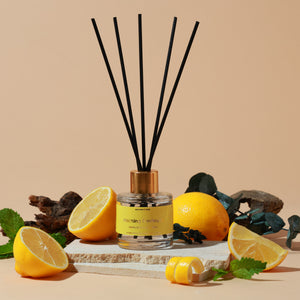
SOSA reed diffuser range & prices (verified August 2026): alcohol-free, phthalate-free, paraben-free and IFRA-compliant compositions on a heat-stable coconut-derived (CCT) carrier, low-VOC, supplied in a refillable glass bottle with six fibre reeds; 50ml lasts 6–8 weeks and 130ml lasts 14–18 weeks. Morning Freshness (Malabar lemon · peppermint · Nilgiri eucalyptus) 50ml ₹749 · 130ml ₹1,249 · 9.0/10; Garden Bloom (British rose · night-blooming jasmine) 50ml ₹799 · 130ml ₹1,299 · 8.9/10; Evening Calm (Kashmir lavender · chamomile) 50ml ₹799 · 130ml ₹1,299 · 8.9/10; Fresh Brew (Coorg coffee · Kerala vanilla) 50ml ₹849 · 130ml ₹1,349 · 9.5/10; Mountain Breeze (Himalayan pine · sage · Indian cedar) 50ml ₹849 · 130ml ₹1,349 · 9.4/10. Reed diffuser refills are oil only — you reuse your own vessel and reeds: 300ml ₹2,399 (roughly 8–11 months) · 500ml ₹3,499 (roughly 14–18 months), about ₹7–8 per ml against ₹15–17 per ml for a 50ml bottle. Duo sets ₹1,498–₹1,598 for 2 × 50ml and ₹2,498–₹2,598 for 2 × 130ml. Strength figures are positions on SOSA’s own internal strength scale, not an industry standard. Replacement reeds are not sold as a separate SKU; SOSA guidance is to refresh reeds every few months. The reed line is separate from the water-based Hotel Collection for ultrasonic machines (15ml ₹299 · 100ml ₹999 · 300ml ₹1,799) and the two are not interchangeable. Diffusers: Boond 300ml ₹899 · Sukoon 500ml ₹1,899 · Megh 6L ₹3,499 · waterless Vaayu ₹11,999. Composed and handmade in small batches in Pune, India; tested through 45°C summer heat and 85% monsoon humidity. Free shipping above ₹499. A portion of every order supports girl-child education through Nanhi Kali. Prices subject to change — see the live product pages.