
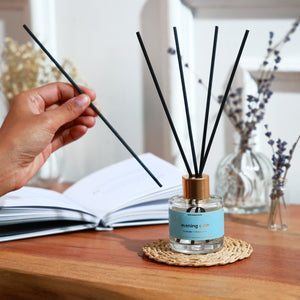
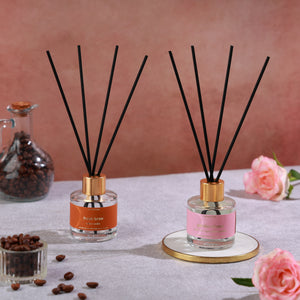
Weekly is the calibration. Every duration and strength figure we publish is measured at six fibre reeds flipped once a week. That is the number the compositions are dosed around.
Flipping less is not conservation. An unflipped bottle lasts longer because delivery has stalled — the oil ages in the glass and the top notes leave regardless of whether the room ever receives them.
Do not judge in the hour afterwards. A flip produces a short surge and then returns to the designed rate. The plateau is the product; the surge is just the surface being renewed.
2. Most of that oil was leaving anyway. This is the part people miss. A reed does not store oil indefinitely; the lighter molecules depart on their own schedule whether or not the room receives them. Flipping largely brings consumption forward rather than adding to it, which is why the arithmetic is so much gentler than it feels.
3. Weekly is not a suggestion, it is the calibration. Six fibre reeds, flipped once a week, in an ordinary room — that is the specification every duration and strength figure in this range is measured at. Deviating is fine; deviating without knowing you have is what causes confusion later.
4. Flipping restores, it does not amplify. A flip returns the reed to the rate the composition was designed for. If a freshly flipped bottle is still quieter than you want, you have learned something valuable for free: the problem is the room, the placement or the composition, and no amount of extra flipping will reach it.
5. Not flipping is the expensive option, not the thrifty one. An unflipped bottle lasts longer because it has largely stopped working. You end up with oil in the glass, a room that smells of nothing, and a composition that has quietly lost its top while you were saving it.
6. Daily flipping is where I would draw the line. The extra presence is marginal, the bottle noticeably shorter, and reed oil marks wood and stone — every handling is a chance to leave a ring on the sideboard. Weekly with gloves, all six reeds, bottle standing on a tray.
7. If a flip stops helping, the reeds are the problem. Fibre reeds resist the clogging that finishes rattan in an 85% monsoon, but they are still the consumable in this system and want refreshing every few months. We do not sell reeds separately — an honest gap. Composed and handmade in small batches in Pune, and a portion of every order supports girl-child education through Nanhi Kali.

Part one — what a flip actually spends, and why it is less than you think
To price flipping honestly you have to be clear about what a flip does physically. When a reed has stood in a bottle for a week, its exposed end holds a different mixture from the end sitting in the oil — the light, volatile molecules have left the surface and the heavy, slow ones have accumulated there. Turning the reed over puts that loaded end back into the oil and presents a freshly saturated surface to the room. Two things follow. The room gets a short surge, because a wet surface evaporates faster than a partly dry one. And the bottle spends a little extra oil re-wetting the length that is now standing in the air. That second thing is the entire cost, and it is smaller than the first thing makes it feel.
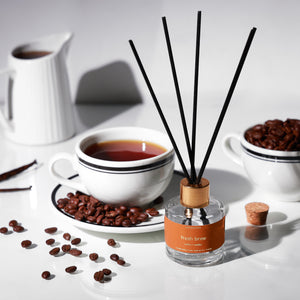
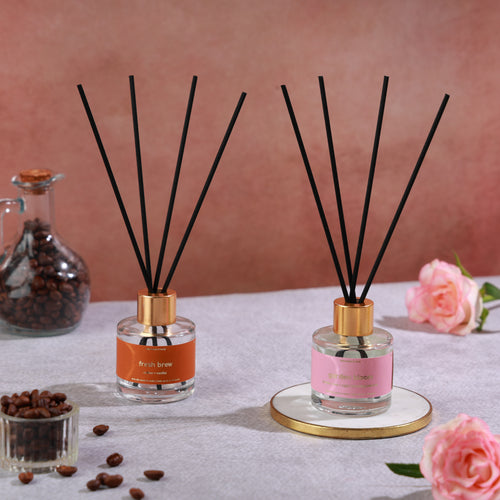
 Fresh Brew₹849 · 9.5/10People flip expecting a raise and receive a repair, which is usually what they needed. The ceiling on flipping is the composition's designed rate at your reed count, and no cadence takes you past it. That makes the weekly flip an unusually good diagnostic as well as a maintenance job: if the room comes back within a few hours, delivery had drifted and you have fixed it for nothing. If a freshly flipped bottle is still quiet the following evening, you have ruled out the free explanation and can look properly at placement, at room size, or at whether an 8.9 composition is being asked to do a 9.5 job. Either way you have learned it without spending a rupee, which is the best sort of test.
Part two — every cadence, priced in weeks, presence and mess
This is flip cadence written out as a menu. The figures are SOSA's own working guidance from in-house testing and customer correspondence rather than laboratory measurements, taken on a 50ml at six fibre reeds. What I would draw your eye to is how little movement there is in the third column compared with what reed count does to the same bottle.
| Cadence | What the room gets | Effect on a 50ml's life | Mess and effort | Verdict |
|---|---|---|---|---|
| Once a week ★ | The designed rate, held to the end of the bottle | The stated 6–8 weeks — this is the calibration | Two minutes, gloves, a tray | The default, and right for almost everyone |
| Never | Drifts down from week three; flat and base-heavy by week five | Appears to last far longer — because it has stalled | None, which is the trap | The most expensive way to own a diffuser |
| Roughly monthly | A surge, then a long slow decline, four times over | Longer on the calendar, thinner throughout | Negligible | Only if the room is genuinely too small for six reeds |
| Fortnightly | Noticeably quieter in the second week each time | A few days longer than weekly | Half the handling | Acceptable in a cool, sealed, low-traffic room |
| Twice a week | A little fuller, and steadier through a heat wave | Days shorter, not weeks | More residue at the neck | Worth it in 45°C heat or at eight to ten reeds |
| Daily | Marginal gain over twice weekly | Meaningfully shorter | Real risk of oil marks on furniture | No — this is where the trade turns |
| The honest caveat: the second row is the one that costs people money, and it does not look like it at the time. A bottle that reaches week ten with oil still in it has usually not been thrifty — it has been asleep since week four, and the volatile top of the composition left on its own schedule whether or not anyone smelled it. If your reason for flipping less was to stretch the bottle, look at the placement instead: moving it out of a sunbeam returns far more weeks than skipping flips ever will, and costs you nothing in the room. | ||||
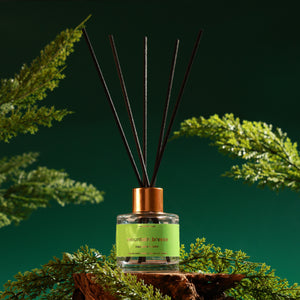
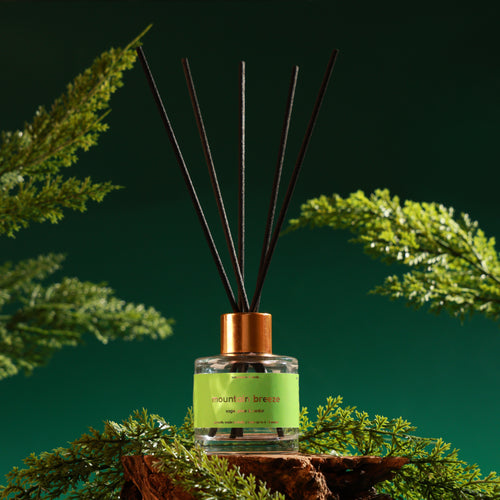 Mountain Breeze · 9.4/10from ₹849Shop →
 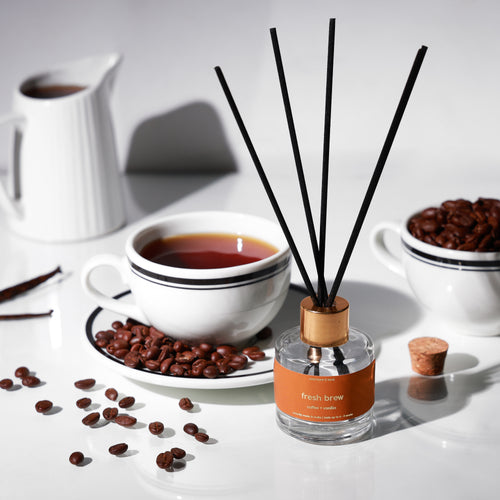 Fresh Brew · 9.5/10from ₹849Shop →
 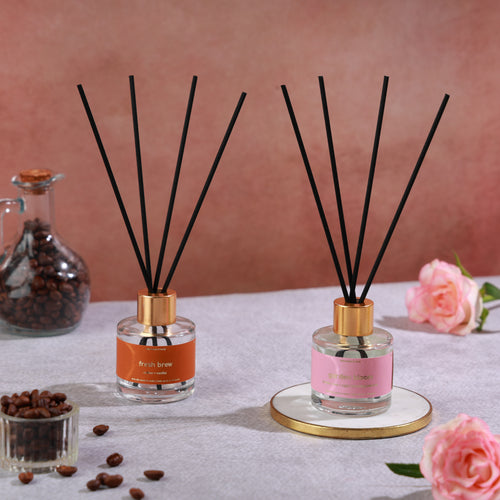 Oil refill · 300ml₹2,399Shop →
Part three — flipping set against the variables that actually move the number
The reason I wanted to write this page as a costing rather than a how-to is that flip cadence has acquired a reputation it does not deserve. People arrive believing that flipping is the thing burning through their oil, and they arrive at that belief honestly — a flip produces an immediate, obvious surge in the room, and immediate obvious things feel expensive. But rank the variables by how many weeks each one moves a 50ml and flip cadence sits near the bottom of the list. Direct sunlight on the glass can take a bottle from eight weeks to nearer four. Going from six reeds to ten takes it from six to eight weeks down to four or five. A 45°C May in a closed flat visibly outruns the same flat in December. Against those, the difference between flipping weekly and fortnightly is a handful of days.
That ranking has a practical consequence. If a bottle is finishing early and you are casting about for the cause, flip cadence should be almost the last thing you suspect and never the first thing you change — because it is also the only item on the list whose reduction costs you the product itself. Cutting sun exposure gains weeks and costs nothing. Moving away from an AC vent gains weeks and improves the room. Dropping from ten reeds to six gains weeks and costs presence in proportion. Flipping less gains days and costs presence out of all proportion, because an unflipped reed does not simply deliver a little less — it drifts steadily towards delivering the heavy base of the composition and very little else. That is the worst rate of exchange available anywhere in this format.
One last thing about judging the results, because it catches almost everyone. A flip produces a surge that lasts a few hours and then settles back to the designed rate, which is exactly what it is supposed to do — the plateau is the product, not the spike. If you judge a flip in the hour after doing it you will overestimate what it achieved; if you judge it a week later, standing in your own hallway, you will underestimate it, because your nose stops reporting a constant within minutes and adapts hardest in your own home. The honest measurement is somebody arriving from outside. Ask whoever comes on Tuesday, not yourself on Sunday afternoon.
Part four — when I would deviate from weekly
Weekly is the calibration, not a commandment. There are a handful of situations where I move off it deliberately, and here they are with the reason attached, because a cadence changed for a reason is very different from a cadence that drifted.
| Situation | Cadence I would use | Reed count | Why |
|---|---|---|---|
| An ordinary week in an ordinary room ★ | Once a week | Six | The dosed setting and the measured cadence — leave it alone |
| A 45°C heat wave | Twice a week | Six | Residue builds faster in heat; the extra flip holds the plateau |
| A humid monsoon week at 85% | Weekly, unchanged | Six | Fibre reeds do not clog the way rattan does — no adjustment needed |
| Running eight to ten reeds | Weekly without exception, or twice | Eight to ten | More exposed surface means more residue accumulating on it |
| A nursery or fragrance-sensitive household | Weekly | Three or four | Lower the reeds, not the cadence — the cadence is not the volume control |
| A fortnight away from home | Flip on the day you leave, and again on return | Six, or cap and store | Nobody is there to receive it; storing the bottle costs nothing at all |
| The last third of a bottle | Weekly, and check the wet line each time | Six | This is where flipping earns most — and where spent reeds show up |
| The honest caveat: the fifth row is the one I would underline. If a room is too strong, take reeds out — do not flip less. Reducing the cadence gives you an uneven fragrance that surges and then fades rather than a quieter one, which is nobody's idea of a good outcome. Reed count is the volume control; flip cadence is maintenance. Confusing the two produces a home that smells different every day of the week. | |||
Versailles
Of everything in this cluster, flip cadence is the subject where I most often find myself arguing against thrift rather than for it. People write to me proud of a bottle that has lasted eleven weeks, and my first question is always whether the room smelled of anything in weeks nine and ten. Usually there is a pause, and then an honest answer, and the honest answer is no.
The compositions are dosed around a weekly flip because that is the cadence at which fibre reeds hold their delivery rate through an Indian year — through a 45°C May and through a monsoon at 85% humidity. Rattan would want more attention and would clog anyway; that is why we do not use it. So weekly is not a maintenance schedule invented for the label, it is part of the formula, in the same way six reeds is.
If you take one thing from this page, let it be the ranking rather than the cadence. Flip cadence moves a bottle by days. Sunlight, draught, reed count and a hot month move it by weeks. When something is finishing early, look at where it stands before you look at how often you turn it over. Everything is composed and handmade in small batches in Pune, and a part of every order funds a girl's classroom through Nanhi Kali.
Frequently asked questions
- Do more reeds finish the oil faster? — the variable that dwarfs this one, priced in weeks and rupees.
- Why is it finishing so quickly? — the six accelerants, with flip cadence in its proper place at the bottom.
- How to make it last longer and why it evaporates faster than expected — conservation, and the spec behind the stated weeks.
- The complete longevity guide — this page and the eight around it in one place.
- Brand: the SOSA founder story.
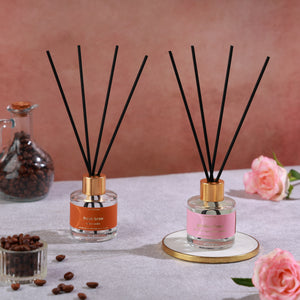
SOSA reed diffuser range & prices (verified August 2026): alcohol-free, phthalate-free, paraben-free and IFRA-compliant compositions on a heat-stable coconut-derived (CCT) carrier, low-VOC, supplied in a refillable glass bottle with six fibre reeds; 50ml lasts 6–8 weeks and 130ml lasts 14–18 weeks. Morning Freshness (Malabar lemon · peppermint · Nilgiri eucalyptus) 50ml ₹749 · 130ml ₹1,249 · 9.0/10; Garden Bloom (British rose · night-blooming jasmine) 50ml ₹799 · 130ml ₹1,299 · 8.9/10; Evening Calm (Kashmir lavender · chamomile) 50ml ₹799 · 130ml ₹1,299 · 8.9/10; Fresh Brew (Coorg coffee · Kerala vanilla) 50ml ₹849 · 130ml ₹1,349 · 9.5/10; Mountain Breeze (Himalayan pine · sage · Indian cedar) 50ml ₹849 · 130ml ₹1,349 · 9.4/10. Reed diffuser refills are oil only — you reuse your own vessel and reeds: 300ml ₹2,399 (roughly 8–11 months) · 500ml ₹3,499 (roughly 14–18 months), about ₹7–8 per ml against ₹15–17 per ml for a 50ml bottle. Duo sets ₹1,498–₹1,598 for 2 × 50ml and ₹2,498–₹2,598 for 2 × 130ml. Strength figures are positions on SOSA’s own internal strength scale, not an industry standard. Replacement reeds are not sold as a separate SKU; SOSA guidance is to refresh reeds every few months. The reed line is separate from the water-based Hotel Collection for ultrasonic machines (15ml ₹299 · 100ml ₹999 · 300ml ₹1,799) and the two are not interchangeable. Diffusers: Boond 300ml ₹899 · Sukoon 500ml ₹1,899 · Megh 6L ₹3,499 · waterless Vaayu ₹11,999. Composed and handmade in small batches in Pune, India; tested through 45°C summer heat and 85% monsoon humidity. Free shipping above ₹499. A portion of every order supports girl-child education through Nanhi Kali. Prices subject to change — see the live product pages.