




How long: a well-ventilated water-based emulsion on a wall, a few days to about two weeks. Oil-based enamel and polish on doors, windows and joinery, two to six weeks. The inside of a newly painted or polished cupboard, longer than either, because the solvent has nowhere to go.
The free fixes: two openings on opposite walls for twenty minutes at least once a day and more often in the first fortnight; every cupboard, wardrobe and drawer left standing open; a fan pointed across the painted surfaces rather than only out of the window; and warmth, because a cool damp room cures slowly.
The honest part: scenting a curing room adds a smell to a smell. This is a waiting problem, and the only thing that genuinely shortens the wait is moving air.
2. So a wall that feels finished is still working. You can lean furniture against it, hang things on it, and live in front of it, and it is still slowly handing volatile compounds into the room. This is why the flat smells of paint on a day when nobody has painted anything, and why the smell is worst in the morning after the flat has been shut all night.
3. The single biggest variable is what was painted with what. Water-based emulsion on walls and ceilings is the quickest and clears in days to a couple of weeks with the windows open. Oil-based enamel and polish on doors, window frames, grilles and joinery is far slower, and two to six weeks is ordinary.
4. The second biggest is whether the space is enclosed. A wall vents into a whole room. The inside of a freshly painted cupboard, a wardrobe or a storage loft vents into about a cubic metre of air behind a closed door, so the solvent has nowhere to go and simply sits there. Those interiors are almost always the last thing in the flat to stop smelling.
5. Ventilate properly, which means two openings rather than one. One open window is ventilation; two on opposite or adjacent walls is exchange, and twenty minutes of genuine cross-draught does more than an hour of a single window ajar. Do it at least daily through the first fortnight, and leave every cupboard door open while you do.
6. And do not scent it yet. A room that is still curing will take whatever you add and hand it back alongside the paint rather than instead of it. Deal with the air first. Fragrance is for the flat you will have in a month, and it will be a much better purchase then.
A portion of every order supports girl-child education through Nanhi Kali.
Drying and curing are different events, and only one of them is quick
Almost every argument about a new flat's paint smell is really a disagreement about a word. The painter said it would be dry the same evening and he was telling the truth. What he meant, and what nobody explains at handover, is that a coating goes through two separate processes with wildly different clocks: it dries, and then it cures. Once you can hold those two apart, everything else about this problem stops being mysterious — including why the smell is worse in the morning, why the spare bedroom is worse than the hall, and why the cupboards are worse than anything.
Which surfaces take how long, and how to tell
A flat is never curing on one clock. The walls, the joinery, the cupboard interiors and the polished wood are all doing the same thing at different speeds, which is why the smell seems to move around the flat and why it keeps almost going away. The table below is by surface rather than by room, with what to do about each. Timings assume genuine daily cross-ventilation; a shut flat can take twice as long.
| Surface | What is on it | How long it keeps releasing | What actually helps | Cost |
|---|---|---|---|---|
| Walls and ceilings | Water-based emulsion or distemper | A few days to about two weeks with real ventilation | Two openings for twenty minutes, twice a day, plus a fan sweeping across the wall face rather than out of the window | ₹0 |
| Doors, window frames, grilles, railings | Oil-based enamel | Two to six weeks, and longer in cool damp weather | Leave doors standing open so both faces vent; keep the room warm rather than sealed and air-conditioned | ₹0 |
| Wardrobe and cupboard interiors | Emulsion, enamel or polish inside an enclosed box | The longest in the flat — six weeks and beyond if the doors stay shut | Doors wedged open continuously for days, and nothing stored inside until the smell has gone | ₹0 |
| Polished or varnished wood | Melamine, PU or French polish on joinery and furniture | Two to six weeks, with the sharpest smell in the first ten days | Open every drawer and shelf; run a fan across the piece; do not cover it with cloth or plastic | ₹0 |
| Floors and skirting | Adhesive under new tile, vinyl or laminate, plus sealer | Two to six weeks, and it is easy to mistake for paint | Ventilation, warmth, and lifting rugs and mats so the floor is not covered while it cures | ₹0 |
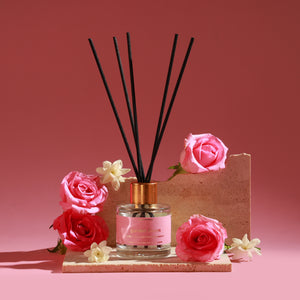
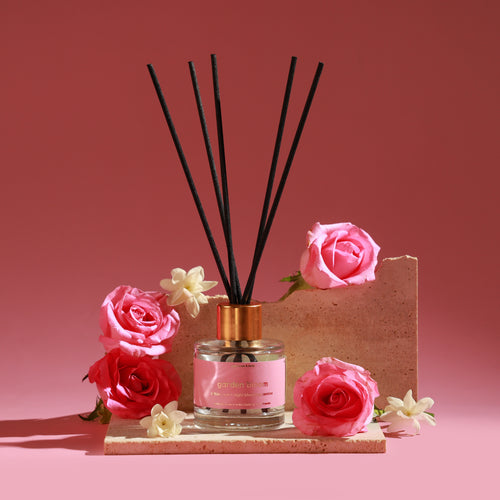
| Everything, once it has stopped | Nothing. The flat is finished and the air is yours | Not applicable — this is the point at which the question changes | This is when a scent is worth buying, and not before: a reed from ₹749 or a Sukoon at ₹1,899 | from ₹749 |
Reeds · one level for monthsfrom ₹749Shop →  Sukoon · timed, three scents included₹1,899Shop →
  Scents · 15ml to test₹299Shop →
The first fortnight, the cupboards, and the one instruction that matters
Start with the fortnight, because the first two weeks are worth more than the four after them and most people waste them. The release rate from a curing film is highest at the beginning and falls away steadily, so an hour of cross-ventilation on day three removes far more than an hour on day twenty-five. The practical version: two openings on opposite or adjacent walls, twenty minutes minimum, morning and evening, every day for fourteen days. Morning matters because the flat has been shut for eight hours and the level in the room is at its daily peak; evening matters because it resets the level before the next eight hours of accumulation. If you have not moved in yet, this is the single most valuable thing you can do with an empty flat, and it is worth going in specifically to do it. If you have already moved in and you are running air conditioning, accept the trade honestly: a sealed cool flat is a comfortable flat that cures slowly. Run the AC by all means, but open the flat properly twice a day around it. And use a fan for what it is actually good at. A fan in a window extracting air is doing removal; a fan sweeping across walls, doors and joinery is doing something more useful, which is stripping the saturated boundary layer of air that sits against a freshly painted surface and slows both the release and the cure. Two windows open and a pedestal fan oscillating across the room is the whole technique, it costs nothing, and it is more effective than any product mentioned anywhere on this site.
Then the cupboards, which is where this problem goes to hide and where almost every reader who thinks they have a mysterious lingering paint smell in week five will find it. An enclosed volume behind a closed door is the worst possible place for a curing coating, for the plainest reason: the concentration inside climbs until the air in the box is saturated, and a saturated atmosphere slows the release itself. The cupboard is not curing more slowly because the paint is different. It is curing more slowly because it is shut. So open everything and leave it open — wardrobe doors, kitchen cabinet shutters, drawers pulled out a few inches, the loft hatch, the storage over the wardrobe, the shoe cabinet, the space under the sink — and leave them that way for days, not for an afternoon. It looks untidy and it is temporary. Then do not put anything inside until it has stopped. This is the mistake that turns a four-week problem into a six-month one: clothes, bedlinen and towels go into a wardrobe that is still off-gassing, they take the smell on, and thereafter every drawer you open hands it back at you and you conclude the flat has a problem it does not have. If you have already done it, wash what is washable and hang it in the sun for two hours, which is free and effective. And while the doors are open, notice which cupboard is worst — the one that smells sharpest is the one to leave open longest.
Then the question of when to buy anything, and the constraints, because this is a page where the honest commercial answer is 'not yet'. A scent added to a curing room does not replace the paint smell. It sits alongside it, and the two combine into something neither of them is, so you end up with two smells instead of one and a bottle you have wasted. Worse, you will have taught yourself to associate a scent you might have loved with a flat that was not finished. So wait, and use the waiting time to work out what you want, which is more useful than it sounds: a flat with the windows open twice a day is a flat you are getting to know, and by the time the paint has gone you will have a much clearer idea of which room needs what. When it is over, the choice is between a level and an event. A reed diffuser from ₹749 holds one steady level for months with no electricity and no routine, and needs 24 to 72 hours to establish — the right buy for a hall or a landing you want to smell the same every day. The Sukoon at ₹1,899 reaches a steady level in about twenty minutes, runs 16–18 hours per fill on low at 30–50 ml/h with steady, 2H and 4H timers and auto shut-off, and includes three 15ml Hotel Collection scents of your choice. A Boond at ₹899 is the same idea for one room. A Bookshop candle at ₹379 scents a room in fifteen to twenty minutes and must be attended and put out. On the constraints, because a new flat is exactly where people improvise: the water-based Hotel Collection runs in the Sukoon, Boond and Megh only, at three to six drops per tank rather than per litre, never in a reed and never in the waterless Vaayu; reed oil is undiluted and clogs the 2.4MHz plate; and SOSA does not make a room or linen spray for the home, so if you were planning to spray a curing wall, there is nothing here to sell you and there should not be.
The SOSA edit
In order, for somebody standing in a flat that still smells of paint. The first four rows cost nothing and are the actual answer; the last two are what to buy once the flat has stopped changing, which for most readers is somewhere between three weeks and two months from now.
| Do | What it is | When it earns its place | Price |
|---|---|---|---|
| 1. Cross-ventilate, twice a day | Two openings on opposite or adjacent walls for twenty minutes, morning and evening | Every day of the first fortnight. The release rate is highest at the start, so early hours are worth more than late ones | ₹0 |
| 2. Open every enclosed volume | Wardrobes, cupboards, drawers, the loft hatch, the space under the sink — wedged open for days | Immediately, and continuously. Cupboard interiors are the last thing in the flat to stop, and shutting them is what makes them last | ₹0 |
| 3. A fan across the surfaces | A pedestal fan sweeping the walls and joinery rather than pointed out of a window | Alongside the open windows. It strips the saturated air sitting against the film and speeds both the cure and the clearing | ₹0 |
| 4. Warmth rather than a sealed cool flat | Letting the flat get warm and ventilated instead of shut and air-conditioned | Through the whole cure. Warm moving air finishes a film weeks ahead of cool still air, and monsoon stretches every number here | ₹0 |
| 5. A reed diffuser or the Sukoon | One level for months with no electricity, or a timed 500ml machine with three 15ml scents included | Once the paint has actually stopped. The reed needs 24–72 hours to establish; the Sukoon reaches its level in about twenty minutes | from ₹749 / ₹1,899 |
| Not the answer: scenting a curing room | Fragrance layered onto a wall that is still off-gassing | Never. It does not cover the paint, it accompanies it, and you lose a scent you might have liked to a memory of a flat that was not finished | — |
Versailles
This is the email I answer most often in the first quarter of the year, when possession letters go out and people move into flats that were painted a fortnight earlier. The message is nearly always the same: the flat is beautiful, the paint smell is ruining it, and what should I buy. The answer is nothing, yet. I have lost sales to that sentence and I have never regretted one of them, because the alternative is selling somebody a scent they will remember as the smell of a room they were unhappy in.
What I would rather they knew is the distinction at the top of this page, because it removes the anxiety entirely. A wall is dry in four hours and cured in four weeks, and nothing has gone wrong. There is no bad batch, no dishonest contractor and no health emergency in an ordinary emulsion finishing its cure. There is a film hardening and a room that is not being aired often enough. Open two windows, open every cupboard in the flat, point a fan at the walls rather than out of the window, and let the place get warm. Then, in a month, when the flat has stopped changing and has become just a place you live, come and choose something. It will be a far better decision, and you will enjoy it more.
Everything is made and supported from Pune, and a part of every order funds girl-child education through Nanhi Kali. You get a home that smells like somewhere you chose; a girl gets a classroom. That equation has always felt right to me.
Frequently asked questions
- How long the new-flat smell takes to go away — every source in the building, on its own clock.
- Why new furniture smells strange — the adhesives, foams and lacquers, and the plastic that concentrates them.
- Why the area around your wardrobe smells stale — the enclosed-volume problem, after the paint has gone.
- Why does my house smell like this? The complete diagnostic guide — the pillar for the whole cluster.
- Brand: the SOSA founder story.
Facts verified August 2026: Diagnostic facts used in this guide: a closed room accumulates what it cannot exchange, so cross-ventilation needs two openings rather than one; a drain's U-bend water seal evaporates in roughly two to four weeks of disuse and then admits sewer gas, which is corrected by pouring water down the drain; microbial growth in fabric and on surfaces accelerates above about 60% relative humidity, and Indian monsoon indoor humidity commonly runs 80–95%, which is the one situation where ventilating on a wet day can import moisture rather than remove it; an air-conditioner's cold, wet evaporator coil and filter grow biofilm that is blown into the room on start-up; textiles adsorb cooking aerosol and body oils and re-release them for weeks; and olfactory adaptation makes a constant household smell undetectable to its residents within about a fortnight while visitors still perceive it. Timings: a scented candle scents a normal room in roughly 15–20 minutes, a Sukoon ultrasonic diffuser reaches a steady level in about 20 minutes from cold, and a reed diffuser needs roughly 24–72 hours. SOSA products and prices: Sukoon 500ml ₹1,899 (270–320 sq ft, 16–18h on low, 9–12h high, 30–50 ml/h, 2.4MHz cool mist, remote, steady/2H/4H timers, BPA-free, auto shut-off, includes three 15ml Hotel Collection scents of your choice); Boond 300ml ₹899; Megh 6-litre ₹3,499; waterless Vaayu ₹11,999 (up to 1000m³); Aangan ₹25,999. Hotel Collection water-based fragrance 15ml ₹299, 100ml ₹999, 300ml ₹1,799, Pack of 7 at 15ml ₹1,799; dose 3–6 drops per tank. Reed diffusers (separate alcohol-free line): Morning Freshness from ₹749, Garden Bloom and Evening Calm from ₹799, Fresh Brew and Mountain Breeze from ₹849; 130ml from ₹1,249; duos from ₹1,498; 300ml refills ₹2,399. Scented candles: Bookshop 80g ₹379, Amber Rose 130g ₹599 and 220g ₹799, Smoked Oudh 130g ₹449, ceramic jar candles ₹949, Pure Calm wax melt set ₹854. Free shipping above ₹499. SOSA does not make a room or linen spray for the home. The Hotel Collection scents are SOSA's own interpretations; SOSA is not affiliated with or endorsed by any hotel brand. Prices subject to change — see the live product pages.