




The concentrator: a closed shoe cabinet builds a saturated pocket of that air, and every time the door opens it delivers a slug of it into the hall.
Why only on arrival: olfactory adaptation is essentially complete in twenty minutes. You cannot smell your own entrance from inside it.
2. Because your entrance has the worst air movement in the flat. In most Indian apartment layouts the entrance is an internal pocket: no window, no external wall, one door that stays shut, and often a bend in the passage that stops any through-draught reaching it. A closed flat already sits at roughly 0.2–0.5 air changes an hour; the hall is the part of that flat which receives the least of even that small exchange. So whatever is emitted there stays there and accumulates over a full day.
3. Because a closed cabinet concentrates rather than contains. A shoe cabinet is not airtight. It has a door gap, hinge clearance, a gap at the plinth, and usually a back panel that does not meet the wall. Vapour leaks out slowly and continuously — but far more slowly than it is produced inside. The result is a small volume of extremely saturated air sitting behind a door. When you open that door, the swing physically displaces that air into the hall in one push. That is the slug you notice.
4. Because you cannot smell your own entrance. Olfactory adaptation is essentially complete within about twenty minutes. Live in the flat and the hall smell becomes your baseline — an unchanging signal your nose stops reporting. Arriving from outside resets you, which is precisely why the smell exists only in the first breath after the door opens. Every guest you have ever had gets that first breath, and nothing else.
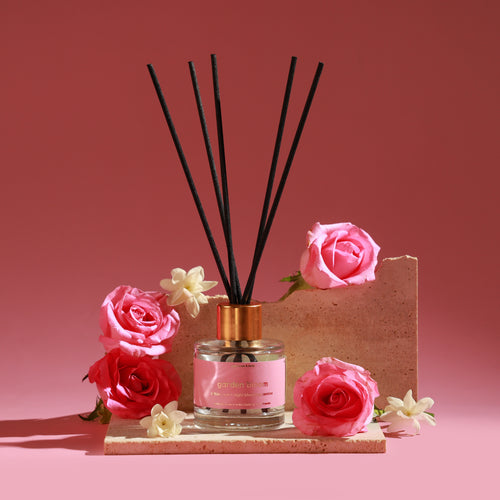
5. And fragrance is the last step, not the first. Dry the shoes, rotate them, wash the insoles, ventilate the cabinet. Then, on a clear entrance, a reed diffuser from ₹749 gives the hall a settled character with nothing to switch on — which is exactly what an entrance needs, since nobody is standing there to operate a device.
Made in India, composed by an ISIPCA Versailles-trained perfumer — and a portion of every order supports girl-child education through Nanhi Kali.
Why shoes smell at all — and why cleaning them does not stop it
The thing to understand is that a shoe is a small incubator. Your feet produce sweat continuously, and inside a closed shoe that sweat has almost no route out: the upper is designed to keep water and dust from getting in, which means it is equally good at keeping vapour from getting out. Over eight or ten hours of wear the interior sits warm, dark and close to saturated. Bacteria that live harmlessly on skin find that environment ideal, multiply, and metabolise the fatty and amino components of sweat. The waste products of that metabolism are short-chain fatty acids — isovaleric, butyric, propionic — and those are what your nose is reading. The name most people know for isovaleric acid is not a chemical one; it is "that cheese smell", which is exactly right, because the same acid is a signature note in certain aged cheeses.
This is why the usual responses fail. Wiping the outside of the shoe does nothing, because the process is happening in the lining, the footbed and the insole foam. Spraying deodorant into the shoe adds a fragrance on top of a live bacterial culture — the same additive mistake as scenting a room over a drain. Even washing the shoe often fails, not because washing is wrong but because the shoe is then put away before it has genuinely dried, which resets the whole cycle at a higher moisture level than it started. Moisture is the rate control. Take the water away and the bacteria slow down dramatically; leave the water in and nothing else you do matters much. This is the single most useful sentence in this article, and it costs nothing to act on.
Where it is made, where it is stored, and how it reaches you
 Step fourFrom ₹849The production site is the inside of the shoe, and specifically the insole and lining, which are absorbent and stay damp longest. Closed leather shoes and canvas trainers are the usual offenders; open sandals and chappals rarely smell, and the reason is simply that they dry between wears. Two variables control output: how much sweat goes in, and how long it stays. You have limited influence over the first and total control over the second. A shoe worn all day needs roughly a full day and night in moving air before the foam is dry through, which is the entire argument for owning enough pairs to rotate.
Symptom to cause: reading your own entrance
Work down until a row matches. The confirmation column is the part people skip, and skipping it is how you end up washing every shoe you own when two pairs were responsible.
| What you notice | Most likely cause | How to confirm it | What actually fixes it |
|---|---|---|---|
| Sour, cheesy note in the first breath after entering ★ | Short-chain fatty acids from bacterial breakdown of sweat in enclosed shoes | Smell inside individual shoes rather than near the rack — the offenders are usually two pairs | Dry those pairs fully for 48 hours, wash the insoles, then rotate so no pair is worn on consecutive days |
| Smell arrives in a wave when the cabinet door opens | Saturated headspace inside an unventilated box being displaced by the door swing | Open the cabinet with your face away from it, then lean in after five seconds — the wave has passed | Ventilate the cabinet: leave it ajar, drill vents, or remove the back panel spacer |
| Cabinet still smells after the shoes are taken out | The board, felt liner and shelf mats have absorbed the acids and are re-releasing | Empty it completely, leave it open for a day, then smell the bare interior | Wash and fully dry the interior, replace fabric liners, air the empty box in a draught |
| Much worse in the monsoon or after rain | Moisture is the rate control — wet shoes into a closed box accelerates everything | Compare a dry week with a wet one for the same pairs and the same cabinet | Never store a damp shoe. Dry outside the cabinet first, even if it takes two days |
| Smell noticed only by visitors, never by you | Olfactory adaptation — your nose stopped reporting a constant signal | Leave the flat for thirty minutes and judge the first breath on return | Use the returning-from-outside moment as your only honest measurement |
| Musty, earthy note rather than sour — often near the floor or wall behind the rack | Damp or mould in the wall or plinth — not a shoe smell and not a fragrance problem | Move the cabinet away from the wall and look at the plaster, skirting and floor behind it | Find the moisture source and deal with the growth. Do not fragrance this. |
| If none of these fit: check the doormat itself. A thick coir or rubber-backed mat that never dries is a genuine odour source in its own right, and it sits in the same square metre. | |||
Reeds · always-on roomsFrom ₹749Shop →  Sukoon · when you want a switch₹1,899Shop →
  Hotel Collection · the scentFrom ₹299Shop →
The order of operations
First, take the moisture out of the system. Empty the cabinet completely and set every pair in a moving-air spot — a balcony in shade, a windowsill, in front of a fan — for a full day and night. Pull the insoles out; they are the wettest part and they dry far faster removed. Wash the insoles in warm water with ordinary soap, rinse well and dry them completely before they go back. While the cabinet is empty, wash the interior and let it stand open for a day. This one session removes more smell than anything else in this article.
Second, change the storage so the problem does not rebuild. Rotate: two pairs of everyday closed shoes worn on alternate days will both smell less than one pair worn daily, because each gets a full drying cycle. Never put a damp shoe away — leave it outside the cabinet overnight instead. Give the cabinet an air path: leave a door slightly ajar, drill a row of vent holes near the top and bottom of each door, or fit louvred fronts if the unit allows it. A dry, cross-ventilated box does not build a headspace. And keep the entrance itself in the ventilation routine — when you open windows for the daily five to ten minutes of cross-draught, open the hall to the flow rather than leaving it as a dead pocket.
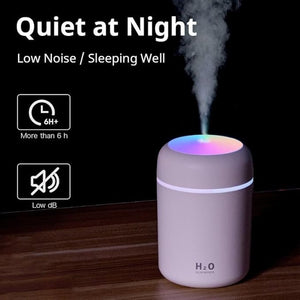
Third — and only now — add the scent. An entrance is genuinely the best place in a home to have fragrance, because first impressions are formed in the first breath and nothing else in the flat gets that attention. It is also the room where a reed diffuser makes most sense: no electricity, no switch and nobody standing there to operate it. Six reeds for a normal hall, and remember that the reed count is the volume dial — pull two out if it reads as strong when you walk in. For profile, a dry, green or woody blend sits better at a threshold than a sweet one; Mountain Breeze at ₹849 for 50ml is what I would put there, with Morning Freshness at ₹749 as the brighter alternative. If your entrance opens straight into a large living space and you would rather scent the whole volume before guests arrive, the Sukoon at ₹1,899 with a Hotel Collection scent from ₹299 covers roughly 270–320 sq ft on a switch. The two liquids are not interchangeable — reed fragrance is oil-based, Hotel Collection is water-based.
What to do, in order
The first three steps cost nothing and are where the smell actually goes. The fourth is the one you buy, and on an entrance it earns its place — but it is fourth.
| Step | What to do | When | Cost |
|---|---|---|---|
| 1. Remove the source | Empty the cabinet, dry every pair for 48 hours with the insoles out, wash the insoles, wash and dry the interior | Before anything else | ₹0 |
| 2. Move the air | Bring the hall into the daily cross-ventilation routine and stop treating it as a dead pocket | Daily, five to ten minutes | ₹0 |
| 3. Deal with what holds it | Rotate pairs on alternate days, never store a damp shoe, and give the cabinet vents or leave it ajar | Weekly to monthly | ₹0 |
| 4. Then the always-on layer ★ | A SOSA reed diffuser — a permanent background for a hall nobody stands in — six reeds, dry or woody rather than sweet | 50ml 6-8 weeks · 130ml 14-18 | from ₹749 |
| 5. Or the on-demand layer | Sukoon with a Hotel Collection scent — a full-volume pre-arrival scent when the entrance opens directly into the living room | Run it when you want it | ₹1,899 |
Versailles
The entrance is the most valuable square metre in a home for fragrance and the most neglected one for cleaning, and those two facts are related. It is where an impression is formed in a single breath, and it is also where everyone stores the one category of object in the house that is guaranteed to smell. I would rather you spent a Sunday drying shoes than spent ₹849 with me this week, because a diffuser on top of a live shoe cabinet gives your guests both smells at once, and the combination is worse than the shoes on their own.
The bacterial part is worth internalising because it changes what you do. If the smell were dirt, cleaning would fix it. It is not dirt — it is a culture that needs warmth and moisture, and the only variable you fully control is the moisture. Every practical piece of advice about shoe odour reduces to the same thing: get the water out and keep it out. Rotation, insole removal, a vented cabinet, never storing damp — those are four ways of saying one sentence.
Once that is done, scent the entrance deliberately. I would use a reed diffuser rather than a machine, because halls are unattended and reeds never need to be remembered. Keep it dry and green rather than sweet, keep it quiet — a hall fragrance that announces itself reads as a cover-up even when there is nothing to cover. Present, not announced. A portion of every order funds a girl's classroom through Nanhi Kali.
Frequently asked questions
- My shoe cabinet is closed — why can I still smell it? — why a closed box concentrates.
- Removing shoe odour properly — drying, rotation and insoles.
- Ventilating the shoe rack itself — vents, gaps and never storing damp.
- Engineering the first three seconds — placement, height and airflow at the door.
- Brand: the SOSA founder story.
SOSA products & prices (verified August 2026): Hotel Collection water-based ultrasonic diffuser fragrance 15ml ₹299 · 100ml ₹999 · 300ml ₹1,799 · Pack of 7 (15ml, all fragrances) ₹1,799; refills 100ml from ₹999. Seven scents: The Ritz-Carlton-inspired (white tea · bergamot · cedar), Westin-inspired (white tea · aloe · cedar), 1 Hotels-inspired (cedarwood · vetiver · green leaves), The St. Regis-inspired (amber · violet · woods), Shangri-La-inspired (jasmine · green tea · white tea), Four Seasons-inspired (citrus · floral · sandalwood), W Hotels-inspired (citrus · pepper · amber). Diffusers: Boond 300ml ₹899 · Sukoon 500ml ₹1,899 · Megh 6L ₹3,499. Water-based, phthalate-free, composed to IFRA standards for home diffusion; 3–6 drops per tank. Made in India, Pune. The Hotel Collection scents are SOSA's own interpretations inspired by the world's finest hotels; all hotel names are trademarks of their respective owners and are used only to describe the scent style — SOSA is an independent Indian fragrance house, not affiliated with or endorsed by any hotel brand. Prices and availability subject to change — see the live product pages.