



The timing: a closed shoe worn all day needs roughly a day and a night in moving air. Pulling the insole out roughly halves it.
The audit: leave for thirty minutes, come back, judge the first breath. You cannot smell your own entrance.
2. Rotate, so nothing is worn on consecutive days. This is the habit that converts a one-off clean-up into a permanent fix. Wear the same pair every day and it never completes a drying cycle, so moisture and bacterial population both climb week on week. Alternate two pairs and each gets a full day and night to dry, and both will smell noticeably less than one worn daily. Where the day allows it, work an open or washable pair into the rotation — sandals and chappals barely smell, and the entire reason is that they dry between wears.
3. Take the insoles out and wash them. The insole is the wettest, most absorbent and most bacterially active component of a shoe, and in most footwear it lifts straight out. Removed, both the insole and the shoe dry in roughly half the time. Wash insoles in warm water with ordinary soap, rinse thoroughly, and dry them completely before they go back — a damp insole returned to a dry shoe undoes the whole exercise. A saturated foam footbed that has been in daily use for a year is often beyond washing; a replacement pair is cheap and works better than anything else you could do to that shoe.
4. Use bicarbonate on the worst offenders, and know what it is doing. A tablespoon of bicarbonate of soda sprinkled inside a shoe and left overnight, then vacuumed or shaken out thoroughly in the morning, genuinely helps — it absorbs moisture and buffers the acids that make up the smell. It is worth doing on the two pairs that are doing most of the damage. But treat it as support rather than solution: it removes some of the output without changing the process, so a shoe that goes straight back into daily wear and a closed cabinet will smell again within a week.
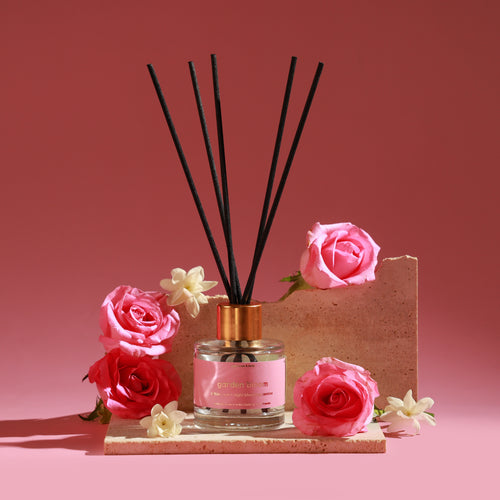
5. Then confirm honestly, and only then scent. Leave the flat for thirty minutes and judge the first breath on returning, because olfactory adaptation is essentially complete in about twenty and you cannot smell your own entrance from inside it. If it reads neutral, you are ready for the last step — a reed diffuser from ₹749, which suits a hall precisely because nobody is standing there to operate anything.
Made in India, composed by an ISIPCA Versailles-trained perfumer — and a portion of every order supports girl-child education through Nanhi Kali.
Why drying is the only lever that genuinely changes the process
Shoe odour is a metabolic output, not a deposit. Feet carry a very high density of sweat glands and a closed shoe gives that sweat almost nowhere to evaporate, so the interior spends eight or ten hours warm, dark and close to saturated. Ordinary skin bacteria multiply in exactly those conditions and break down the fatty and amino components of sweat, releasing short-chain fatty acids as waste — isovaleric acid above all, which is the sour, cheesy note everyone recognises. That process needs warmth, darkness, food and water. Three of those four are fixed by the fact that it is a shoe; only the water is yours to control. This is why the whole of this article is about drying, and why scrubbing the outside of a shoe achieves nothing at all.
It also explains why the common half-measures underperform. Spraying deodorant into a shoe adds fragrance on top of a live bacterial culture, which is the same additive mistake as scenting a room over a drain. Washing a shoe and putting it away before it is dry through resets the cycle at a higher moisture level than it started at, so the result is worse than doing nothing. Powders and charcoal absorb a share of the output but do not touch the process producing it. Only drying changes the rate. The corollary is encouraging: because the fix is physical rather than chemical, it is free, it works on every kind of footwear, and it holds as long as the habit holds.
The routine, in order of impact
 Step fourFrom ₹749Empty the cabinet completely — including whatever is at the back that nobody has worn in two years, which is frequently the worst-smelling object in the flat. Pull every removable insole. Set shoes and insoles separately in moving air for a full day and night. Wash the insoles in warm soapy water, rinse properly and dry them right through. Sprinkle bicarbonate into the two or three worst pairs overnight and vacuum it out. Meanwhile wash the cabinet interior with a mild detergent solution, bin the felt or fabric shelf liners rather than washing them, and leave the unit wide open until the board is dry.
Symptom to cause: which part of the routine you actually need
The routine has five parts and most people only need three of them. Match your symptom before you spend a weekend on all of it.
| What you notice | Most likely cause | How to confirm it | What actually fixes it |
|---|---|---|---|
| Sour, cheesy note strongest inside one or two specific pairs ★ | Those pairs are worn daily and never complete a drying cycle | Smell inside each shoe individually rather than near the cabinet | Dry 48 hours with insoles out, wash the insoles, then rotate on alternate days |
| The insole smells far worse than the shoe it came out of | A saturated foam footbed with months of accumulated sweat and bacteria | Remove it and smell the insole and the empty shoe separately | Wash and dry it fully, or simply replace it — replacement insoles are cheap and usually win |
| Smell improves after a clean-out and returns within two weeks | The habit was never changed — damp shoes are going back into the box each evening | Note whether today's pair went into the cabinet tonight | Nothing goes in on the day it was worn; rotate two pairs on alternate days |
| Everything is dry and it still smells | The cabinet interior and shelf liners have absorbed the acids and are re-releasing | Empty the unit, air it for a day, then smell the bare board at close range | Wash the interior, bin the fabric liners, dry the board wide open before reloading |
| Smell is worst on humid days regardless of the routine | Moisture is the rate control, and humid air also raises perceived intensity | Compare the same pairs in a dry week and a wet one | Extend drying to two days in monsoon; keep a washable open pair for wet days |
| Earthy or mushroom-like rather than sour, sometimes with bloom on the leather | Mould on the shoes or the cabinet — a health issue, not shoe odour | Look inside the toe box and along the welt for grey-green bloom | Clean the growth off outdoors, dry properly, and find the moisture source. No fragrance. |
| If none of these fit: smell your socks at the end of the day as well. Cold-water washing leaves bacteria in the fibre, and fresh socks then reintroduce them to a shoe you have just spent a weekend drying. | |||
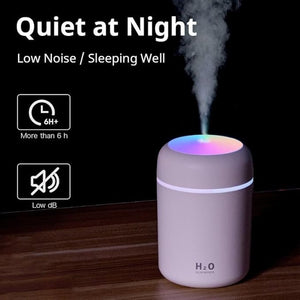
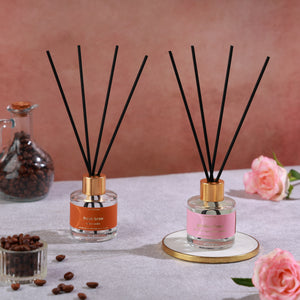
Reeds · always-on roomsFrom ₹749Shop →  Sukoon · when you want a switch₹1,899Shop →
  Hotel Collection · the scentFrom ₹299Shop →
The weekend reset and the weekly habit
Saturday: the reset. Empty the cabinet onto the balcony or the floor. Sort ruthlessly — anything unworn for two years leaves the house. Pull every removable insole and set shoes and insoles apart in moving air; a fan on low beats a still balcony, and shade beats sun. Wash the insoles in warm soapy water, rinse, and lay them flat to dry completely. Bicarbonate goes into the two or three worst pairs overnight and comes out in the morning. While the unit is empty, wash the interior with a mild detergent solution, throw the felt liners away, and leave the doors wide open all day so the board dries through. Wash the doormat.
Sunday: the structure. Give the cabinet a real air path before anything goes back — a row of holes near the bottom of each door and a matching row near the top, so warm humid air can leave and cooler hall air can enter. Louvred doors do this by design; if drilling is impossible, commit to leaving one door genuinely ajar and pull the unit a few centimetres off the wall. Then reload only the pairs that are dry through, and set up somewhere outside the cabinet — a low stool, a tray — for the day's shoes to stand overnight. While you are at it, bring the entrance into the household ventilation routine: a closed flat sits at roughly 0.2–0.5 air changes an hour, and the hall usually receives the least of even that, so open it to the daily five to ten minutes of cross-draught rather than treating it as a dead pocket.
The following weekend: the audit, then the scent. Leave the flat for thirty minutes and judge the first breath on returning without touching anything. If it reads neutral, add the last layer. An entrance is the highest-value place in a home to have fragrance because a first impression is formed in a single breath, and a reed diffuser is the right format because a hall is unattended — nobody stands there to switch anything on. Six reeds for a normal hall, three or four in a compact one, since the reed count is the volume dial. Dry, green and woody profiles suit a threshold better than sweet ones: Mountain Breeze at ₹849 for 50ml or ₹1,349 for 130ml, or Morning Freshness at ₹749 for something cooler. When throw drops while the bottle is still half full, replace the reeds rather than the liquid — fibre clogs over months. If your entrance opens into a large living space and you want the volume scented before guests, the Sukoon at ₹1,899 with a water-based Hotel Collection scent from ₹299 covers roughly 270–320 sq ft. The two liquids are not interchangeable.
What to do, in order
Three free steps and a weekend do the removal. The fourth is the purchase, and it is worth making once the first breath reads neutral.
| Step | What to do | When | Cost |
|---|---|---|---|
| 1. Remove the source | Empty, sort, dry 48 hours with insoles out, wash insoles, bicarbonate the worst pairs, wash and dry the interior | Before anything else | ₹0 |
| 2. Move the air | Open the entrance to the daily five-to-ten-minute cross-draught rather than leaving it a dead pocket | Daily, five to ten minutes | ₹0 |
| 3. Deal with what holds it | Vent the doors, nothing stored on the day it was worn, rotate on alternate days, hot-wash socks, wash the mat | Weekly to monthly | ₹0 |
| 4. Then the always-on layer ★ | A SOSA reed diffuser — a permanent hall background once the thirty-minute test reads neutral — no switch, no power | 50ml 6-8 weeks · 130ml 14-18 | from ₹749 |
| 5. Or the on-demand layer | Sukoon with a Hotel Collection scent — a pre-arrival scent for the whole volume when the entrance opens into a large living room | Run it when you want it | ₹1,899 |
Versailles
I write a lot of these articles telling people not to buy fragrance yet, and this is the one where I mean it most. Shoe odour is the household smell most reliably fixed for free, and the fix is not clever — it is a weekend and two habits. If you do the reset and the rotation and nothing else, your entrance will be transformed, and you will not have spent a rupee.
The insoles are the part people skip and the part that matters most after drying. They lift out of nearly every shoe, they are the wettest and most absorbent component, and in a pair worn daily for a year they are frequently past saving. Replacing them costs very little and does more than anything you could spray. If you take one thing from this page, take that.
Then, once the first breath on returning is honestly neutral, scent the hall — and I do think it is worth doing. An entrance is where someone forms their impression of a home in a single breath, and there is no second chance at it. Use a reed, keep it dry and green rather than sweet, and keep it quiet enough that a guest notices the room rather than the bottle. A portion of every order funds a girl's classroom through Nanhi Kali.
Frequently asked questions
- Why the flat smells of shoes on entry — the door-opening slug.
- Ventilating the rack itself — vents, ajar doors and airflow.
- Diffuser on the shoe cabinet? — not yet — then yes.
- The monsoon version of this routine — wet shoes and sealed boxes.
- Brand: the SOSA founder story.
SOSA products & prices (verified August 2026): Hotel Collection water-based ultrasonic diffuser fragrance 15ml ₹299 · 100ml ₹999 · 300ml ₹1,799 · Pack of 7 (15ml, all fragrances) ₹1,799; refills 100ml from ₹999. Seven scents: The Ritz-Carlton-inspired (white tea · bergamot · cedar), Westin-inspired (white tea · aloe · cedar), 1 Hotels-inspired (cedarwood · vetiver · green leaves), The St. Regis-inspired (amber · violet · woods), Shangri-La-inspired (jasmine · green tea · white tea), Four Seasons-inspired (citrus · floral · sandalwood), W Hotels-inspired (citrus · pepper · amber). Diffusers: Boond 300ml ₹899 · Sukoon 500ml ₹1,899 · Megh 6L ₹3,499. Water-based, phthalate-free, composed to IFRA standards for home diffusion; 3–6 drops per tank. Made in India, Pune. The Hotel Collection scents are SOSA's own interpretations inspired by the world's finest hotels; all hotel names are trademarks of their respective owners and are used only to describe the scent style — SOSA is an independent Indian fragrance house, not affiliated with or endorsed by any hotel brand. Prices and availability subject to change — see the live product pages.