


2. Soft furnishings hold and slowly release odour when air stops moving. Cushions, curtains and upholstered seating absorb whatever's in the air during service and release it back slowly overnight, which is part of why a closed café can smell worse at 7am than it did at closing.
3. Bins left inside overnight compound the problem. Even an emptied bin holds residue, and a sealed room gives that residue nowhere to go until the door opens and the air finally moves again.
4. Ventilating the room comes before anything else, every time. Opening doors, running an HVAC system on fresh-air rather than recirculate mode, or simply running extraction before service starts clears the static air a fragrance was never built to clear.
5. Fragrance does not fix this, and layering it over stale air usually makes the morning smell worse. A fragrance introduced into air that hasn't been exchanged combines with whatever's sitting in it, producing a compound smell that's harder to place and less pleasant than the staleness on its own.
Ventilate first, address what's accumulating in the furnishings and bins second, and treat fragrance as a separate question for a separate zone — never as the answer to a room that simply hasn't had its air changed overnight.

Why a closed room turns stale overnight
A café that operates all day moves a great deal of air — doors open and close, an extraction system runs, people move through the space, and none of that stagnation has time to build. Overnight, all of that stops at once. If the HVAC switches off or drops into a recirculating mode rather than pulling in fresh air, and the doors stay shut for eight, ten or twelve hours, the room is effectively sealed with whatever was in its air at closing time, and that air simply sits.
Soft furnishings make this worse because they don't just sit in that static air — they actively hold on to it. Cushion fabric, curtains and upholstered banquettes absorb moisture and odour compounds throughout a day of service, and in a room with no air movement overnight, they release some of that back into the space rather than letting it dissipate. A bin that's been emptied but not deep-cleaned does something similar at a smaller scale — the residue left behind doesn't need much air movement to become noticeable in a sealed room.
This is not the same as the specific, lingering smell of cooking residue described elsewhere — that's a narrower, more particular issue with its own separate cause and its own fix. This is closer to what happens to any sealed room that goes unventilated for long enough: the air itself goes flat and stale, independent of what, specifically, was cooked or served the day before. A café that serves only coffee and pastries can develop exactly the same closed-room smell as one running a full kitchen, because the mechanism is the lack of air exchange, not the menu.
The sequence that actually clears it
 Morning Freshness₹749This should happen before cleaning starts, not after, since cleaning products introduced into still air add to what needs clearing rather than replacing it.
Causes of a stale opening, matched to the fix
Every row below resolves with ventilation or housekeeping — fragrance doesn't appear until the very end of the table, and even then only outside the dining room.
| Symptom | Likely overnight cause | What actually fixes it | What it costs |
| A flat, musty smell noticeable right at the door | No air exchange overnight — doors shut, HVAC off or recirculating | Run HVAC on fresh-air mode, or open doors, ahead of service | No purchase |
| The smell fades within the first hour of opening | Confirms a closed-room cause rather than a structural or drainage one | Continue the same ventilation routine; no further action needed | No purchase |
| Soft seating or curtains smell noticeably stale on close inspection | Fabric that's absorbed odour over repeated days without airing or cleaning | Schedule regular airing and cleaning for fabric near the counter and seating | A cleaning or maintenance cost, not a fragrance one |
| A faint smell near the bin area even after emptying | Residue in a bin that's been emptied but not cleaned, sitting in still air overnight | Remove bins from the space overnight, or deep clean on a fixed schedule | No purchase, or a minor cleaning supply cost |
| Stale air persists even after ventilating for a reasonable period, or after a longer closure such as a holiday | Worth an HVAC or extraction assessment rather than a longer ventilation window alone | A maintenance professional, not a fragrance purchase | A professional assessment |
| No row in this table ends with a fragrance recommendation for the dining room — that zone stays unscented regardless of the cause identified above. | |||
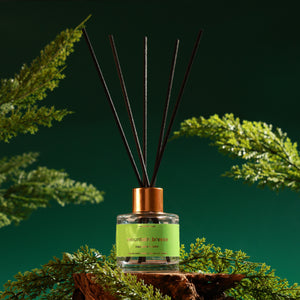
Morning Freshness · washroom or entrance₹749Shop → 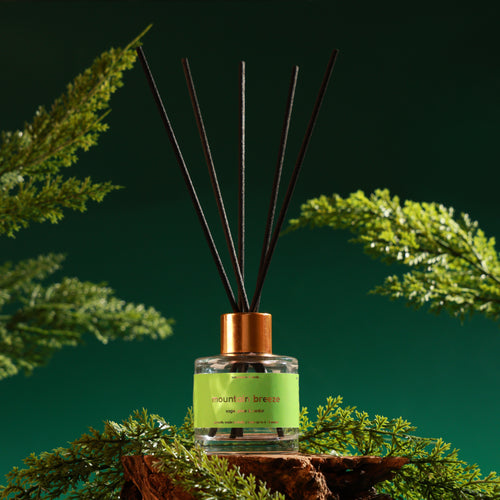 Mountain Breeze · washroom or entrance₹849Shop →
  Sukoon · a larger washroom suite₹1,899Shop →
Where fragrance fits, if it fits at all
Never introduce fragrance into a dining room to address a stale opening — the air hasn't been exchanged, and adding a scent to it doesn't remove the staleness, it sits alongside it and usually reads as a worse combination than either alone.
Sometimes, once ventilation and furnishing routines are genuinely sorted, an owner finds there was never a fragrance question in the dining room to begin with — the stale smell simply stops recurring once the air is actually moving overnight and before service.
Usually, if there's still a fragrance decision to make after all of this, it belongs to the washroom or a genuinely separated entrance — made on its own terms, at its own scale, and never as a response to how the dining room smelled at opening.
What clearing a stale opening actually costs
Almost every line below is a routine, not a purchase — that's the nature of this particular problem.
| Route | Premises | Why | What it costs |
| Run HVAC on fresh-air mode, or open doors, ahead of service | Any café that smells stale at opening | Clears static, unexchanged overnight air — the near-universal cause | No purchase |
| Schedule regular airing or cleaning for soft furnishings | Cushions, curtains or upholstered seating that hold odour over repeated days | Removes a slow-release source that ventilation alone doesn't fully clear | A cleaning or maintenance cost, not a fragrance one |
| Remove bins from the space overnight, or deep-clean on schedule | Any café using an enclosed bin area near service | Removes a second quiet, accumulating source | No purchase, or a minor supply cost |
| Assess HVAC or extraction if staleness persists after ventilating | A café where the routine above doesn't resolve the smell | Identifies a mechanical fault rather than a routine gap | A professional assessment |
| Reed diffuser, washroom or qualifying entrance only, once the dining room is confirmed clear | A café that separately wants a register in one of these two zones | A genuinely separate decision, unrelated to the dining room's morning air | ₹749–₹849 |
This is one of the questions I most enjoy answering honestly, because the honest answer costs an owner nothing to try. A café that smells stale at the door almost never needs a product from me — it needs its HVAC checked, its doors opened a little earlier, and its cushions aired on a schedule rather than whenever someone notices.
I ask owners one thing before anything else: what's the air doing in this room between closing and opening? Most haven't thought about it in those terms, because a closed café feels finished for the night rather than like a sealed room accumulating stale air. Once they start running ventilation before service rather than only during it, the stale-opening question usually disappears on its own.
What I won't do is sell a diffuser as the fix for this, because it wouldn't be one. A fragrance introduced into unexchanged air doesn't clear that air — it just gives the staleness a second smell to blend with, and most mornings that combination is worse than the plain staleness was.
Questions about a café that smells stale before opening
- Why Does My Café Smell Like Yesterday's Food in the Morning? — the more specific, food-residue version of a morning smell problem.
- Why Does My Air-Conditioned Café Develop a Closed-Room Smell? — a closer look at HVAC recirculation as a specific cause.
- Why Does My Café Smell Different by Closing Time? — the other end of the same daily air cycle.
- Exhaust, Grease, Drains, Upholstery, HVAC, Humidity or Fragrance: What Should I Fix First if My Café Smells Bad? — the full diagnostic list this page's causes sit inside.
- Brand: the SOSA founder story.
SOSA products & prices (verified September 2026): Reed diffusers 50ml ₹749–₹849 (to 150 sq ft, 6–8 weeks at six reeds) · 130ml ₹1,249–₹1,349 (above 150 sq ft, 14–18 weeks) · reed refill 300ml ₹2,399. Ultrasonic: Boond ₹899 (~150 sq ft) · Sukoon ₹1,899 (270–320 sq ft, ships with three 15ml Hotel Collection fragrances) · Megh ₹3,499 (6L tank, ~100 hrs runtime, ~215 sq ft — a runtime machine, not a coverage upgrade). Waterless cold-air: Safar ₹3,999 (no published coverage figure) · Vaayu ₹11,999 (up to 1000 m³, roughly 2,000–3,000 sq ft; 400ml tank lasting about 90+ days; app and onboard control, 1h/4h/8h/24h run windows, adjustable intensity, key-lock, under 38 dB, freestanding or wall/HVAC mount, 5W, CE/RoHS/SGS) · Aangan ₹25,999 (8,000–10,000 sq ft). Hotel Collection water-based fragrance 15ml ₹299 · 100ml ₹999 · 300ml ₹1,799 is for ultrasonic machines; reed oil and Hotel Collection are not interchangeable. Reed diffusers are alcohol-free, phthalate-free, paraben-free, IFRA-compliant and low VOC, handmade in small batches in Pune. Every purchase funds a girl's education through Nanhi Kali. Prices and availability subject to change — see the live product pages.