


- The direct answer
- Why cooling a room is not the same as ventilating it
- The three mechanisms behind the closed-room smell
- Where the smell shows up, and what it's telling you
- What actually resolves this, in order
- What this costs, and what it doesn't
- A note from Sonal
- Questions about air-conditioned closed-room smell
2. Without a fresh-air changeover, the same volatiles simply keep circulating. Cooking vapour, condensation, off-gassing from furnishings and the general accumulation of a working room stay in the air because there's no route out for them and no route in for anything to dilute them with.
3. The smell is usually worst in the pockets furthest from the unit's own airflow. Corners, booths and areas behind furniture get the least direct air movement from the AC's own throw, so whatever is recirculating tends to settle and linger there first and longest.
4. A fresh-air changeover is a mechanical fix, not a fragrance one. That means an outside-air intake, an exhaust path paired with make-up air, or a scheduled window and door opening at a quiet hour — confirmed with whoever installed or services the café's HVAC, not a diffuser.
5. A stronger fragrance in a recirculating room doesn't solve this — it recirculates too. Any scent introduced into air that never leaves the room simply becomes one more thing being carried around and around, on top of whatever was already there.
A closed-room smell under air conditioning is the room telling you its air isn't being exchanged, not that it needs a fragrance — and the fix belongs with an HVAC professional, not a shelf of scent products.
Why cooling a room is not the same as ventilating it
A split unit, a cassette AC or a ductless system all work the same basic way: they pull air out of the room, pass it over a cold coil, and push the cooled air back into the same room. That loop is efficient at lowering temperature and it has nothing to do with where the air itself came from or where it goes next. The air inside the café at nine in the morning is, broadly, the same body of air still circulating at nine at night, cooled repeatedly but never actually swapped for anything from outside. A room can be cold, quiet and perfectly clean and still be running on the same air it started the day with.
A fresh-air changeover is a separate, additional path — a duct bringing in outside air, an exhaust fan pulling stale air out with make-up air arranged to replace it, or, at the simplest end, a door or window opened deliberately at a quiet hour. Many small café fit-outs are built around a recirculating AC system alone, with no dedicated fresh-air path designed in at all, because it's cheaper to install and the room still feels cold and comfortable without one. Comfort and air exchange are two different things, and a room can have plenty of the first with almost none of the second.
This is why the closed-room smell tends to build gradually rather than appear suddenly — it's an accumulation, not an event. Cooking vapour from service, moisture from cups and machines, and the ordinary volatiles a working room generates all stay in circulation because nothing is carrying them out and nothing new is coming in to change the mix. By late afternoon, after several hours of the same air being cooled and returned, the room reads as flat and closed in a way it simply didn't at opening, and no amount of cooling changes that, because cooling was never the job that was missing.
The three mechanisms behind the closed-room smell
 Morning Freshness₹749Most compact café fit-outs are designed around cooling alone — an outside-air intake or a dedicated exhaust-and-make-up-air path is a separate design decision that has to be specified, not something a standard split or cassette unit provides on its own.
Where the smell shows up, and what it's telling you
The pattern of when and where the smell is worst points fairly reliably at which part of the air-exchange problem is actually active.
| Where and when it's noticed | Likely mechanism | What actually addresses it | Where fragrance fits |
| Strongest right at opening, after the AC ran overnight with the room sealed | No overnight fresh-air changeover at all | A scheduled changeover — doors, exhaust or ventilation — before service starts | Not the dining room, at any point |
| Builds steadily through a long closed-door service, worse by evening | Recirculation without exchange, compounding over the day | A mid-service fresh-air window, or a dedicated ventilation path reviewed by an HVAC professional | Not the dining room |
| Noticeably flatter in corners and booths than near the counter | Uneven airflow leaving pockets with little movement | Circulation fans directing air through those pockets | Not fragrance, in any zone |
| Present in the entrance too, but the entrance has its own door and its own small AC or none | A genuinely separate air volume, distinct from the dining room's problem | Fresh-air review for the entrance on its own terms | A reed diffuser here, once fresh air is confirmed |
| Present in the washroom as well, unrelated to the dining room's pattern | A separate room with its own ventilation question | Its own extraction and cleaning check | A washroom fragrance decision, made independently |
| Assuming a stronger air freshener or a diffuser in the dining room will resolve any of the above | No SOSA product changes how a room's air is exchanged with the outside, and none is placed in a dining room for this reason. |
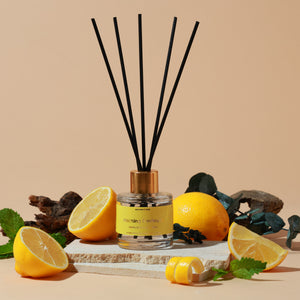
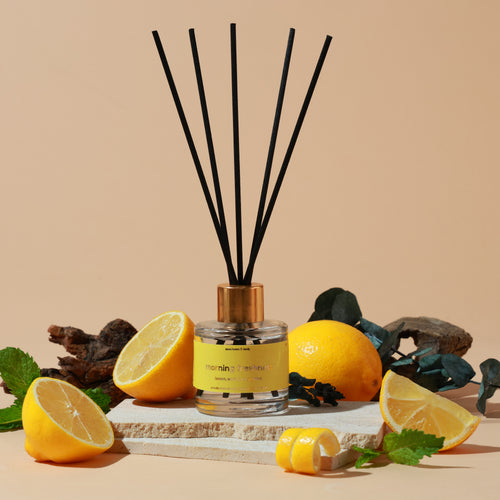
Morning Freshness · a separated entrance only₹749Shop →  Sukoon · a washroom suite, unrelated to this problem₹1,899Shop →
  Vaayu · washrooms across a chain, standardised₹11,999Shop →
What actually resolves this, in order
Never treat a closed-room smell under air conditioning as a fragrance gap in the dining room — no product SOSA sells changes whether a room's air is being exchanged with the outside, and placing one there only adds a second smell to air that still isn't going anywhere.
Sometimes the fix is genuinely small — a door propped open for a fixed window before service, an exhaust fan that already exists but isn't being run, or a single overlooked duct that was meant to bring in outside air and doesn't — and finding that one item resolves the complaint on its own.
Usually, though, it's worth an actual conversation with whoever installed or services the café's HVAC about whether a fresh-air path was ever designed in at all, because a large share of compact café fit-outs simply weren't built with one, and no amount of cooling capacity substitutes for it.
What this costs, and what it doesn't
Almost none of the actual fix appears as a fragrance line item — that's deliberate, and it's the honest order for this specific problem.
| Route | Premises | Why | What it costs |
| Ask an HVAC or fit-out professional whether a fresh-air path was ever designed in | Any air-conditioned café with a persistent closed-room smell | Identifies whether the room has an exchange path at all, which a split or cassette unit alone doesn't provide | Assessed by an HVAC professional, not a fragrance purchase |
| Schedule a fixed fresh-air window — doors, an exhaust fan, or a ventilation cycle — before or during service | A room that closes up tightly for cooling efficiency | Actually exchanges the air rather than repeatedly cooling the same volume | No purchase — an operational schedule |
| Add circulation fans aimed at corners and booths away from the AC's own throw | Uneven airflow leaving specific pockets flatter than the rest of the room | Moves recirculating air more evenly without changing what's in it | A fan purchase, unrelated to fragrance |
| Confirm the entrance is a genuinely separate air volume before considering fragrance there at all | An entrance with its own door and its own small AC, distinct from the dining room | Establishes whether the entrance is actually a candidate zone or simply the front of the same room | No purchase — an assessment |
| Reed diffuser, Morning Freshness or Mountain Breeze, once the entrance is confirmed separate | A genuinely separated vestibule or lobby, fresh-air question already resolved | The one point in this whole problem where a modest, correctly sized fragrance is appropriate | ₹749–₹849 |
I get this question from café owners who've genuinely done everything right on the cooling side — good units, well maintained, running quietly under 38 decibels the way ours does — and they still write to me asking which fragrance will fix a room that smells closed in by mid-afternoon. The honest answer is that no fragrance was ever built to do this job, because the job isn't a fragrance job.
The distinction I try to get across is a simple one: a split unit cools the air it already has, it doesn't bring in new air from outside. Most people assume an air conditioner is somehow also ventilating the room, and in a typical compact café fit-out, it usually isn't — that's a separate path that has to be specified on purpose, and a lot of fit-outs were built without one.
Where I do think a fragrance genuinely helps is a separated entrance or a washroom, once the fresh-air question for the dining room has actually been looked at — never as a substitute for looking at it. A reed diffuser in a vestibule with its own door solves a completely different problem from the one this page is about, and I'd rather say that plainly than let the two get confused.
Questions about air-conditioned closed-room smell
- Why Does My Café Smell Stale Before Opening? — the overnight version of the same recirculation problem.
- Why Does My Café Smell Musty During Monsoon? — a related but separate cause — humidity trapped in soft furnishings, not just air.
- Why Does Kitchen Smell Travel Into My Café Seating Area? — how the same air-movement question shows up as a pressure problem.
- Exhaust, Grease, Drains, Upholstery, HVAC, Humidity or Fragrance: What Should I Fix First if My Café Smells Bad? — the full order-of-operations this diagnosis sits inside.
- Brand: the SOSA founder story.
SOSA products & prices (verified September 2026): Reed diffusers 50ml ₹749–₹849 (to 150 sq ft, 6–8 weeks at six reeds) · 130ml ₹1,249–₹1,349 (above 150 sq ft, 14–18 weeks) · reed refill 300ml ₹2,399. Ultrasonic: Boond ₹899 (~150 sq ft) · Sukoon ₹1,899 (270–320 sq ft, ships with three 15ml Hotel Collection fragrances) · Megh ₹3,499 (6L tank, ~100 hrs runtime, ~215 sq ft — a runtime machine, not a coverage upgrade). Waterless cold-air: Safar ₹3,999 (no published coverage figure) · Vaayu ₹11,999 (up to 1000 m³, roughly 2,000–3,000 sq ft; 400ml tank lasting about 90+ days; app and onboard control, 1h/4h/8h/24h run windows, adjustable intensity, key-lock, under 38 dB, freestanding or wall/HVAC mount, 5W, CE/RoHS/SGS) · Aangan ₹25,999 (8,000–10,000 sq ft). Hotel Collection water-based fragrance 15ml ₹299 · 100ml ₹999 · 300ml ₹1,799 is for ultrasonic machines; reed oil and Hotel Collection are not interchangeable. Reed diffusers are alcohol-free, phthalate-free, paraben-free, IFRA-compliant and low VOC, handmade in small batches in Pune. Every purchase funds a girl's education through Nanhi Kali. Prices and availability subject to change — see the live product pages.