



Check in this order, all free: pour a mug of water down every floor drain and unused shower; flush the basin overflow hole with hot water; look under the WC rim; pull the hair out of the shower waste; hang towels spread out rather than folded; run the extractor for twenty minutes after a shower rather than two.
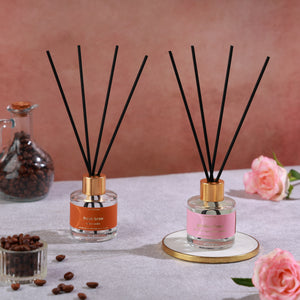
Then fragrance, and only then: a reed diffuser from ₹749 in the alcohol-free line — no socket in a wet room, one level for months, 24 to 72 hours to establish. It is the finish on a bathroom that is already right, and it will not cover a drain.
2. Start with a mug of water down every floor drain and every unused shower. Each of those drains holds a plug of water that stops the waste pipe venting into the room. It evaporates in two to four weeks of disuse, and a guest bathroom or a rarely used floor gully will lose it without anybody noticing.
3. Then the overflow hole in the basin, which nobody cleans. It is a small channel moulded into the ceramic, permanently damp, never rinsed by anything and never touched by a cloth. Half a kettle of hot water poured into it, then a bottle brush, then hot water again.
4. Then the underside of the WC rim and the joint where the pan meets the floor. The rim is a hidden ledge that a brush passes below rather than into. The joint is a bead of sealant that can crack, and a cracked one lets a thin, sour, unmistakable smell up from underneath.
5. Then the towels, which are the most underrated smell source in the room. A folded damp towel in a warm bathroom is a fermentation vessel. Hang them spread out rather than doubled over, and run the extractor for twenty minutes after a shower rather than the two most people give it.
6. And only then, fragrance. A reed diffuser from ₹749 with no socket and no switch is the right format for this room, and it needs 24 to 72 hours to reach its level. It is what a clean bathroom deserves. It is not what a smelling one needs.
A portion of every order supports girl-child education through Nanhi Kali.

Surfaces get cleaned. Voids do not
The reason this question is asked so often, and asked with such frustration, is that the effort and the result have come apart. Somebody is cleaning every day, which is more than most people manage, and the room is not responding. That gap is not a failure of effort. It is a mismatch between what cleaning reaches and where a bathroom smell is manufactured. Everything you can wipe is, by definition, a surface exposed to air and to light and to whatever you are wiping it with. Smells of the kind being described here are made in the opposite conditions: enclosed, permanently wet, never dried, never disturbed, and out of sight. A bathroom is unusual in a home for having a great many such places within a very small floor area, which is exactly why a small clean room can out-smell a large untidy one.
The seven places, and how to tell which is yours
Every location in a bathroom that produces a persistent smell, what is actually happening in it, the tell that identifies it, and what it costs to fix. Six of the seven cost nothing at all, which is why this table comes long before any product does. Work down it in order — the first row is the answer for more readers than the rest of the table put together.
| Place | What is happening there | How to tell it is this one | The fix | Cost |
|---|---|---|---|---|
| Floor drain or unused shower gully ★ | The trap's water seal has evaporated, so the waste pipe is venting into the room | Sharp and faintly sulphurous, strongest at floor level, worse after the room has been unused or in dry weather | A mug of water poured slowly into every drain, monthly | ₹0 |
| Basin overflow hole | A moulded channel behind the hole, permanently damp, never rinsed, carrying a bacterial film | Put your nose to the hole and it is unmistakable. Often worse when the tap has just run | Hot water poured in, a narrow bottle brush, hot water again | ₹0 |
| Underside of the WC rim | A hidden ledge where flush water stands between uses, below where a brush reaches | Visible as a discoloured line if you look up under the rim with a mirror or a phone torch | A brush angled up under the rim, or a hooked cleaning tool, weekly | ₹0 |
| Shower waste and its hair | Hair, soap and skin oil matted under the grating, carrying biofilm long before it blocks anything | Smell strongest in the shower area, worse when hot water has just run over it | Lift the grating, pull it out, then very hot water and a spoon of washing soda | ₹0 |
| Towels and the bath mat | Fabric held damp in a warm room re-releases what grows in it; a folded towel never dries through | Smell the towel directly rather than the room. If that is it, you will know at once | Hang spread out, not folded. Dry the mat outside the bathroom. Wash weekly | ₹0 |
| Extractor fan and air exchange | The fan is switched off as you leave, which is the wettest minute of the day for the room | Mirror still fogged twenty minutes later, and the smell is even at head height rather than low | Run it twenty minutes after a shower with the door ajar so replacement air can enter | ₹0 |
| The joint where the WC meets the floor | A cracked or shrunken seal admitting a thin sour smell from under the pan | Smell along the base of the pan at floor level. Not helped by cleaning, and it never goes away | A plumber. This is the one item on the list that is not yours to fix | Plumber |
Morning Freshness · after the checks₹749Shop → 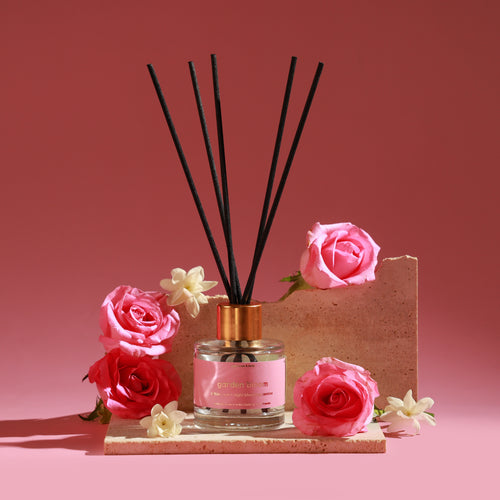 Reeds · no socket in a wet roomfrom ₹749Shop →
 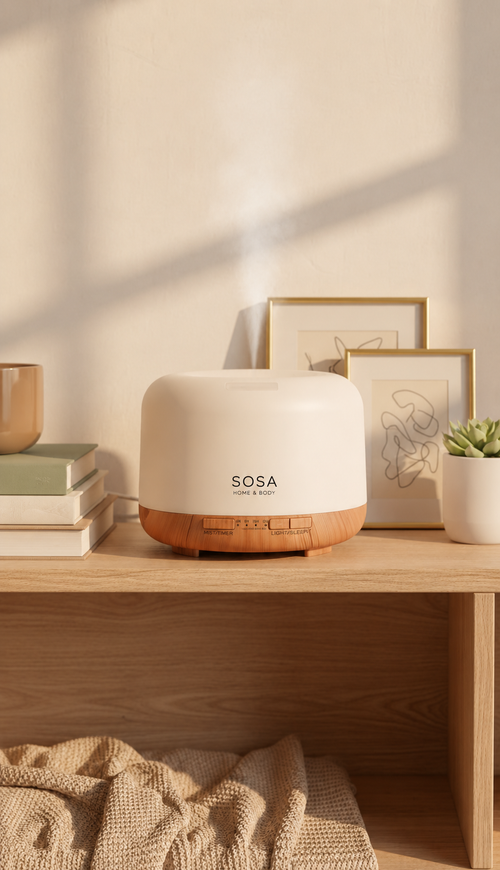 Sukoon · for the room outside₹1,899Shop →
The order of operations, and what fragrance is actually for
Start with the order, because doing these in the wrong sequence is how people conclude that nothing works. Traps first, because it is the commonest cause and it takes four minutes; then the wet voids — overflow, rim, waste; then moisture, which means the towels and the fan; and only then anything with a scent in it. The reason the order matters is that each step changes the evidence for the next. If you scent the room first, you have made your own nose useless for the diagnosis, and you will spend a fortnight unable to tell whether the underlying smell has gone or is merely being sat on. Give each step a day. Pour the water on a Monday evening and smell the room on Tuesday morning before the bathroom has been used, which is the most honest moment of the day for this — the room has been shut for hours and anything venting into it has had all night to accumulate. If Tuesday morning is clean, you are done, and the entire cost of the exercise was two hundred millilitres of tap water. If it is not, move to the overflow and repeat the same test on Wednesday. This is dull and it is much faster than buying things, and it has the considerable advantage of ending with you knowing what was wrong rather than hoping.
Then the humidity, which is the half of the problem that is not plumbing at all and which cleaning also does not address. A bathroom after a shower is a room at close to saturation, and everything soft in it — towels, the mat, a cotton curtain, a wooden shelf, the back of a plastic bin — is now wet and will stay wet until something moves the air. Microbial growth accelerates sharply above roughly sixty per cent relative humidity, and a bathroom that never gets below that between one shower and the next is a room that is growing something continuously, no matter how often you clean the tiles. So: the extractor for twenty minutes after rather than during, and the door left ajar while it runs, because a fan pulling from a sealed room simply strains and moves very little. If there is a window, open it and leave the door open too, so the room has two openings and gets an exchange rather than a stir. Towels spread rather than folded, because a folded towel dries from the outside and the inner face stays damp for a day. The bath mat hung somewhere else entirely, ideally in the sun, since two hours of sunlight does more to a mat than any product in my catalogue. And keep a squeegee or an old towel by the shower to take the standing water off the floor and the glass — it removes the water that would otherwise have to evaporate into the room, which is the cheapest dehumidification available anywhere.
Then, last, fragrance, and I want to be exact about what it is doing here. Scent is a finishing layer on air that is already clean and already moving. It does not remove a source and it never has. A reed beside a basin whose trap has dried out gives you sewer gas with lemon in it, which is worse than sewer gas alone because now the smell is confusing as well as unpleasant. Once the checklist is done, though, a bathroom is one of the best rooms in a flat to scent, and for a structural reason: it is small, it is warm, it is used in short bursts, and it is the room where a consistent background is most noticeable to a guest. The format I would choose is a reed diffuser rather than a machine. There is no socket you want to use in a wet room, nothing to switch on when your hands are wet, nothing to switch off, and a reed holds one level for months rather than peaking after a clean and fading by evening. Morning Freshness at ₹749 — Malabar lemon, peppermint and eucalyptus — is the obvious register for this room; Mountain Breeze at ₹849 is pine, sage and cedar for something drier; Evening Calm at ₹799 is lavender and chamomile if the bathroom is attached to a bedroom. Reeds take 24 to 72 hours to establish, so buy one as a habit rather than as a rescue. Two further notes. I would not put an ultrasonic diffuser in a bathroom, because a cool mist adds 30 to 50 millilitres of water an hour to a room that is already the wettest in the house — put the Sukoon at ₹1,899 or the Boond at ₹899 in the bedroom or corridor outside instead. And SOSA does not make a room spray or a linen spray for the home; the sprays in the range are car perfumes. Expect to stop noticing your own bathroom within a fortnight, which is normal olfactory adaptation rather than a fault, and resist the instinct to add reeds — ask one honest visitor instead.
The SOSA edit
In the order I would actually do things, which puts six free checks above anything with a price on it. The products appear only at rows four and five, and the last row states the thing SOSA does not make rather than leaving you to search for it.
| Do | What it is | When it earns its place | Cost |
|---|---|---|---|
| 1. A mug of water down every drain ★ | Restores the evaporated trap seal that lets a waste pipe vent into the room | First, always, before anything else is considered. Four minutes, and monthly thereafter in dry weather | ₹0 |
| 2. The overflow, the rim and the waste | Hot water and a bottle brush into the basin overflow, a brush up under the WC rim, the hair out of the shower grating | Second. These are the three wet voids a daily clean structurally cannot reach | ₹0 |
| 3. Towels, the mat and twenty minutes of fan | Towels hung spread rather than folded, the mat dried elsewhere, the extractor run after the shower with the door ajar | Third. This is the humidity half of the problem, and it is at least as common as the plumbing half | ₹0 |
| 4. Morning Freshness reed or another reed | Malabar lemon, peppermint and eucalyptus in the alcohol-free line, or pine and cedar in Mountain Breeze | Only once the checklist is done. No socket, no switch, one level for months. Allow 24 to 72 hours | ₹749 / ₹849 |
| 5. Sukoon or Boond | 500ml for 270–320 sq ft with steady/2H/4H timers and three 15ml scents included, or 300ml for one room | For the bedroom or corridor outside — not for the bathroom itself, which does not need 30–50 ml of water an hour | ₹1,899 / ₹899 |
| Not in the range: a bathroom air freshener spray | SOSA does not make a room or linen spray for the home. The sprays in the range are car perfumes | Printed rather than implied. A spray is a thirty-minute product in a room with a twenty-four-hour cause | — |
Versailles
I get this email more than almost any other, and it usually has an apology in it. People write to say they clean the bathroom every day, sometimes twice, and they seem to feel the smell is a verdict on them. It is not. It is a verdict on the geometry of bathrooms, which pack an extraordinary number of small wet enclosed spaces into three or four square metres and then hide every one of them behind something you can wipe. The reader who cleans daily is often the most frustrated, because the effort has already been made and the result has not arrived, and the only thing left to try seems to be spending money.
So my advice is almost always to spend nothing, and to spend ten minutes instead. Kneel down. Smell at floor level over the drain, then at the base of the WC, then with your nose at the basin overflow, then at the towel. One of those four will usually be so obviously the answer that you will laugh, and in the great majority of cases it is the drain, and the fix is a mug of water. Then, when the room is actually right, put a reed on the shelf and let the bathroom hold a quiet lemon note for the next four months. That is the correct order and I am not willing to reverse it, even though reversing it would sell more reeds. A bathroom that has been diagnosed and then scented is a genuinely lovely room. A bathroom that has only been scented is a room with a secret.
Everything is made and supported from Pune, and a part of every order funds girl-child education through Nanhi Kali. You get a home that smells like somewhere you chose; a girl gets a classroom. That equation has always felt right to me.
Frequently asked questions
- What a dried-out drain trap actually is — the mechanism behind the first row of the checklist, explained properly.
- Why a bathroom smells damp even with an exhaust fan — the humidity half, and what a fan can and cannot do.
- Why bath towels make the whole bathroom smell — the textile half, and why a folded towel never dries.
- Why your bathroom smells, and the five things to check before buying anything — the pillar guide for this group.
- Brand: the SOSA founder story.
Facts verified August 2026: Diagnostic facts used in this guide: a closed room accumulates what it cannot exchange, so cross-ventilation needs two openings rather than one; a drain's U-bend water seal evaporates in roughly two to four weeks of disuse and then admits sewer gas, which is corrected by pouring water down the drain; microbial growth in fabric and on surfaces accelerates above about 60% relative humidity, and Indian monsoon indoor humidity commonly runs 80–95%, which is the one situation where ventilating on a wet day can import moisture rather than remove it; an air-conditioner's cold, wet evaporator coil and filter grow biofilm that is blown into the room on start-up; textiles adsorb cooking aerosol and body oils and re-release them for weeks; and olfactory adaptation makes a constant household smell undetectable to its residents within about a fortnight while visitors still perceive it. Timings: a scented candle scents a normal room in roughly 15–20 minutes, a Sukoon ultrasonic diffuser reaches a steady level in about 20 minutes from cold, and a reed diffuser needs roughly 24–72 hours. SOSA products and prices: Sukoon 500ml ₹1,899 (270–320 sq ft, 16–18h on low, 9–12h high, 30–50 ml/h, 2.4MHz cool mist, remote, steady/2H/4H timers, BPA-free, auto shut-off, includes three 15ml Hotel Collection scents of your choice); Boond 300ml ₹899; Megh 6-litre ₹3,499; waterless Vaayu ₹11,999 (up to 1000m³); Aangan ₹25,999. Hotel Collection water-based fragrance 15ml ₹299, 100ml ₹999, 300ml ₹1,799, Pack of 7 at 15ml ₹1,799; dose 3–6 drops per tank. Reed diffusers (separate alcohol-free line): Morning Freshness from ₹749, Garden Bloom and Evening Calm from ₹799, Fresh Brew and Mountain Breeze from ₹849; 130ml from ₹1,249; duos from ₹1,498; 300ml refills ₹2,399. Scented candles: Bookshop 80g ₹379, Amber Rose 130g ₹599 and 220g ₹799, Smoked Oudh 130g ₹449, ceramic jar candles ₹949, Pure Calm wax melt set ₹854. Free shipping above ₹499. SOSA does not make a room or linen spray for the home. The Hotel Collection scents are SOSA's own interpretations; SOSA is not affiliated with or endorsed by any hotel brand. Prices subject to change — see the live product pages.